CALIDAD & PUREZAMoligand™?Moligand™ — Aladdin's line of ligands and bioactive small molecules. Use for receptor, pathway, and binding studies needing defined small-molecule tools.≥98%
A structural analogue of the endogenous cannabinoid receptor ligand anandamide.
Condiciones de almacenamiento de almacenamiento
Store at -20°C,Desiccated
Enviado en
Ice chest + Ice pads
Este producto requiere envío en cadena de frío. Los servicios terrestres y otros servicios económicos no están disponibles.
Grado
Moligand™
Nota
Wherever possible, you should prepare and use solutions on the same day. However, if you need to make up stock solutions in advance, we recommend that you store the solution as aliquots in tightly sealed vials at -20°C. Generally, these will be useable for up to one month. Before use, and prior to opening the vial we recommend that you allow your product to equilibrate to room temperature for at least 1 hour. Need more advice on solubility, usage and handling? Please visit our frequently asked questions (FAQ) page for more details.
This compound belongs to the class of organic compounds known as n-acylethanolamines. These are compounds containing an N-acyethanolamine moiety, which is characterized by an acyl group is linked to the nitrogen atom of ethanolamine.
External Descriptors
N-acyl ethanolamines (endocannabinoids)
1. Djoumbou Feunang Y, Eisner R, Knox C, Chepelev L, Hastings J, Owen G, Fahy E, Steinbeck C, Subramanian S, Bolton E, Greiner R, and Wishart DS. ClassyFire: Automated Chemical Classification With A Comprehensive, Computable Taxonomy. Journal of Cheminformatics, 2016, 8:61.
Determine the necessary mass, volume, or concentration for preparing a solution.
Dilution Calculator
Determine the dilution needed to prepare a stock solution.
Reconstitution Calculator
Reseñas
Reseñas de cliente
Application Protocols
No vendor-tested bioassay protocols are specified for this item. The following are general, literature-informed practices for handling NAEs in research settings (not product-validated):
Stock preparation: Dissolve in anhydrous DMSO (e.g., 10–50 mM) or ethanol (e.g., 1–10 mM). Aliquot under inert gas; store at −20 °C.
Aqueous dosing: Add organic stock to stirred buffer to a final organic content ≤0.5–1% v/v. Include 0.05–1% BSA or a mild nonionic surfactant (e.g., Tween-20, Pluronic F-127) for dispersion.
Enzyme assays (e.g., FAAH activity; literature): Use micromolar substrate concentrations in buffered systems (pH 7.4–8.0), 25–37 °C; quantify product (linoleic acid/ethanolamine) by LC–MS or colorimetric coupled assays.
Lipidomics standards: Spike samples with known amounts of LEA before extraction; use internal standards (e.g., deuterated NAE). Extract with CHCl3:MeOH (2:1), dry under N2, and analyze by LC–MS/MS using reverse-phase gradients; monitor characteristic transitions.
Always optimize conditions for your specific system and refer to peer-reviewed procedures. This product is for research use only.
Biological Roles
Content below reflects general literature knowledge about linoleoylethanolamide (LEA) as an endogenous-like lipid; it is provided for biochemical context only (no medical/clinical claims).
Class: N-acylethanolamine (NAE), a family that includes anandamide (AEA), palmitoylethanolamide (PEA), and oleoylethanolamide (OEA).
Biosynthetic context (literature): Formed via N-acyl phosphatidylethanolamine (NAPE) pathways and released by phospholipase-mediated reactions; levels are regulated by anabolic and catabolic enzymes, notably fatty acid amide hydrolase (FAAH) and NAAA.
Biophysical properties: Amphiphilic molecule that partitions into lipid bilayers; the ethanolamide headgroup can engage in hydrogen bonding, while the linoleoyl chain modulates membrane fluidity and domain preference.
Molecular interactions (literature):
Substrate/ligand for amidases (e.g., FAAH) used in enzymology studies.
NAEs can interact with certain nuclear receptors and transient receptor channels; specific affinity/efficacy of LEA varies and is generally studied relative to OEA/AEA benchmarks.
Analytical relevance: Serves as a standard/analyte in lipidomics workflows examining NAE profiles in tissues, cells, and biofluids.
Stability considerations: Bis-allylic positions in the linoleoyl chain (Δ9, Δ12) render LEA prone to peroxidation, impacting biological readouts; employ antioxidants-free, inert handling for mechanistic studies.
Use is restricted to research laboratories. Verify target engagement and pathway implications empirically under defined experimental conditions.
Buffer Applications
Linoleyl ethanolamide is a hydrophobic lipid, not a buffering agent. It does not form classical buffer systems and is not used to control pH.
Practical note: When delivering LEA into aqueous buffers for assays, pre-dissolve in DMSO or ethanol and add to vigorously stirred buffer containing a suitable carrier (e.g., BSA or nonionic surfactant) to aid dispersion. Maintain organic cosolvent below typical assay limits (e.g., ≤0.5–1% v/v) to avoid artifacts (general guidance).
Green Alternatives
As a research lipid, linoleyl ethanolamide is not a process solvent, but its preparation, handling, and analytical workflows can be improved via greener choices.
Greener synthesis options (literature/general):
Biobased feedstocks: Source linoleic acid from renewable vegetable oils (e.g., safflower, sunflower). Employ enzymatic amidation (lipase-catalyzed coupling of linoleic acid or its ester with ethanolamine) in solvent-minimized systems to reduce waste and avoid hazardous coupling reagents.
Solvent selection: Favor bio-derived or safer solvents (2-MeTHF, CPME, ethyl acetate) over chlorinated solvents during protection/deprotection or purification steps. Employ supercritical CO2 for extraction where applicable.
Oxidation control without additives:
Use oxygen-impermeable vials and nitrogen/argon headspace instead of synthetic antioxidants if downstream assays are sensitive to additives.
Waste minimization:
Prepare concentrated stock solutions and aliquot to reduce repeated thaw/use cycles that lead to degradation and disposal.
Comparison (literature context):
Conventional approach: Carbodiimide (DCC/EDC) or mixed anhydride couplings in CH2Cl2/DMF; efficient but generates urea waste and uses problematic solvents.
Greener alternative: Novozym 435-catalyzed amidation of linoleic acid ethyl ester with ethanolamine in solvent-free or 2-MeTHF media; recyclable biocatalyst, lower E-factor, milder conditions.
Trade-offs: Enzymatic routes may require longer reaction times and careful control of water activity; solvent substitution can alter crystallization and purification profiles.
Pharmaceutical Uses
No excipient or pharmacopeial status is specified for this item; it is supplied strictly for research use only.
Employed as a bioactive lipid standard in preclinical discovery workflows and biophysical assays.
Useful in formulation studies as a model amphiphile to examine incorporation into liposomes, micelles, or lipid nanoparticles for delivery research.
Serves as a reference compound in method validation (e.g., recovery, matrix effects) for LC–MS/MS lipidomics.
No therapeutic, diagnostic, or clinical use is claimed or supported for this SKU.
Physical Properties
Item-specific specifications are not provided for this SKU. Values below are literature/general references for linoleoylethanolamide (for method development only; not item specifications).
Physical state/appearance: Typically a viscous oil or low-melting wax at room temperature (literature).
Molecular formula: C20H37NO2 (literature)
Molecular weight: ~323.53 g/mol (literature)
Melting point: Often below ambient temperature; reports range from semi-solid to liquid near room temperature (literature; not standardized).
Boiling point: Not commonly reported due to thermal lability; decomposes before distillation under atmospheric pressure (literature).
Density: Not specified for this item; refer to CoA/Spec Sheet. (Typical long-chain amides ~0.9–1.0 g/mL at 20–25°C; literature context only.)
Solubility (qualitative, literature):
Water: Practically insoluble.
Organic: Soluble in chloroform, dichloromethane, ethyl acetate, acetone, ethanol, isopropanol; highly soluble in nonpolar solvents (hexane, toluene) and in polar aprotic media (THF, DMSO).
LogP: Expected high hydrophobicity (estimated cLogP > 6; literature estimates for C18 NAEs).
Refractive index: Not specified for this item; refer to CoA/Spec Sheet.
pKa: Amide is non-basic/weakly basic (conjugate acid pKa ≪ 1; literature). Terminal alcohol pKa ~15–16 (non-ionizing in water; literature).
Always verify exact values for your lot via the CoA. Handle as an oxidizable unsaturated lipid (susceptible to peroxidation).
Quality and Grades
Item-specific grade: Moligand™
Context: Moligand™ is positioned for discovery chemistry and ligand screening collections, emphasizing compound identity and fitness for biochemical/biophysical assays. It is not a clinical/clinical-grade material.
Purity/assay: Not specified for this item; refer to CoA/Spec Sheet.
Stabilizers/inhibitors: Not specified for this item; refer to CoA/Spec Sheet. Note: Unsaturated NAEs are sometimes packaged under inert gas or with antioxidant traces; confirm on the CoA.
What this means for users:
Suitable for research and library applications, target engagement studies, lipid signaling investigations, and as a reference material in analytical workflows.
Each lot should be accompanied by identity confirmation (e.g., NMR/HRMS/LC-MS). Verify the CoA for the analytical package provided.
UV/UPLC suitability: HPLC/UPLC suitability (e.g., low UV background) is not specified for this item. For trace-level quantitation (lipidomics), verify residual solvent and peroxide content on the CoA if critical to your method.
Packaging considerations: For oxidizable lipids, headspace may be purged with nitrogen/argon and containers sealed with PTFE-lined caps to minimize oxygen ingress (general best practice). Confirm packaging details on receipt.
Compliance: Research use only; not intended for human or veterinary use. No pharmacopoeial designation is claimed for this SKU.
Reaction and Applications
This compound is primarily a bioactive lipid standard and research tool, but it also serves as a substrate/ligand in enzyme and receptor studies.
Research applications (literature/general):
Model N-acylethanolamine (NAE) for studying lipid signaling, metabolism (e.g., fatty acid amide hydrolase, amidases), and membrane interactions.
Analytical standard in lipidomics (LC–MS/MS) for quantifying endogenous LEA in biological matrices.
Ligand screening in Moligand™ collections for target engagement with lipid-binding proteins.
Synthetic/chemical applications:
Starting point for headgroup derivatization (e.g., O-acylation to carbamates/carbonates, N-acyl modifications) to create probes and stability-enhanced analogs.
Photoaffinity/fluorophore conjugation via the ethanolamine hydroxyl to generate reporter lipids.
Practical handling tips:
Work under inert atmosphere to limit peroxidation; store aliquots at −20°C.
For assays, prepare fresh solutions; minimize freeze–thaw.
To assess oxidation, monitor by LC–MS for +16 Da adducts and characteristic aldehydic fragments.
Related reactions (literature):
Enzymatic hydrolysis by FAAH and NAAA; use LEA as a probe substrate in activity assays.
Non-enzymatic autoxidation at bis-allylic positions; relevant when interpreting biological readouts.
Note: No medical or clinical claims are made; usage is limited to research laboratories.
Reaction Conditions
General literature guidance for synthesizing and modifying linoleyl ethanolamide (LEA); these are not product specifications.
Direct amidation routes:
Acid chloride pathway: Convert linoleic acid to linoleoyl chloride (SOCl2, catalytic DMF; 0 °C to rt), then add ethanolamine (2–3 equiv) in anhydrous CH2Cl2 or THF with base (Et3N). Typical: 0–25 °C, 1–3 h; workup with aqueous quench. Caution: competitive O-acylation; control via slow addition and temperature.
Carbodiimide coupling: EDC·HCl (1.1–1.5 equiv) with HOBt/HOAt or DMAP in CH2Cl2/DMF at 0–25 °C, 2–12 h. Minimizes acid chloride handling; urea byproduct requires thorough purification.
CDI activation: CDI (1.2–1.5 equiv) in THF at rt, then ethanolamine addition; milder, often cleaner.
Enzymatic amidation:
Lipase-catalyzed coupling of linoleic acid (or ethyl linoleate) with ethanolamine using immobilized Candida antarctica lipase B (Novozym 435) under reduced pressure or in 2-MeTHF; 40–60 °C, 6–24 h (literature), enabling greener processing.
Headgroup derivatization:
Carbonate formation with p-nitrophenyl chloroformate (1.1–1.5 equiv) in CH2Cl2, 0 °C to rt, then coupling to amines/labels; monitor to avoid over-carbonylation of the amide nitrogen.
Epoxidation of double bonds:
mCPBA (≤1.1 equiv per double bond) in CH2Cl2 at 0 °C to rt, 0.5–2 h; quench and purify rapidly to limit rearrangements.
Analytical control: Monitor reactions by TLC (neutral alumina to reduce isomerization), LC–MS (M+H+ 324 for LEA; literature), and 1H NMR (allylic/olefinic regions). Protect from air/light; employ antioxidants-free conditions if downstream biology is planned.
Safety and Handling
Classification: GHS signal word, hazard statements, and pictograms are not specified for this item; refer to the SDS for authoritative information.
General hazards (literature/general): Fatty acid ethanolamides are typically of low acute toxicity but may cause skin/eye irritation. Unsaturated lipids can undergo autoxidation forming peroxides/aldehydes that may be irritants.
Special risks: Contains two double bonds; susceptible to oxidation by air/light/heat. Oxidation can produce rancid odors and reactive species. Maintain under inert gas and minimize light exposure.
Recommended PPE: Laboratory coat, safety glasses or goggles, and appropriate gloves (e.g., nitrile). Handle in a chemical fume hood when weighing/dissolving bulk quantities.
Incompatibilities: Strong oxidizing agents; prolonged exposure to air/oxygen, light, and elevated temperature accelerates peroxidation. Avoid strong bases/acids during storage (can catalyze hydrolysis).
First aid (overview; consult SDS):
Skin: Wash with soap and water. Remove contaminated clothing.
Eyes: Rinse cautiously with water for several minutes; remove contact lenses if present and easy to do.
Inhalation: Move to fresh air; seek medical attention if symptoms occur.
Ingestion: Rinse mouth; do not induce vomiting; seek medical advice.
Spill/cleanup: Absorb with inert material (e.g., vermiculite), collect for disposal. Prevent entry into drains.
Waste: Dispose of in accordance with institutional and local regulations; lipid peroxidation residues may require special consideration.
Always defer to the product SDS for definitive safety guidance.
Solvent Selection
Linoleyl ethanolamide is amphiphilic but strongly hydrophobic; solvent choice should reflect its unsaturated C18 chain and polar ethanolamide headgroup.
Polarity/miscibility (literature/general):
Water: Practically insoluble.
Miscible/soluble: Chloroform, dichloromethane, ethyl acetate, acetone, methanol, ethanol, isopropanol, THF, toluene, hexanes, MTBE, CPME; DMSO and DMF provide strong solvating power for stock solutions.
DMSO (10–50 mM) for screening libraries; dilute into assay buffers with vigorous mixing and carrier protein/detergent if needed.
Ethanol or isopropanol for LC/MS standards and working solutions; commonly mixed with water and a small amount of surfactant to aid dispersion.
Chloroform:methanol (2:1) for lipid extraction/stock preparation; evaporate and reconstitute as required.
Practical tips:
Warm gently (30–40°C) and vortex/sonicate to dissolve. Avoid prolonged heating.
For aqueous delivery, pre-dissolve in DMSO or ethanol and add slowly to stirred buffer containing 0.1–1% carrier (e.g., BSA or nonionic surfactant) to minimize precipitation (general practice in lipid assays).
Comparison (literature context):
DMSO: maximal solubilization; may affect some targets at >0.5% v/v.
Ethanol: more biocompatible but lower solubility ceiling.
Nonpolar solvents (hexane/toluene): excellent solubility but limited use in bioassays; useful for synthetic operations and thin-film deposition.
Storage and Reconstitution
Item-specific storage (from Product Data):
Store at −20°C, desiccated.
Shipped in ice chest with ice pads.
Handling best practices (general for unsaturated NAEs):
Protect from air and light; purge vials with nitrogen/argon after each use. Keep tightly sealed with PTFE-lined caps.
Minimize freeze–thaw by preparing single-use aliquots of concentrated stock solutions (e.g., in DMSO, ethanol, or CHCl3:MeOH). For solid/semi-solid material, warm gently to liquefy before aliquoting.
If forming films for reconstitution, dissolve in volatile organic solvent, dry under a stream of nitrogen, and place under high vacuum (≥1 h) to remove residual solvent; then hydrate or re-dissolve as needed.
Reconstitution guidance:
For analytical stocks: Prepare 1–50 mM in anhydrous DMSO or 1–10 mM in ethanol; vortex/sonicate if necessary. Use immediately or store aliquots at −20 °C.
For aqueous systems: Add organic stock slowly to vigorously stirred buffer; consider carriers (BSA or mild surfactants) to aid dispersion. Use promptly to minimize oxidation.
Stability notes:
Monitor for signs of oxidation (odor, color change, LC–MS +16 Da adducts). Discard degraded material.
Refer to the CoA/SDS for lot-specific guidance and compatibility notes. Research use only.
Structure and Identity
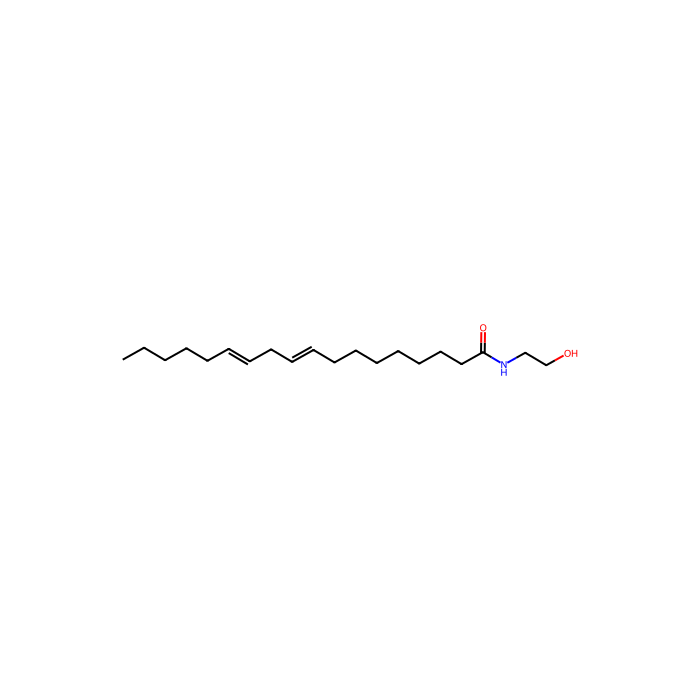
Linoleyl ethanolamide (linoleoylethanolamide, LEA) is an N-acylethanolamine derived from linoleic acid, featuring a C18:2 polyunsaturated acyl chain linked to ethanolamine via an amide bond.
Item-specific identifiers (from Product Data):
CAS: 68171-52-8
PubChem CID: 5283446
InChIKey: Not specified for this item; refer to CoA/Spec Sheet. (Product Data lists an incomplete key: "187228")
2D structural description: A linear 18-carbon chain containing two cis-configured double bonds at Δ9 and Δ12 (positions along the chain), terminated at one end by an amide carbonyl (–CONH–) connected to a 2-hydroxyethyl group (–CH2–CH2–OH). Functional groups include one amide (primary) and one terminal alcohol.
Key functional features: N-acylethanolamine core; polyunsaturation (2 alkenes) that can undergo autoxidation; amphiphilic character with a polar headgroup and hydrophobic tail.
Stereochemistry: The double bonds in native linoleoyl residues are typically 9Z,12Z; unless specified, commercial LEA may be provided without explicit stereochemical annotation (literature note).
Synthetic Utility
Linoleyl ethanolamide combines a reactive ethanolamine headgroup with a polyunsaturated C18 acyl chain, enabling diverse derivatizations for probe and materials chemistry.
Transformations via the headgroup (literature/general):
O-acylation/O-alkylation to form carbonate/carbamate or ether derivatives for stability tuning or reporter installation.
Carbonate linkers enabling payload release (self-immolative) under esterase or pH triggers.
Formation of ureas/thioureas via CDI or isothiocyanates at the –NH– site to modulate H-bonding.
Chain-focused chemistry:
Epoxidation at allylic double bonds (mCPBA) followed by ring-opening to map lipid–protein adducts.
Radical additions or thiol–ene modifications to introduce handles without altering the headgroup.
Conjugation strategies:
Click-compatible handles introduced via carbonate activation (e.g., pNP-carbonate followed by amine–azide linkers), preserving the amide bond.
Retrosynthetic note:
Disconnection at the amide bond yields linoleic acid (or activated derivative) and ethanolamine; choice of activation (acid chloride, mixed anhydride, CDI, EDC/HOBt) balances efficiency vs. side reactions (O- vs N-acylation).
These chemistries support creation of fluorescent/photoaffinity NAEs, immobilized ligands for pull-downs, and modified lipids for membrane biophysics. Verify conditions to avoid over-oxidation of the linoleoyl chain.
Target Specificity
No item-specific target, antigen, or clone information applies to this small-molecule lipid. This SKU is not an antibody or protein reagent. For biochemical targets potentially studied with linoleyl ethanolamide (e.g., lipid-binding proteins, hydrolases), refer to the Reaction & Applications and Biological Roles sections for general literature context.
Preguntas frecuentes
What is the purity of this product?
This product is supplied at ≥98% purity (chemical assay). Lot-specific values are stated on the Certificate of Analysis.
What is Moligand??
Moligand? is one of Aladdin Scientific's premium product lines, formulated for high-purity applications across multiple workflows. Compared to standard grades in the same workflow, Moligand? products typically offer tighter specifications, more rigorous QC, and stronger lot-to-lot consistency.
How should this product be stored?
Store at ?20 °C, desiccated. Keep the container tightly closed with desiccant — the material is moisture-sensitive.
How is this product shipped?
This product ships in an insulated container with ice pads. Unpack on arrival and transfer it to the storage condition stated above.
What are the CAS number, molecular formula and molecular weight?
The CAS Number is 68171-52-8, the molecular formula is C20H37NO2, and the molecular weight is 323.51 g/mol. InChIKey KQXDGUVSAAQARU-HZJYTTRNSA-N.
What documentation is provided?
Available product documentation, including Certificates of Analysis (COA), Safety Data Sheets (SDS), and specification sheets, is shown in the product document area. Document availability and access follow the current site policy.
¿Necesita ayuda para elegir la calidad?
Nuestra guía de selección de calidades cubre la pureza, el estado del estabilizador y la idoneidad de la aplicación para todas las variantes de nuestro catálogo.
Utilizamos cookies para garantizar el correcto funcionamiento del sitio web y, cuando esté permitido, para mejorar su experiencia. Puede gestionar sus preferencias en cualquier momento en Configuración. Más información en nuestra Política de Cookies.
¿Quieres que te enviemos un mensaje cuando tengamos descuentos disponibles?
Recordármelo más tarde
¡Gracias! Por favor, revisa tu bandeja de entrada de correo electrónico para confirmar.
Products are supplied to verified businesses, institutions, and qualified professionals for research and development use only. Not for use in humans, animals, diagnosis, or therapy.

 C2627120