CALIDAD & PUREZAMoligand™?Moligand™ — Aladdin's line of ligands and bioactive small molecules. Use for receptor, pathway, and binding studies needing defined small-molecule tools.10 mM in DMSO
Linuron is a phenylurea herbicide that is widely used to control the growth of grass and weeds in various agriculture crops and in orchards. Linuron is a photosystem II inhibitor. Linuron is also a competitive androgen receptor (AR) antagonist with a K i of 100 μM. Linuron shows reproductive toxicity in animals that acts as an endocrine disruptor .
Especificaciones
Especificaciones y pureza
Moligand™, 10 mM in DMSO
Condiciones de almacenamiento de almacenamiento
Store at -80°C
Enviado en
Dry ice packs + Cold packs
Este producto requiere envío en cadena de frío. Los servicios terrestres y otros servicios económicos no están disponibles.
Determine the necessary mass, volume, or concentration for preparing a solution.
Dilution Calculator
Determine the dilution needed to prepare a stock solution.
Reconstitution Calculator
Reseñas
Reseñas de cliente
Application Protocols
Tested/validated applications and recommended conditions: Not specified for this item; refer to CoA/Spec Sheet.
General reminder:
Because this is a Moligand library compound supplied for research use only, users should establish and validate their own protocols (e.g., stock preparation in DMSO, dilution schemes, assay conditions) appropriate to their systems and instrumentation.
Biological Roles
Role in plants and photosynthetic organisms (literature, general):
Linuron is a classical photosystem II (PSII) inhibitor of the substituted urea class. It binds to the QB site on the D1 protein of PSII, blocking plastoquinone binding and electron transfer, thereby suppressing photophosphorylation and oxygen evolution.
Its activity and binding energetics make it a standard tool compound for studying herbicide–PSII interactions, resistance mutations in D1 (psbA), and structure–activity relationships among urea/amide herbicides.
Off-target considerations (research context):
In non-plant systems, aryl ureas can interact with certain xenobiotic-binding proteins. Use appropriate controls in cell-based assays to distinguish solvent/co-solvent effects from compound-specific responses.
Environmental/biochemical fate (general):
Typical pathways include N-demethoxylation, N-demethylation, and hydrolysis to substituted anilines and ureas under biotic and abiotic conditions. Photolysis may occur on surfaces and in aqueous systems depending on light and dissolved organic matter.
Notes and limitations:
The above reflects literature background for experimental design; it does not imply suitability for any agricultural, clinical, or diagnostic use. This product is supplied strictly for research applications as indicated in the Product Data.
Buffer Applications
Not typically applicable: Linuron is a neutral, hydrophobic small molecule and does not function as a buffering agent.
Practical note for assays:
When using aqueous buffers (e.g., phosphate, HEPES) in biochemical assays, dissolve Linuron first in a miscible organic co-solvent (commonly DMSO), then add to the buffered system with thorough mixing. Maintain consistent final co-solvent content across controls and treatments to avoid confounding effects.
Green Alternatives
Context: Linuron is a persistent aryl urea herbicide analyte; the focus for greener practice is on solvent and waste management rather than substitution of the analyte itself.
Greener solvent choices for handling (general):
Prefer DMSO or ethanol over DMF/NMP where feasible for stock solutions and extractions due to improved hazard profiles.
For LC methods, acetonitrile (with solvent recycling) is often favored over chlorinated solvents; aqueous mobile phases with higher water content reduce solvent load.
Waste minimization strategies:
Scale down screening assays (96/384-well) and use micro-extractions to reduce solvent volumes.
Segregate halogenated waste; employ activated carbon or specialized sorbents for capture from dilute streams before disposal per regulation.
Energy and storage efficiency:
Consolidate freezer storage to minimize door-open time; store concentrated stocks to reduce vial count and packaging.
DMF vs DMSO: DMSO generally lower chronic toxicity concerns and easier to manage; choose DMSO for routine stocks.
Chlorinated eluents vs MeCN/H2O in LC: Favor MeCN/H2O gradients; avoid halogenated eluents unless absolutely necessary.
Trade-offs:
Higher water in mobile phases may reduce analyte retention/peak shape; optimize columns (e.g., phenyl-hexyl or polar-embedded C18) to maintain performance while keeping greener conditions.
Pharmaceutical Uses
Not applicable: Linuron is a herbicidal analyte and is not used as a pharmaceutical active or recognized excipient.
Research-relevant notes:
It may be utilized as a reference small molecule in ADME-style in vitro assays or target-binding studies as part of broad screening libraries, but this does not constitute or imply any therapeutic application.
No pharmacopeial monograph information is provided for this item. Any formulation-related experimentation should be limited to research methodology development only.
Physical Properties
Item-specific specifications: Not specified for this item; refer to CoA/Spec Sheet.
General/literature profile (for reference only; not product specifications):
Physical state: typically an off-white to beige crystalline solid (substituted urea herbicide class).
Volatility: very low vapor pressure; non-volatile under ambient laboratory conditions typical for urea herbicides.
Solubility: sparingly soluble in water (hydrophobic aryl urea); readily soluble in polar aprotic organic solvents such as DMSO, DMF, acetone, acetonitrile, and moderately soluble in alcohols. Limited solubility in nonpolar hydrocarbons compared to chlorinated/aromatic solvents.
Ionization: neutral over biological pH; no strongly ionizable groups (one weakly acidic anilide N–H and a urea carbonyl H-bond acceptor).
Partitioning: expected moderate lipophilicity (logP in the low-to-mid single digits, literature); tends to adsorb to organic phases and plastics less than very hydrophobic PAHs but more than small polar analytes.
Thermal behavior: melts before decomposition; avoid overheating to prevent degradation and potential HCl/amine-containing byproducts.
Practical notes for handling solutions (general guidance):
Prepare concentrated stocks in dry, anhydrous DMSO (e.g., 10–50 mM) and dilute into assay media with vigorous mixing to avoid precipitation.
Use amber vials or foil wrap if conducting long light-exposure studies; aromatic ureas can show slow photolysis in environmental matrices.
What Moligand grade typically implies (general information about this Aladdin library classification):
Curated small-molecule library member intended for screening, target engagement studies, and reference control experiments.
Emphasis on structural fidelity, identity verification, and suitability for preparing high-quality DMSO stocks used in biochemical or biophysical assays.
Purity and analytics:
Specific purity, residual solvent content, and other analytical limits for this item: Not specified for this item; refer to CoA/Spec Sheet.
Each batch should be accompanied by identity confirmation (e.g., NMR/HRMS/UPLC) appropriate for a screening-grade compound; verify the accompanying documentation for your lot.
Practical implications for end-users:
For quantitative work (e.g., IC50 determination, standard curve generation), consult the CoA to confirm purity and any stabilizers before use.
If LC/UV applications are planned, check the UV profile in the CoA/SDS; aromatic ureas often exhibit strong UV absorbance in the 220–280 nm range (literature, general), which can be leveraged for detection.
Stabilizers/additives:
Presence/absence and identity of any stabilizer: Not specified for this item; refer to CoA/Spec Sheet.
Reaction and Applications
Item-specific manufacturer applications: Not specified in Product Data beyond inclusion in a small-molecule/compound library (Moligand). The following are general research uses of this chemotype and analyte.
Research applications (general, literature):
Photosystem II (PSII) inhibitor reference: Linuron is widely used as a benchmark urea-type PSII blocker in plant biochemistry and photophysiology to probe electron transport at the D1 protein QB site.
Analytical standard: Employed for method development/validation in environmental residue analysis (LC–MS/MS, GC–MS after derivatization), matrix effects studies, and proficiency testing.
Molecular recognition studies: Serves as a ligand in binding assays, QSAR, and chemoproteomic profiling for herbicide–protein interactions.
Practical tips:
For binding/biochemical assays, prepare fresh DMSO stocks, filter (0.22 μm PTFE) if necessary, and verify concentration by UV where applicable.
For environmental analytics, include isotopically labeled internal standards if available; control for photolysis by using amber glassware and minimizing light exposure during sample prep.
Synthetic chemistry context:
Linuron itself is not typically used as a reagent. However, its urea motif exemplifies reactivity patterns of aryl isocyanates/ureas (e.g., hydrolysis under strong acid/base, N–O bond sensitivity), informing stability studies and forced-degradation protocols in method validation.
Reaction Conditions
This product is generally used as an analyte/ligand, not as a reagent; thus no canonical synthetic reaction conditions apply to its use. The following guidance addresses preparation and handling of solutions for assays and analytics (general best practices, not product specifications):
Stock solutions:
Solvent: DMSO (preferred), DMF, or acetonitrile depending on downstream application.
Concentration: commonly 10–50 mM for screening; adjust based on solubility and assay requirements.
Filtration: optional 0.22 μm PTFE filtration to remove particulates.
Working solutions:
For biochemical assays, dilute stocks into buffered media with vigorous mixing; maintain constant final co-solvent content (≤0.5–1% v/v DMSO typical).
For LC–MS/MS calibrants, prepare serial dilutions in acetonitrile:water or methanol:water with 0.1% formic acid if compatible with the method.
Stability considerations:
Temperature: keep solutions cold and protected from light during extended preparations. Minimize freeze–thaw cycles by aliquoting concentrated stocks.
pH: avoid strong acids/bases which can accelerate hydrolysis or N–O cleavage; neutral pH buffers are preferred for short-term operations.
Expected performance (literature/general):
As an aromatic urea, it shows strong UV absorbance near 230–280 nm, enabling UV detection in HPLC. In ESI–MS, [M+H]+ is typically observed for the parent analyte; optimize source conditions to mitigate in-source fragmentation.
Safety and Handling
GHS and hazard statements: Not specified for this item; refer to the product SDS for authoritative classification, pictograms, signal word, and H/P statements.
General safety profile (class-based, literature):
Substituted urea herbicide; handle as a potentially harmful chemical. Avoid inhalation of dust, ingestion, and skin/eye contact. Prevent release to the environment—high aquatic toxicity is common within this class.
Use in a certified chemical fume hood. Wear appropriate PPE: lab coat, safety glasses or goggles, and chemical-resistant gloves (e.g., nitrile). For weighing fine powders, consider a balance enclosure or dampen with solvent to minimize airborne particulates.
Incompatibilities and stability (general):
Avoid strong oxidizers and strong acids/bases which can promote degradation (hydrolysis or N–O cleavage). Thermal decomposition may produce fumes of HCl, NOx, and chlorinated organics.
Protect solutions from prolonged light/heat to minimize photo- and thermolysis.
First-aid overview (consult SDS for details):
Skin/eye contact: Rinse with water for ≥15 minutes; remove contaminated clothing; seek medical attention for persistent irritation.
Inhalation: Move to fresh air; seek medical advice if symptoms occur.
Ingestion: Rinse mouth; do not induce vomiting unless directed by medical personnel; seek medical attention.
Environmental precautions:
Avoid discharge to drains. Collect spills with inert absorbent and dispose of as hazardous waste according to institutional and regulatory requirements.
Solvent Selection
Polarity and solubility considerations (general):
Linuron is a neutral, moderately lipophilic aryl urea. It dissolves well in polar aprotic solvents (DMSO, DMF, NMP, acetone, acetonitrile) and is sparingly soluble in water and aliphatic hydrocarbons.
Prepare concentrated stocks in anhydrous DMSO (e.g., 10–50 mM). For biological assays, limit final DMSO to ≤0.5–1.0% v/v to avoid solvent effects.
For analytical calibrants (LC/GC), acetonitrile or methanol are common diluents; ensure compatibility with your method and detector.
Miscibility profile (general, literature):
DMSO, DMF, NMP: excellent; permit high-concentration stocks and stable storage at low temperature.
Acetonitrile/methanol: good, but long-term storage of highly concentrated solutions can risk precipitation upon cooling or water uptake.
Water/buffer: low solubility; co-solvent or cosolubilization strategies (DMSO seed, surfactant, or cyclodextrin) may be required.
When to choose alternatives:
Choose acetonitrile for LC–UV methods due to low viscosity and strong eluotropic strength; choose methanol for GC derivatization workflows when needed.
Avoid chlorinated solvents for routine stock preparation unless method-specific, to reduce environmental and safety burdens.
Quick comparison (general guidance):
DMSO vs DMF: DMSO preferred for biotesting (lower toxicity profile, higher solvating power for aryl ureas); DMF can be used for synthetic/analytical tasks but is more hygroscopic and less desirable biologically.
Storage and Reconstitution
Storage conditions (from Product Data):
Store at −80°C.
Shipped with dry ice packs + cold packs to maintain ultra-low temperature.
Container and handling (practical advice):
Keep container tightly closed. Allow vials to equilibrate to room temperature in a desiccator before opening to minimize moisture condensation.
Aliquot upon first thaw to avoid repeated freeze–thaw cycles; use low-bind, chemically resistant vials (glass or high-grade PP with PTFE-lined caps).
Reconstitution:
Item-specific solvent, concentration, and procedure: Not specified for this item; refer to CoA/Spec Sheet.
General guidance (not a specification): Dissolve in anhydrous DMSO to prepare a concentrated stock (e.g., 10–50 mM), vortex until fully dissolved, and, if necessary, gently warm to ambient temperature. Filter through 0.22 μm PTFE if particulate persists.
Stability after reconstitution (general):
Store DMSO stocks at −20 to −80°C protected from light. Use aliquots within a reasonable timeframe for your application, and discard upon signs of precipitation, discoloration, or assay drift.
Research use note: For research use only.
Structure and Identity
Overview: Linuron is a substituted urea herbicidal chemotype included here as a Moligand small-molecule library member for research use.
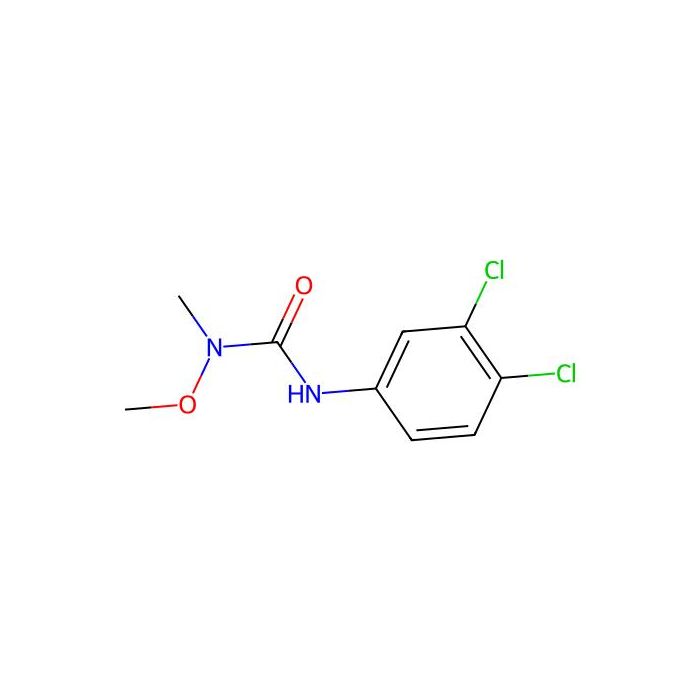
Core scaffold: a monosubstituted urea bearing an N-methoxy-N-methyl carbamoyl moiety coupled to a 3,4-dichlorophenyl anilide. Functional groups include a urea carbonyl (C=O), one anilide N–H (hydrogen-bond donor), an N-methoxy substituent (H-bond acceptor), and two aryl chlorides on a 1,2,4-trisubstituted benzene ring.
Stereochemistry: achiral, no stereocenters; planar aromatic ring with rotatable urea–aryl and N–O bonds.
Computational/registry strings:
Molecular formula: Not specified for this item; refer to CoA/Spec Sheet.
Molecular weight: Not specified for this item; refer to CoA/Spec Sheet.
SMILES: Not specified for this item; refer to CoA/Spec Sheet.
InChIKey: Not specified for this item; refer to CoA/Spec Sheet.
2D structure (verbal): A 3,4-dichlorophenyl ring para to an amide-type linker connects to a urea carbonyl whose distal nitrogen is N-methyl and N-methoxy substituted; the proximal nitrogen is bound to the aniline ring (anilide).
Synthetic Utility
General perspective:
Linuron is an end-use small molecule rather than a synthetic intermediate. It is rarely employed as a reagent. However, understanding its functional groups can guide stability studies, impurity tracking, and derivatization for analytical purposes.
Functional group features (chemistry, general):
Urea carbonyl (C=O): H-bond acceptor; susceptible to hydrolysis under strong acidic/basic conditions and to nucleophilic attack in harsh media.
Anilide N–H: weakly acidic; can engage in H-bonding and, under forcing conditions, undergo acyl transfer or form salts with strong bases.
Aryl chlorides: typically inert toward SNAr without activating substituents but can participate under strongly electron-withdrawing conditions or with specialized catalysts.
N–O (methoxy on urea N): relatively labile under strong reducing or acidic conditions; sometimes leveraged in derivatization strategies.
Derivatization and analytical chemistry:
For GC-based workflows, derivatization (e.g., silylation of polar sites when applicable) may improve volatility/thermal stability of metabolites rather than the parent compound.
Stable-isotope dilution LC–MS/MS methods benefit from analogs with labeled aryl carbons or urea carbonyl for precise quantitation of residues and degradation products.
Retrosynthetic context (background):
The molecule exemplifies coupling of a substituted aniline with an N-alkoxy-N-alkyl carbamoyl donor (e.g., via isocyanate/urethane routes), a strategy relevant to preparing analog series for SAR.
Target Specificity
Item-specific targeting information (e.g., antigen/clone/isotype/species reactivity): Not specified for this item; refer to CoA/Spec Sheet.
Note: This product is a small-molecule library member (not an antibody or biologic). Any binding information in the literature (e.g., photosystem II QB site interactions) is context-dependent and is not a validated product-specific specification.
Nuestra guía de selección de calidades cubre la pureza, el estado del estabilizador y la idoneidad de la aplicación para todas las variantes de nuestro catálogo.
Utilizamos cookies para garantizar el correcto funcionamiento del sitio web y, cuando esté permitido, para mejorar su experiencia. Puede gestionar sus preferencias en cualquier momento en Configuración. Más información en nuestra Política de Cookies.
¿Quieres que te enviemos un mensaje cuando tengamos descuentos disponibles?
Recordármelo más tarde
¡Gracias! Por favor, revisa tu bandeja de entrada de correo electrónico para confirmar.
Products are supplied to verified businesses, institutions, and qualified professionals for research and development use only. Not for use in humans, animals, diagnosis, or therapy.