GRADE & PURITYAR?Analytical Reagent grade — high-purity chemicals meeting strict assay limits for lab analysis. Use when accuracy matters and trace impurities could skew results.≥99%
Determine the necessary mass, volume, or concentration for preparing a solution.
Dilution Calculator
Determine the dilution needed to prepare a stock solution.
Reconstitution Calculator
Reseñas
Reseñas de cliente
Application Protocols
Not applicable
No validated bioassay protocols (WB, IHC, IF, FC, etc.) are associated with this inorganic reagent. Application conditions depend on your analytical or synthetic method.
General laboratory use suggestions (literature/context)
Preparing a standardized chromate solution: Accurately weigh a clean, dry portion in a fume hood; dissolve in volumetric-grade water; dilute to mark; store in amber glass if prolonged storage is unavoidable. Verify concentration by primary-standard titration where applicable.
Using as an indicator source (argentometry): Follow your method’s prescribed concentration and ionic strength; ensure absence of interfering anions/cations; note that Li+ may alter activity coefficients compared to Na+/K+ systems—calibrate accordingly.
Oxidation trials: Perform small-scale tests to establish kinetics/selectivity, controlling pH and temperature, and implement CrVI quench/waste treatment.
Item-specific
Manufacturer application notes are not provided for this item; consult your method SOPs and the product SDS.
Biological Roles
Applicability
Lithium chromate hydrate is an inorganic laboratory reagent. It is not used as a biological metabolite or nutrient. The following notes are provided as general biochemical context for chromate species.
Literature/general context
Chromium speciation: Cr exists biologically primarily as trace Cr(III) complexes; Cr(VI) chromate (CrO4^2−) is not a normal metabolite and is highly toxic. Chromate can enter cells via sulfate transporters due to oxyanion similarity, where it is reduced to reactive Cr(V/IV/III) intermediates that can generate oxidative stress and DNA/protein adducts.
Enzymology: No known physiological enzymes use chromate (CrVI) as a cofactor in eukaryotes; certain bacteria can reduce CrVI to CrIII enzymatically as a detoxification pathway (bioremediation interest).
Biomaterials/cell culture: Chromate salts are cytotoxic and genotoxic; they are not appropriate for routine biological media or buffer formulations. Any use in bioassays is typically as a toxicant control in environmental or toxicology studies under strict containment.
Item-specific statement
This product is for research use only. No medical, diagnostic, or therapeutic use is intended or implied.
Buffer Applications
Not typically applicable
Lithium chromate hydrate is not used as a biological buffer due to the toxicity of Cr(VI). While the chromate/hydrogen chromate equilibrium (HCrO4− ⇌ CrO4^2− + H+, pKa2 around mid-6 range; literature) can in principle provide buffering near mildly acidic to neutral pH, safer buffering systems (phosphate, HEPES, Tris, acetate, MOPS, etc.) should be used for any biochemical work.
If chromate-containing aqueous solutions are required (analytical/teaching labs)
Prepare only the minimal volume needed, in a fume hood, using deionized water and clean glassware dedicated to oxidizers.
Clearly label and segregate solutions; avoid storage in contact with metals and reducing agents.
Dispose of solutions via validated CrVI reduction to CrIII, followed by compliant disposal as hazardous waste.
Item-specific
No buffer recipes or pH specifications are provided for this item; refer to your method and institutional safety guidance.
Green Alternatives
Context
Chromate(VI) compounds are on multiple regulatory hazard lists (carcinogenicity, environmental toxicity). Where feasible, replace CrVI chemistry with less hazardous alternatives.
Potential alternatives (literature; selection depends on application)
Dess–Martin periodinane (DMP) or IBX: Chromium-free, mild, but cost and shock sensitivity (IBX) must be managed.
Swern or Parikh–Doering (DMSO-based): No chromium; requires low temperature and manages dimethyl sulfide odor.
Catalytic Ru or Pd aerobic oxidations: High atom economy; requires precious metals and O2 handling.
Corrosion inhibition/coatings:
Molybdate, vanadate, phosphate, silane, rare-earth salts (e.g., cerium) as non-chromate inhibitors (performance and durability vary by substrate/system).
Analytical indicators:
Non-chromate endpoints (e.g., adsorption indicators for halide titrations) or instrumental methods (ion chromatography) to avoid CrVI entirely.
Trade-offs
Performance vs hazard: Chromates combine strong oxidizing power and self-healing passivation in coatings—difficult to match without process changes. Alternatives may require tighter process control, different substrates, or accept slightly reduced corrosion performance.
Waste and compliance: Chromium-free routes simplify waste treatment and regulatory burden, often at higher reagent or equipment cost.
Decision guidance
For new method development, default to chromium-free options. If chromate is unavoidable (legacy method/spec), minimize scale, implement closed handling, and plan CrVI reduction and verified disposal.
Pharmaceutical Uses
Not a pharmaceutical excipient
Due to the toxicity and carcinogenicity of hexavalent chromium, chromate salts are not employed as pharmaceutical excipients or active ingredients.
Historical/legacy uses of chromate reagents in industrial settings include oxidation or coloration steps and redox titrations. Modern pharmaceutical manufacturing avoids CrVI reagents where possible; if used in a controlled analytical method (e.g., legacy redox titration), they are handled at micro-scale with strict containment and waste management.
Regulatory perspective: Use of CrVI compounds triggers stringent controls on worker exposure (occupational limits), product contamination limits, and environmental emissions. Alternative methods are strongly preferred.
Item-specific note
No pharmacopeial monograph, excipient role, or formulation guidance is provided for this item. This product is supplied for research use only.
Physical Properties
Item-specific (from Product Data)
Appearance: Not specified for this item; refer to CoA/Spec Sheet.
Physical state: Inorganic crystalline solid; chromate salts typically yellow due to CrVI ligand-to-metal charge transfer.
Thermal behavior: Chromate salts do not exhibit a true boiling point; they decompose on strong heating, ultimately reducing CrVI to lower-valent chromium with oxygen release (literature).
Solubility: Chromate salts are generally soluble in water to varying extents; lithium chromate is typically water-soluble, with solubility increasing with temperature (literature). Insoluble or sparingly soluble in most nonpolar organic solvents.
Hygroscopicity: Hydrate state may shift with ambient humidity; materials can gain or lose lattice water depending on storage (literature).
pH behavior: Aqueous chromate solutions are alkaline; acidification converts chromate to hydrogen chromate (HCrO4−) and dichromate (Cr2O7^2−) species (literature). Buffering capacity near the HCrO4−/CrO4^2− equilibrium is possible but rarely used due to toxicity.
Density, refractive index, logP, pKa, UV cutoff: Not specified for this item; refer to CoA/Spec Sheet.
Practical notes
Exact melting point, hydration number, and water content are hydrate- and lot-dependent; verify on CoA before quantitative work.
Quality and Grades
Item-specific (from Product Data)
Grade: AR (Analytical Reagent)
What AR grade generally signifies (context)
AR grade typically denotes high purity suitable for analytical laboratory use, with tight control of inorganic contaminants and consistent assay. For inorganic oxidants such as chromates, AR grade commonly targets low levels of other transition metals, alkali/alkaline-earth contaminants, and insoluble matter to minimize background in titrations, gravimetric analyses, and instrumental methods.
Implications for this item
Low background in classic wet-chemical determinations (e.g., use as a chromate source/indicator in certain titrations) and in ion analyses where trace-metal contamination must be controlled.
Batch-to-batch reproducibility supports method validation and QC use.
Not provided for this item; confirm on CoA/Spec Sheet
Assay (percent CrVI/chromate content), water of hydration (x in Li2CrO4·xH2O), trace metal limits, insolubles, loss on drying, UV absorbance profile. Always refer to the item’s CoA for quantitative specifications and release criteria.
Stabilizers/processing aids
Not specified for this item; refer to CoA/Spec Sheet. In general, chromate hydrates do not require added stabilizers; protection from reducing environments and contamination is essential to maintain CrVI content.
Reaction and Applications
Item-specific
Manufacturer applications: Not provided for this item.
Literature/general applications of lithium chromate/chromate salts
Oxidation chemistry: Chromate(VI) is a strong two-electron oxidant. While organic synthesis more commonly uses PCC/PDC/Jones reagents, aqueous chromate (including lithium chromate solutions) can oxidize certain substrates (e.g., sulfides to sulfoxides/sulfones; primary/secondary alcohols under acidic conditions) and is widely used in redox kinetics and mechanistic studies.
Analytical chemistry: Source of chromate indicator in argentometric titrations (e.g., Mohr method typically uses K2CrO4; Li+ alternative may be chosen to avoid K+/Na+ in systems where those cations interfere). Employed in standardization of redox titrants and in gravimetric precipitation (e.g., BaCrO4) studies.
Inorganic synthesis: Precursor to other chromium compounds via metathesis or reduction to Cr(III). Chromate can be introduced where Li+ is the desired counterion (e.g., ion-exchange materials, solid-state explorations).
Corrosion science: Chromate-based inhibitors (now heavily restricted) have been investigated for passivation films; lithium chromate historically evaluated in coatings and conversion treatments. Modern practice seeks non-chromate alternatives due to CrVI hazards.
Practical tips
Maintain oxidizing power: Avoid contact with reducing agents and organic contaminants. Prepare fresh aqueous solutions; protect from light and reducing dusts.
Speciation control: Adjust pH deliberately—acidic media increase oxidizing strength via HCrO4−/Cr2O7^2− formation; alkaline media favor CrO4^2−.
Solvents: Water is the primary solvent for lithium chromate hydrate. For organic substrates, biphasic water/organic systems or phase-transfer catalysis may be employed; however, purpose-built CrVI reagents in organic solvents usually give better results and safer handling.
Temperature: Many chromate oxidations proceed at ambient temperature; rates increase with heating but decomposition and side reactions increase. Use external cooling for exothermic additions.
Stoichiometry: Typically ≥1 equivalent of CrVI per two-electron oxidation, adjusted for substrate and pathway. Monitor by TLC/GC/HPLC as appropriate.
Catalysts/additives: Mineral acids (H2SO4) to adjust pH; buffers (nonreducing) to stabilize conditions. Avoid chloride where chlorination is a concern; avoid organic bases that can be oxidized.
Workup: Quench residual CrVI by reduction (e.g., sodium bisulfite or ascorbate) before aqueous extractions. Precipitated Cr(III) hydroxides can be filtered after basification. Confirm absence of CrVI (e.g., diphenylcarbazide test) prior to disposal.
Yields and kinetics
Highly substrate- and condition-dependent; consult substrate-specific literature. Emphasize micro-scale trials to optimize conditions safely.
Safety and Handling
Item-specific (from Product Data)
GHS/Signal word/H-statements/Pictograms: Not specified for this item; refer to the SDS for authoritative hazard classification.
Storage: Room temperature (per product listing). Ship under normal conditions.
Literature/general chromate (CrVI) safety profile
Hazard overview: Hexavalent chromium compounds are strong oxidizers and are typically classified as toxic, carcinogenic (Carc. 1A/1B), mutagenic, skin/respiratory sensitizers, and hazardous to the aquatic environment. Severe eye/skin irritation or burns can occur on contact. Inhalation of dust is dangerous. Always consult the specific SDS for this product/lot.
PPE: Wear lab coat, chemical-resistant gloves (e.g., nitrile; change frequently), splash goggles or face shield. Handle powders in a certified fume hood to avoid inhalation. Avoid generating dust/aerosols.
Incompatibilities: Strong reducing agents, organic combustibles, powdered metals, sulfides, hydrides, and concentrated acids (which can form more mobile HCrO4−/Cr2O7^2−). Avoid contact with easily oxidized organics; keep away from heat and ignition sources.
First aid (overview; follow SDS): Eye/skin contact—immediately flush with water for ≥15 min, remove contaminated clothing, seek medical attention. Inhalation—move to fresh air, monitor breathing, seek medical attention. Ingestion—rinse mouth, do NOT induce vomiting, seek urgent medical attention.
Spill/Disposal: Avoid dry sweeping; carefully dampen and collect while minimizing dust. Dispose of CrVI wastes as hazardous waste per local regulations; reduce to CrIII where permitted before disposal using validated procedures.
Special risks: Environmental persistence and toxicity; prevent release to drains/soil. Chromate residues can stain surfaces yellow; neutralize/decontaminate appropriately.
Solvent Selection
Applicability
Lithium chromate hydrate is an inorganic oxidizing salt typically handled as an aqueous solution or solid reagent. Solvent selection mainly concerns dissolution for analytical or preparative purposes rather than chromatographic-grade solvent choice.
Literature/general guidance
Polarity/miscibility: Readily dissolves in water (literature). Insoluble or sparingly soluble in nonpolar and most aprotic organic solvents. Solubility decreases in strongly basic brines containing competing anions.
Acid–base/speciation: In alkaline to neutral water, chromate (CrO4^2−) predominates; upon acidification, hydrogen chromate (HCrO4−) and dichromate (Cr2O7^2−) form. Speciation affects oxidizing strength and analytical behavior.
Practical solvent choices:
Water (preferred): Prepare standardized stock solutions for titration/indicator use, redox studies, and inorganic synthesis precursors.
Water–alcohol mixtures: Sometimes used to tune solubility/ionic strength, but avoid combustible organics with strong oxidizers and follow SDS guidance.
Non-aqueous media: Direct dissolution in common organics is limited; if a non-aqueous chromate source is required, consider phase-transfer approaches or alternative CrVI reagents designed for organic solvents (e.g., PCC, PDC; literature alternatives only).
Comparison (literature)
Potassium/sodium chromates: Higher molar mass, different cation effects (crystal habit, solubility). Lithium chromate can offer differing lattice energies and may influence crystallization or ion-exchange processes when Li+ is desired/benign in the system.
Storage and Reconstitution
Item-specific (from Product Data)
Storage conditions: Room temperature.
Shipping: Normal.
Best practices (literature/general for chromate salts)
Container: Store tightly closed in chemically resistant containers (glass or HDPE) with intact seals. Label clearly as an oxidizer and carcinogenic hazardous substance per your jurisdiction.
Environment: Keep in a cool, dry, well-ventilated area away from sunlight. Segregate from reducing agents, acids, organic combustibles, and metal powders. Avoid humid conditions that could alter hydration state.
Shelf life: Stable when properly stored; monitor for caking, color change, or contamination. Verify assay/speciation periodically for critical analytical work.
Reconstitution/preparation of solutions
Solvent: Use deionized water. Add solid slowly with stirring to minimize dust. Prepare only the quantity required for immediate use when possible.
Concentration: Determine based on your method; confirm solubility limits at your working temperature.
Filtration: If particulate matter is present, filter through inert media; avoid cellulose filters if oxidation risk is a concern.
Storage of solutions: Short-term storage in amber glass at room temperature may be acceptable; for longer storage, minimize headspace and protect from light. Periodically verify concentration/speciation. Discard/replace solutions that show precipitation or contamination.
Safety notes
Open and handle in a fume hood wearing appropriate PPE. Implement validated procedures to reduce any residual CrVI to CrIII before disposal.
Research use
For research use only, not for human or veterinary use.
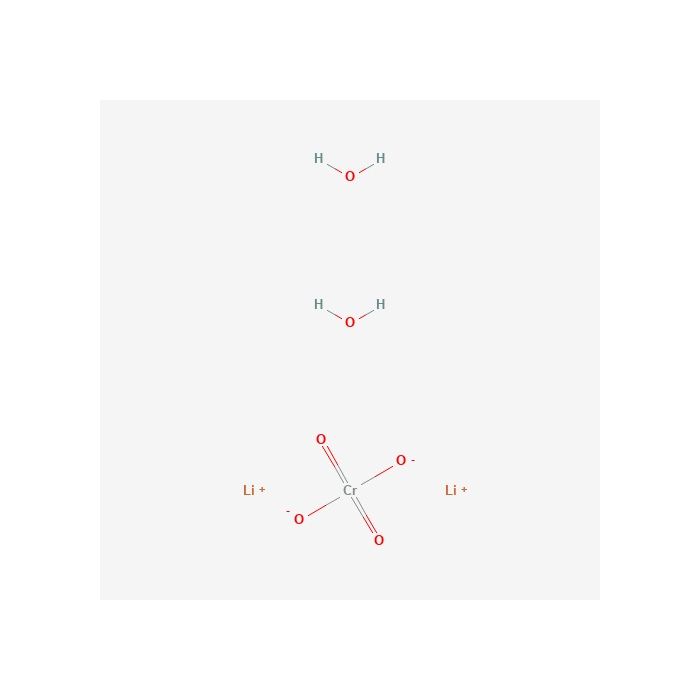
Core composition: Lithium chromate corresponds to the chromate(VI) anion (CrO4^2−) charge-balanced by Li+ cations; hydrates contain coordinated/occluded water (x H2O, where x varies by preparation and storage humidity).
2D structural description: The chromate(VI) anion is a nearly tetrahedral [CrO4]2− unit with chromium in oxidation state +6 bonded to four oxide ligands. In hydrates, water is present in the lattice (not covalently bound to Cr) and may hydrogen-bond to oxide ligands and/or coordinate to Li+ centers in the crystal lattice.
Functional/structural features: Inorganic salt; contains a high-valent oxoanion (CrVI) with strong oxidizing character, paired with hard Li+ counterions. No stereocenters.
Notes
Hydrate level determines exact formula and formula weight; consult the item-specific CoA for definitive identity parameters.
Synthetic Utility
General reactivity (literature)
Oxidizing agent: Chromate(VI) oxidizes a range of substrates. In aqueous/acidic solution, it can convert primary/secondary alcohols to carbonyls, oxidize sulfides to sulfoxides/sulfones, and effect oxidative cleavage of certain diols and allylic systems. Control of pH determines speciation (CrO4^2− vs HCrO4−/Cr2O7^2−) and kinetics.
Inorganic transformations: Useful as a chromate source for ion-exchange loading, preparation of insoluble chromates (e.g., BaCrO4 for demonstrations/standards), or conversion to Cr(III) salts via reduction.
Solid-state chemistry: Li+ counterion can be advantageous in solid-state or ionically conductive materials research where lithium content is desired.
Practical considerations
Choice of medium: Aqueous systems are preferred for Li2CrO4·xH2O; for nonaqueous organic oxidations, chromium(VI) reagents tailored to organic media (PCC, PDC, Collins) are typically superior.
Stoichiometry and workup: Chromate oxidations generate Cr(III) byproducts; plan for thorough workup and waste reduction (e.g., bisulfite or ascorbate reduction of residual CrVI, filtration of Cr(III) precipitates when applicable).
Selectivity: In the absence of tailored ligation and solvent, chromate is less chemoselective than designer CrVI reagents; sensitive functionalities (e.g., aldehydes, activated alkenes) may over-oxidize in strongly acidic media.
Item-specific
No application examples are provided by the manufacturer; adapt literature protocols to your scale, observing all safety and waste rules.
Target Specificity
Not applicable
This product is an inorganic chemical reagent, not a biological targeting agent (e.g., antibody, ligand, or inhibitor). No antigen/epitope specificity, clone, isotype, or species reactivity data are relevant.
Item-specific
No target-related information is provided for this item.
Need help choosing the grade?
Our grade selection guide covers purity, stabilizer status, and application suitability for all variants in our catalog.
Utilizamos cookies para garantizar el correcto funcionamiento del sitio web y, cuando esté permitido, para mejorar su experiencia. Puede gestionar sus preferencias en cualquier momento en Configuración. Más información en nuestra Política de Cookies.
¿Quieres que te enviemos un mensaje cuando tengamos descuentos disponibles?
Recordármelo más tarde
¡Gracias! Por favor, revisa tu bandeja de entrada de correo electrónico para confirmar.
Products are supplied to verified businesses, institutions, and qualified professionals for research and development use only. Not for use in humans, animals, diagnosis, or therapy.

 C2324104