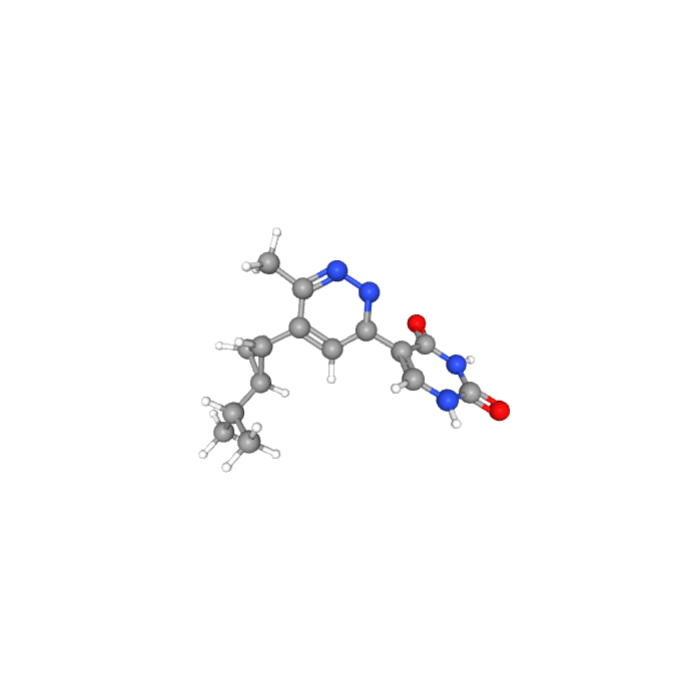
LY-3475070 LY-3475070 is a potent, selective and orally bioavailable inhibitor of the ectoenzyme CD73 (cluster of differentiation 73, 5'-ecto-nucleotidase, 5'-NT, ecto-5'-nucleotidase) .
Targets
CD73
Especificaciones
Especificaciones y pureza
≥99%
Mecanismos bioquímicos y fisiológicos
LY-3475070 is a potent, selective and orally bioavailable inhibitor of the ectoenzyme CD73 (cluster of differentiation 73, 5'-ecto-nucleotidase, 5'-NT, ecto-5'-nucleotidase).
Condiciones de almacenamiento de almacenamiento
Store at -20°C
Enviado en
Ice chest + Ice pads
Este producto requiere envío en cadena de frío. Los servicios terrestres y otros servicios económicos no están disponibles.
This compound belongs to the class of organic compounds known as pyrimidones. These are compounds that contain a pyrimidine ring, which bears a ketone. Pyrimidine is a 6-membered ring consisting of four carbon atoms and two nitrogen centers at the 1- and 3- ring positions.
External Descriptors
Not available
1. Djoumbou Feunang Y, Eisner R, Knox C, Chepelev L, Hastings J, Owen G, Fahy E, Steinbeck C, Subramanian S, Bolton E, Greiner R, and Wishart DS. ClassyFire: Automated Chemical Classification With A Comprehensive, Computable Taxonomy. Journal of Cheminformatics, 2016, 8:61.
Determine the necessary mass, volume, or concentration for preparing a solution.
Dilution Calculator
Determine the dilution needed to prepare a stock solution.
Reconstitution Calculator
Reseñas
Reseñas de cliente
Application Protocols
No manufacturer-tested biological or analytical protocols are provided for this item. The following are general, non-binding recommendations for small-molecule screening compounds.
DMSO stock preparation (general):
Allow vial to equilibrate to room temperature in a desiccator to minimize moisture condensation.
Add dry DMSO to achieve a desired stock concentration (e.g., 10, 20, or 50 mM) based on the molecular weight once confirmed; vortex until fully dissolved.
If particulates remain, centrifuge briefly or filter through a PTFE 0.2 µm filter if adsorption losses are acceptable.
Dispense into single-use aliquots (low-bind tubes/plates) and store at -20°C, protected from light if the compound is photosensitive (unknown; verify on CoA/SDS).
Serial dilution for assays (general):
Prepare serial dilutions in DMSO or assay buffer with matched DMSO percentage across wells. Include vehicle controls and, where applicable, positive/negative control compounds.
Analytical QC (general):
Verify concentration by UV–Vis if the extinction coefficient is known, or by quantitative NMR/LC–MS against internal standards.
Notes:
Avoid more than 3–4 freeze–thaw cycles. Track lot number and aliquot IDs in your LIMS.
Item-specific protocols (WB, IHC, IF, FC, etc.) are not specified for this item.
Biological Roles
Item-specific biological targets or roles are not provided in the Product Data.
Item-specific data (from Product Data):
Target/Pathway/Mechanism: Not specified for this item; refer to CoA/Spec Sheet and internal databases.
General considerations for small-molecule tools:
Screening compounds can modulate enzymes, receptors, transporters, or protein–protein interactions depending on structure, which is not supplied here.
When deploying in biological systems, perform dose–response analyses, counterscreens for assay interference, and orthogonal validation to confirm on-target activity.
Ensure vehicle controls (DMSO-only) and assess basic ADME-relevant properties experimentally (permeability, stability in assay buffer, nonspecific binding to plastic/serum proteins) before interpreting phenotypes.
Evaluate chemical liabilities when structure is available (e.g., electrophiles, Michael acceptors, redox cyclers, chelators) to exclude false positives.
No medical or clinical claims are made. This product is supplied strictly for research use only.
Buffer Applications
This product is not a buffering agent; no specific buffer system data are provided.
Practical guidance (general):
Reconstitute the compound in DMSO to a concentrated stock, then dilute into the desired buffer while maintaining a constant, low final % DMSO across all samples and controls.
Common assay buffers (e.g., HEPES, Tris, PBS) can be used depending on the biological target. Confirm compatibility with detection modality (fluorescence/absorbance) and ionic strength requirements.
To minimize precipitation upon dilution, add the DMSO stock slowly with mixing to pre-warmed buffer. If needed and assay-permissible, include a small amount of non-ionic surfactant (e.g., 0.01–0.05% Tween-20) to mitigate aggregation.
Not specified for this item; refer to CoA/Spec Sheet for any recommended solvents/buffers from the manufacturer.
Green Alternatives
Because this product is a small-molecule screening compound rather than a process reagent or solvent, “green alternative” considerations primarily concern solvent choice for dissolution and analytics.
Solvent choices (general guidance):
Prefer water-based buffers with minimal co-solvent where compatible with solubility and assay readouts.
Keep DMSO at the lowest feasible final percentage (often ≤0.2–0.5%) to reduce environmental and biological burden.
For preparative handling, favor ethanol over methanol where possible, and acetonitrile over halogenated solvents for analytical dilutions.
Small comparison (general):
| Use case | Conventional | Greener-leaning alternative | Trade-offs |
|---|---|---|---|
| Stock preparation | DMSO | Aqueous buffer + minimal DMSO | Risk of precipitation; may need surfactant |
| Analytical sample | ACN/MeOH | ACN/EtOH or buffered aqueous ACN | Peak shape/solubility can change |
| Cleaning | Dichloromethane | Ethyl acetate/isopropanol | Slower drying; possible residue |
Operational practices:
Use miniaturized assay formats (384/1536-well) to reduce solvent consumption.
Consolidate LC sequences to minimize rinse/waste cycles and adopt solvent recycling where validated.
Item-specific environmental or hazard metrics (e.g., EHS scores) are not specified for this item; consult SDS and institutional green chemistry guidelines.
Pharmaceutical Uses
No pharmacopeial status, excipient role, or formulation specifications are provided for this item.
Item-specific data (from Product Data):
Regulatory/Pharmacopeia status: Not specified for this item; refer to CoA/Spec Sheet.
General note:
LY-3475070 is offered as a research-use-only small molecule. It is not intended for human or veterinary use, drug substance manufacturing, or clinical applications.
If used in pre-formulation research, confirm solubility, stability, and compatibility with common excipients (only in non-clinical lab settings). Any development beyond bench research requires full structure disclosure, impurity profiles, and regulatory-grade documentation, which are not part of this listing.
Physical Properties
Item-specific physical data are not provided in the Product Data.
Item-specific data (from Product Data):
Appearance: Not specified for this item; refer to CoA/Spec Sheet.
Molecular Weight: Not specified for this item; refer to CoA/Spec Sheet.
Molecular Formula: Not specified for this item; refer to CoA/Spec Sheet.
Melting point / Boiling point: Not specified for this item; refer to CoA/Spec Sheet.
Density, refractive index, pKa, logP/logD, solubility: Not specified for this item; refer to CoA/Spec Sheet.
Practical guidance (general chemistry knowledge):
Small-molecule library compounds are commonly supplied as solids or film in vials or plates. If solid, they are typically reconstituted in DMSO to prepare high-concentration stocks (e.g., 10–50 mM), then diluted into assay buffers or media.
If solubility is uncertain, run a micro-scale solubility screen in DMSO, DMF, MeOH, and aqueous buffer containing co-solvent (e.g., 0.1–1% DMSO), monitoring turbidity and LC–UV response.
Hygroscopicity or polymorphism may impact handling and reconstitution; minimize atmospheric moisture exposure and record any visually observed changes upon thaw.
Note on literature/computed values:
No literature or computed values are provided here due to the absence of a confirmed structure in the Product Data. Consult the CoA/Spec Sheet or your internal databases for property predictions tied to the exact structure.
Quality and Grades
Item-specific data (from Product Data):
Grade/Purity: Not specified for this item; refer to CoA/Spec Sheet.
What to expect for screening compounds (general guidance):
Library/screening molecules are typically supplied with an HPLC purity metric (often ≥95% by area) and identity confirmation by LC–MS and/or NMR. Because no grade/purity is specified here, verify acceptance criteria on the lot-specific CoA.
If your use case is biochemical or cell-based screening, confirm low levels of residual solvents and verify absence of reactive impurities (e.g., aldehydes, electrophiles) that can trigger assay artifacts.
Stabilizers and additives:
No stabilizers are listed. If present in your lot, they will be disclosed on the CoA/Spec Sheet. Stabilizers can affect bioassays or analytical baselines; account for them during control experiments.
Practical QC recommendations (general):
Perform incoming HPLC/UPLC check (UV at 210–254 nm and, where applicable, MS channel) to confirm stated purity and to assess stability after shipping.
For long-term studies, archive a retain sample and periodically re-check purity after storage at -20°C to monitor potential degradation.
If form (free base vs. salt, solvate, or polymorph) is relevant to your application, confirm by NMR, Karl Fischer (for hydrates), and PXRD/DSC as needed.
Reaction and Applications
This item is positioned as a screening/library small molecule rather than a synthetic reagent; no specific reactive functional groups or transformation roles are provided.
Item-specific notes (from Product Data):
Manufacturer Applications: Not specified.
Chemical reactivity profile: Not specified; refer to CoA/Spec Sheet for functional group information if synthetic derivatization is planned.
General applications for library compounds:
Assay development and screening: Use in target-based or phenotypic assays to probe biological pathways, validate hits, and build SAR hypotheses.
Reference control or tool molecule: May serve as a comparator in pathway interrogation or as part of a focused set for orthogonal screening.
Analytical characterization workflows: Calibration of LC–MS methods (RT and ionization behavior) when structure is known.
Practical tips (general):
Prepare concentrated DMSO stocks (e.g., 10–50 mM), confirm absence of precipitation after dilution into the assay matrix, and include DMSO-matched controls.
If using in live-cell assays, pre-screen for assay interference: intrinsic fluorescence/absorbance, redox activity, aggregation (use detergent controls), and reactivity toward thiols.
For orthogonal validation, employ multiple assay formats (biochemical vs. cellular), and, where feasible, counterscreens (e.g., PAINS/REOS filters if structure is known).
For synthetic transformations or reaction conditions specific to this molecule, structure and functionality must be confirmed; these details are not specified for this item.
Reaction Conditions
No reaction or transformation conditions are specified for this product, and it is not positioned as a synthetic reagent in the Product Data.
If using as a tool compound in synthesis (derivatization):
Choose reaction conditions based on confirmed functional groups once structure is available via CoA/Spec Sheet.
Perform small-scale feasibility tests to probe solvent tolerance (e.g., DMF, DMSO, MeCN, dioxane), base/acid sensitivity, and thermal stability by TLC/LC–MS time courses.
Typical conditions (literature, general):
Amide couplings: HATU/DIPEA in DMF or MeCN, rt to 50°C, 1–12 h.
Suzuki couplings: Pd(PPh3)4 (1–3 mol%), K2CO3, dioxane/H2O 80–100°C, 2–16 h.
Buchwald–Hartwig amination: Pd2(dba)3/XPhos, NaOtBu, toluene or dioxane, 80–110°C.
These are generic literature guidelines only and may not apply to the undisclosed structure; verify compatibility experimentally.
Analytics:
Monitor by HPLC/UPLC–MS and confirm identity/purity after reaction. Assess for degradation vs. desired transformation.
Item-specific recommended conditions are not available; refer to CoA/Spec Sheet.
Safety and Handling
Safety-specific data are not provided; handle under general good laboratory practices for research chemicals.
Item-specific data (from Product Data):
GHS Classification / Signal Word / H-statements / Pictograms: Not specified for this item; refer to SDS.
Storage Conditions: Store at -20°C.
Shipping: Ice chest + ice pads (cold chain).
Research Use Note: For research use only.
General handling guidance (defer to SDS as authoritative):
Wear appropriate PPE: lab coat, safety glasses, and nitrile gloves; consider double-gloving for DMSO-handled stocks due to skin permeation potential of DMSO.
Work in a chemical fume hood to avoid inhalation of dusts/aerosols. Avoid ingestion and skin/eye contact.
Prevent cross-contamination of screening libraries by using sterile, solvent-resistant tips and dedicated reservoirs; change tips between samples.
For unknown hazard profiles, treat as potentially harmful: avoid aerosolization, and keep quantities to the minimum needed for experiments.
Incompatibilities and reactivity (general):
Avoid strong oxidizers and strong acids/bases unless compatible with your protocol. Do not heat or evaporate to dryness with reactive metals or bases unless structure-specific compatibility is known.
First-aid overview (general):
Skin/eye contact: Rinse with water for at least 15 minutes; remove contaminated clothing; seek medical attention if irritation persists.
Inhalation: Move to fresh air; seek medical attention if symptoms occur.
Ingestion: Rinse mouth; do not induce vomiting; seek medical attention.
Always consult the product-specific SDS and CoA for definitive hazard, handling, and disposal information.
Solvent Selection
Item-specific solubility is not provided; the following guidance reflects common practice for small-molecule screening compounds.
Primary reconstitution solvent:
DMSO is the default for library stocks due to broad solvating power and compatibility with most biochemical/cell assays at low final % (typically ≤0.5%).
Alternative solvents and co-solvents (general):
DMF: High polarity; good for difficult-to-dissolve compounds; ensure compatibility with assay and plates.
Methanol/Acetonitrile: Useful as minor co-solvents or for analytical sample prep; limit % in biological assays.
Aqueous buffers: Use only after preparing a DMSO concentrate; minimize precipitation by gradual dilution with mixing and surfactant (e.g., 0.01–0.05% Tween-20) if assay-tolerated.
Practical tips:
Filter stock solutions (0.2 µm PTFE) if particles persist and if the compound is not adsorptive; otherwise, centrifuge-clarify to avoid loss on filters.
Appearance: Not specified for this item; refer to CoA/Spec Sheet.
Reconstitution (general guidance for screening compounds):
Reconstitute in anhydrous DMSO to a convenient stock concentration (e.g., 10–50 mM) once molecular weight is confirmed. Mix thoroughly to ensure complete dissolution.
If aqueous reconstitution is required, first prepare a DMSO concentrate, then slowly dilute into buffer with mixing to avoid precipitation. Validate solubility at the intended working concentration.
Aliquoting and stability (general):
Prepare single-use aliquots to minimize freeze–thaw. Store aliquots at -20°C in tightly sealed, inert (low-bind) containers, protected from light if the compound is photosensitive (not specified).
Record preparation date, solvent, and concentration on each aliquot. Periodically reassess purity by HPLC/UPLC after prolonged storage.
Thawing:
Thaw on ice or at room temperature; briefly vortex to re-homogenize. Inspect for precipitation or discoloration before use.
Disposal:
Dispose of solutions and residues according to institutional hazardous waste protocols. Consult the SDS for compound-specific disposal guidance if available.
Structure and Identity
Brief overview: LY-3475070 is listed as a small-molecule library/compound screening item. Structural identifiers for this specific lot are not provided in the Product Data.
Item-specific data (from Product Data):
Product Name: LY-3475070
SKU: L414499
CAS: 2375815-63-5
CID: 152262911
InChIKey: 398708 (provided as-is in Product Data; note: typical InChIKeys are 27 characters; verify on CoA/SDS)
SMILES: Not specified for this item; refer to CoA/Spec Sheet.
Molecular Formula: Not specified for this item; refer to CoA/Spec Sheet.
Molecular Weight: Not specified for this item; refer to CoA/Spec Sheet.
Structural features:
Not specified for this item; refer to CoA/Spec Sheet.
2D structure description (general statement):
Not available in the Product Data. For experimental planning or cheminformatics use (e.g., docking, property prediction), request the structure (SMILES/SDF) via CoA/Spec Sheet or confirm using the provided CAS/CID with your internal regulatory/compliance workflows.
Identity verification (practical guidance):
For analytical confirmation, use orthogonal methods such as LC–MS (accurate mass), 1H/13C NMR, and HPLC/UPLC purity profiling. Ensure spectra and chromatograms match the manufacturer’s CoA for the exact lot you receive.
Synthetic Utility
Without a disclosed structure, specific synthetic transformations or functional-group strategies cannot be detailed for this item.
Item-specific data (from Product Data):
Functional groups / Salt form: Not specified; refer to CoA/Spec Sheet.
General guidance (if derivatization is intended):
Upon obtaining the structure, map reactive handles (e.g., aryl halides, anilines, alcohols, carboxylic acids) for diversification by cross-coupling (Suzuki, Buchwald–Hartwig), amide coupling, or heterocycle modifications.
Consider late-stage functionalization methods (C–H activation, Minisci) for rapid SAR expansion if the scaffold tolerates such chemistry.
Establish robust analytical characterization (LC–MS, NMR) to track modifications and to confirm site-selectivity.
Protecting-group and stability considerations:
Verify stability to acids/bases, oxidants/reductants, and heat before planning multi-step sequences. Unknown stability warrants small-scale scouting experiments.
Item-specific synthetic roles (e.g., as a reagent, catalyst, or monomer) are not specified for this item.
Target Specificity
No target specificity or bioactivity profile is provided in the Product Data for LY-3475070.
Item-specific data (from Product Data):
Target/Pathway/Selectivity: Not specified for this item; refer to CoA/Spec Sheet.
General guidance for users:
Treat as a tool compound candidate pending structure and activity confirmation. Validate activity using orthogonal assays and appropriate counterscreens to exclude assay interference.
If the compound is used as part of a focused library, compare activity fingerprints across related targets to infer selectivity trends.
No claims of potency, selectivity, or mechanism are made here.
Utilizamos cookies para garantizar el correcto funcionamiento del sitio web y, cuando esté permitido, para mejorar su experiencia. Puede gestionar sus preferencias en cualquier momento en Configuración. Más información en nuestra Política de Cookies.
¿Quieres que te enviemos un mensaje cuando tengamos descuentos disponibles?
Recordármelo más tarde
¡Gracias! Por favor, revisa tu bandeja de entrada de correo electrónico para confirmar.
Products are supplied to verified businesses, institutions, and qualified professionals for research and development use only. Not for use in humans, animals, diagnosis, or therapy.

 L2304248