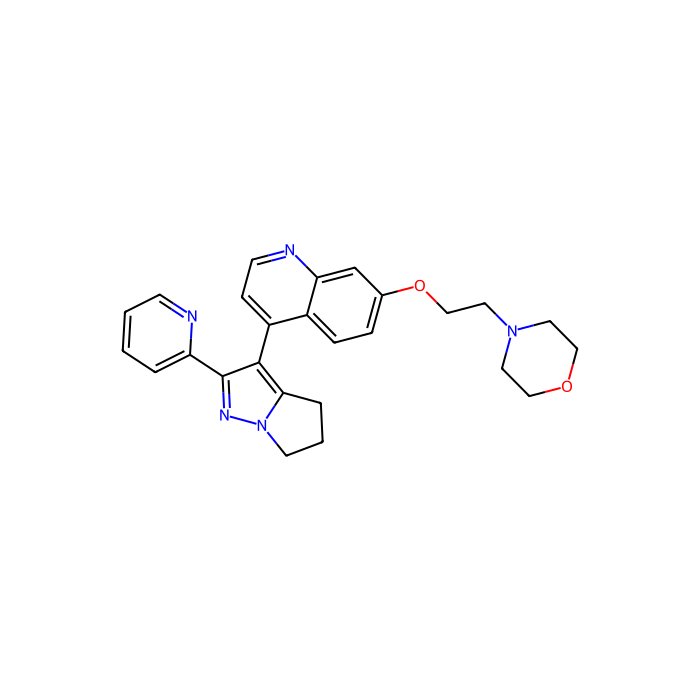
LY2109761 - Moligand™, ≥99% , Inhibitor of transforming growth factor beta receptor 1;Inhibitor of transforming growth factor beta receptor 2, CAS No.700874-71-1, Inhibitor of transforming growth factor beta receptor 1;Inhibitor of transforming growth factor beta receptor 2

CAS: 700874-71-1 Cat. No.: L126135 Fórmula: C26H27N5O2 Peso molecular: 441.52
Disponible para pedir
CALIDAD & PUREZA Moligand™ ? Moligand™ — Aladdin's line of ligands and bioactive small molecules. Use for receptor, pathway, and binding studies needing defined small-molecule tools. ≥99%
Synonyms
LY 2109761|.ALPHA.-KETOGLUCONIC ACID|Quinoline, 4-(5,6-dihydro-2-(2-pyridinyl)-4H-pyrrolo(1,2-b)pyrazol-3-yl)-7-(2-(4-morpholinyl)ethoxy)-|4-(5,6-Dihydro-2-(2-pyridinyl)-4H-pyrrolo(1,2-b)pyrazol-3-yl)-7-(2-(4-morpholinyl)ethoxy)quinoline|7-(2-morpholin-4-yl-ethoxy)-4-(2-pyridin-2-yl-5,6-dihydro-4H-pyrrolo[1,2-b]pyrazol-3-yl)-quinoline|7-(2-morpholin-4-ylethoxy)-4-(2-pyridin-2-yl-5,6-dihydro-4H-pyrrolo[2,1-e]pyrazol-3-yl)quinoline|Quinoline, 4-[5,6-dihydro-2-(2-pyridinyl)-4H-pyrrolo[1,2-b]pyrazol-3-yl]-7-[2-(4-morpholinyl)ethoxy]-|4-[2-[4-(2-pyridin-2-yl-5,6-dihydro-4H-pyrrolo[1,2-b]pyrazol-3-yl)quinolin-7-yl]oxyethyl]morpholine|Dihydropyrrolopyrazole, 15d|LY2109761|LY-2109761|4-(2-((4-(2-(Pyridin-2-yl)-5,6-dihydro-4H-pyrrolo[1,2-b]pyrazol-3-yl)quinolin-7-yl)oxy)ethyl)morpholine|4-[5,6-dihydro-2-(2-pyridinyl)-4H-pyrrolo[1,2-b]pyrazol-3-yl]-7-[2-(4-morpholinyl)ethoxy]-quinoline|4-(3-CHLOROANILINO)-6,7-DIMETHOXYQUINAZOLINE HYDROCHLORIDE|Cefodizime Impurity (2-Mercapto-4-methyl-5-thiazoleacetic acid)|LY2109761,CAS:700874-71-1|4-[2-({4-[2-(pyridin-2-yl)-4H,5H,6H-pyrrolo[1,2-a]pyrazol-3-yl]quinolin-7-yl}oxy)ethyl]morpholine
Storage
Store at -20°C
Shipped In
Ice chest + Ice pads
★
Talla
Alemania (EU)
USA*
Precio
Cantidad
5mg
L126135-5mg
—
3 Disponible
93,63€
10mg
L126135-10mg
—
3 Disponible
160,44€
50mg
L126135-50mg
—
2 Disponible
481,51€
Enter a quantity for the sizes you want to add.

Descripción general

LY2109761 is a novel selective TGF-β receptor type I/II (TβRI/II) dual inhibitor with Ki of 38 nM and 300 nM, respectively; shown to negatively affect the phosphorylation of Smad2.
A small molecule inhibitor of the TGF-β receptor type 1/type II kinases.

Especificaciones

Sinónimos
LY 2109761 | .ALPHA.-KETOGLUCONIC ACID | Quinoline, 4-(5,6-dihydro-2-(2-pyridinyl)-4H-pyrrolo(1,2-b)pyrazol-3-yl)-7-(2-(4-morpholinyl)ethoxy)- | 4-(5,6-Dihydro-2-(2-pyridinyl)-4H-pyrrolo(1,2-b)pyrazol-3-yl)-7-(2-(4-morpholinyl)ethoxy)quinoline | 7-(2-morpholin-4-yl-ethoxy)-4-(2-pyridin-2-yl-5,6-dihydro-4H-pyrrolo[1,2-b]pyrazol-3-yl)-quino Show more
Especificaciones y pureza
Moligand™, ≥99%
Condiciones de almacenamiento de almacenamiento
Store at -20°C
Enviado en
Ice chest + Ice pads
Este producto requiere envío en cadena de frío. Los servicios terrestres y otros servicios económicos no están disponibles.
Grado
Moligand™
Tipo de acción
INHIBITOR
Mecanismo de acción
Inhibitor of transforming growth factor beta receptor 1;Inhibitor of transforming growth factor beta receptor 2
Pureza
≥99%
Nombres e identificadores
Pubchem Sid
Pubchem Sid Url
https://pubchem.ncbi.nlm.nih.gov/substance/504766627
SMILES
C1CC2=C(C(=NN2C1)C3=CC=CC=N3)C4=C5C=CC(=CC5=NC=C4)OCCN6CCOCC6
IUPAC Name
4-[2-[4-(2-pyridin-2-yl-5,6-dihydro-4H-pyrrolo[1,2-b]pyrazol-3-yl)quinolin-7-yl]oxyethyl]morpholine
InChIKey
IHLVSLOZUHKNMQ-UHFFFAOYSA-N
InChI
1S/C26H27N5O2/c1-2-9-27-22(4-1)26-25(24-5-3-11-31(24)29-26)21-8-10-28-23-18-19(6-7-20(21)23)33-17-14-30-12-15-32-16-13-30/h1-2,4,6-10,18H,3,5,11-17H2
Isómeros SMILES
C1CC2=C(C(=NN2C1)C3=CC=CC=N3)C4=C5C=CC(=CC5=NC=C4)OCCN6CCOCC6
Peso molecular
441.52
Reaxys
14275148
Reaxys-RN_link_address
https://www.reaxys.com/reaxys/secured/hopinto.do?context=S&query=IDE.XRN=14275148&ln=

Datos avanzados

Taxonomic Classification

Taxonomy Tree

KingdomOrganic compounds
SuperclassOrganoheterocyclic compounds
ClaseQuinolines and derivatives
SubclassNot available
Intermediate Tree Nodes Not available
Direct ParentQuinolines and derivatives
Alternative Parents Pyrrolopyrazoles  Phenol ethers  Alkyl aryl ethers  Pyridines and derivatives  Morpholines  Pyrroles  Pyrazoles  Heteroaromatic compounds  Trialkylamines  Oxacyclic compounds  Dialkyl ethers  Azacyclic compounds  Hydrocarbon derivatives  
Molecular FrameworkAromatic heteropolycyclic compounds
Substituents Quinoline - Phenol ether - Pyrrolopyrazole - Alkyl aryl ether - Morpholine - Oxazinane - Pyridine - Benzenoid - Heteroaromatic compound - Pyrrole - Pyrazole - Azole - Tertiary amine - Tertiary aliphatic amine - Oxacycle - Azacycle - Dialkyl ether - Ether - Hydrocarbon derivative - Organic nitrogen compound - Organonitrogen compound - Organooxygen compound - Amine - Organic oxygen compound - Aromatic heteropolycyclic compound
DescripciónThis compound belongs to the class of organic compounds known as quinolines and derivatives. These are compounds containing a quinoline moiety, which consists of a benzene ring fused to a pyrimidine ring to form benzo[b]azabenzene.
External Descriptors Not available
Estructura 3D
Modelo de Estructura Química Interactiva


Objetivos asociados (humanos)
TGFBR1 Tchem TGF-beta receptor type-1 (2 Activities)
Activity TypeActivity Value -log(M)Mechanism of ActionActivity ReferencePublications (PubMed IDs)
TGFBR2 Tchem TGF-beta receptor type-2 (1 Activities)
Activity TypeActivity Value -log(M)Mechanism of ActionActivity ReferencePublications (PubMed IDs)
MAPK11 Tchem MAP kinase p38 beta (2785 Activities)
Activity TypeRelationActivity valueUnitsAction TypeJournalPubMed IddoiAssay Aladdin ID
LCK Tclin Tyrosine-protein kinase LCK (9212 Activities)
Activity TypeRelationActivity valueUnitsAction TypeJournalPubMed IddoiAssay Aladdin ID
MAPK14 Tchem MAP kinase p38 alpha (12866 Activities)
Activity TypeRelationActivity valueUnitsAction TypeJournalPubMed IddoiAssay Aladdin ID
GSK3B Tclin Glycogen synthase kinase-3 beta (11785 Activities)
Activity TypeRelationActivity valueUnitsAction TypeJournalPubMed IddoiAssay Aladdin ID
MAP2K6 Tchem Dual specificity mitogen-activated protein kinase kinase 6 (1284 Activities)
Activity TypeRelationActivity valueUnitsAction TypeJournalPubMed IddoiAssay Aladdin ID
PRKAB1 Tchem AMP-activated protein kinase, beta-1 subunit (56 Activities)
Activity TypeRelationActivity valueUnitsAction TypeJournalPubMed IddoiAssay Aladdin ID
SRC Tclin Tyrosine-protein kinase SRC (10310 Activities)
Activity TypeRelationActivity valueUnitsAction TypeJournalPubMed IddoiAssay Aladdin ID
CHEK2 Tchem Serine/threonine-protein kinase Chk2 (4015 Activities)
Activity TypeRelationActivity valueUnitsAction TypeJournalPubMed IddoiAssay Aladdin ID
PKN2 Tchem Protein kinase N2 (1991 Activities)
Activity TypeRelationActivity valueUnitsAction TypeJournalPubMed IddoiAssay Aladdin ID
RPS6KA5 Tchem Ribosomal protein S6 kinase alpha 5 (3355 Activities)
Activity TypeRelationActivity valueUnitsAction TypeJournalPubMed IddoiAssay Aladdin ID
RAF1 Tclin Serine/threonine-protein kinase RAF (4169 Activities)
Activity TypeRelationActivity valueUnitsAction TypeJournalPubMed IddoiAssay Aladdin ID
KDR Tclin Vascular endothelial growth factor receptor 2 (20924 Activities)
Activity TypeRelationActivity valueUnitsAction TypeJournalPubMed IddoiAssay Aladdin ID
MAP2K4 Tchem Dual specificity mitogen-activated protein kinase kinase 4 (1051 Activities)
Activity TypeRelationActivity valueUnitsAction TypeJournalPubMed IddoiAssay Aladdin ID
MAPK13 Tchem MAP kinase p38 delta (2605 Activities)
Activity TypeRelationActivity valueUnitsAction TypeJournalPubMed IddoiAssay Aladdin ID
MAPKAPK2 Tchem MAP kinase-activated protein kinase 2 (4814 Activities)
Activity TypeRelationActivity valueUnitsAction TypeJournalPubMed IddoiAssay Aladdin ID
MAPKAPK5 Tchem MAP kinase-activated protein kinase 5 (2831 Activities)
Activity TypeRelationActivity valueUnitsAction TypeJournalPubMed IddoiAssay Aladdin ID
ROCK2 Tclin Rho-associated protein kinase 2 (6206 Activities)
Activity TypeRelationActivity valueUnitsAction TypeJournalPubMed IddoiAssay Aladdin ID
MAPK9 Tchem c-Jun N-terminal kinase 2 (4655 Activities)
Activity TypeRelationActivity valueUnitsAction TypeJournalPubMed IddoiAssay Aladdin ID
MAPK10 Tchem c-Jun N-terminal kinase 3 (3396 Activities)
Activity TypeRelationActivity valueUnitsAction TypeJournalPubMed IddoiAssay Aladdin ID
MAP2K1 Tclin Dual specificity mitogen-activated protein kinase kinase 1 (4127 Activities)
Activity TypeRelationActivity valueUnitsAction TypeJournalPubMed IddoiAssay Aladdin ID
PRKCA Tchem Protein kinase C alpha (5923 Activities)
Activity TypeRelationActivity valueUnitsAction TypeJournalPubMed IddoiAssay Aladdin ID
CDK2 Tchem Cyclin-dependent kinase 2 (9050 Activities)
Activity TypeRelationActivity valueUnitsAction TypeJournalPubMed IddoiAssay Aladdin ID
BLK Tchem Tyrosine-protein kinase BLK (2498 Activities)
Activity TypeRelationActivity valueUnitsAction TypeJournalPubMed IddoiAssay Aladdin ID
FYN Tclin Tyrosine-protein kinase FYN (5308 Activities)
Activity TypeRelationActivity valueUnitsAction TypeJournalPubMed IddoiAssay Aladdin ID
CDK1 Tchem Cyclin-dependent kinase 1 (3927 Activities)
Activity TypeRelationActivity valueUnitsAction TypeJournalPubMed IddoiAssay Aladdin ID
ZAP70 Tchem Tyrosine-protein kinase ZAP-70 (2189 Activities)
Activity TypeRelationActivity valueUnitsAction TypeJournalPubMed IddoiAssay Aladdin ID
AKT1 Tchem Serine/threonine-protein kinase AKT (9192 Activities)
Activity TypeRelationActivity valueUnitsAction TypeJournalPubMed IddoiAssay Aladdin ID
PDK1 Tchem Pyruvate dehydrogenase kinase isoform 1 (2021 Activities)
Activity TypeRelationActivity valueUnitsAction TypeJournalPubMed IddoiAssay Aladdin ID
SGK1 Tchem Serine/threonine-protein kinase Sgk1 (2343 Activities)
Activity TypeRelationActivity valueUnitsAction TypeJournalPubMed IddoiAssay Aladdin ID
MAP2K7 Tchem Dual specificity mitogen-activated protein kinase kinase 7 (1145 Activities)
Activity TypeRelationActivity valueUnitsAction TypeJournalPubMed IddoiAssay Aladdin ID
RPS6KB1 Tchem Ribosomal protein S6 kinase 1 (4456 Activities)
Activity TypeRelationActivity valueUnitsAction TypeJournalPubMed IddoiAssay Aladdin ID
CHEK1 Tchem Serine/threonine-protein kinase Chk1 (6846 Activities)
Activity TypeRelationActivity valueUnitsAction TypeJournalPubMed IddoiAssay Aladdin ID
MAPK12 Tchem MAP kinase p38 gamma (2776 Activities)
Activity TypeRelationActivity valueUnitsAction TypeJournalPubMed IddoiAssay Aladdin ID
TGFBR1 Tchem TGF-beta receptor type I (3786 Activities)
Activity TypeRelationActivity valueUnitsAction TypeJournalPubMed IddoiAssay Aladdin ID
YES1 Tclin Tyrosine-protein kinase YES (2781 Activities)
Activity TypeRelationActivity valueUnitsAction TypeJournalPubMed IddoiAssay Aladdin ID
Caco-2 (12174 Activities)
Activity TypeRelationActivity valueUnitsAction TypeJournalPubMed IddoiAssay Aladdin ID
TGFBR2 Tchem TGF-beta receptor type II (795 Activities)
Activity TypeRelationActivity valueUnitsAction TypeJournalPubMed IddoiAssay Aladdin ID
MX1 (889 Activities)
Activity TypeRelationActivity valueUnitsAction TypeJournalPubMed IddoiAssay Aladdin ID
Liver microsomes (16955 Activities)
Activity TypeRelationActivity valueUnitsAction TypeJournalPubMed IddoiAssay Aladdin ID
Objetivos asociados (no humanos)
Prkcd Protein kinase C delta (192 Activities)
Activity TypeRelationActivity valueUnitsAction TypeJournalPubMed IddoiAssay Aladdin ID
Prkcb Protein kinase C beta (2 Activities)
Activity TypeRelationActivity valueUnitsAction TypeJournalPubMed IddoiAssay Aladdin ID
Mapk1 MAP kinase ERK2 (650 Activities)
Activity TypeRelationActivity valueUnitsAction TypeJournalPubMed IddoiAssay Aladdin ID
Hdac6 Histone deacetylase 6 (222 Activities)
Activity TypeRelationActivity valueUnitsAction TypeJournalPubMed IddoiAssay Aladdin ID
Fgfr3 Fibroblast growth factor receptor 3 (21 Activities)
Activity TypeRelationActivity valueUnitsAction TypeJournalPubMed IddoiAssay Aladdin ID
Mus musculus (284745 Activities)
Activity TypeRelationActivity valueUnitsAction TypeJournalPubMed IddoiAssay Aladdin ID
Rattus norvegicus (775804 Activities)
Activity TypeRelationActivity valueUnitsAction TypeJournalPubMed IddoiAssay Aladdin ID
NIH3T3 (5395 Activities)
Activity TypeRelationActivity valueUnitsAction TypeJournalPubMed IddoiAssay Aladdin ID
rep Replicase polyprotein 1ab (378 Activities)
Activity TypeRelationActivity valueUnitsAction TypeJournalPubMed IddoiAssay Aladdin ID
Plasma (328 Activities)
Activity TypeRelationActivity valueUnitsAction TypeJournalPubMed IddoiAssay Aladdin ID
Mecanismos de acción
Certificados (CoA, COO, BSE/TSE y tabla de análisis)
C of A & Other Certificates(BSE/TSE, COO):
Analytical Chart:

Find and download the COA for your product by matching the lot number on the packaging.

2 results found

Lot NumberCertificate TypeFechaArticulo
A2206729A2206729Certificate of AnalysisJul 14, 2025 L126135
J1521091J1521091Certificate of AnalysisMay 10, 2023 L126135
Propiedades químicas y físicas
SolubilidadDMSO 2 mg/mL (4.52 mM);Water <1 mg/mL (<1 mM);Ethanol <1 mg/mL (<1 mM)
Peso molecular441.5
XLogP32.800
Hydrogen Bond Donor Count0
Hydrogen Bond Acceptor Count6
Rotatable Bond Count6
Exact Mass441.216 Da
Monoisotopic Mass441.216 Da
Topological Polar Surface Area65.300 Ų
Heavy Atom Count33
Formal Charge0
Complexity632.000
Isotope Atom Count0
Defined Atom Stereocenter Count0
Undefined Atom Stereocenter Count0
Defined Bond Stereocenter Count0
Undefined Bond Stereocenter Count0
The total count of all stereochemical bonds0
Covalently-Bonded Unit Count1
Seguridad y peligros (GHS)
Reaxys
14275148
Reaxys-RN_link_address
https://www.reaxys.com/reaxys/secured/hopinto.do?context=S&query=IDE.XRN=14275148&ln=
Preguntas frecuentes y artículos
Citations of This Product
Calculadoras de soluciones
Reseñas

Reseñas de cliente

Application Protocols

Only provide information present in Product Data.

  • Tested applications, recommended working concentrations/dilutions, positive controls: Not provided for this item.

General guidance (for planning only; confirm locally):

  • Prepare DMSO stocks (e.g., 10 mM), dilute into assay medium while maintaining consistent vehicle controls, and construct concentration–response curves. Validate readouts (e.g., SMAD2/3 phosphorylation) appropriate to your model system.

Always defer to your lab’s SOPs and the primary literature. This product is for research use only.

Biological Roles

Scope: The following describes literature-reported functions for LY2109761 as a research tool compound. These statements are provided for biochemical context only and do not imply medical or clinical use.

Literature context (general):

  • LY2109761 is widely reported as a small-molecule inhibitor targeting the transforming growth factor-β (TGF-β) receptor serine/threonine kinases. Publications describe activity against TGF-β receptor type I (TGFBR1/ALK5) and, in some reports, type II (TGFBR2), enabling modulation of canonical SMAD2/3 signaling.
  • Utility in basic research includes dissecting TGF-β–dependent transcriptional programs, epithelial–mesenchymal transition (EMT) phenomena, fibrosis-related gene expression, and pathway cross-talk with MAPK/PI3K cascades.
  • In cell culture models, researchers frequently evaluate phosphorylation status of SMAD2/3, nuclear translocation, and reporter assays (e.g., CAGA-luc) to quantify functional pathway inhibition.

Experimental considerations (general):

  • Apparent potency can vary with receptor expression, ligand concentration (TGF-β1/2/3), serum content, and assay format (biochemical vs cellular). Establish concentration–response under your conditions rather than relying solely on literature IC50 values.
  • Off-target profiling data, if required, should be sourced from vendor CoA or primary literature; kinase selectivity may depend on assay panel and ATP concentration.

Note: For research use only. Not for diagnostic, therapeutic, or clinical applications.

Buffer Applications

Not typically applicable. LY2109761 is a discrete bioactive small molecule and is not used as a buffering agent or buffer component.

Practical guidance (general):

  • When formulating working solutions for biological assays, prepare concentrated DMSO stocks and dilute into pre-equilibrated assay buffers (e.g., HEPES- or phosphate-based) while matching vehicle controls.
  • Maintain final solvent percentages within the tolerance of your cells/enzymes and verify that buffer composition does not induce precipitation.
Green Alternatives

Because LY2109761 is a discrete bioactive small molecule used as a research ligand, the concept of “green alternatives” pertains more to handling and solvent choices than substitution of the compound itself.

Greener practice opportunities (general):

  • Stock solvent optimization: Use the minimum DMSO carryover compatible with assay performance (e.g., ≤0.1–0.2% v/v), and employ micro-aliquoting to reduce waste from freeze–thaw losses.
  • Solvent selection: Where possible, explore water-based vehicles aided by cyclodextrins or biocompatible co-solvents to reduce reliance on high-boiling aprotic solvents. Validate that such vehicles do not alter biological readouts.
  • Scale discipline: Prepare only the amount of solution needed for the immediate experiment to limit expired stock disposal.
  • Waste reduction: Consolidate and segregate organic solvent wastes; avoid unnecessary rinses and use calibrated pipetting to minimize excess.

Illustrative comparison (general) – stock preparation vehicles:

  • DMSO: Highest solubilizing power; environmental and exposure considerations; widely accepted in screening labs.
  • Ethanol: More volatile and easier to remove but often inadequate solubility for hydrophobic inhibitors; potential cytotoxicity at modest percentages.
  • Aqueous + excipients (e.g., HP-β-CD): Potentially greener and more biocompatible; may require optimization and can affect assay outcomes.

Note: There is no direct “green substitute” for LY2109761’s specific target engagement profile; sustainability gains focus on solvent minimization, right-sizing, and careful waste management.

Pharmaceutical Uses

This product is supplied strictly for research use only (as stated in Product Data) and is not intended for human or veterinary use, clinical diagnostics, or as an excipient.

Research and development context (general, non-clinical):

  • Employed as a tool compound in drug discovery to interrogate TGF-β receptor signaling and to validate target hypotheses in preclinical models and in vitro assays.
  • Can serve as a reference control in screening cascades evaluating novel TGF-β pathway modulators, aiding SAR interpretation and assay benchmarking.

Formulation considerations for research studies (general):

  • For in vitro work, concentrated DMSO stocks are commonly diluted into aqueous assay media; confirm solubility and stability over the assay period.
  • For non-clinical in vivo method development in laboratory animals (if permitted by institutional approvals), vehicle systems often include DMSO, PEG-400, ethanol, and saline; however, any such use must follow institutional IACUC/ethics guidelines and is the responsibility of the investigator. Aladdin provides no recommendations for in vivo administration.

Regulatory note:

  • No pharmacopeial monograph or GMP status is claimed for this item. Obtain and retain the CoA for your records and quality documentation.
Physical Properties

The following properties are item-specific only when explicitly stated. Values not listed below are not specified for this catalog item and should be confirmed on the CoA/Spec Sheet or SDS.

Item-specific (from Product Data):

  • Appearance: Not specified for this item; refer to CoA/Spec Sheet.

Commonly referenced properties for bioactive small molecules (literature/general; not guaranteed for this item):

  • Physical state: Often supplied as a solid for screening libraries.
  • Solubility practice in screening: Frequently prepared as concentrated DMSO stock solutions for biochemical or cell-based assays.

Key physicochemical data for LY2109761 such as melting point, boiling point, density, logP/cLogP, pKa, refractive index, UV/Vis characteristics, and aqueous/organic solubility are not provided in the Product Data. Do not assume values; consult authoritative databases (e.g., PubChem CID 11655119), primary literature, or the CoA for exact numbers before experimental planning.

Practical notes (general):

  • When preparing DMSO stocks of hydrophobic inhibitors, allow time for complete dissolution with gentle warming (≤40 °C) and vortexing/sonication as needed; filter sterilize if required by the assay.
  • Avoid repeated freeze–thaw cycles of stock solutions to maintain integrity; aliquot upon first use.
Quality and Grades

Item-specific grade:

  • Grade/Purity: Moligand™ (as provided in Product Data)

What Moligand™ typically implies (general description of grade; not a specification for this item):

  • Designed for molecular screening and ligand discovery workflows (e.g., target validation, pathway interrogation, and SAR exploration).
  • Emphasis on structural identity and suitability for biochemical/cellular assays; suppliers commonly verify identity by LC–MS and/or NMR and provide purity by HPLC/LC. For this specific item, the exact analytical methods and acceptance criteria are not specified; refer to the CoA.

Key points for this catalog entry:

  • Intended use: Research use only (per Product Data).
  • Appearance, exact purity percentage, residual solvent limits, water content, and detailed impurity profiles: Not specified for this item; refer to CoA/Spec Sheet.

Practical guidance for users:

  • For screening campaigns, request or download the latest CoA to confirm purity, identity, and storage recommendations for your regulatory and data-quality needs.
  • If ultra-low UV background or cell-culture suitability is critical, confirm relevant attributes (e.g., UV cut-off, endotoxin/bioburden, stabilizers) with the CoA, as these are not specified here.
  • Document batch numbers and retain CoAs for reproducibility across assays and publications.
Reaction and Applications

This product is a bioactive screening compound rather than a general-purpose synthetic reagent or solvent. As such, it is not typically employed as a stoichiometric reagent, catalyst, or solvent in preparative organic chemistry.

Applicable uses (research context, literature/general):

  • Tool compound for probing TGF-β pathway signaling in biochemical assays and cellular models (e.g., modulation of receptor kinase activity and downstream SMAD phosphorylation readouts).
  • Chemical biology applications such as target engagement assays, mechanistic pathway studies, and validation of phenotypic screening hits where TGF-β receptor activity is implicated.

Not typically applicable:

  • Named reactions (e.g., Grignard, cross-coupling) and process catalysis are not relevant to this item.

Practical notes for biological assay use (general):

  • Confirm identity/purity (CoA) before screening. Prepare DMSO stocks, filter if sterility is required, and employ appropriate vehicle controls.
  • Establish concentration–response curves to determine potency under your specific assay conditions; published values can vary with format and substrate. Avoid overinterpretation across disparate systems.
  • Monitor compound stability in the chosen medium over the assay window (light, temperature, and protein binding can influence apparent potency).
Reaction Conditions

Not applicable. LY2109761 is not intended to function as a reagent, catalyst, or solvent in chemical synthesis; therefore, there are no typical “reaction conditions” to report for this item.

Assay conditions (research utility, general):

  • Biochemical kinase assays: Often performed at physiological pH in buffered aqueous media with defined ATP concentrations; inhibitor potency can be ATP-competitive and will vary with ATP level.
  • Cellular assays: Titrate compound in complete media with controlled DMSO vehicle (commonly ≤0.1–0.5% v/v). Readouts may include SMAD2/3 phosphorylation, reporter gene activity, or phenotypic changes.

Note: Specific assay parameters should be optimized locally. Consult the literature and your institutional SOPs.

Safety and Handling

Safety information specific to this item is not provided in the Product Data. Always consult the SDS for authoritative guidance.

GHS and hazard data (item-specific):

  • Signal word: Not specified for this item; refer to SDS.
  • H-statements: Not specified for this item; refer to SDS.
  • GHS classification/pictograms: Not specified for this item; refer to SDS.

General laboratory precautions for bioactive small molecules (good practice; not a substitute for SDS):

  • Handle in a chemical fume hood; avoid inhalation, ingestion, and skin/eye contact.
  • Personal protective equipment: lab coat, safety glasses, and appropriate chemically resistant gloves (e.g., nitrile). Consider double-gloving for DMSO solutions that can enhance dermal absorption.
  • Storage incompatibilities: Keep away from strong oxidizers and strong acids/bases unless verified stable. Protect from moisture and light if the compound is light- or hydrolytically sensitive (check SDS/CoA).
  • First-aid overview: In case of skin/eye contact, rinse with water for at least 15 minutes; remove contaminated clothing. If inhaled, move to fresh air. If ingested, rinse mouth and seek medical attention. Always follow site-specific emergency procedures.
  • Spills and waste: Absorb small spills with inert material and dispose of in accordance with institutional and local regulations. Treat solutions and solid waste as hazardous chemical waste.

Note: Bioactive inhibitors may have potent biological effects at very low concentrations. Use caution to avoid exposure and environmental release.

Solvent Selection

Context: LY2109761 is supplied as a research ligand; dissolution behavior and solvent choice depend on the compound’s intrinsic solubility and your assay format.

Item-specific solubility: Not specified for this item; refer to CoA/Spec Sheet.

General guidance for small-molecule kinase inhibitors (literature/practice):

  • Primary stock solvent: DMSO is commonly used due to broad solubilizing power and compatibility with biochemical and cellular assays at low final percentages (e.g., ≤0.1–0.5% v/v in assay wells). Ensure vehicle controls match the highest DMSO percentage.
  • Alternative solvents: DMF and ethanol can aid dissolution for some scaffolds, but may be less preferred in live-cell assays. Aqueous buffers with co-solvents (DMSO, PEG-400, or cyclodextrins) can sometimes improve working concentration range.
  • pH adjustments: If ionizable groups are present (check the structure), modest pH modulation can influence solubility; avoid conditions that risk degradation.

Comparison (general):

  • DMSO: Highest success rate for initial stocks; hygroscopic; enhances skin absorption—use PPE.
  • Ethanol: Lower solubility for many hydrophobic inhibitors; better volatility for rapid removal in some workflows.
  • Aqueous buffers: Lowest solubility without co-solvent; best for direct biological compatibility if achievable.

Practical tips:

  • Prepare concentrated stocks (e.g., 10–50 mM) in DMSO, verify complete dissolution, then aliquot and store frozen to minimize freeze–thaw.
  • If precipitates appear on dilution, increase mixing time, warm gently, or raise DMSO carryover within assay tolerance.
Storage and Reconstitution

Item-specific storage conditions (from Product Data):

  • Storage: Store at -20°C.
  • Shipping: Shipped in an ice chest with ice pads.

Additional item-specific details (appearance, stabilizers, aqueous stability, reconstitution solvent): Not specified for this item; refer to CoA/Spec Sheet.

General guidance (literature/practice; not item-specific specifications):

  • Reconstitution: Prepare concentrated stock solutions in anhydrous DMSO (e.g., 10–50 mM) to facilitate accurate dilution into assay media. Mix thoroughly and verify complete dissolution; gentle warming (≤40 °C) and brief sonication can assist.
  • Aliquoting: Dispense into single-use micro-aliquots to avoid repeated freeze–thaw cycles that may impact potency or purity.
  • Storage of solutions: Store DMSO stocks at -20 °C or below, protected from light and moisture. Allow frozen aliquots to reach room temperature before opening to minimize condensation ingress.
  • Stability checks: Periodically assess stock integrity by LC–MS or HPLC, especially after extended storage.

Note: Follow the SDS for safe handling during reconstitution. For exact shelf life and stability, consult the CoA for the specific lot purchased.

Structure and Identity

Brief overview: LY2109761 is a cataloged small-molecule research ligand (Moligand grade) widely referenced in the literature as a tool compound for interrogating TGF-β signaling pathways.

Item-specific identifiers (from Product Data):

  • SKU: L126135
  • Product Name: LY2109761
  • CAS: 700874-71-1
  • PubChem CID: 11655119
  • InChIKey: 141059 (as provided)
  • SMILES: Not specified for this item; refer to CoA/Spec Sheet.

Molecular formula and molecular weight:

  • Not specified for this item; refer to CoA/Spec Sheet.

Structural features (general, literature-level, not item-specific specs):

  • Reported in the literature as a synthetic, heteroatom-containing, kinase-targeted small molecule designed to engage ATP-binding pockets of TGF-β receptor serine/threonine kinases.
  • Typical scaffolds for this chemical class incorporate multiple aromatic/heteroaromatic rings and H-bond donor/acceptor motifs consistent with ATP-competitive kinase inhibitors. Exact ring system and substitution pattern should be verified from primary literature or the CoA.

2D structure description (general):

  • A polycyclic, largely planar framework with polar heteroatoms positioned to form key hinge-binding interactions, and a substituted aryl/heteroaryl appendage that occupies hydrophobic pockets (literature description of class; consult structural databases for the precise 2D structure of LY2109761).
Synthetic Utility

Not typically applicable. LY2109761 is sold as a finished, discrete bioactive small molecule for use as a research ligand rather than as a synthetic building block.

General remarks (chemical perspective):

  • While the compound’s scaffold could, in principle, inspire medicinal chemistry derivatization for SAR exploration, such activities fall outside the scope of typical catalog use of this product.
  • If analog generation is desired, consult the primary literature for reported cores and substituent patterns associated with TGF-β receptor inhibition; use appropriate starting materials rather than modifying the catalog compound.

Recommendation:

  • Treat LY2109761 as a reference standard/control compound within screening workflows, reserving synthetic efforts for bespoke analog design and synthesis.
Target Specificity

Only provide information present in Product Data.

  • Target/antigen, epitope, species reactivity, clone/isotype (if applicable): Not provided for this item.

Comment:

  • Although LY2109761 is discussed in the literature as a TGF-β receptor kinase inhibitor, no target specificity details are provided in the Product Data for this catalog entry. Refer to primary literature or the CoA for target panel or selectivity profiling if needed.

Preguntas frecuentes

What is the purity of this product?
This product is supplied at ≥99% purity (chemical assay). Lot-specific values are stated on the Certificate of Analysis.
What is Moligand??
Moligand? is one of Aladdin Scientific's premium product lines, formulated for high-purity applications across multiple workflows. Compared to standard grades in the same workflow, Moligand? products typically offer tighter specifications, more rigorous QC, and stronger lot-to-lot consistency.
How should this product be stored?
Store at ?20 °C. Freezer storage is required to maintain the specified shelf life.
How is this product shipped?
This product ships in an insulated container with ice pads. Unpack on arrival and transfer it to the storage condition stated above.
What are the CAS number, molecular formula and molecular weight?
The CAS Number is 700874-71-1, the molecular formula is C26H27N5O2, and the molecular weight is 441.52 g/mol. InChIKey IHLVSLOZUHKNMQ-UHFFFAOYSA-N.
What documentation is provided?
Available product documentation, including Certificates of Analysis (COA), Safety Data Sheets (SDS), and specification sheets, is shown in the product document area. Document availability and access follow the current site policy.

¿Quieres que te enviemos un mensaje cuando tengamos descuentos disponibles?

Recordármelo más tarde

¡Gracias! Por favor, revisa tu bandeja de entrada de correo electrónico para confirmar.

¡Vaya! Las notificaciones están desactivadas.