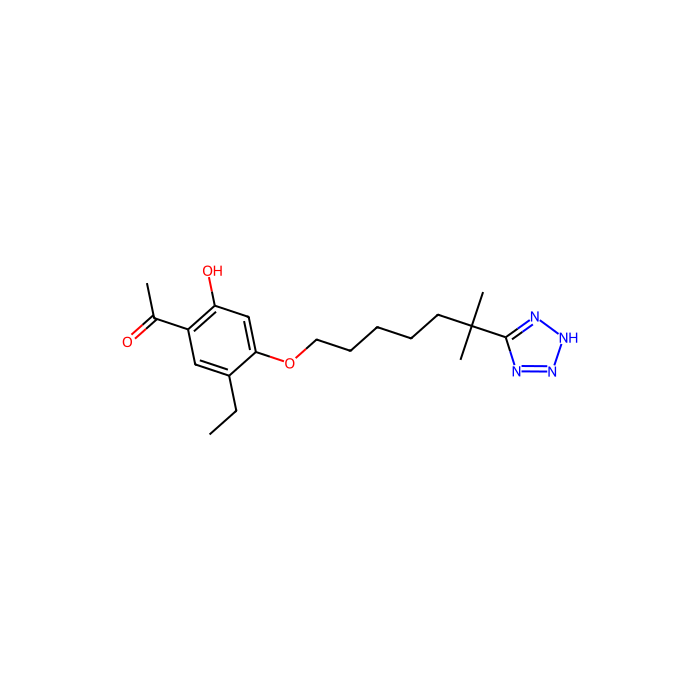
LY255283 - Moligand™, ≥98% , Antagonist of BLT 1 receptor;Antagonist of BLT 2 receptor, CAS No.117690-79-6, Antagonist of BLT 1 receptor;Antagonist of BLT 2 receptor

CAS: 117690-79-6 Cat. No.: L275852 Fórmula: C19H28N4O3 Peso molecular: 360.5
Disponible para pedir
CALIDAD & PUREZA Moligand™ ? Moligand™ — Aladdin's line of ligands and bioactive small molecules. Use for receptor, pathway, and binding studies needing defined small-molecule tools. ≥98%
Synonyms
LY255283;LY-255283;CGS 23356|1-[5-ETHYL-2-HYDROXY-4-[[6-METHYL-6-(1H-TETRAZOL-5-YL)HEPTYL]OXY]PHENYL]ETHANONE|SODIUM TETRADECYL SULFATE [MART.]|(1-(5-Ethyl-2-hydroxy-4-(6-methyl-6-(1H-tetrazol-5-yl)heptyloxy)phenyl)ethanone)|SODIUM HYPOCHLORITE [II]|1-(5-Ethyl-2-hydroxy-4-(6-methyl-6-(1H-tetrazol-5-yl)heptyloxy)phenyl)ethanone|1-[5-ethyl-2-hydroxy-4-[6-methyl-6-(2H-tetrazol-5-yl)heptoxy]phenyl]ethanone|LY255283|LY-255283|Levotiroxina sodica|1-(5-Ethyl-2-hydroxy-4-((6-methyl-6-(2H-tetrazol-5-yl)heptyl)oxy)phenyl)ethan-1-one|Ethanone, 1-(5-ethyl-2-hydroxy-4-((6-methyl-6-(2H-tetrazol-5-yl)heptyl)oxy)phenyl)-|Ethanone,1-[5-ethyl-2-hydroxy-4-[[6-methyl-6-(2H-tetrazol-5-yl)heptyl]oxy]phenyl]-|Bis(pentamethylcyclopentadienyl)hafniumdichloride|LY 255283|CGS-23356|Ethanone, 1-(5-ethyl-2-hydroxy-4-((6-methyl-6-(1H-tetrazol-5-yl)heptyl)oxy)phenyl)-
Storage
Almacenar a -20°C,Cargado con argón,Desecado
Shipped In
Hielera + almohadillas de hielo
★
Talla
Alemania (EU)
USA*
Precio
Cantidad
1mg
L275852-1mg
—
7 Disponible

8,59€

12,93€
Guardar 4,34 € (33.56%)
5mg
L275852-5mg
—
6 Disponible

16,40€

25,08€
Guardar 8,68 € (34.60%)
10mg
L275852-10mg
—
3 Disponible

28,55€

43,30€
Guardar 14,75 € (34.07%)
25mg
L275852-25mg
—
4 Disponible

61,52€

92,76€
Guardar 31,24 € (33.68%)
50mg
L275852-50mg
—
4 Disponible

110,98€

166,52€
Guardar 55,54 € (33.35%)
100mg
L275852-100mg
—
4 Disponible

198,63€

298,42€
Guardar 99,79 € (33.44%)
Enter a quantity for the sizes you want to add.

Especificaciones

Sinónimos
LY255283;LY-255283;CGS 23356 | 1-[5-ETHYL-2-HYDROXY-4-[[6-METHYL-6-(1H-TETRAZOL-5-YL)HEPTYL]OXY]PHENYL]ETHANONE | SODIUM TETRADECYL SULFATE [MART.] | (1-(5-Ethyl-2-hydroxy-4-(6-methyl-6-(1H-tetrazol-5-yl)heptyloxy)phenyl)ethanone) | SODIUM HYPOCHLORITE [II] | 1-(5-Ethyl-2-hydroxy-4-(6-methyl-6-(1H-tetrazol-5-yl)heptyloxy)phenyl)ethanone | Show more
Especificaciones y pureza
Moligand™, ≥98%
Mecanismos bioquímicos y fisiológicos
Selective, competitive BLT2 receptor antagonist (IC 50 values are 1 and 10 μM for BLT2 and BLT1 respectively). Shows antiasthmatic effects in vivo. Orally active.
Condiciones de almacenamiento de almacenamiento
Almacenar a -20°C,Cargado con argón,Desecado
Enviado en
Hielera + almohadillas de hielo
Grado
Moligand™
Tipo de acción
ANTAGONIST
Mecanismo de acción
Antagonist of BLT 1 receptor;Antagonist of BLT 2 receptor
Nota
Siempre que sea posible, prepare y utilice las soluciones el mismo día. Sin embargo, si necesita preparar soluciones madre con antelación, le recomendamos que almacene la solución como alícuotas en viales herméticamente cerrados a -20°C. Por lo general, podrán utilizarse durante un mes. Antes de su uso, y antes de abrir el vial, le recomendamos que deje que el producto se equilibre a temperatura ambiente durante al menos 1 hora. ¿Necesita más consejos sobre solubilidad, uso y manipulación? Visite nuestra página de preguntas frecuentes (FAQ) para obtener más información.
Pureza
≥98%
Nombres e identificadores
Pubchem Sid
Pubchem Sid Url
https://pubchem.ncbi.nlm.nih.gov/substance/504756859
SMILES
CCC1=CC(=C(C=C1OCCCCCC(C)(C)C2=NNN=N2)O)C(=O)C
IUPAC Name
1-[5-ethyl-2-hydroxy-4-[6-methyl-6-(2H-tetrazol-5-yl)heptoxy]phenyl]ethanone
InChIKey
WCGXJPFHTHQNJL-UHFFFAOYSA-N
InChI
1S/C19H28N4O3/c1-5-14-11-15(13(2)24)16(25)12-17(14)26-10-8-6-7-9-19(3,4)18-20-22-23-21-18/h11-12,25H,5-10H2,1-4H3,(H,20,21,22,23)
Isómeros SMILES
CCC1=CC(=C(C=C1OCCCCCC(C)(C)C2=NNN=N2)O)C(=O)C
Peso molecular
360.5
Reaxys
6665232
Reaxys-RN_link_address
https://www.reaxys.com/reaxys/secured/hopinto.do?context=S&query=IDE.XRN=6665232&ln=

Datos avanzados

Taxonomic Classification

Taxonomy Tree

KingdomOrganic compounds
SuperclassOrganic oxygen compounds
ClaseOrganooxygen compounds
SubclassCarbonyl compounds
Intermediate Tree Nodes Ketones - Aryl ketones - Phenylketones
Direct ParentAlkyl-phenylketones
Alternative Parents Acetophenones  Phenoxy compounds  Phenol ethers  Benzoyl derivatives  Aryl alkyl ketones  Alkyl aryl ethers  1-hydroxy-2-unsubstituted benzenoids  Vinylogous acids  Tetrazoles  Heteroaromatic compounds  Azacyclic compounds  Organopnictogen compounds  Organonitrogen compounds  Organic oxides  Hydrocarbon derivatives  
Molecular FrameworkAromatic heteromonocyclic compounds
Substituents Alkyl-phenylketone - Acetophenone - Benzoyl - Phenol ether - Aryl alkyl ketone - Phenoxy compound - 1-hydroxy-2-unsubstituted benzenoid - Alkyl aryl ether - Phenol - Monocyclic benzene moiety - Benzenoid - Tetrazole - Heteroaromatic compound - Azole - Vinylogous acid - Azacycle - Ether - Organoheterocyclic compound - Organopnictogen compound - Organonitrogen compound - Organic nitrogen compound - Hydrocarbon derivative - Organic oxide - Aromatic heteromonocyclic compound
DescripciónThis compound belongs to the class of organic compounds known as alkyl-phenylketones. These are aromatic compounds containing a ketone substituted by one alkyl group, and a phenyl group.
External Descriptors Not available
Estructura 3D
Modelo de Estructura Química Interactiva


Objetivos asociados (humanos)
LTB4R Tchem Leukotriene B4 receptor 1 (7 Activities)
Activity TypeActivity Value -log(M)Mechanism of ActionActivity ReferencePublications (PubMed IDs)
LTB4R2 Tchem Leukotriene B4 receptor 2 (0 Activities)
Activity TypeActivity Value -log(M)Mechanism of ActionActivity ReferencePublications (PubMed IDs)
ABL1 Tclin Tyrosine-protein kinase ABL (18331 Activities)
Activity TypeRelationActivity valueUnitsAction TypeJournalPubMed IddoiAssay Aladdin ID
ADRB2 Tclin Beta-2 adrenergic receptor (11824 Activities)
Activity TypeRelationActivity valueUnitsAction TypeJournalPubMed IddoiAssay Aladdin ID
ADRA2A Tclin Alpha-2a adrenergic receptor (9450 Activities)
Activity TypeRelationActivity valueUnitsAction TypeJournalPubMed IddoiAssay Aladdin ID
TSHR Tclin Thyroid stimulating hormone receptor (29986 Activities)
Activity TypeRelationActivity valueUnitsAction TypeJournalPubMed IddoiAssay Aladdin ID
AGTR1 Tclin Type-1 angiotensin II receptor (5176 Activities)
Activity TypeRelationActivity valueUnitsAction TypeJournalPubMed IddoiAssay Aladdin ID
THRB Tclin Thyroid hormone receptor beta-1 (7926 Activities)
Activity TypeRelationActivity valueUnitsAction TypeJournalPubMed IddoiAssay Aladdin ID
GSK3B Tclin Glycogen synthase kinase-3 beta (11785 Activities)
Activity TypeRelationActivity valueUnitsAction TypeJournalPubMed IddoiAssay Aladdin ID
CSNK1D Tchem Casein kinase I delta (4546 Activities)
Activity TypeRelationActivity valueUnitsAction TypeJournalPubMed IddoiAssay Aladdin ID
LTB4R Tchem Leukotriene B4 receptor 1 (1083 Activities)
Activity TypeRelationActivity valueUnitsAction TypeJournalPubMed IddoiAssay Aladdin ID
LTB4R2 Tchem Leukotriene B4 receptor 2 (146 Activities)
Activity TypeRelationActivity valueUnitsAction TypeJournalPubMed IddoiAssay Aladdin ID
ALDH1A1 Tchem Aldehyde dehydrogenase 1A1 (77053 Activities)
Activity TypeRelationActivity valueUnitsAction TypeJournalPubMed IddoiAssay Aladdin ID
NR1H4 Tclin Bile acid receptor FXR (6228 Activities)
Activity TypeRelationActivity valueUnitsAction TypeJournalPubMed IddoiAssay Aladdin ID
S1PR1 Tclin Sphingosine 1-phosphate receptor Edg-1 (5806 Activities)
Activity TypeRelationActivity valueUnitsAction TypeJournalPubMed IddoiAssay Aladdin ID
CDK2 Tchem Cyclin-dependent kinase 2 (9050 Activities)
Activity TypeRelationActivity valueUnitsAction TypeJournalPubMed IddoiAssay Aladdin ID
GLP1R Tclin Glucagon-like peptide 1 receptor (111429 Activities)
Activity TypeRelationActivity valueUnitsAction TypeJournalPubMed IddoiAssay Aladdin ID
ALOX15 Tchem Arachidonate 15-lipoxygenase (7108 Activities)
Activity TypeRelationActivity valueUnitsAction TypeJournalPubMed IddoiAssay Aladdin ID
C5AR1 Tclin C5a anaphylatoxin chemotactic receptor (2677 Activities)
Activity TypeRelationActivity valueUnitsAction TypeJournalPubMed IddoiAssay Aladdin ID
CYP3A4 Tclin Cytochrome P450 3A4 (53859 Activities)
Activity TypeRelationActivity valueUnitsAction TypeJournalPubMed IddoiAssay Aladdin ID
AURKA Tchem Serine/threonine-protein kinase Aurora-A (10240 Activities)
Activity TypeRelationActivity valueUnitsAction TypeJournalPubMed IddoiAssay Aladdin ID
Homo sapiens (32628 Activities)
Activity TypeRelationActivity valueUnitsAction TypeJournalPubMed IddoiAssay Aladdin ID
U2OS (164939 Activities)
Activity TypeRelationActivity valueUnitsAction TypeJournalPubMed IddoiAssay Aladdin ID
HCT-116 (91556 Activities)
Activity TypeRelationActivity valueUnitsAction TypeJournalPubMed IddoiAssay Aladdin ID
CX3CR1 Tchem C-X3-C chemokine receptor 1 (1686 Activities)
Activity TypeRelationActivity valueUnitsAction TypeJournalPubMed IddoiAssay Aladdin ID
FPR2 Tchem Lipoxin A4 receptor (3472 Activities)
Activity TypeRelationActivity valueUnitsAction TypeJournalPubMed IddoiAssay Aladdin ID
HSD17B10 Tchem Endoplasmic reticulum-associated amyloid beta-peptide-binding protein (20669 Activities)
Activity TypeRelationActivity valueUnitsAction TypeJournalPubMed IddoiAssay Aladdin ID
FFAR4 Tchem G-protein coupled receptor 120 (2999 Activities)
Activity TypeRelationActivity valueUnitsAction TypeJournalPubMed IddoiAssay Aladdin ID
BRD4 Tchem Bromodomain-containing protein 4 (13122 Activities)
Activity TypeRelationActivity valueUnitsAction TypeJournalPubMed IddoiAssay Aladdin ID
HPGD Tchem 15-hydroxyprostaglandin dehydrogenase [NAD+] (24926 Activities)
Activity TypeRelationActivity valueUnitsAction TypeJournalPubMed IddoiAssay Aladdin ID
GPR35 Tchem G-protein coupled receptor 35 (2643 Activities)
Activity TypeRelationActivity valueUnitsAction TypeJournalPubMed IddoiAssay Aladdin ID
MEN1 Tchem Menin/Histone-lysine N-methyltransferase MLL (48157 Activities)
Activity TypeRelationActivity valueUnitsAction TypeJournalPubMed IddoiAssay Aladdin ID
LTB4R2 Tchem Leukotriene B4 receptor (773 Activities)
Activity TypeRelationActivity valueUnitsAction TypeJournalPubMed IddoiAssay Aladdin ID
TRIM24 Tchem Transcription intermediary factor 1-alpha (2087 Activities)
Activity TypeRelationActivity valueUnitsAction TypeJournalPubMed IddoiAssay Aladdin ID
BRPF1 Tchem Peregrin (2217 Activities)
Activity TypeRelationActivity valueUnitsAction TypeJournalPubMed IddoiAssay Aladdin ID
HEK-293T (167025 Activities)
Activity TypeRelationActivity valueUnitsAction TypeJournalPubMed IddoiAssay Aladdin ID
Objetivos asociados (no humanos)
Cruzipain (33337 Activities)
Activity TypeRelationActivity valueUnitsAction TypeJournalPubMed IddoiAssay Aladdin ID
Aplnr Apelin receptor (201 Activities)
Activity TypeRelationActivity valueUnitsAction TypeJournalPubMed IddoiAssay Aladdin ID
Mapk1 MAP kinase ERK2 (650 Activities)
Activity TypeRelationActivity valueUnitsAction TypeJournalPubMed IddoiAssay Aladdin ID
Hdac6 Histone deacetylase 6 (222 Activities)
Activity TypeRelationActivity valueUnitsAction TypeJournalPubMed IddoiAssay Aladdin ID
Fgfr3 Fibroblast growth factor receptor 3 (21 Activities)
Activity TypeRelationActivity valueUnitsAction TypeJournalPubMed IddoiAssay Aladdin ID
Cavia porcellus (23802 Activities)
Activity TypeRelationActivity valueUnitsAction TypeJournalPubMed IddoiAssay Aladdin ID
lef Anthrax lethal factor (7585 Activities)
Activity TypeRelationActivity valueUnitsAction TypeJournalPubMed IddoiAssay Aladdin ID
rep Replicase polyprotein 1ab (378 Activities)
Activity TypeRelationActivity valueUnitsAction TypeJournalPubMed IddoiAssay Aladdin ID
Gpr119 Glucose-dependent insulinotropic receptor (270 Activities)
Activity TypeRelationActivity valueUnitsAction TypeJournalPubMed IddoiAssay Aladdin ID
fba Putative fructose-1,6-bisphosphate aldolase (15559 Activities)
Activity TypeRelationActivity valueUnitsAction TypeJournalPubMed IddoiAssay Aladdin ID
SARS-CoV-2 (38078 Activities)
Activity TypeRelationActivity valueUnitsAction TypeJournalPubMed IddoiAssay Aladdin ID
Mecanismos de acción
Certificados (CoA, COO, BSE/TSE y tabla de análisis)
C of A & Other Certificates(BSE/TSE, COO):
Analytical Chart:

Find and download the COA for your product by matching the lot number on the packaging.

12 results found

Lot NumberCertificate TypeFechaArticulo
F2317238F2317238Certificate of AnalysisMay 23, 2023 L275852
F2317240F2317240Certificate of AnalysisMay 23, 2023 L275852
F2317241F2317241Certificate of AnalysisMay 23, 2023 L275852
F2317242F2317242Certificate of AnalysisMay 23, 2023 L275852
F2317244F2317244Certificate of AnalysisMay 23, 2023 L275852
F2317255F2317255Certificate of AnalysisMay 23, 2023 L275852
F2317263F2317263Certificate of AnalysisMay 23, 2023 L275852
F2317281F2317281Certificate of AnalysisMay 23, 2023 L275852
F2317287F2317287Certificate of AnalysisMay 23, 2023 L275852
F2317290F2317290Certificate of AnalysisMay 23, 2023 L275852
F2317293F2317293Certificate of AnalysisMay 23, 2023 L275852
F2317340F2317340Certificate of AnalysisMay 23, 2023 L275852
Propiedades químicas y físicas
SolubilidadSoluble in ethanol to 25 mM and in DMSO to 100 mM
Peso molecular360.5
XLogP34.600
Hydrogen Bond Donor Count2
Hydrogen Bond Acceptor Count6
Rotatable Bond Count10
Exact Mass360.216 Da
Monoisotopic Mass360.216 Da
Topological Polar Surface Area101.000 Ų
Heavy Atom Count26
Formal Charge0
Complexity447.000
Isotope Atom Count0
Defined Atom Stereocenter Count0
Undefined Atom Stereocenter Count0
Defined Bond Stereocenter Count0
Undefined Bond Stereocenter Count0
The total count of all stereochemical bonds0
Covalently-Bonded Unit Count1
Seguridad y peligros (GHS)
Precauciones

P264:Wash hands [and …] thoroughly after handling.

Reaxys
6665232
Reaxys-RN_link_address
https://www.reaxys.com/reaxys/secured/hopinto.do?context=S&query=IDE.XRN=6665232&ln=
Calculadoras de soluciones
Reseñas

Reseñas de cliente

Application Protocols

No item-specific, validated application protocols are provided.

General protocol framework for small-molecule ligands (to be adapted):

  • Stock preparation: Dissolve the compound in anhydrous DMSO to 10–50 mM. Vortex/sonicate briefly; filter if needed. Record exact concentration by weight-in and solution density or by quantitative NMR if precision is required.
  • Aliquoting: Dispense single-use aliquots (10–50 µL) in low-bind tubes under inert gas to minimize moisture/oxygen exposure. Freeze immediately.
  • Dosing: Add to assay plates to achieve the desired final concentration and solvent content (e.g., ≤0.1% DMSO). Include vehicle controls and, if possible, a reference compound.
  • Stability check: Confirm short-term stability in the assay matrix by LC–MS before full deployment.

These steps are general good practice and not a substitute for item-specific, validated methods. Adjust to your target, cells, or enzyme system as appropriate.

Biological Roles

Item-specific biological target or mode-of-action information is not included in this listing.

  • Target/mechanism: Not specified for this item; consult peer-reviewed literature by CAS (117690-79-6) or PubChem CID (122023) and verify structure equivalence to your lot.
  • Research context (general): Small-molecule ligands such as this are commonly employed as chemical probes for enzyme active sites, GPCRs, ion channels, transporters, or protein–protein interaction interfaces. Their biological roles in experiments depend on affinity, selectivity, and cellular permeability, which must be established empirically.
  • Assay considerations: Determine cytotoxicity windows, nonspecific binding, and off-target liabilities early. Incorporate orthogonal target-engagement assays (e.g., CETSA/DSF vs enzymatic readouts) to validate on-target effects.
  • ADME-relevant properties (general): Lipophilicity, ionization (pKa), and efflux susceptibility can profoundly influence cellular potency and phenotype. Without item-specific data, these characteristics should be profiled in-house if cell-based work is planned.

Important note: All uses are for research only. No medical, diagnostic, or therapeutic uses are supported or implied by this listing.

Buffer Applications

This product is a small-molecule ligand rather than a buffering agent. It does not form a defined conjugate acid–base pair suitable for controlling pH ranges, and no pKa/solubility data are provided.

  • Not typically applicable: Do not use this product for buffer preparation.
  • Practical note: When dosing into biological buffers (e.g., PBS, HEPES), prepare concentrated organic stocks (commonly in DMSO) and dilute immediately before use to minimize precipitation. Verify compatibility with buffer components (salts, detergents, cofactors).
Green Alternatives

Because the item is a small-molecule ligand rather than a process solvent or bulk reagent, “green alternatives” are less directly applicable. Nonetheless, greener choices can be made around the handling environment and diluents.

  • Solvent considerations (general): If dissolution in DMSO is not mandatory, assess ethanol or isopropanol as greener, bio-derived cosolvents for intermediate stocks, provided the compound’s stability and assay tolerance permit.
  • Miniaturization: Reduce solvent and compound use via microplate miniaturization (384/1536-well formats) and acoustic dispensing to decrease waste.
  • Waste reduction: Consolidate waste streams (halogenated vs non-halogenated) appropriately to optimize disposal and minimize environmental impact.

Illustrative comparison (general):

  • DMSO: Excellent solvency, high boiling point; low volatility reduces emissions but complicates waste; typically petrochemical-derived.
  • Ethanol (anhydrous): Renewable routes available; higher volatility and flammability; solubility limitations for very lipophilic ligands.
  • Isopropanol: Widely available; workable solvency for moderate lipophilicity; also flammable and may affect some assays.

Trade-offs:

  • Switching from DMSO to greener alcohols may reduce solubility and increase assay interference; thorough pre-validation is required.

Conclusion: Prioritize solvent minimization, careful aliquoting to avoid material loss, and validated substitution with greener diluents where compatible with the assay and compound stability.

Pharmaceutical Uses

No pharmacopeial or formulation-grade information is provided for this item, and it is designated For research use only.

  • Regulatory status: Research chemical; not intended for human or veterinary use, drug substance manufacture, or clinical diagnostics.
  • Excipient/formulation context: Not applicable. There is no evidence of compliance with USP/EP/JP monographs or GMP manufacture in this listing.
  • Discovery setting (general): In preclinical research, small-molecule ligands may be utilized as reference standards, tool compounds, or controls in in vitro studies. Any use in formulation screening or in vivo research requires additional internal qualification (identity, purity, endotoxin, residual solvent) beyond the scope of this listing.

Conclusion: Restrict use to laboratory research under the supervision of qualified personnel and institutional approvals.

Physical Properties

Item-specific physicochemical specifications are not included in this listing.

  • Appearance: Not specified for this item; refer to CoA/Spec Sheet.
  • Melting point (MP): Not specified for this item; refer to CoA/Spec Sheet.
  • Boiling point (BP): Not specified for this item; refer to CoA/Spec Sheet.
  • Density: Not specified for this item; refer to CoA/Spec Sheet.
  • Solubility: Not specified for this item; refer to CoA/Spec Sheet.
  • LogP/logD: Not specified for this item; refer to CoA/Spec Sheet.
  • pKa: Not specified for this item; refer to CoA/Spec Sheet.
  • Refractive index: Not applicable to solids; if liquid, not specified for this item; refer to CoA/Spec Sheet.

General handling notes (literature/practice-based):

  • Many screening ligands are supplied as solids or films intended for dissolution in anhydrous DMSO to prepare a 10–50 mM stock. If aqueous assays are planned, serial dilution into assay buffer typically keeps the final DMSO ≤0.1–0.5% v/v.
  • Actual solubility and stability may depend strongly on ionization state and substituent pattern; verify empirically by a small-scale solubility screen (DMSO, ethanol, isopropanol, DMF) and by short-term stability in the chosen assay buffer.

Note: For authoritative, item-specific values and QC acceptance criteria, consult the CoA/Spec Sheet accompanying your lot.

Quality and Grades

Grade/Purity: Moligand™ (as listed)

What Moligand™ typically implies (general description):

  • A research-grade small-molecule ligand appropriate for biochemical screening, target validation, and probe development workflows. Such materials are commonly qualified by chromatographic purity (e.g., HPLC/UPLC), mass identity (ESI–MS), and occasionally 1H NMR. Typical acceptance criteria for screening libraries are often ≥95% purity (literature/general practice), but this specific item’s certified limits are Not specified for this item; refer to CoA/Spec Sheet.

Analytical package (expectations; general):

  • Supplied with a Certificate of Analysis specifying lot-specific purity, analytical method, and storage guidance. When available, impurity profiles, residual solvents, and water content may be listed. Item-specific numerical values are Not specified for this item; refer to CoA/Spec Sheet.

Implications for end-use:

  • Suitable for in vitro biochemical assays, cell-free target engagement, and preliminary cellular studies contingent on internal qualification. For regulated work or quantitative bioanalysis, consider orthogonal recharacterization (qNMR, HRMS) and stability studies under intended assay conditions.

Stabilizers/additives:

  • None are disclosed in the listing. If stabilizers are present, they will be declared on the CoA. For this item: Not specified for this item; refer to CoA/Spec Sheet.

Documentation best practices:

  • Record lot number, receipt date, and storage conditions in your ELN. Attach the CoA and any in-house requalification data (HPLC, NMR) to ensure traceability.
Reaction and Applications

This product is cataloged as a Moligand™ small-molecule research ligand. It is not primarily offered as a synthetic reagent, but rather for target engagement and assay applications.

Research applications (general, non-clinical):

  • Biochemical or biophysical assays: evaluation of binding to protein targets using techniques such as enzymatic inhibition assays, fluorescence polarization, thermal shift (DSF), MST, or SPR.
  • Cellular probe studies: assessment of pathway modulation, target validation, or phenotypic screening after internal QC of purity and identity.
  • Reference/competitor compound: use as a positive/negative control in SAR campaigns if aligned with the intended target class.

Assay implementation tips:

  • Prepare a fresh anhydrous DMSO stock (e.g., 10–50 mM), aliquot, and minimize freeze–thaw cycles to preserve integrity.
  • Verify chemical stability under assay conditions by LC–MS before broad deployment. Many ligands can hydrolyze, oxidize, or isomerize in aqueous buffers or light.
  • Include a vehicle control matching final solvent (e.g., 0.1% DMSO) and test for compound aggregation (detergent sensitivity, light scattering) where applicable.

Note: No item-specific target, potency, or mechanistic data are provided in this listing. For target-focused applications, consult peer-reviewed literature keyed to CAS 117690-79-6 or PubChem CID 122023 and confirm equivalence of the chemical structure with your lot documentation.

Reaction Conditions

Not typically applicable. This product is not offered as a reagent or catalyst, and no item-specific reactivity or condition sets are provided.

General note (if conducting exploratory derivatization for SAR):

  • Verify structure and purity (1H/13C NMR, HRMS) before modification.
  • Pilot reactions on ≤5 mg scale to assess stability to heat, base/acid, and common coupling reagents.
  • Monitor by LC–MS to detect degradation or rearrangements.

For standardized reaction parameters or yields, consult primary literature for the exact structure corresponding to CAS 117690-79-6, ensuring alignment with your lot’s documentation.

Safety and Handling

Safety information specific to this item is not provided in the listing.

  • GHS Classification: Not specified for this item; refer to SDS.
  • Signal Word / Pictograms / H-Statements: Not specified for this item; refer to SDS.

General laboratory precautions (good practice):

  • Handle in a chemical fume hood while wearing appropriate PPE: lab coat, safety glasses, and disposable nitrile gloves. Avoid inhalation of dust or aerosols and prevent skin/eye contact.
  • Storage incompatibilities: Keep away from strong oxidizers and moisture until specific compatibility is confirmed. The listing notes inert-atmosphere storage; avoid air/moisture exposure during handling.
  • First aid (overview; defer to SDS): In case of skin contact, wash with soap and water; for eye contact, rinse cautiously with water for several minutes and seek medical attention; if inhaled, move to fresh air; if ingested, rinse mouth. Provide the SDS to medical personnel.
  • Hygiene: Do not eat, drink, or smoke in work areas. Wash hands and exposed skin after handling.
  • Waste: Dispose of residues and contaminated consumables as organic chemical waste per institutional and local regulations.

Special risks/notes:

  • Many small-molecule ligands are lipophilic and may adsorb to plastics; use low-bind tubes and pre-wet tips with solvent when preparing dilute solutions.
  • Always consult the item-specific SDS for definitive hazard and response information.
Solvent Selection

With structure-specific solubility not provided, choose solvents using standard practices for small-molecule ligands intended for screening.

  • Primary stock solvent (general best practice): Anhydrous DMSO is commonly used due to broad solvating power and compatibility with high-throughput screening.
  • Secondary solvents: DMF, ethanol (EtOH), isopropanol (IPA), or acetonitrile (MeCN) can be evaluated if DMSO is unsuitable for the assay or compound.
  • Aqueous use: Prepare concentrated organic stocks and dilute into aqueous buffers immediately before use to limit precipitation. Keep final organic cosolvent ≤0.1–0.5% v/v when possible.

Polarity/miscibility considerations (general):

  • DMSO, DMF: Highly polar, miscible with water; good for polar and many moderately lipophilic ligands.
  • MeCN, EtOH, IPA: Miscible with water; may reduce adsorption to plastics relative to neat DMSO for some chemotypes.

Practical tips:

  • Perform a small solvent screen at the target concentration (e.g., 10 mM) to confirm clarity and stability over 24–48 h at room temperature and at assay temperature.
  • Pre-warm gently (≤40 °C) and sonicate briefly to aid dissolution; avoid prolonged heating.
  • Filter 0.2 µm if particulates persist and the compound is not adsorptive; verify no loss to filter by analytical recovery.

When to choose alternatives:

  • If compound exhibits poor DMSO solubility or assay is DMSO-intolerant, consider DMF or MeCN stocks with rapid dilution. For highly lipophilic analytes, adding a small amount of nonionic surfactant to assay buffer may help maintain dispersion (validate for target compatibility).
Storage and Reconstitution

Item-specific storage conditions are provided; follow them strictly to maintain material integrity.

  • Storage temperature: Store at -20°C (as listed).
  • Atmosphere: Argon charged; maintain under inert gas after opening. Purge headspace with dry argon or nitrogen before re-sealing.
  • Desiccation: Store desiccated to minimize moisture uptake. Keep container tightly closed when not in use.
  • Shipping: Shipped in an ice chest with ice pads to limit thermal excursions during transit.

Reconstitution (general best practice):

  • Solvent: Use anhydrous DMSO (or another validated solvent) to prepare a concentrated stock (e.g., 10–50 mM). The exact solubility for this item is Not specified for this item; refer to CoA/Spec Sheet; verify empirically.
  • Technique: Allow vial to equilibrate to room temperature in a desiccator before opening to prevent condensation. Open under inert atmosphere if possible.
  • Aliquoting: Prepare single-use aliquots in low-bind vials; backfill with argon, cap tightly, and refreeze promptly.
  • Freeze–thaw: Minimize cycles; repeated thawing can accelerate degradation and concentration drift due to adsorption or precipitation.
  • Light: If the compound is light-sensitive (not specified), protect from light during handling and storage.

Record-keeping: Document preparation date, solvent, concentration, and any observed solubility/stability notes in your ELN. For lot-specific details (stability limits, retest dates), refer to the CoA/Spec Sheet.

Structure and Identity

Brief overview: LY255283 is listed as a Moligand-grade small molecule for research use. Item-specific structural identifiers are limited in this listing.

  • SKU: L275852
  • Product Name: LY255283
  • CAS: 117690-79-6 (catalog identifier)
  • PubChem CID: 122023 (catalog identifier)
  • InChIKey: 394621 (as provided in listing)
  • SMILES: Not specified for this item; refer to CoA/Spec Sheet.
  • Molecular Formula: Not specified for this item; refer to CoA/Spec Sheet.
  • Molecular Weight: Not specified for this item; refer to CoA/Spec Sheet.

Structural features (general note):

  • The precise functional groups, ring systems, and stereochemical elements are not provided in this catalog entry. For definitive structural information (2D connectivity, stereochemistry), consult the CoA/Spec Sheet or authoritative databases keyed to the CAS or CID.

2D structure description:

  • Not specified for this item; refer to CoA/Spec Sheet.

Identity confirmation guidance (general):

  • Professional users typically confirm identity by matching LC–MS exact mass/retention time and 1H NMR against a reference. When the InChIKey/SMILES are not supplied, cross-reference CAS 117690-79-6 and CID 122023 with institutional databases and document versioning in ELN for traceability.
Synthetic Utility

This catalog listing presents LY255283 as a Moligand™ small-molecule ligand intended for biological or biophysical research workflows, not as a synthetic building block.

  • Not typically applicable: There is no item-specific functional group or reactivity information enabling recommendations for use in named reactions or as a coupling partner.

If repurposed in synthesis (general guidance only):

  • Confirm compatibility of the molecule’s functional groups (if known from literature) with planned transformations via small-scale scouting. Many bioactive ligands contain sensitive motifs (e.g., aryl halides, nitriles, sulfonamides) that may require protecting strategies.
  • Establish stability under standard workup and purification conditions (silica, reverse phase, pH swings, oxidants/reductants).

Primary recommendation: Use this product as provided for research ligand applications; obtain dedicated synthetic-grade precursors for preparative chemistry.

Target Specificity

Target and selectivity information are not provided in this listing.

  • Target class, species reactivity, and binding constants: Not specified for this item; refer to peer-reviewed literature for CAS 117690-79-6 or PubChem CID 122023 and verify structural identity with your lot.

Note: Because small-molecule specificity can vary by assay system and endpoint, validate target engagement with at least two orthogonal readouts and include appropriate counterscreens to assess off-target activity.

Preguntas frecuentes

What is the purity of this product?
This product is supplied at ≥98% purity (chemical assay). Lot-specific values are stated on the Certificate of Analysis.
What is Moligand??
Moligand? is one of Aladdin Scientific's premium product lines, formulated for high-purity applications across multiple workflows. Compared to standard grades in the same workflow, Moligand? products typically offer tighter specifications, more rigorous QC, and stronger lot-to-lot consistency.
How is this product shipped?
This product ships in an insulated container with ice pads. Unpack on arrival and transfer it to the storage condition stated above.
How should this product be stored?
Store at ?20 °C, desiccated, under argon. It is supplied under an argon blanket; reseal under inert gas after each use.
What are the CAS number, molecular formula and molecular weight?
The CAS Number is 117690-79-6, the molecular formula is C19H28N4O3, and the molecular weight is 360.5 g/mol. InChIKey WCGXJPFHTHQNJL-UHFFFAOYSA-N.
What documentation is provided?
Available product documentation, including Certificates of Analysis (COA), Safety Data Sheets (SDS), and specification sheets, is shown in the product document area. Document availability and access follow the current site policy.

¿Quieres que te enviemos un mensaje cuando tengamos descuentos disponibles?

Recordármelo más tarde

¡Gracias! Por favor, revisa tu bandeja de entrada de correo electrónico para confirmar.

¡Vaya! Las notificaciones están desactivadas.