CALIDAD & PUREZAMoligand™?Moligand™ — Aladdin's line of ligands and bioactive small molecules. Use for receptor, pathway, and binding studies needing defined small-molecule tools.10mM in DMSO
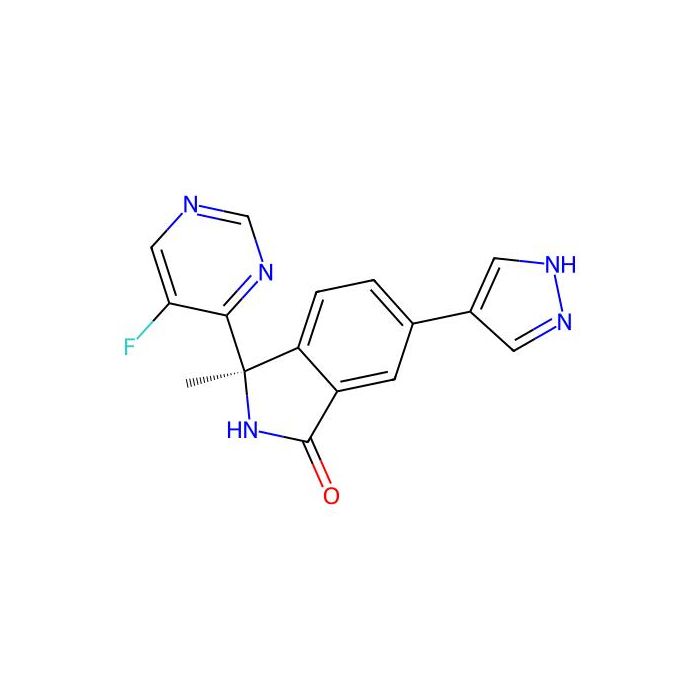
LY3177833 (Example 4) is an orally active CDC7 and pMCM2 inhibitor with IC 50 values of 3.3 nM and 290 nM, respectively. LY3177833 is a senescence inducer
In Vitro
LY3177833 (10 μM; 4 days) increases SA-β-gal content in Hep3B cells. MCE has not independently confirmed the accuracy of these methods. They are for reference only. Western Blot AnalysisCell Line: Hep3B cells Concentration: 10 μM Incubation Time: 4 days Result: Increased the expression of human SA-β-gal.
In Vivo
LY3177833 (Example 4; 10.4-31.2 mg/kg; oral gavage; twice a day; for 2 weeks; female athymic Balb/c nude mice with SW620 cells) treatment causes significant tumor regression in a dose-dependent manner. Also, no significant tumor growth is observed for 2 weeks after dosing cessation . MCE has not independently confirmed the accuracy of these methods. They are for reference only. Animal Model: Female athymic Balb/c nude mice (5-6 weeks old) with SW620 cells Dosage: 10.4 mg/kg, 20.8 mg/kg and 31.2 mg/kg Administration: Oral gavage; twice a day for 2 weeks Result: Showed dose dependent antitumor activity in SW620 mouse xenograft tumor model.
LY3177833 (Example 4) is an orally active CDC7 and pMCM2 inhibitor with IC 50 values of 3.3 nM and 290 nM, respectively. LY3177833 is a senescence inducer.
Condiciones de almacenamiento de almacenamiento
Store at -80°C
Enviado en
Dry ice packs + Cold packs
Este producto requiere envío en cadena de frío. Los servicios terrestres y otros servicios económicos no están disponibles.
Determine the necessary mass, volume, or concentration for preparing a solution.
Dilution Calculator
Determine the dilution needed to prepare a stock solution.
Reconstitution Calculator
Reseñas
Reseñas de cliente
Application Protocols
Item-specific facts (from Product Data)
Tested applications, assay types, and recommended concentrations are not provided for LY3177833.
General protocols for small-molecule screening (not item-specific)
Stock preparation: dissolve compound in anhydrous DMSO to 10–50 mM. Vortex, sonicate briefly if needed, and filter through 0.22 µm PTFE. Dispense into single-use aliquots and store at −80 °C.
Biochemical assays: titrate in half-log or one-third-log dilutions to define a complete concentration–response curve. Maintain constant final DMSO (≤0.5–1% v/v). Include positive/negative controls and detergent where appropriate to suppress aggregation.
Cellular assays: confirm absence of precipitation upon dilution into media. Validate exposure by measuring remaining supernatant concentration via LC–MS/MS when possible.
Data quality: compute Z′ factor for plate performance, include intra- and inter-plate replicates, and verify potency with orthogonal readouts.
Limitation
Any specific, validated protocols for LY3177833 (assay type, readout, incubation times, control compounds) are: Not specified for this item; refer to CoA/Spec Sheet.
Biological Roles
Item-specific facts (from Product Data)
Specific biological targets, pathways, or roles for LY3177833 are not provided in this catalog entry.
General considerations (not item-specific; no medical/clinical claims)
Small molecules in screening libraries may modulate enzymes, receptors, ion channels, transporters, or scaffolding proteins. Assignment of “biological role” requires verified target engagement data (e.g., enzymatic IC50/Ki with mechanism, cellular EC50 with selectivity panel) and orthogonal confirmation to exclude assay artifacts.
Without a known structure/annotation, researchers should evaluate liabilities that can confound readouts: colloidal aggregation (use detergent counterscreens), redox activity (ROS assays), intrinsic fluorescence/absorbance (spectral interference scans), and covalent reactivity (glutathione trapping assays).
If a structure is available on the CoA, cheminformatic filters (PAINS, REOS, Brenk) and physicochemical profiling (cLogP, TPSA, pKa) help anticipate permeability, efflux susceptibility, and nonspecific binding.
Recommended practice
Define intended biological context a priori, set accept/reject criteria, and include reference controls. Map concentration ranges to solubility/stability windows to ensure on-target testing.
Note
For this item, any specific biological function or target selectivity is: Not specified for this item; refer to CoA/Spec Sheet and primary literature if available.
Buffer Applications
Applicability note
LY3177833 is a small-molecule library compound, not a buffer component. It is not typically used to prepare or control pH in buffer systems.
General lab guidance (not item-specific)
When dosing small molecules into biological buffers, ensure the final co-solvent content (e.g., DMSO) is compatible with the biological system and does not perturb buffer capacity or protein stability.
Precipitation checks: after spiking from a DMSO stock, visually inspect and, if needed, verify by nephelometry or HPLC to confirm the compound remains in solution over the assay timeframe.
Item-specific data
No buffer composition compatibility, pKa, or solubility limits are provided for this item. For any buffer-use scenario, details are: Not specified for this item; refer to CoA/Spec Sheet.
Green Alternatives
Applicability note
As a research screening compound rather than a bulk solvent or reagent, “green alternatives” primarily concern solvent choices and handling practices during dissolution, assay preparation, and purification, not substitution of the compound itself.
Greener solvent and handling choices (general)
Prefer water-rich systems whenever feasible: dilute DMSO stocks into buffered aqueous media at the lowest effective DMSO percentage (≤0.1–0.5% v/v) compatible with solubility and assay performance.
Consider bio-based or lower-toxicity co-solvents in method development: 2-MeTHF or CPME for synthetic steps; ethanol or isopropanol over acetonitrile/DMF when solvency permits for noncritical operations.
Minimize waste: prepare small aliquots matched to immediate needs; avoid over-preparing concentrated stocks that may be discarded after stability expires.
Energy-conscious storage: consolidate aliquots and use secondary containment to reduce freezer door-open time; maintain accurate inventory to avoid redundant shipments.
Trade-offs
Replacing DMSO with greener alternatives can compromise solubility and assay compatibility; any switch must be validated for compound stability, target readout, and background signal.
Item-specific note
No solvent or stability specifications are provided for this item; refer to CoA/Spec Sheet before implementing changes to established dissolution protocols.
Pharmaceutical Uses
Applicability note
This product is sold strictly for research use only. No clinical, diagnostic, or therapeutic use is implied.
General formulation context (not item-specific)
In preclinical research, small molecules are commonly formulated for in vitro dosing (DMSO stocks diluted into media) or for exploratory in vivo studies using cosolvent systems (e.g., PEG400/saline, Captisol, hydroxypropyl-β-cyclodextrin) once solubility and stability permit. Excipients and vehicles must be validated for the target model and route.
Regulatory and compendial status
There is no pharmacopeial monograph or excipient designation provided for LY3177833 in this catalog entry. Any GMP or clinical-use suitability is out of scope for this product.
Item-specific information
Formulation roles, salt form, and polymorph information: Not specified for this item; refer to CoA/Spec Sheet. If transitioning to regulated studies, source GMP-grade material under appropriate quality systems and perform full CMC characterization (identity, purity, solid form, residual solvents, stability).
Physical Properties
Item-specific facts (from Product Data)
Physical state/appearance: Not specified for this item; refer to CoA/Spec Sheet.
Molecular weight: Not specified for this item; refer to CoA/Spec Sheet.
Molecular formula: Not specified for this item; refer to CoA/Spec Sheet.
Literature/general guidance (not item-specific)
Many drug-like small molecules are solids at ambient temperature and dissolve in polar aprotic solvents (e.g., DMSO, DMF) and, variably, in alcohols. Exact solubility, melting point, logP, pKa, and refractive index are structure-dependent and must be taken from the item’s CoA.
Practical handling tips (general)
Solubility screening workflow: start with anhydrous DMSO to prepare a 10–50 mM stock; if insoluble, warm gently (≤40–50 °C) and sonicate. Consider co-solvent blends (DMSO:H2O or DMSO:EtOH) after verifying chemical stability.
Filter sterilization: for cell-based work, pass freshly prepared solutions through a 0.22 µm PTFE filter (DMSO stocks) to remove particulates.
Avoid repeated heating–cooling cycles; many heteroaromatic/amide-rich molecules can crystallize or degrade upon cycling.
Important
Do not treat literature estimates as specifications. For this catalog item, all numeric physical constants are: Not specified for this item; refer to CoA/Spec Sheet.
Quality and Grades
Item-specific facts (from Product Data)
Grade/Purity: Moligand™
Purity details: Not specified for this item; refer to CoA/Spec Sheet.
About Moligand™ grade (general description)
Moligand™ denotes screening-library suitability: batches are prepared and packaged to support assay reproducibility (traceability, controlled storage/shipping, and accompanying analytical documentation). While exact tests can vary by chemotype, a typical data pack for library-grade small molecules includes chromatographic purity (HPLC/UPLC), mass identity (LC–MS/HRMS), and, where applicable, water/volatile content and residual solvent checks. Numeric thresholds are batch-specific and provided on the CoA.
Implications for research use
Library-grade materials prioritize identity and purity consistent with high-throughput screening (HTS), chemical probe exploration, and SAR. Low-biomatrix interference and minimized UV-active impurities are generally favored; however, do not assume HPLC-grade solvent specifications or trace-metal specs unless explicitly stated on the CoA.
What is specific to this item
Storage at −80 °C and shipment on dry ice/cold packs indicate stability benefits at deep-cold temperatures. For any critical application (e.g., lead-optimization studies), consult the lot-specific CoA for exact purity, identity metrics, salt form, and counterions, as these can affect solubility and assay behavior.
Reaction and Applications
Item-specific facts (from Product Data)
Manufacturer Applications: Not provided beyond inclusion in a small-molecule/compound library catalog. For research use only.
General applications for library compounds (not item-specific)
Chemical biology: probe-based studies, target hypothesis testing, and phenotypic screening (cellular or biochemical). Results should be confirmed with orthogonal assays and counter-screens to exclude assay artifacts (e.g., redox cycling, aggregation, fluorescence interference).
SAR and profiling: use LY3177833 alongside analogs to explore structure–activity relationships once the chemical series is known. Apply concentration–response testing with well-defined replicates and controls.
ADME screening: evaluate solubility, metabolic stability (microsomes/hepatocytes), permeability (PAMPA/Caco-2), and plasma protein binding to determine assay-compatible conditions.
Important caveats
Without target disclosure, do not ascribe mechanism or pathway effects to this item. Employ cheminformatics (if structure is available on the CoA) to flag PAINS substructures, quinones, Michael acceptors, or metal chelators that can drive non-specific bioactivity.
Assay practice tips
Include vehicle controls matching final DMSO percentage; verify compound stability in assay buffer over the intended incubation time (e.g., LC–MS time-course). Use fresh dilutions to minimize degradation or adsorption losses.
Reaction Conditions
Applicability note
This catalog item is a finished small-molecule library compound and is not provided for use as a reagent in named synthetic transformations. Therefore, no reaction-condition guidance specific to this compound is applicable.
General lab practice for solution preparation (not item-specific)
Stock solutions for assays: prepare in anhydrous DMSO under inert atmosphere if the chemotype is air/moisture sensitive (unknown here). Typical concentrations: 10–50 mM, filtered (0.22 µm PTFE) and aliquoted.
Stability checks: use LC–MS to monitor for hydrolysis/oxidation after exposure to aqueous buffers; conduct time-course at relevant temperatures (room temperature to 37 °C).
Item-specific data
Reaction solvents, catalysts, temperatures, or yields related to chemical transformations of LY3177833 are: Not specified for this item; refer to CoA/Spec Sheet and any associated literature if disclosed.
Safety and Handling
Item-specific facts (from Product Data)
GHS classification, signal word, pictograms, and H-statements: Not specified for this item; refer to SDS.
Storage: Store at −80 °C.
Shipping: Dry ice packs + cold packs.
General laboratory precautions (not item-specific; defer to SDS)
Handle in a chemical fume hood with appropriate PPE: lab coat, safety glasses, and suitable gloves (e.g., disposable nitrile). Avoid inhalation of dust/aerosols and contact with skin/eyes.
Prevent moisture ingress; keep containers tightly closed. Allow shipment vials to equilibrate to room temperature in a desiccator before opening to minimize condensation.
Incompatibilities (general): strong oxidizers and strong acids/bases may promote degradation of many drug-like molecules; segregate accordingly.
Hygiene measures: wash hands after handling; avoid eating, drinking, or smoking in work area.
First-aid overview (general)
Inhalation: move to fresh air; seek medical attention if symptoms persist.
Skin/eye contact: rinse with water for at least 15 minutes; remove contaminated clothing; seek medical attention if irritation persists.
Ingestion: rinse mouth; seek medical advice.
Waste and decontamination
Dispose of residues and contaminated materials as organic hazardous waste per institutional and local regulations. Decontaminate surfaces with appropriate organic solvent followed by detergent and water. Always consult the product-specific SDS for authoritative safety information.
Solvent Selection
Item-specific facts (from Product Data)
No solvent/solubility data are provided for this item; refer to CoA/Spec Sheet.
General solvent strategy for drug-like small molecules (literature/practice)
Primary stock solvent: anhydrous DMSO is the most common for HTS/profiling due to broad solvency and biological compatibility at ≤0.5–1% v/v in assays.
Secondary options: DMF, NMP (higher solvency, but greater cytotoxicity risk), ethanol or isopropanol (miscible with water; limited solvency for very lipophilic compounds).
Aqueous delivery: prepare concentrated DMSO stock, then dilute into assay buffer with rapid mixing to avoid precipitation. Include nonionic surfactants (e.g., 0.01–0.05% Tween-20 or Pluronic F-127) only if validated for your assay to mitigate aggregation.
Polarity/miscibility profile (general)
Without a disclosed structure, polarity class and dielectric behavior cannot be assigned for this item. Plan empirical solubility tests: DMSO → DMF → EtOH → MeCN → buffer with co-solvent.
Practical tips
Pre-wet plasticware with solvent to reduce adsorption of hydrophobic compounds.
Validate concentration by UV–Vis or LC–UV/LC–MS after dilution; some chemotypes adsorb to glass or bind serum proteins, reducing free concentration.
Avoid freeze–thaw of DMSO solutions; aliquot stocks to single-use vials to maintain integrity.
Storage and Reconstitution
Item-specific facts (from Product Data)
Storage conditions: Store at −80 °C.
Shipping: Dry ice packs + cold packs.
Appearance: Not specified for this item; refer to CoA/Spec Sheet.
General reconstitution guidance (not item-specific)
Allow vial to warm in a desiccator to room temperature before opening to prevent moisture condensation. If the compound is hygroscopic or air-sensitive (unknown here), handle quickly under dry inert gas.
Prepare concentrated stock in anhydrous DMSO (typical: 10–50 mM). If higher solubility is required, consider DMF or NMP; verify assay compatibility before use. Filter (0.22 µm PTFE) if particulates are observed.
Aliquot into low-bind tubes to minimize adsorption losses; flush headspace with inert gas if the chemotype is oxidation-prone (unknown here). Label aliquots with lot number, concentration, and preparation date.
Stability and freeze–thaw (general)
Minimize freeze–thaw cycles by using single-use aliquots. Track cumulative time at room temperature and in aqueous buffers; confirm stability by LC–MS.
Item-specific limitations
Exact solubility, stability window, and re-test date for this item are: Not specified for this item; refer to CoA/Spec Sheet. For long-term projects, periodically re-qualify an aliquot by HPLC/LC–MS before critical experiments.
Structure and Identity
Item-specific facts (from Product Data)
Product name: LY3177833 (SKU: L655564)
CAS: 1627696-51-8
PubChem CID: 81689696
Grade: Moligand™
Molecular formula: Not specified for this item; refer to CoA/Spec Sheet.
Molecular weight: Not specified for this item; refer to CoA/Spec Sheet.
InChIKey: Not specified for this item; refer to CoA/Spec Sheet.
SMILES: Not specified for this item; refer to CoA/Spec Sheet.
General chemistry notes
LY3177833 is a small-molecule entry typically supplied for screening and chemical biology applications. Without a disclosed structure, structural motifs, ring systems, and stereochemistry cannot be described for this catalog record.
Practical identification guidance
Recommended identity confirmation (general): LC–MS or HRMS to confirm expected [M+H]+, 1H NMR for gross structure verification (where structure is available), and HPLC/UPLC for purity profile. Use the batch-specific CoA for exact identification parameters and acceptance criteria.
If using in screening, record the exact lot number to correlate biological results with analytical identity.
Synthetic Utility
Applicability note
LY3177833 is listed as a finished small-molecule library compound. It is not positioned as a synthetic reagent, catalyst, monomer, or building block in this catalog entry.
General considerations (not item-specific)
If the structure is made available (e.g., on the CoA), retrosynthetic analysis could reveal modular points for analogue synthesis; common handles include aryl halides (for cross-coupling), amines/acids (for amide formation), or heteroaryl cores (for SNAr). However, no such features can be asserted for this item without disclosure.
As a target of method development, purification strategies typically include reverse-phase preparative HPLC and solid-form control (salt screening, polymorph assessment) for probe-quality material.
Item-specific statement
Functional groups, named-reaction compatibility, and derivatization routes: Not specified for this item; refer to CoA/Spec Sheet.
Target Specificity
Item-specific facts (from Product Data)
No target, enzyme, receptor, or pathway specificity information is provided for LY3177833 in this catalog entry.
Guidance (general; not item-specific)
Establish target specificity via a tiered approach: biochemical potency with mechanism (competitive/noncompetitive, reversible/irreversible), cellular efficacy with target engagement biomarkers, and selectivity across close homologs and safety panels.
Control for artifacts: assess concentration-dependent aggregation, covalent adduct formation (GSH trapping), and redox cycling to ensure apparent specificity is genuine.
Statement of limitation
For this item, any claims of target binding, selectivity, or mode of action are: Not specified for this item; refer to CoA/Spec Sheet and primary references if available.
Preguntas frecuentes
How should this product be stored?
Store at ?80 °C. Ultra-low temperature storage is required to maintain the specified shelf life.
What is Moligand??
Moligand? is one of Aladdin Scientific's premium product lines, formulated for high-purity applications across multiple workflows. Compared to standard grades in the same workflow, Moligand? products typically offer tighter specifications, more rigorous QC, and stronger lot-to-lot consistency.
How is this product shipped?
This product ships frozen with dry ice and cold packs. Unpack on arrival and transfer it to the storage condition stated above; handle dry ice with insulated gloves in a ventilated area.
What are the CAS number, molecular formula and molecular weight?
The CAS Number is 1627696-51-8, the molecular formula is C16H12FN5O, and the molecular weight is 309.30 g/mol.
What documentation is provided?
Available product documentation, including Certificates of Analysis (COA), Safety Data Sheets (SDS), and specification sheets, is shown in the product document area. Document availability and access follow the current site policy.
¿Necesita ayuda para elegir la calidad?
Nuestra guía de selección de calidades cubre la pureza, el estado del estabilizador y la idoneidad de la aplicación para todas las variantes de nuestro catálogo.
Utilizamos cookies para garantizar el correcto funcionamiento del sitio web y, cuando esté permitido, para mejorar su experiencia. Puede gestionar sus preferencias en cualquier momento en Configuración. Más información en nuestra Política de Cookies.
¿Quieres que te enviemos un mensaje cuando tengamos descuentos disponibles?
Recordármelo más tarde
¡Gracias! Por favor, revisa tu bandeja de entrada de correo electrónico para confirmar.
Products are supplied to verified businesses, institutions, and qualified professionals for research and development use only. Not for use in humans, animals, diagnosis, or therapy.

 K2618784