10mM in DMSO para flujos de trabajo cromatográficos y analíticos sensibles que requieren una interferencia mínima de la línea base.
🌡
Almacenamiento y envío
Store at -80°C Envío Dry ice packs + Cold packs. Consulte el COA específico del lote para conocer las especificaciones exactas.
📋
Documentos de calidad
SDS, COA, ficha técnica y hoja de especificaciones disponibles para descargar. COA específico del lote accesible mediante búsqueda por número de lote.
📚
Prueba documental
Citado en 0 publicaciones revisadas por pares sobre cromatografía, síntesis orgánica y reacciones de acoplamiento cruzado.
Descripción general
Maytansine is a highly potent microtubule-targeted compound that induces mitotic arrest and kills tumor cells at subnanomolar concentrations.
In Vitro
Maytansine, at 6x10 -8 M, irreversibly inhibits cell division in eggs of sea urchins and clams. Maytansine causes the disappearance of a mitotic apparatus or prevents one from forming if added at early stages. Maytansine inhibits in vitro polymerization of tubulin. MCE has not independently confirmed the accuracy of these methods. They are for reference only.
Especificaciones
Especificaciones y pureza
10mM in DMSO
Mecanismos bioquímicos y fisiológicos
Maytansine is a highly potent microtubule-targeted compound that induces mitotic arrest and kills tumor cells at subnanomolar concentrations.
Condiciones de almacenamiento de almacenamiento
Store at -80°C
Enviado en
Dry ice packs + Cold packs
Este producto requiere envío en cadena de frío. Los servicios terrestres y otros servicios económicos no están disponibles.
Certificados (CoA, COO, BSE/TSE y tabla de análisis)
C of A & Other Certificates(BSE/TSE, COO):
Analytical Chart:
Calculadoras de soluciones
Molarity Calculator
Determine the necessary mass, volume, or concentration for preparing a solution.
Dilution Calculator
Determine the dilution needed to prepare a stock solution.
Reconstitution Calculator
Reseñas
Reseñas de cliente
Application Protocols
No vendor-tested application protocols are provided for this specific item. The following general, literature-style guidance may aid experimental setup (research use only):
Stock preparation: Dissolve maytansine in anhydrous DMSO to 1–10 mM. Vortex and, if needed, sonicate briefly. Filter through a 0.2 µm PTFE syringe filter for particulate removal. Aliquot into low-bind tubes and store at –80°C.
Cell-based assays: Prepare serial dilutions in culture media to achieve final DMSO ≤0.1–0.5% v/v. Typical exploratory concentration ranges span 0.01–100 nM, adjusted per cell line sensitivity. Include vehicle controls and replicate wells.
Biochemical tubulin assays: Dilute stocks into polymerization buffer immediately before use; maintain consistent DMSO across conditions. Monitor assembly by turbidimetry or fluorescence per kit instructions.
Stability checks: Confirm integrity by LC–MS before and after assay. Discard aliquots after single thaw when possible.
Note: Due to extreme potency, adopt cytotoxic compound handling procedures, pre-plan dilutions to minimize manipulations, and validate assay windows to avoid off-scale effects.
Biological Roles
General (literature-based; for research context only, not clinical claims):
Mechanism of action: Maytansine binds to tubulin and inhibits microtubule polymerization, disrupting formation of the mitotic spindle. This leads to mitotic arrest and cell death pathways in rapidly dividing cells in experimental systems.
Binding site: Maytansinoids interact at a site on β-tubulin associated with destabilizing agents; competition with other site-binders has been reported in the literature.
Cellular phenotypes (assay observations): G2/M arrest, spindle abnormalities, and downstream activation of cell-cycle checkpoints. Time- and concentration-dependent effects are typically observed in mammalian cell lines.
Structure–activity relationships: Substituent changes on the maytansinoid scaffold can modulate tubulin affinity and cellular potency; linker-bearing derivatives (e.g., thiol- or disulfide-containing analogs) retain high potency when appropriately positioned.
Use in chemical biology:
Tool compound for dissecting microtubule dynamics, assessing tubulin-binding site occupancy, and benchmarking novel payload/linker constructs.
Serve as a positive control in microscopy-based assays of mitosis or in biochemical tubulin polymerization assays.
Note: Experimental outcomes depend strongly on cell type, efflux transporter expression, serum content, and co-solvent concentration. Validate concentration ranges and exposure times for each system.
Buffer Applications
This compound is not a buffering agent and is not used to prepare pH buffer systems. For experimental use, it is typically introduced as a concentrated stock in DMSO and then diluted into culture media or assay buffers. If precipitation occurs upon dilution, consider adding co-solvent (small % DMSO/EtOH) or using carrier proteins/detergents compatible with your assay.
Green Alternatives
Context: Maytansine is a specialized, high-potency natural product used as a research tool/payload progenitor; there is no direct “green alternative” with identical function. However, greener choices can be made around solvent and process conditions.
Greener handling choices (general guidance):
Prefer DMSO over DMF/NMP when feasible for stock solutions due to a more favorable environmental and toxicity profile.
Minimize use of chlorinated solvents (CH2Cl2, CHCl3). If required for sample prep, use microscale volumes and ensure proper capture and disposal.
Employ room-temperature, catalytic, or enzyme-mediated transformations where compatible to reduce energy input and hazardous reagents during semisynthetic modification.
Comparison snapshot (general):
DMSO (preferred) vs DMF/NMP: Lower worker exposure concerns; biodegradable; commonly accepted in bioassays.
MeOH/EtOH vs isopropanol: MeOH offers higher solvating power but greater toxicity; EtOH or iPrOH may be greener if solubility allows.
Waste and exposure reduction:
Handle under containment to prevent aerosolization; use pre-aliquoted vials to avoid repeated open transfers.
Quench and segregate cytotoxic waste streams; adopt solvent recycling where validated.
Pharmaceutical Uses
Formulation/manufacturing context (research only; no therapeutic claims):
Role in ADC R&D: Maytansine is the progenitor of multiple maytansinoid payloads used in antibody–drug conjugate research. Process development typically focuses on semisynthetic modification of the parent scaffold to introduce a conjugation handle (e.g., to form linkers for attachment to antibodies via lysine or cysteine residues—performed on derivatives, not on the native maytansine itself).
Handling as a high-potency API (HPAPI) in development settings: Requires containment, dedicated equipment, and specialized waste management. Pre-aliquoted, frozen vials reduce handling risk and improve dose accuracy during formulation trials.
Solubilization strategies: Concentrated DMSO or co-solvent systems; cyclodextrin inclusion or lipid-based carriers may be evaluated for exploratory formulations. Always confirm chemical stability and absence of macrolide transesterification during processing.
Analytical controls: Implement potency assays, LC–MS identity/impurity profiling, and stability-indicating methods under ICH-like stressors (light, heat, oxidative, hydrolytic) for method development.
Pharmacopeia status/monographs:
Not specified for this item; refer to CoA/Spec Sheet and relevant compendia for any monograph status of the parent or derivatives.
Physical Properties
Item-specific physico-chemical data provided for this catalog entry:
Appearance: Not specified for this item; refer to CoA/Spec Sheet.
Molecular weight: Not specified for this item; refer to CoA/Spec Sheet.
Molecular formula: Not specified for this item; refer to CoA/Spec Sheet.
Melting point, boiling point, density, refractive index, UV cutoff: Not specified for this item; refer to CoA/Spec Sheet.
General/literature guidance (non-spec, for method development only):
Physical state: Typically isolated as a solid; often handled as concentrated DMSO solutions due to very low water solubility.
Solubility (qualitative): Poorly soluble in water and aqueous buffers; soluble in polar aprotic organic solvents such as DMSO and DMF; moderate solubility in chlorinated solvents and alcohols is reported in the literature. Always verify solubility for your lot.
pKa/logP: The native scaffold is largely non-ionizable within physiological pH; high lipophilicity is commonly reported for maytansinoids (literature, qualitative trends).
Practical notes (general):
Prepare small-volume, high-concentration stock solutions in anhydrous DMSO, then dilute into assay media with vigorous mixing to avoid precipitation.
Adsorptive losses to plastic can be significant at low concentrations; consider low-bind plastics or glass vials.
Protect from light and repeated freeze–thaw, which may degrade complex macrolides.
Quality and Grades
Item-specific grade/purity data:
Grade/Purity: Not specified for this item; refer to CoA/Spec Sheet.
How to interpret common grades (general guidance):
Research-grade small molecules are typically qualified by identity (NMR/HRMS), purity by HPLC/UPLC, and controlled residual solvents. For high-potency agents like maytansine, tight control of trace impurities is important for biological assay consistency.
If available, HPLC- or LC–MS-grade specifications indicate minimized non-volatile residues and well-resolved impurity profiles, aiding reproducibility in bioassays and conjugation workflows.
What to request for this item:
CoA with chromatographic purity, identity confirmation (e.g., 1H/13C NMR, HRMS), and residual solvent data.
Information on counterions/salt form (if any), water content (Karl Fischer), and assay basis (anhydrous vs as-is). If any stabilizers are used, they should be disclosed.
Stabilizers/additives:
Not specified for this item; refer to CoA/Spec Sheet.
Implications for use:
For ADC or linker-derivatization method development, lot-to-lot consistency and impurity profiling are critical. If you plan downstream chemical modification, confirm functional group integrity (e.g., ester content) by orthogonal methods.
Reaction and Applications
This product is principally used as a bioactive small molecule and as a progenitor for payload chemistry; it is not a general-purpose reagent. Relevant applications (research):
Microtubule studies (literature): Maytansine is a well-established inhibitor of tubulin polymerization. It serves as a reference compound in cell-free tubulin assembly assays and cell-based mitotic arrest studies. Use sub-nanomolar to low-nanomolar ranges depending on system sensitivity.
ADC payload research: Maytansine is the natural product parent of widely used maytansinoids (e.g., DMx series). Semisynthetic derivatives introduce linker handle(s) for bioconjugation to antibodies or other carriers. This item can function as a structural reference or starting point in exploratory derivatization workflows.
SAR/probe development: The dense functionalization enables selective modification at certain positions to tune potency, solubility, or conjugation compatibility.
Practical notes:
Due to the sensitivity of macrocycles, avoid strong base, prolonged heating, and acidic methanolysis conditions that risk ester cleavage or transesterification.
During derivatization, rigorously exclude moisture when forming activated esters or carbamates; use mild coupling reagents and monitor closely by LC–MS.
For biological assays, verify compound integrity by LC–MS before and after incubation to confirm absence of degradation or adsorption losses.
Reaction Conditions
Because maytansine is a complex, sensitive natural product, any chemical transformations should prioritize mild, chemoselective conditions. The following are general literature-style guidelines for semisynthetic modification of maytansinoids (not specific to this item):
Solvents: Anhydrous DCM, THF, or DMF are commonly used for acylation/carbamate formations; DMSO is primarily for dissolution, not coupling. Maintain rigorously dry conditions.
Bases: Weak, non-nucleophilic bases (e.g., DIPEA) in catalytic amounts minimize side reactions; avoid strong bases that promote ester cleavage.
Coupling strategies: CDI-mediated carbamate formation or EDC/HOBt (or Oxyma) esterification at selectively reactive alcohols under 0–25°C can provide good conversions. Monitor closely by LC–MS.
Protecting groups: Temporary protection of more reactive hydroxyls may be necessary to achieve site selectivity; use easily removed, mild PGs to preserve the macrocycle.
Reaction times/temperatures: Short exposures (0.5–4 h) at 0–25°C are typical; extended heating increases risk of degradation.
Workup/purification: Quench gently, avoid strong aqueous base/acid; purify rapidly by reversed-phase prep HPLC or flash chromatography under cooled conditions to limit decomposition.
Expected yields: Highly substrate- and site-dependent; micro- to milligram-scale reactions often afford modest yields (20–60%) after careful optimization (literature experience, not a specification).
Safety and Handling
Regulatory/GHS for this specific item:
Signal word: Not specified for this item; refer to SDS.
H-statements: Not specified for this item; refer to SDS.
GHS classification/pictograms: Not specified for this item; refer to SDS.
General safety considerations for maytansinoids (literature/best practice; not a substitute for SDS):
Maytansine is an extremely potent cytotoxic research chemical that disrupts microtubule dynamics. Handle in a certified chemical fume hood or a containment device appropriate for highly potent compounds (e.g., designated cytotoxic hood or isolator).
Implement closed handling wherever possible; avoid aerosols, dust, and skin contact. Use dedicated, labeled equipment.
Recommended PPE: double nitrile gloves (change frequently), lab coat/gown, eye/face protection; consider disposable sleeve covers. For weighing, use pre-tared containers or enclosed balances.
Decontamination: Wipe work surfaces with appropriate organic solvent followed by detergent and water; dispose of wipes as cytotoxic waste per institutional policy.
First aid (overview; follow SDS): If inhaled—move to fresh air and seek medical attention. Skin/eye contact—immediately flush with water for ≥15 min and remove contaminated clothing; obtain medical attention. If swallowed—rinse mouth; do not induce vomiting; seek medical attention.
Storage incompatibilities: Avoid strong acids/bases and strong oxidants that may degrade the macrolide scaffold. Protect from light and moisture.
Aqueous buffers: Very low solubility; precipitation is likely upon direct dilution from DMSO without co-solvent strategies.
Recommended solvents for stocks: Anhydrous DMSO is preferred due to high solvating power for polyoxygenated, lipophilic macrolides.
Alternative organic solvents: DMF and NMP can dissolve maytansinoids; some solubility may be obtained in methanol/ethanol and chlorinated solvents (e.g., CH2Cl2, CHCl3). Verify experimentally.
Practical selection tips:
Prepare concentrated DMSO stock (e.g., 1–10 mM) and dilute into pre-warmed assay media with vigorous mixing; keep final DMSO ≤0.1–0.5% v/v to minimize biological interference.
For in vitro biochemistry, include a co-solvent strategy (DMSO + small % ethanol or PEG-400) if precipitation is observed upon buffer addition.
For solid-phase handling or drying films, chlorinated solvents or MeOH can help cast uniform films that are later re-dissolved in DMSO.
Comparison (general):
DMSO vs DMF: DMSO offers broader solubility and is more commonly accepted in bioassays; DMF/NMP can be more difficult to remove and may have higher assay interference.
Alcohols vs chlorinated solvents: Alcohols are protic and can participate in transesterification under basic conditions; chlorinated solvents are inert but less desirable environmentally and for certain instrumentation.
Storage and Reconstitution
Item-specific storage and shipping:
Storage Conditions: Store at -80°C (per Product Data).
General reconstitution/stability guidance (not a specification):
Reconstitution solvent: Anhydrous DMSO is recommended to prepare concentrated stock solutions (e.g., 1–10 mM). Mix thoroughly until fully dissolved.
Aliquoting: Dispense single-use aliquots in low-bind tubes to avoid repeated freeze–thaw. Maintain inert atmosphere or dry box conditions during aliquoting to limit moisture uptake.
Storage of solutions: Keep frozen at –80°C, protected from light. For working stocks, –20°C short-term storage may be acceptable if validated by LC–MS/HPLC.
Freeze–thaw: Minimize to a single thaw. If multiple thaws are unavoidable, monitor for precipitation and degradation by analytical methods.
Aqueous dilutions: Prepare immediately before use; prolonged exposure in aqueous buffers may lead to degradation or adsorption losses.
Expiration/retention:
Not specified for this item; refer to CoA/Spec Sheet and perform periodic re-qualification (purity, potency) for long-stored lots.
Research Use Only: For research use only (per Product Data).
Structure and Identity
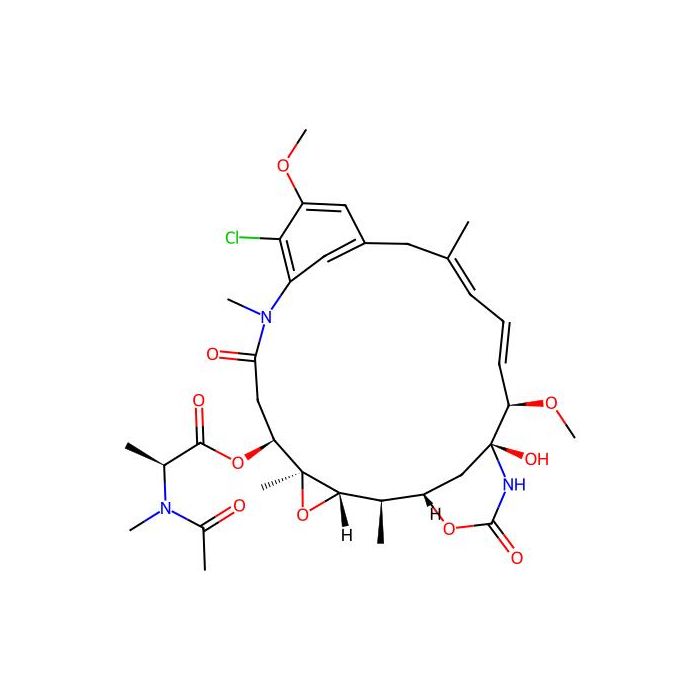
Brief description: Maytansine is a highly potent, complex macrocyclic natural product (maytansinoid) used widely as a tubulin-targeting research tool and as a progenitor for antibody–drug conjugate (ADC) payloads in R&D.
Item-specific registry details (Product Data):
CAS: 35846-53-8
SKU: M655077
Category: Small molecules and compound libraries (research use only)
Molecular formula (item-specific): Not specified for this item; refer to CoA/Spec Sheet.
Molecular weight (item-specific): Not specified for this item; refer to CoA/Spec Sheet.
SMILES (item-specific): Not specified for this item; refer to CoA/Spec Sheet.
InChIKey (item-specific): Not specified for this item; refer to CoA/Spec Sheet.
Structural features (general/literature description):
Complex ansa-macrolide scaffold with multiple oxygenated functionalities (e.g., esters/ethers) and numerous stereocenters.
Dense, polyoxygenated framework typical of maytansinoids; conformationally constrained macrocycle.
Lacks simple ionizable groups; generally neutral and highly lipophilic with poor aqueous solubility (literature, qualitative).
2D structural description (general):
A large macrocyclic ring spanning an aromatic/ansamer segment to an aliphatic, oxygen-rich region; several acetyl or acyl substituents; multiple contiguous stereocenters along the macrocycle. The scaffold presents hydrogen-bond acceptors (carbonyl/ether oxygens) and limited donors, consistent with its neutral, hydrophobic character.
Synthetic Utility
General reactivity considerations (literature-based):
The maytansine scaffold contains multiple oxygenated functions (esters/ethers) and numerous stereocenters, making it sensitive to strong acids/bases and nucleophiles that can induce cleavage or transesterification.
Semisynthetic diversification often targets selectively accessible positions to introduce linker handles (e.g., formation of carbamates/esters or conversion to analogs that bear thiol/disulfide or amine functionalities—typically on derivatives rather than the native parent where required).
Utility in research synthesis:
Platform for payload SAR: Strategic protection–deprotection schemes and mild coupling reagents (e.g., carbonyldiimidazole, carbodiimides with catalytic DMAP under controlled conditions) can be used to form stable carbamates/esters on suitably reactive hydroxyls in maytansinoids.
Late-stage functionalization: Stoichiometric control and chemoselective activation are critical to avoid over-acylation; micro-scale reactions with rapid LC–MS feedback are recommended.
Reference standard: Native maytansine serves as a comparator in analytical or biological profiling when evaluating semisynthetic analogs.
Cautions:
Avoid prolonged exposure to MeOH under acidic/basic conditions to prevent methyl transesterification.
Limit temperature and exclude moisture; many transformations are best run at 0–25°C with short reaction times and immediate workup.
Target Specificity
Item-specific immunological or molecular target metadata are not applicable to this small-molecule product.
General/literature context:
Molecular target class: β-Tubulin (microtubules). Maytansine and its analogs bind to tubulin and inhibit polymerization, leading to microtubule destabilization in cell-based systems.
No antibody clone/isotype or epitope details apply to this compound.
Utilizamos cookies para garantizar el correcto funcionamiento del sitio web y, cuando esté permitido, para mejorar su experiencia. Puede gestionar sus preferencias en cualquier momento en Configuración. Más información en nuestra Política de Cookies.
¿Quieres que te enviemos un mensaje cuando tengamos descuentos disponibles?
Recordármelo más tarde
¡Gracias! Por favor, revisa tu bandeja de entrada de correo electrónico para confirmar.
Products are supplied to verified businesses, institutions, and qualified professionals for research and development use only. Not for use in humans, animals, diagnosis, or therapy.