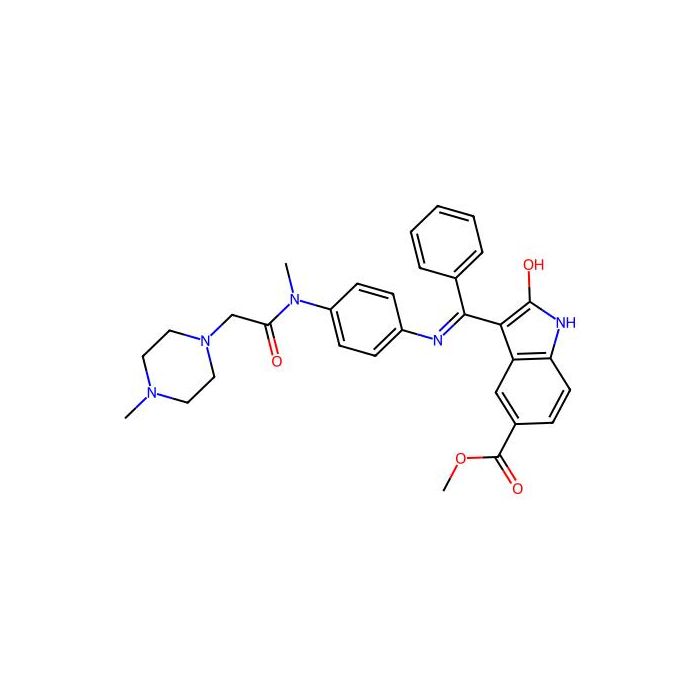
This compound belongs to the class of organic compounds known as indolecarboxylic acids. These are compounds containing a carboxylic acid group linked to an indole.
External Descriptors
Not available
1. Djoumbou Feunang Y, Eisner R, Knox C, Chepelev L, Hastings J, Owen G, Fahy E, Steinbeck C, Subramanian S, Bolton E, Greiner R, and Wishart DS. ClassyFire: Automated Chemical Classification With A Comprehensive, Computable Taxonomy. Journal of Cheminformatics, 2016, 8:61.
Certificados (CoA, COO, BSE/TSE y tabla de análisis)
C of A & Other Certificates(BSE/TSE, COO):
Analytical Chart:
Propiedades químicas y físicas
Solubilidad
DMSO : 1 mg/mL (1.85 mM; ultrasonic and warming and heat to 60°C)
Peso molecular
539.6
XLogP3
4.300
Hydrogen Bond Donor Count
2
Hydrogen Bond Acceptor Count
7
Rotatable Bond Count
8
Exact Mass
539.253 Da
Monoisotopic Mass
539.253 Da
Topological Polar Surface Area
101.000 Ų
Heavy Atom Count
40
Formal Charge
0
Complexity
892.000
Isotope Atom Count
0
Defined Atom Stereocenter Count
0
Undefined Atom Stereocenter Count
0
Defined Bond Stereocenter Count
0
Undefined Bond Stereocenter Count
0
The total count of all stereochemical bonds
0
Covalently-Bonded Unit Count
1
Calculadoras de soluciones
Molarity Calculator
Determine the necessary mass, volume, or concentration for preparing a solution.
Dilution Calculator
Determine the dilution needed to prepare a stock solution.
Reconstitution Calculator
Reseñas
Reseñas de cliente
Application Protocols
There are no tested application protocols provided in the Product Data for this catalog item.
General protocol framework for small-molecule tool compounds (non–item-specific):
Stock solution: Prepare a concentrated solution in anhydrous DMSO (e.g., 10–50 mM). Vortex and, if necessary, sonicate briefly. Record exact concentration based on the molecular weight and salt form from the CoA.
Aliquoting: Dispense into single-use, low-bind tubes or microplates to minimize freeze–thaw cycles and adsorption.
Working solutions: Prepare serial dilutions in assay buffer to achieve the desired concentration range, keeping final DMSO constant (e.g., 0.1–0.5% v/v). Inspect for precipitation or opalescence.
Controls: Include vehicle controls, positive/negative controls where available, and consider detergent controls to mitigate aggregation artifacts.
Data integrity: Verify compound identity/purity by LC–MS prior to critical studies; track lot numbers and storage history.
For detailed, item-specific protocols (e.g., enzymatic assay conditions, readouts), please refer to your laboratory SOPs or request additional documentation.
Biological Roles
Item-specific biological activity data are not provided. The following context is general background on the biological target class named by the product label and does not constitute claims about this lot.
Context (general): MELK denotes Maternal Embryonic Leucine zipper Kinase, a serine/threonine protein kinase implicated in cell-cycle regulation and other signaling processes (literature background). Compounds labeled as “MELK-IN-1” in the literature are typically used as chemical tools in kinase-focused research to probe biochemical pathways. Specific potency, selectivity, and off-target profiles vary by structure and must be verified experimentally.
Assay implications: When evaluating any putative kinase tool compound, incorporate controls for DMSO tolerance, nonspecific aggregation (use detergent controls where appropriate), and assay interference (fluorescence/absorbance overlap, redox activity). Confirm target engagement with orthogonal methods (e.g., biochemical kinase assays, cellular readouts, CETSA/TPP) as applicable.
ADME/PK in vitro (general): For tool compounds, assess intrinsic stability (microsomes/S9), permeability (e.g., PAMPA/MDCK), and plasma protein binding before drawing mechanistic conclusions from cellular phenotypes.
Important: No biological claims (potency, selectivity, or phenotype) are made for this catalog item. Users should generate their own data under defined assay conditions.
Buffer Applications
This catalog item is a small-molecule research compound rather than a buffering agent. It does not define pH or provide buffering capacity.
Practical guidance for use in buffered assays (general, non–item-specific):
Choose assay buffers based on biological target requirements (e.g., HEPES 20–50 mM, pH 7.2–7.6 for many enzyme/cell assays; Tris 20–50 mM, pH 7.4–8.0 where amine interactions are acceptable; PBS for immunoassays).
Maintain constant organic co-solvent content (e.g., fixed 0.1–1% v/v DMSO) across controls and treatments to avoid solvent artifacts.
If the compound is prone to precipitation, include a small amount of non-ionic surfactant (e.g., 0.01–0.05% Tween 20) and pre-wet plastics. Filter buffers through 0.22 µm to reduce nucleation sites.
Item-specific buffer parameters (pKa, solubility vs pH) are not provided; refer to CoA/Spec Sheet or determine empirically.
Green Alternatives
In the absence of item-specific solvent/processing requirements, the environmental profile largely depends on solvent and workflow choices. Consider greener practices when handling small-molecule screening compounds such as this item.
Greener solvent considerations (general):
Replace or reduce DMF/NMP with lower-toxicity media when feasible (e.g., ethanol, isopropanol, ethyl lactate, or water with excipients), provided solubility and assay compatibility are maintained.
Optimize DMSO usage: Keep final assay DMSO ≤0.5% v/v where possible, and use miniaturized plate formats (e.g., 384/1536-well) to reduce solvent consumption.
Employ aqueous formulations with PEG400, polysorbates, or cyclodextrins for in vitro work when compatible.
Ethanol/IPA: Renewable feedstock options; lower toxicity; limited solvency for some chemotypes.
Ethyl lactate: Biobased, good for certain aromatics; assay compatibility must be verified.
Water + excipients: Greenest carrier; may require excipients and careful stability assessment.
Process improvements:
Use closed dispensing (acoustic or positive-displacement) to minimize emissions.
Consolidate analytical runs and adopt fast-gradient UHPLC to reduce solvent usage and energy.
Store in aliquots to prevent waste from repeated thawing and discard.
Note: Validate any solvent substitution for chemical stability, solubility, and biological assay performance before adoption.
Pharmaceutical Uses
No pharmacopeial status, excipient role, or formulation specifications are provided for this item. It is supplied strictly for research use only.
General formulation research context (non–item-specific):
Tool compounds are sometimes formulated for preclinical research using co-solvent systems (e.g., PEG400/saline, Captisol, or ethanol/propylene glycol/saline) to achieve workable concentrations for in vivo models; such uses require rigorous internal safety and stability evaluation.
For in vitro work, DMSO stock solutions are standard, with subsequent dilution into assay media while controlling final solvent concentration.
Compliance note: This product is not intended for human or veterinary use, diagnostic procedures, or as an API/excipient in regulated drug products. No clinical or therapeutic claims are made.
Physical Properties
Item-specific physicochemical parameters have not been provided in the Product Data. For method development and handling, consult the CoA/Spec Sheet for this batch.
Appearance: Not specified for this item; refer to CoA/Spec Sheet.
Melting point (literature/computed): Not specified here; verify against CoA/Spec Sheet or primary literature for the exact registry (CAS 2095596-44-2).
Boiling point: Not applicable/reported for solids; if needed, use TGA/DSC for thermal profile (general guidance).
Density: Not specified for this item; refer to CoA/Spec Sheet.
Solubility: Not specified for this item; refer to CoA/Spec Sheet. In practice, many screening compounds are dissolved in anhydrous DMSO to prepare stock solutions (general practice, not item-specific).
logP/logD, pKa, refractive index: Not specified for this item; refer to CoA/Spec Sheet.
Practical notes (general, non–item-specific):
For poorly aqueous-soluble screening molecules, typical stock preparation involves 10–50 mM in dry DMSO, followed by dilution into assay buffer with final DMSO ≤0.5–1% v/v to minimize assay interference.
If aqueous stock is preferred, co-solvent or solubilization aids (e.g., 10–30% PEG400, 5–10% ethanol, 0.5–1% Tween 80) may be explored in small-scale tests. Always confirm stability by LC–MS/HPLC before committing to large batches.
Quality and Grades
Grade/purity details are not specified in the Product Data for this catalog item. Consult the CoA/Spec Sheet for certificate-backed information (purity assay, analytical methods, residual solvents, and identification tests).
What to look for on the CoA (general guidance for small-molecule screening compounds):
Assay/Purity: Typically reported by HPLC/UPLC (UV or CAD/ELSD), and/or quantitative NMR. Purity thresholds ≥95% are commonly targeted for screening, but confirm for this lot.
Identity: 1H NMR, HRMS/ESI-MS, and sometimes 13C NMR. A matching retention time with a reference method may be noted.
Residual solvents/water: Karl Fischer for water and GC for solvents may be provided; if not, request on demand. For sensitive assays, ensure limits meet your internal criteria.
Counter-ions/salt form: Verify whether the material is free base, salt, or solvate/hydrate; this impacts molecular weight used for dosing.
Implications of unspecified grade:
Without a stated grade (e.g., “Screening grade,” “≥98%”), users should set acceptance criteria aligned to project needs (e.g., minimum purity, isomer profile, and metal/halide residues if relevant) and request analytical confirmation if critical.
Reaction and Applications
This product is offered as a small-molecule research compound within a screening/compound library context; it is not typically used as a classical synthetic reagent. Accordingly, there are no item-specific “named reaction” roles to highlight.
Research applications (general, non–item-specific):
Use as a reference material or tool compound candidate in biochemical/biophysical assays for kinase-focused discovery programs. Confirm identity and purity by in-house analytics before biological testing.
Suitable for structure–activity relationship (SAR) exploration, screening cascade development, and method qualification (e.g., LC–MS peak tracking, stability-indicating chromatography).
Potential use as a spike-in standard to validate assay window, DMSO tolerance, precipitation limits, and compound management workflows.
Practical tips:
Prepare concentrated DMSO stocks (e.g., 10–50 mM) and aliquot to minimize freeze–thaw. Record exact concentration using salt form/molecular weight from the CoA.
For enzyme assays, pre-dilute stock into assay buffer to the highest tolerated DMSO percentage (commonly ≤0.5–1% v/v) before addition to biomolecules.
Validate compound stability under assay conditions by LC–MS/HPLC time courses (e.g., 0, 2, 24 h at room temperature and 37°C), checking for hydrolysis/oxidation depending on structure (not specified here).
Note: Any target engagement or potency claims must be established under your laboratory conditions; none are provided in the Product Data.
Reaction Conditions
Not typically applicable. This product is not positioned as a reagent for chemical synthesis; therefore, defined reaction conditions (solvent, temperature, catalysts, yields) are not provided for this item.
If the compound is to be used in bioassays or physicochemical studies (general guidance):
Stock preparation: Dissolve in anhydrous DMSO to a validated concentration (e.g., 10–50 mM), confirm clarity, and filter through 0.22 µm PTFE if particulate is observed.
Dilution: Add stock to assay buffer with vigorous mixing to avoid local supersaturation; keep final DMSO consistent across controls.
Stability checks: Monitor by LC–MS/HPLC at relevant temperatures and times (e.g., 0–24 h at room temperature/37°C) to confirm no significant degradation or adsorption to plastics.
For any planned chemical reactions involving this molecule, obtain the full structure and analytical data from the CoA and design conditions accordingly.
Safety and Handling
Hazard information for this specific item has not been provided. Always review the product SDS prior to use.
GHS Classification: Not specified for this item; refer to SDS.
Signal Word / Pictograms / H-Statements: Not specified for this item; refer to SDS.
General laboratory precautions (non–item-specific):
Use suitable PPE: lab coat, safety glasses, and appropriate chemical-resistant gloves (e.g., nitrile). Handle powders/solid reagents in a fume hood to prevent inhalation of dust or aerosols.
Avoid ingestion, inhalation, and skin/eye contact. Wash thoroughly after handling. Prevent environmental release—collect waste according to institutional hazardous-waste procedures.
Storage incompatibilities: Keep away from strong oxidizers and strong acids/bases unless confirmed compatible by SDS. Protect from moisture and light as a precaution for small-molecule research compounds.
First-aid overview: If inhaled—move to fresh air; if on skin—wash with soap/water; if in eyes—rinse cautiously with water for several minutes; if ingested—rinse mouth, seek medical advice. Provide the SDS to medical personnel.
Thermal/chemical stability: Unknown for this specific item; minimize repeated freeze–thaw cycles and avoid prolonged exposure to elevated temperature or high humidity.
Definitive guidance: Defer to the SDS and institutional EHS policies for authoritative hazard, exposure limits, and spill/accident response.
Solvent Selection
No item-specific solubility profile is provided. The following guidance reflects common practice for small-molecule screening compounds and should be validated experimentally for MELK-IN-1 (CAS 2095596-44-2).
Primary stock solvent: Anhydrous DMSO is the default for discovery compounds due to broad solvency and assay compatibility at ≤0.5–1% v/v final concentration.
Alternative co-solvents: DMF and NMP offer high solvency but may have greater assay interference; ethanol or isopropanol can assist aqueous dilution if compatible with the bioassay.
Aqueous vehicles: For limited water solubility, explore buffered saline with co-solvent (e.g., 10–30% PEG400, 5–10% ethanol) or cyclodextrin inclusion (e.g., 1–10% HP-β-CD) to enhance solubility. Verify stability and binding effects.
pH Considerations: If the compound possesses ionizable groups (unknown for this item), modest pH adjustment (±1 pH unit) can improve solubility; avoid extremes that risk degradation.
Comparison (general):
DMSO: Highest solvency, excellent for 10–50 mM stocks; potential to affect cells/enzymes above ~1% v/v.
DMF/NMP: Strong solvency; consider toxicity and plastic compatibility.
EtOH/IPA: Lower solvency, good for co-solvent roles; volatile and assay-dependent.
Aqueous + excipients: Tailored to in vitro/in vivo formulation research; requires screening for compatibility and stability.
Recommendation: Begin with DMSO stock preparation, then dilute into assay buffer while monitoring clarity and activity. Document precipitation thresholds during serial dilutions.
Storage and Reconstitution
Item-specific guidance from Product Data:
Storage Conditions: Store at -20°C.
Shipped In: Ice chest + Ice pads.
Additional best practices (general, non–item-specific):
Protect from light and moisture. Keep container tightly closed under inert headspace if feasible, especially for hygroscopic or oxidatively sensitive compounds (item-specific sensitivity not provided).
Upon receipt: Allow the sealed container to equilibrate to room temperature before opening to prevent condensation. Reseal promptly after use.
Reconstitution: If solid, prepare stock solutions in anhydrous DMSO (typical 10–50 mM) unless CoA indicates alternative solvent preference. If a solution is supplied, verify concentration on the label/CoA before dilution.
Aliquoting: Prepare single-use aliquots to minimize freeze–thaw. Store aliquots at -20°C or below. Avoid repeated thawing; thaw only what is needed for immediate use.
Stability: Long-term stability data and retest dates are not specified for this item; refer to CoA/Spec Sheet. Periodically confirm integrity by HPLC/LC–MS, especially after 6–12 months of storage or if visual changes occur.
Disposal: Follow institutional chemical waste procedures; segregate halogenated and non-halogenated solvent waste if applicable.
Research Use Note: For research use only.
Structure and Identity
MELK-IN-1 is cataloged as a small-molecule research compound commonly used in screening collections.
SKU: M646879
Product Name: MELK-IN-1
CAS: 2095596-44-2 (item-specific)
PubChem CID: 137248544 (item-specific)
InChIKey: 418804 (as provided; format appears truncated—refer to CoA/SDS for the full key)
SMILES: Not specified for this item; refer to CoA/Spec Sheet.
Molecular Formula: Not specified for this item; refer to CoA/Spec Sheet.
Molecular Weight: Not specified for this item; refer to CoA/Spec Sheet.
Structural features (general guidance):
Functional group and ring-system details are not available in the provided Product Data for this specific item. If structural elucidation is required (e.g., for LC–MS or NMR method setup), please consult the CoA/Spec Sheet or authoritative literature for MELK-IN-1 under the stated CAS.
2D structural description:
Not specified for this item; refer to CoA/Spec Sheet. Without a confirmed SMILES/InChI, a reliable 2D description cannot be provided. For accurate structure, use the supplier’s spectral data or cross-reference the CAS/CID in peer-reviewed databases, ensuring the entry matches this exact registry number.
Synthetic Utility
This item is offered as a finished small-molecule research compound, not as a synthetic intermediate or reagent. Without a disclosed structure and functional groups, synthetic reactivity and derivatization routes cannot be described for this specific catalog entry.
General considerations (non–item-specific):
If analog synthesis or derivatization is planned, obtain the confirmed structure (SMILES/InChI) and consider late-stage diversification handles (e.g., heteroaryl halides, anilines, amides) typically leveraged in kinase-tool chemotypes.
For analytical development, establish a stability-indicating HPLC/UPLC method and forced-degradation panel (acid/base, oxidative, thermal, photolytic) to guide any future synthetic or formulation work.
For this catalog item, consult the CoA/Spec Sheet for structure and purity data prior to any synthetic manipulation.
Target Specificity
Only item-specific data may appear here. The Product Data do not provide target, selectivity, or binding information for SKU M646879.
Target/class: Not specified for this item; refer to CoA/Spec Sheet.
Species/reactivity: Not specified for this item; refer to CoA/Spec Sheet.
Assay-validated applications: Not specified for this item; refer to CoA/Spec Sheet.
Note: Any assumptions about target engagement or selectivity should be validated experimentally under your assay conditions.
Preguntas frecuentes
What is the purity of this product?
This product is supplied at ≥98% purity (chemical assay). Lot-specific values are stated on the Certificate of Analysis.
How should this product be stored?
Store at ?20 °C. Freezer storage is required to maintain the specified shelf life.
How is this product shipped?
This product ships in an insulated container with ice pads. Unpack on arrival and transfer it to the storage condition stated above.
What are the CAS number, molecular formula and molecular weight?
The CAS Number is 2095596-44-2, the molecular formula is C31H33N5O4, and the molecular weight is 539.62 g/mol. InChIKey XIMRJNBUWJTLAL-UHFFFAOYSA-N.
What documentation is provided?
Available product documentation, including Certificates of Analysis (COA), Safety Data Sheets (SDS), and specification sheets, is shown in the product document area. Document availability and access follow the current site policy.
Utilizamos cookies para garantizar el correcto funcionamiento del sitio web y, cuando esté permitido, para mejorar su experiencia. Puede gestionar sus preferencias en cualquier momento en Configuración. Más información en nuestra Política de Cookies.
¿Quieres que te enviemos un mensaje cuando tengamos descuentos disponibles?
Recordármelo más tarde
¡Gracias! Por favor, revisa tu bandeja de entrada de correo electrónico para confirmar.
Products are supplied to verified businesses, institutions, and qualified professionals for research and development use only. Not for use in humans, animals, diagnosis, or therapy.