CALIDAD & PUREZAMoligand™?Moligand™ — Aladdin's line of ligands and bioactive small molecules. Use for receptor, pathway, and binding studies needing defined small-molecule tools.10mM in DMSO
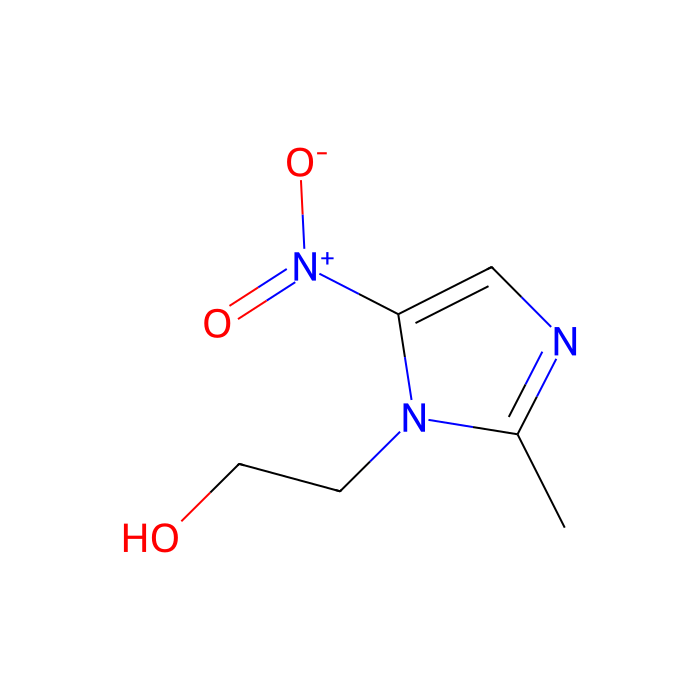
Metronidazole Metronidazole, a synthetic antibacterial and antiprotozoal agent of the nitroimidazole class, is used against protozoa. In vitro
Metronidazole is relatively inactive until it is metabolized within host or microbial cells. Metronidazole is activated when it receives an electron from ferredoxin or fla vodoxin that is reduced by POR in anaerobic or microaerophilic bacteria or luminal parasites. Metronidazole damages cells by forming protein and DNA adducts. Metronidazole has activity against protozoans like Entamoeba histolytica, Giardia lamblia and Trichomonas vaginalis, for which the drug is first approved as an effective treatment. The activity of metronidazole against anaerobic bowel flora has been used for prophylaxis and treatment of patients with Crohn\'s disease who might develop an infectious complication. Metronidazole\xa0has played an important role in anaerobic-related infections.\xa0 \xa0Metronidazole\xa0has notable effectiveness in treating anaerobic brain abscesses. Metronidazole resistance tends to result from de novo mutation in the resident rdxA gene, rather than from lateral transfer of mutant rdxA (or other) genes from unrelated but Mtzr strains. Metronidazole partially inhibits growth stimulate forward mutation to rifampin resistance in rdxA(+) (Metronidazole(s)) and also in rdxA (Metronidazole(r)) H. pylori strains, and that expression of rdxA in Escherichia coli results in equivalent Mtz-induced mutation. Metronidazole leads to apoptosis-like features in growing cultures of axenic B. hominis, including key morphological and biochemical features of programmed cell death (PCD), viz. nuclear condensation and nicked DNA in nucleus, reduced cytoplasmic volume, externalization of phosphatidylserine and maintenance of plasma membrane integrity with increasing permeability.
In vivo
Cell Data
cell lines:
Concentrations:
Incubation Time:
Powder Purity:≥99%
Especificaciones
Especificaciones y pureza
Moligand™, 10mM in DMSO
Mecanismos bioquímicos y fisiológicos
Metronidazole, a synthetic antibacterial and antiprotozoal agent of the nitroimidazole class, is used against protozoa.
Condiciones de almacenamiento de almacenamiento
Store at -80°C
Enviado en
Dry ice packs + Cold packs
Este producto requiere envío en cadena de frío. Los servicios terrestres y otros servicios económicos no están disponibles.
Nuestra guía de selección de calidades cubre la pureza, el estado del estabilizador y la idoneidad de la aplicación para todas las variantes de nuestro catálogo.
Utilizamos cookies para garantizar el correcto funcionamiento del sitio web y, cuando esté permitido, para mejorar su experiencia. Puede gestionar sus preferencias en cualquier momento en Configuración. Más información en nuestra Política de Cookies.
¿Quieres que te enviemos un mensaje cuando tengamos descuentos disponibles?
Recordármelo más tarde
¡Gracias! Por favor, revisa tu bandeja de entrada de correo electrónico para confirmar.
Products are supplied to verified businesses, institutions, and qualified professionals for research and development use only. Not for use in humans, animals, diagnosis, or therapy.

 K2624925