Ethylthiourea is a compound most commonly used as a corrosion inhibitor for metals but also retains bactericidal properties. The compound has been used as a precursor for the synthesis of new rhenium complexes.
This compound belongs to the class of organic compounds known as thioureas. These are organic compounds containing the thiourea functional group, a derivative of urea with the general structure (R1(N)R2C(=S)(R3)R4, R1-R4=H, alkyl, aryl), obtained by replacing the carbonyl group of urea with a thiocarbonyl group.
External Descriptors
Not available
1. Djoumbou Feunang Y, Eisner R, Knox C, Chepelev L, Hastings J, Owen G, Fahy E, Steinbeck C, Subramanian S, Bolton E, Greiner R, and Wishart DS. ClassyFire: Automated Chemical Classification With A Comprehensive, Computable Taxonomy. Journal of Cheminformatics, 2016, 8:61.
Determine the necessary mass, volume, or concentration for preparing a solution.
Dilution Calculator
Determine the dilution needed to prepare a stock solution.
Reconstitution Calculator
Reseñas
Reseñas de cliente
Application Protocols
No standardized bioassay or immunoassay protocols are associated with this small-molecule reagent in our catalog.
General lab use
For synthetic reactions, see the Reaction Conditions and Synthetic Utility sections for starting points.
For solution preparation in assays, determine solubility in your chosen solvent/buffer, prepare fresh solutions, and filter if particulate persists (0.2 µm PTFE/nylon as compatible).
Always validate conditions at small scale before scale-up.
Biological Roles
General biochemical context (literature; no medical claims)
The thiourea motif is a classical urea bioisostere, offering stronger hydrogen-bond donating capacity and altered acidity compared to urea. As such, thioureas feature in ligand–protein interaction studies and as pharmacophore elements in medicinal chemistry exploration.
N-Substitution (e.g., N-ethyl) modulates pKa, lipophilicity, and conformational preferences, impacting target engagement in enzyme active sites and receptors via dual H-bond donation and anion binding.
Thioureas can coordinate soft metal centers through sulfur, relevant to metalloenzyme modeling and small-molecule complexation studies.
Tautomerism (thione ↔ thiol/imine) is typically biased toward the thione in aqueous/neutral media, influencing binding geometry and redox behavior.
Practical implications
When using N-ethylthiourea in biochemical assays, control pH and ionic strength to maintain a consistent protonation state.
Consider nonspecific binding to proteins via H-bonding; include appropriate controls and use orthogonal detection methods.
Note: The above reflects general roles of thiourea-containing compounds; this catalog item is sold strictly for research use only.
Buffer Applications
N-Ethylthiourea is not a buffering reagent and is not typically employed to prepare pH buffer systems.
Guidance
If used in aqueous assays, dissolve in an appropriate assay buffer (e.g., phosphate, HEPES) prepared separately, ensuring compatibility with thioureas (avoid strong oxidants and nitrosating conditions).
Determine solubility and stability in the chosen buffer empirically; adjust ionic strength and organic co-solvent (e.g., 5–20% ethanol or DMSO) as needed.
Green Alternatives
Opportunity areas
Solvent substitution generally offers the largest green impact for thiourea chemistry. Favor bio-based ethers/alcohols or water where feasible.
Reagent selection for sulfurization and heterocycle formation can avoid high-hazard reagents (e.g., CS2, H2S, or harsh thionating agents).
Comparison of options (literature/general)
Conventional: DMF, DMSO, MeCN for S-alkylations and condensations.
Greener alternatives:
2-Methyltetrahydrofuran (2-MeTHF) or cyclopentyl methyl ether (CPME) for certain SN2 processes; often paired with phase-transfer catalysis to maintain rates.
Ethanol or isopropanol for thiazole condensations; good balance of safety, renewability, and workup.
Water/ethanol biphasic systems under PTC to reduce solvent load and enhance safety.
Tradeoffs
Rates may decrease in greener solvents; consider mild heating, higher concentration, or catalytic additives (e.g., TBAB) to compensate.
Solubility of starting materials can limit conversions; mixed-solvent systems are often optimal.
Waste and energy
Employ room-temperature or reflux-in-ethanol protocols where possible.
Design crystallization-based isolations to avoid chlorinated solvent extractions.
Note: Selection depends on substrate set; screen a small solvent matrix (EtOH, i-PrOH, MeCN, 2-MeTHF, water/EtOH) to identify feasible greener conditions.
Pharmaceutical Uses
Formulation/excipient status
No pharmacopeial excipient status is indicated for N-ethylthiourea. It is not typically used as a formulation excipient.
Process/synthesis context (literature/general)
N-ethylthiourea may serve as an intermediate or building block in the synthesis of heterocycles (e.g., thiazoles) and sulfur-containing scaffolds encountered in drug discovery campaigns.
The thiourea motif is frequently explored as a hydrogen-bonding pharmacophore in SAR studies; N-alkylation (here, ethyl) adjusts physicochemical properties for ADME screening.
Compliance note
This product is for research and laboratory use only. No clinical or therapeutic claims are made or implied. For any GMP or clinical manufacturing use, consult regulatory guidance and source GMP-grade materials.
Physical Properties
Item-specific specs:
Grade/Purity: Not specified for this item; refer to CoA/Spec Sheet.
Appearance: Not specified for this item; refer to CoA/Spec Sheet.
Literature/general reference values (not specifications; consult CoA/SDS for item-specific data)
Physical state: typically a crystalline solid (literature)
Melting point: reported ~108–115 °C (literature, varies with source and purity)
Boiling point: not commonly distilled; decomposes before or near bp (literature)
Density: not widely reported (literature)
Solubility: expected to be soluble in polar solvents (water, alcohols) and highly soluble in DMSO/DMF due to H-bonding and polarity (literature, qualitative)
pKa/acidity-basicity: thiourea NHs are weakly acidic (pKa in DMSO typically ~20–22 for related thioureas); conjugate-acid pKaH small (weak base) (literature, approximate trends)
LogP: low; compound is polar and H-bonding (literature, qualitative)
UV characteristics: thiocarbonyls show n→π* absorption in near-UV; specific cutoff not established (literature)
Refractive index: not applicable to solids
Notes:
Values above are for context only and may vary with measurement conditions and sample history. For method development, determine exact solubility and thermal behavior under your lab conditions.
Quality and Grades
Item-specific information
Grade/Purity: Not specified for this item; refer to CoA/Spec Sheet.
Stabilizers/Additives: Not specified for this item; refer to CoA/Spec Sheet.
UV/GC/HPLC suitability: Not specified for this item; refer to CoA/Spec Sheet.
Guidance on interpreting grades (general)
Analytical/Reagent grade typically indicates low inorganic/organic impurities suitable for most synthetic and analytical tasks.
HPLC/LC–MS grade emphasizes low UV-absorbing and low non-volatile residues to minimize baseline noise and ion suppression.
“Synth” or “technical” grades are intended for preparative chemistry where trace impurities are tolerable.
Practical notes for N-ethylthiourea
If using in catalysis, heterocycle synthesis, or as a ligand precursor, check metal content and residual solvents on the CoA when selectivity is metal-sensitive.
For spectroscopic studies (e.g., binding assays), verify water content and any stabilizers that could participate in H-bonding or acid–base equilibria.
Lot-specific CoA should be consulted for assay (by titration, NMR, or HPLC), residual solvents, and any relevant impurity profiles.
Documentation
CoA/Spec Sheet and SDS are the authoritative sources for this catalog item.
Reaction and Applications
N-Ethylthiourea is a versatile sulfur–nitrogen synthon used across heterocycle construction, sulfur-transfer chemistry, and ligand/ion-pair assembly.
Key reaction families (literature/general)
S-alkylation to isothiouronium salts using alkyl halides or sulfonates; subsequent base or amine treatment can yield thioureas, thioamides, or guanidines depending on partner and conditions.
Condensation with α-haloketones/α-haloesters to form 2-aminothiazoles or thiazolines (Hantzsch-type thiazole synthesis).
Acylation at sulfur followed by rearrangement or substitution to access thioamides and thio-carbamates.
Formation of hydrogen-bonding organocatalysts and anion receptors; N-ethyl substitution can tune acidity and binding geometry relative to thiourea parent.
Mechanistic notes
The sulfur atom is the softer, more nucleophilic site; initial S-alkylation is typical under SN2 conditions. Nitrogen alkylation becomes competitive under strongly basic or specific solvent regimes.
Resonance delocalization across N–C(=S)–N enforces planarity, influencing transition state orientation and selectivity in cyclizations.
Practical tips
Use mild, non-nucleophilic bases (K2CO3, Cs2CO3) in polar aprotics (DMF/DMSO) for clean S-alkylation.
For thiazole formation, ethanol or n-propanol at reflux with an α-bromocarbonyl often affords high conversions; monitor to prevent over-alkylation.
Protecting-group strategy: the N-ethyl group can impart differential reactivity, enabling selective transformations relative to the remaining NH.
Reaction Conditions
General, literature-based guidance for typical transformations involving N-ethylthiourea (not item specifications):
S-alkylation (to isothiouronium salts)
Solvent: DMF or MeCN; base: K2CO3 or Cs2CO3 (0.5–1.5 equiv)
Temperature/time: 20–60 °C, 1–12 h; monitor by TLC/LC–MS
Notes: minimize water to suppress hydrolysis; quench to crystallize salts or extract free base after downstream conversion
Thiazole formation (Hantzsch-type)
Partners: α-bromoketone or α-bromoester (1.0–1.2 equiv)
Solvent: ethanol or i-PrOH; base often not required
Temperature/time: solvent reflux, 1–6 h
Outcome: 2-aminothiazoles, often precipitating on cooling; wash with alcohol to purify
Thioacylation to thioamides
Reagents: acyl chlorides or anhydrides (1.1–1.5 equiv)
Solvent: CH2Cl2 or MeCN; base: triethylamine or pyridine (1–2 equiv)
Temperature/time: 0–25 °C addition, then 25–50 °C, 1–4 h
Notes: acylation occurs preferentially at sulfur; subsequent workup affords thioamide derivatives after appropriate conversion steps
Typical workup
Filtration of precipitated products or aqueous workup with pH control (avoid strong oxidants). Dry organic layers over Na2SO4; avoid high heat on rotary evaporation if thermal sensitivity is suspected.
Safety and Handling
Item-specific hazard data
Signal word: Not specified for this item; refer to CoA/Spec Sheet.
H-statements: Not specified for this item; refer to CoA/Spec Sheet.
GHS classification/pictograms: Not specified for this item; refer to CoA/Spec Sheet.
General safety considerations for thioureas (literature/general; defer to SDS for authoritative guidance)
Potential hazards: may cause skin/eye irritation and respiratory irritation; some thioureas are suspected of reproductive or carcinogenic effects—exercise caution until specific SDS is reviewed.
PPE: wear lab coat, safety glasses or face shield, and appropriate chemical-resistant gloves (e.g., nitrile). Use in a fume hood to minimize inhalation.
Handling: avoid dust formation; prevent contact with strong oxidizers and electrophiles. Wash thoroughly after handling.
Storage incompatibilities: separate from strong oxidizing agents, strong acids capable of nitrosation, and acylating/alkylating agents unless in controlled reaction setups.
First aid overview: in case of skin/eye contact, rinse with water for at least 15 minutes; remove contaminated clothing. If inhaled, move to fresh air. If ingested, rinse mouth; do not induce vomiting—seek medical attention. Always follow your institutional SOPs.
Fire: organic solid; use water spray, CO2, dry chemical, or foam. Thermal decomposition may release nitrogen/sulfur oxides.
Always consult the product’s SDS for definitive hazard, exposure limits, spill response, and disposal instructions.
Solvent Selection
N-Ethylthiourea is a polar, multi-dentate H-bonding solid. Solvent choice primarily impacts reaction rate/selectivity and crystallization behavior rather than “use as a solvent.”
Polarity/miscibility (literature/general)
Highly compatible with polar protic (water, methanol, ethanol) and polar aprotic solvents (DMSO, DMF, acetonitrile). Limited solubility expected in nonpolar hydrocarbons.
Strong hydrogen-bond donor/acceptor character; solubility increases with solvent HBA/HBD capacity.
Typical use scenarios
Nucleophilic sulfur reactions (S-alkylation/acylation): DMF, DMSO, MeCN with inorganic base (e.g., K2CO3) promote clean SN2.
Condensations to heterocycles (e.g., thiazoles): ethanol or isopropanol at reflux often balances solubility and manageable workup.
Metal coordination studies: aqueous alcohols or buffered aqueous-organic mixtures help control protonation state.
Comparison (general guidance)
DMSO vs DMF: DMSO offers higher solubility; DMF may give faster SN2 kinetics with less competing side reactions for some substrates.
Alcohols vs water: alcohols improve substrate solubility and can moderate reaction rates; water enhances green metrics but may reduce solubility.
Practical tips
Dry polar aprotic solvents for base-promoted S-alkylations to avoid hydrolysis/competitive protonation.
For crystallizations, mixed solvent systems (EtOH/EtOAc or EtOH/water) can provide sharp precipitation on cooling.
Storage and Reconstitution
Item-specific storage/transport
Storage Conditions: Room temperature (per Product Data)
Shipped: Normal (per Product Data)
Container and environment
Store tightly closed in a dry, well-ventilated place. Use the original container or compatible glass/HDPE with a secure closure.
Segregate from strong oxidizers and strong acids capable of nitrosation. Protect from excessive heat.
Shelf life
Not specified for this item; refer to CoA/Spec Sheet. Periodically check by NMR/HPLC if critical to your application.
Prepare stock solutions in polar solvents (e.g., DMSO, DMF, ethanol, or water, as compatible with your application). Warm gently and sonicate if needed to aid dissolution.
Filter solutions through 0.2 µm syringe filter for sensitive applications. Prepare fresh solutions for best consistency; if storage is required, aliquot and store at 2–8 °C or frozen depending on solvent stability (user-validated).
Research use note
For research use only.
Structure and Identity
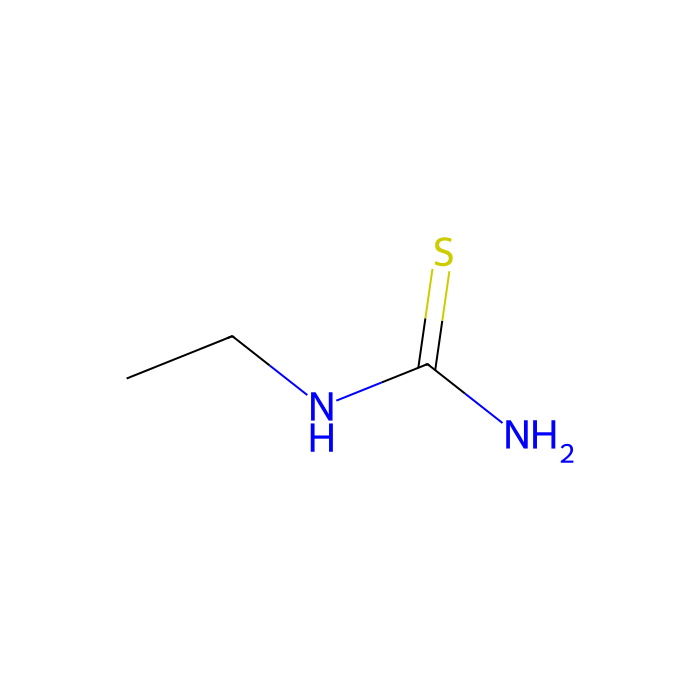
A mono-N-alkyl thiourea featuring one ethyl substituent on the urea nitrogen and a thio-carbonyl (C=S), making a bifunctional H-bond donor/acceptor useful in synthesis and coordination chemistry.
Item-specific identifiers (from Product Data)
CAS: 625-53-6
CID: 3032338
InChIKey: 105682
SKU: E346726
Product name: N-Ethylthiourea
Literature/computed identifiers and features (for reference; not item specifications)
Structural features: one thioamide (thiourea) core with C=S; two nitrogens (one N-ethyl, one primary NH2); capable of keto–thione/thiol–imine tautomerism, though thione predominates in neutral media.
2D description: an ethyl group (–CH2CH3) attached to an –NH– which is bound to a C(=S)–NH2 fragment; planar around the C(=S) due to resonance with adjacent nitrogens.
Synthetic Utility
Functional group leverage
Soft nucleophilic sulfur allows efficient S-alkylation/acylation, giving isothiouronium or thioacyl intermediates that can be diversified to thioamides, thioesters, and guanidines.
Dual H-bond donor capacity (two NHs, one N-ethyl-substituted) enables roles as organocatalyst fragments or anion-binding motifs.
Hantzsch-type thiazole synthesis: condensation with α-haloketones/esters to form 2-aminothiazoles.
Isothiouronium route to guanidines: S-alkylation (e.g., MeI) → S-methyl isothiouronium salt → displacement by amines to furnish N-ethylguanidines.
Thioacyl transfer: activation with acyl chlorides at sulfur to provide intermediates convertible to thioamides under mild conditions.
Retrosynthetic value
Serves as a masked N-ethyl guanidine/thiourea element; N-ethyl substituent offers orthogonal reactivity relative to the unsubstituted NH2, facilitating selective derivatization.
Practical synthesis tips
Control stoichiometry and temperature to favor S- over N-alkylation.
Employ polar aprotic media and carbonate/tertiary amine bases for clean conversions; isolate salts where advantageous for purification.
Target Specificity
This product is a small-molecule reagent, not a biological targeting reagent (e.g., antibody, ligand with defined biomolecular selectivity) in this catalog context.
No antigen/epitope, clone, isotype, or species reactivity data apply to this item.
Utilizamos cookies para garantizar el correcto funcionamiento del sitio web y, cuando esté permitido, para mejorar su experiencia. Puede gestionar sus preferencias en cualquier momento en Configuración. Más información en nuestra Política de Cookies.
¿Quieres que te enviemos un mensaje cuando tengamos descuentos disponibles?
Recordármelo más tarde
¡Gracias! Por favor, revisa tu bandeja de entrada de correo electrónico para confirmar.
Products are supplied to verified businesses, institutions, and qualified professionals for research and development use only. Not for use in humans, animals, diagnosis, or therapy.

 J2217492