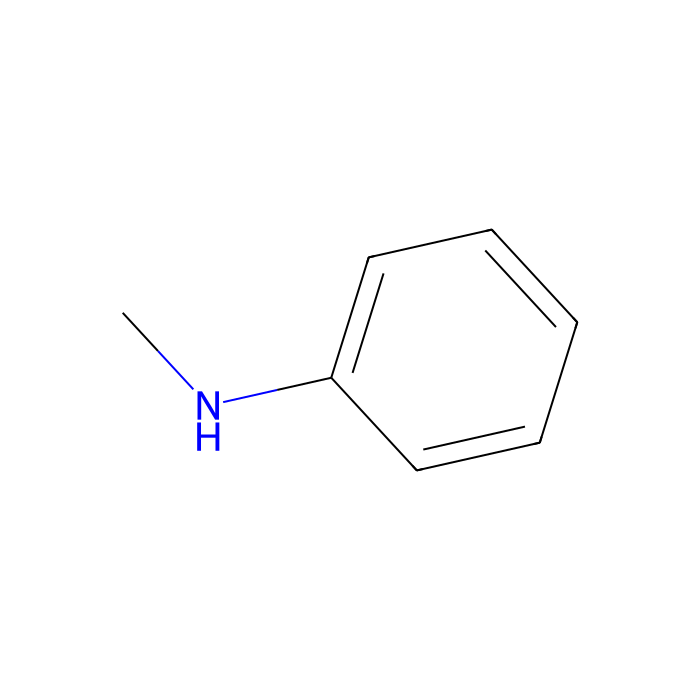
This compound belongs to the class of organic compounds known as phenylalkylamines. These are organic amines where the amine group is secondary and linked on one end to a phenyl group and on the other end, to an alkyl group.
External Descriptors
a small molecule
1. Djoumbou Feunang Y, Eisner R, Knox C, Chepelev L, Hastings J, Owen G, Fahy E, Steinbeck C, Subramanian S, Bolton E, Greiner R, and Wishart DS. ClassyFire: Automated Chemical Classification With A Comprehensive, Computable Taxonomy. Journal of Cheminformatics, 2016, 8:61.
Determine the necessary mass, volume, or concentration for preparing a solution.
Dilution Calculator
Determine the dilution needed to prepare a stock solution.
Reconstitution Calculator
Reseñas
Reseñas de cliente
Application Protocols
Not applicable to this chemical reagent.
No WB/IHC/IF/FC or similar bioassay protocols are associated with N-Methylaniline.
If used as a substrate or reagent in biochemical assays, follow method-specific literature and validate conditions locally.
Biological Roles
Applicability note
N-Methylaniline is not a natural metabolite; it is a xenobiotic aromatic amine. This section summarizes general biochemical fate without implying any clinical use.
Literature/General information
Absorption and distribution: Like other small aromatic amines, it can be absorbed via skin, inhalation, or ingestion and distribute to perfused tissues.
Metabolic pathways: Phase I transformations may include N-demethylation (yielding aniline), N-oxidation (hydroxylamine formation), and aromatic ring hydroxylation (cytochrome P450-mediated). Phase II conjugations can yield glucuronides or sulfates of phenolic metabolites or N-acetylated products.
Hematological effects: Aromatic amine hydroxylamine/nitroso metabolites can oxidize hemoglobin iron, leading to methemoglobin formation (mechanistic toxicology). The presence of an N–H and aromatic ring facilitates such redox cycling.
Environmental fate: Moderately hydrophobic (logP ~1.6–1.9) and basic; may partition into organic phases and sorb to soils/sediments; undergoes slow abiotic/biotic degradation compared to aliphatic amines.
Research implications
Useful as a probe substrate in studies of arylamine N-oxidation, P450 isoform selectivity, and nitrosamine formation controls. Handle with care in bioassays due to potential cytotoxic/methemoglobinemic mechanisms.
Buffer Applications
Not typically applicable.
N-Methylaniline is a reactive secondary aromatic amine and is not used as a laboratory buffer component. Its basicity (pKaH ~5) and reactivity (acylation, nitrosation) make it unsuitable for maintaining defined pH in aqueous systems.
For pH control, use established buffer systems (e.g., acetate, phosphate, Tris); select based on target pH and compatibility with amines if present.
Green Alternatives
Context
N-Methylaniline is a valuable building block but poses toxicity and potential environmental concerns characteristic of aromatic amines. Substitution strategies should balance performance, hazard, and lifecycle impact.
Potential greener choices (literature/general)
For “basic medium” without nucleophilicity: Use less hazardous tertiary amines (e.g., DMAP alternatives or carbonate bases) or inorganic bases (K2CO3, Cs2CO3) in green solvents (2-MeTHF, CPME, EtOAc) if the amine is not required as a reagent.
For cross-coupling to make arylamines: Employ ammonia surrogates or benign amines (ethanolamine derivatives) when feasible; conduct in greener solvents (2-MeTHF, propylene carbonate) with high-turnover catalysts to reduce metal loadings.
For reductive amination steps: Use aqueous hydrogenation with supported catalysts in bio-based solvents (MeOH from renewable sources) or 2-PrOH as hydrogen donor (transfer hydrogenation) to avoid cyanoborohydrides.
N-Methylaniline: High nucleophilicity, strong ring activation, but toxic/xenobiotic; limited biodegradability.
Ethanolamine/Aniline alternatives: Improved biodegradability (ethanolamine), lower toxicity in some cases, but different reactivity/selectivity; may introduce extra functional groups to manage.
Risk reduction when use is essential
Minimize excess, adopt closed transfers, recover/recycle via distillation, and implement efficient scrubbing of amine vapors and nitrosamine controls (exclude nitrite/strong acid).
Pharmaceutical Uses
Applicability note
This product is for research use only. No medical or clinical claims are made.
Role: N-Methylaniline is not used as a pharmaceutical excipient. However, it is a common synthetic intermediate in fine-chemical and API routes where aryl secondary or tertiary anilines are needed.
Representative utilities: Formation of N-methylanilide auxiliaries, introduction of dimethylamino phenyl motifs via further alkylation, and construction of diarylamine scaffolds through cross-coupling.
Regulatory considerations: Because aromatic amines and potential nitrosamine byproducts are tightly controlled impurities, processes employing N-methylaniline typically incorporate robust purge, derivatization, or destruction steps and sensitive analytical monitoring (e.g., GC-MS/LC-MS for residual arylamines and nitrosamines).
Handling in GMP settings: Employ closed handling, validated cleaning, and specific waste capture to prevent cross-contamination. Consult regional guidance on nitrosamine risk assessment if nitrosating conditions may be encountered.
Physical Properties
Item-specific (from Product Data)
Appearance: Not specified for this item; refer to CoA/Spec Sheet.
Literature/Computed values (typical; not item specifications)
State at 20–25 C: Liquid (aromatic secondary amine)
Vapor pressure: low; ~0.2–0.4 mmHg at 25 C (literature)
pKa (conjugate acid, in water): ~5.0–5.2 at 25 C (literature)
LogP (XlogP3-AA): ~1.6–1.9 (literature)
Water solubility: sparingly to moderately soluble (tens of g/L); miscible with many organic solvents (alcohols, ethers, chlorinated solvents) (literature)
UV characteristics: Aromatic chromophore; strong absorption in the UV with bathochromic shift vs benzene due to –NR substituent (literature); exact cutoffs Not specified for this item.
Notes for practice (general)
The basic nitrogen and aromatic ring can engage in H-bonding and π–π interactions, influencing retention in chromatographic methods.
Hygroscopicity is low, but the liquid can darken on air exposure due to oxidative byproducts; inert atmosphere storage limits color change.
Quality and Grades
Item-specific (from Product Data)
Grade/Purity: Not specified for this item; refer to CoA/Spec Sheet.
Guidance on quality considerations (general)
Typical grades encountered for aromatic amines include technical, laboratory, and high-purity grades. For synthetic applications sensitive to basic/UV-active impurities (e.g., catalysis or analytical work), a higher-purity or GC-assayed grade is preferred.
UV/Chromatography: Secondary anilines strongly absorb in the UV; “HPLC grade” is generally a solvent designation and is not typically used for this reagent. For trace analysis, pre-verify background absorbance.
Stabilizers: Not commonly stabilized; however, inert gas headspace (as provided: Argon charged) mitigates oxidative discoloration and formation of trace quinone-imine species.
Metals/peroxides/water limits: Not specified for this item; refer to CoA/Spec Sheet for exact impurity profiles if critical to your application.
Recommended verifications: GC purity, water by Karl Fischer, color (APHA), and amine value/assay can be useful metrics depending on use case (e.g., polymerization, catalysis).
Reaction and Applications
Item-specific (from Product Data)
Manufacturer applications: Not specified for this item.
Literature/General applications (for research use only)
Nucleophilic aromatic substitution and cross-coupling: Common nucleophile in Pd-catalyzed Buchwald–Hartwig amination to form diaryl secondary/tertiary anilines from aryl halides/triflates.
Electrophilic acylation/sulfonylation: Rapid formation of N-methylanilides with acyl chlorides/anhydrides and sulfonyl chlorides; useful for amide/sulfonamide libraries and as directing groups.
Reductive alkylation: Conversion to N,N-dimethylaniline via formaldehyde reductive amination (e.g., NaBH3CN or H2/Pd-C), or to other tertiary arylamines using carbonyl partners.
Quaternization: Alkylation to trialkylanilinium salts (phase-transfer agents, intermediates) using alkyl halides under controlled conditions.
Electrophilic aromatic substitution: Strongly ring-activating; preferentially para- and ortho-substitution (e.g., nitration under mild conditions, Friedel–Crafts acylation on the ring often requires protection of the amine).
Metalation strategies: Formation of anilide salts (e.g., with BuLi/NaH) enables directed ortho metalation for further functionalization.
Polymer/dye intermediates: Precursor to azo dyes (via coupling after N-protection or via para-directed substitution) and specialty accelerators/photoinitiator components.
Practical notes
Keep oxygen/moisture low for air-sensitive catalytic couplings; dry solvents and inert gas are beneficial.
The amine can coordinate and poison metal catalysts; ligand/base choices (e.g., BINAP/Xantphos, NaOtBu) and slow addition can mitigate deactivation.
Reaction Conditions
General literature guidance (illustrative; not item specifications)
Buchwald–Hartwig amination: Aryl bromide (1.0 eq), N-methylaniline (1.2–1.5 eq), Pd2(dba)3 (1–2 mol%), Xantphos or BINAP (2–4 mol%), base NaOtBu or Cs2CO3 (2.0 eq), toluene or dioxane, 90–110 C, 6–16 h; isolated yields commonly 70–95% with activated aryl halides.
N-Acylation: Acyl chloride (1.05–1.2 eq) added to N-methylaniline (1.0 eq) with base (pyridine, Et3N, or Na2CO3, 1.5–2.0 eq) in CH2Cl2 or THF at 0–25 C, 0.5–2 h; near-quantitative conversion; quench into aqueous base to minimize HCl salt formation.
N-Sulfonylation: Sulfonyl chloride (1.05–1.2 eq) in organic solvent with base (Et3N/NaHCO3) at 0–25 C affords sulfonamides in high yields; cooling advised due to exotherm.
Reductive amination to tertiary anilines: Formaldehyde (excess), N-methylaniline, NaBH3CN (1.2–1.5 eq) in MeOH or MeOH/AcOH buffer, 0–25 C, 1–6 h; or H2 (1–5 bar) with Pd/C in EtOH at RT–50 C.
Ortho metalation (via anilide): Pre-form N-acyl derivative, then treat with s-BuLi (1.1–1.5 eq) in THF at −78 to −40 C, trap with electrophile (e.g., CO2, B(OMe)3) for functionalization.
Operational notes
Dry, oxygen-free conditions improve outcomes in Pd-catalyzed couplings.
Acidic aqueous washes are effective for removing excess amine from organic phases; basify to recover product amines if needed.
Safety and Handling
Item-specific (from Product Data)
Storage conditions: Room temperature; Argon charged (store under inert gas as supplied).
Shipped in: FedEx DG Service.
Hazard information (signal word, H-statements, GHS classes, pictograms): Not specified for this item; refer to the SDS.
Literature/General safety guidance (not a substitute for SDS)
Hazard profile: Aromatic amines (including N-methylaniline) may be toxic by ingestion, inhalation, or skin absorption; may cause methemoglobinemia. Handle as a toxic, combustible liquid.
Incompatibilities: Strong oxidizers (risk of exotherm/oxidation), strong acids (forms anilinium salts; heat on neutralization), acid chlorides/anhydrides (acylation), nitrosating agents (risk of N-nitrosamine formation—avoid nitrite + strong acid).
PPE: Lab coat, safety glasses/goggles, suitable chemical-resistant gloves (e.g., nitrile), closed footwear. Use in a certified fume hood; avoid skin contact and inhalation.
First aid (overview): Move to fresh air if inhaled; rinse skin with soap/water on contact; irrigate eyes thoroughly if exposed; seek medical attention for symptoms of hypoxia/blue coloration or if swallowed. Provide SDS to responders.
Fire safety: Combustible; use CO2, dry chemical, or foam. Vapors heavier than air; avoid ignition sources.
Spill response: Absorb with inert material, transfer to chemical waste. Prevent entry to drains. Decontaminate surfaces with appropriate solvent and detergent.
Disposal: Treat as hazardous waste per local regulations; avoid nitrosamine-generating conditions.
Always consult the product’s SDS for authoritative classification and emergency measures.
Solvent Selection
Applicability note
N-Methylaniline is primarily a reactive reagent/amine base rather than a routine process solvent. Nevertheless, understanding its solvation and miscibility is useful for reaction planning.
Miscibility: Miscible with common organic solvents (alcohols, ethers, esters, hydrocarbons, chlorinated solvents). Sparingly to moderately soluble in water.
Dielectric constant: on the order of ~6–7 at 20–25 C (literature, similar to aniline).
When to use vs. alternatives (general guidance)
As a reagent/medium: Can serve as both nucleophile and base; in some cases used as a cosolvent to enhance solubility of aromatic substrates and facilitate acylation/sulfonylation of the amine.
Alternatives: For non-nucleophilic basic media, use hindered bases (e.g., DIPEA) in an inert solvent (e.g., toluene, MeCN). For greener aromatic-amine-compatible solvents, consider 2-MeTHF or CPME when the amine is only a substrate.
Practical tips
If employing as a cosolvent, account for its basicity and nucleophilicity (may compete in acylations/alkylations).
Aqueous workup often benefits from acid extraction (forms water-soluble anilinium salt), followed by basification and back-extraction to recover the free base.
Storage and Reconstitution
Item-specific (from Product Data)
Storage conditions: Room temperature; Argon charged. Store tightly closed under inert gas to minimize air oxidation and color change.
Reconstitution: Not applicable; supplied as a neat liquid (appearance not specified for this item; refer to CoA/Spec Sheet).
General handling/storage guidance
Protect from air, light, and moisture when feasible; fill headspace with inert gas after each use.
Use clean, dry glassware; avoid prolonged contact with reactive metals and strong oxidizers.
If solidification occurs at low temperatures (below its melting point, literature ~−57 C), gently warm to ambient and mix homogeneously before use.
For long-term quality: Periodically check by GC for purity/color. If discoloration is observed, distillation under reduced pressure over a small amount of base (e.g., KOH) can refresh material for non-GMP uses, subject to internal QC.
Keep away from nitrosating conditions during storage (avoid nitrite contaminants and strong acids).
Structure and Identity
Item-specific (from Product Data)
SKU: M109539
Product name: N-Methylaniline
CAS: 100-61-8
PubChem CID: 7515
InChIKey: 3812 (as provided; refer to CoA/Spec Sheet for confirmation)
SMILES: Not specified for this item; refer to CoA/Spec Sheet.
Literature/General identity (for reference only; not item specifications)
Preferred IUPAC name: N-methylaniline
Molecular formula (literature): C7H9N
Molecular weight (literature): 107.16 g/mol
Common SMILES (literature): CNc1ccccc1
Common InChIKey (literature): BPCPGLBGRZYQIR-UHFFFAOYSA-N
Core framework: A monosubstituted benzene ring bearing a secondary anilide nitrogen (an aniline where the nitrogen is methylated).
Functional groups: Secondary aromatic amine (anilinium base when protonated); aromatic ring enables electrophilic aromatic substitution (typically ortho/para-directing by –NRR').
2D arrangement: Planar phenyl ring (sp2 C6) attached to an –NH–CH3 substituent at one ring carbon; nitrogen is pyramidal but undergoes rapid inversion; one N–H proton remains (secondary amine). No stereocenters.
Resonance: Lone pair on nitrogen engages in partial conjugation with the ring, enhancing ring activation and slightly decreasing basicity relative to aliphatic secondary amines.
Synthetic Utility
General synthetic roles (literature)
Electrophile trapping at nitrogen: Rapid acylation/sulfonylation yields N-methylanilides/sulfonamides; products can serve as directing groups (DoM) or be deprotected under hydrolytic conditions.
Aryl C–N bond formation: Functions as a nucleophile in Buchwald–Hartwig aminations to generate N-methyl diarylamines (phosphine or NHC ligands; bases like NaOtBu or Cs2CO3).
Reductive amination/alkylation: Access to tertiary anilines via condensation with aldehydes/ketones followed by reduction (NaBH3CN, H2/Pd/C, or transfer hydrogenation). Eschweiler–Clarke can overmethylate to tertiary amine from primary aniline via N-methylaniline as an intermediate in a stepwise plan.
Directed ortho metalation: Deprotonation of the anilide (after N-acylation) or formation of lithium anilide enables ortho-functionalization (halogenation, formylation, borylation).
Electrophilic aromatic substitution: The –NMeH group is strongly activating and ortho/para-directing; nitration, halogenation, and sulfonation proceed under milder conditions relative to benzene.
Quaternization and salt chemistry: Formation of anilinium salts modifies solubility for separations and phase-transfer catalysis.
Practical considerations
Control chemoselectivity by protecting or modulating nitrogen basicity (e.g., carbamate, amide) to direct reactivity to the ring when desired.
Avoid nitrosating conditions; if unavoidable in a synthesis plan, implement scavengers and rigorous analytical control for nitrosamines.
Target Specificity
Not applicable to this chemical reagent.
No antigen/epitope, clone, isotype, or species reactivity information is relevant for N-Methylaniline.
Item-specific test applications are not provided in Product Data.
We use cookies to ensure the website functions properly and, where permitted, to improve your experience. You can manage your preferences at any time in Settings. Learn more in our Cookie Policy.
Shall we send you a message when we have discounts available?
Remind me later
Thank you! Please check your email inbox to confirm.
Products are supplied to verified businesses, institutions, and qualified professionals for research and development use only. Not for use in humans, animals, diagnosis, or therapy.

 H2626113