This compound belongs to the class of organic compounds known as dialkylamines. These are organic compounds containing a dialkylamine group, characterized by two alkyl groups bonded to the amino nitrogen.
External Descriptors
Not available
1. Djoumbou Feunang Y, Eisner R, Knox C, Chepelev L, Hastings J, Owen G, Fahy E, Steinbeck C, Subramanian S, Bolton E, Greiner R, and Wishart DS. ClassyFire: Automated Chemical Classification With A Comprehensive, Computable Taxonomy. Journal of Cheminformatics, 2016, 8:61.
Determine the necessary mass, volume, or concentration for preparing a solution.
Dilution Calculator
Determine the dilution needed to prepare a stock solution.
Reconstitution Calculator
Reseñas
Reseñas de cliente
Application Protocols
Not applicable. No tested bioassay protocols (e.g., WB, IHC, IF, FC) are associated with this small-molecule amine reagent. For synthetic applications, refer to the Reaction Conditions and Synthetic Utility sections for general procedural guidance.
Biological Roles
This compound is a synthetic aliphatic secondary amine and does not have a known natural biological role.
General context (literature/general)
Small aliphatic amines can interact with biological membranes and proteins via basicity and hydrophobic interactions, but N-tert-Butylethylamine is primarily a laboratory reagent.
Secondary amines can form N-nitrosamines in the presence of nitrosating agents; such species are of toxicological concern. Avoid nitrosating conditions during handling and waste treatment.
Protonated forms (ammonium salts) are water-soluble and can participate in ion-pairing; the free base is more lipophilic and membrane-permeant.
No clinical or therapeutic claims are made. Use is restricted to research and laboratory applications.
Buffer Applications
This product is not commonly used as a defined buffering agent in aqueous biochemical systems.
General notes (literature/general)
Secondary aliphatic amines exhibit conjugate acid pKaH values typically ~10–11, suggesting potential buffering in the alkaline range; however, volatility, odor, and reactivity (e.g., with CO2, electrophiles) make them impractical for routine biological buffers.
If a basic environment is needed in nonaqueous or organic media (e.g., during derivatizations), this amine can serve as a Brønsted base rather than a formal buffer.
For preparative chemistry requiring controlled pH, select established buffering systems (e.g., TRIS, carbonate, borate) with known buffer capacity and biocompatibility.
Green Alternatives
Choice of base/nucleophile impacts solvent and EHS profiles. While N-tert-Butylethylamine is effective, greener options may be considered depending on role.
Comparison of base choices (literature/general)
N-tert-Butylethylamine: Moderately hindered, nucleophilic; can serve dual role (nucleophile and HCl scavenger) thereby reducing additives but is volatile and odorous.
DIPEA (Hunig’s base): More hindered, less nucleophilic; often reduces side reactions. Still volatile/odorous; similar EHS profile.
2,6-Lutidine/Collidine: Aromatic bases with lower vapor pressure (reduced odor/emissions), but persistent in waste streams; lower acute toxicity issues than some aliphatic amines.
Carbonate bases (K2CO3, NaHCO3): Non-volatile, benign inorganic bases suitable for many acylations and SNAr in polar aprotic media; not nucleophilic, simpler waste handling.
Solvent strategy
Pair with greener solvents (e.g., 2-MeTHF, CPME, EtOAc, toluene) instead of chlorinated solvents where feasible.
Use solvent-free or concentrated conditions when the amine is both reagent and base to reduce solvent volumes.
Process intensification and waste minimization
Employ in situ salt capture (e.g., solid-supported acids) to reduce aqueous washes.
Consider continuous flow for improved containment of volatile amines and better heat/mass transfer.
Trade-offs: Less nucleophilic bases may slow reactions or require higher temperatures. Always balance EHS benefits with kinetic/chemoselectivity needs.
Pharmaceutical Uses
Item-specific pharmacopeial status: Not specified for this item; refer to CoA/Spec Sheet.
General formulation/manufacturing context (non-clinical)
Secondary aliphatic amines like N-tert-Butylethylamine are primarily used as synthetic intermediates or as bases/scavengers in process chemistry (e.g., acylations, sulfonylations, reductive aminations) during API/intermediate manufacture.
As a fragment donor, it can introduce the N-tert-butyl–N-ethyl motif into amide/sulfonamide side chains, modulating basicity and lipophilicity of drug-like molecules.
Amine salts (e.g., hydrochloride) may be handled for improved stability and odor control during processing steps.
Quality considerations
For GMP settings, control of residual amine in intermediates and APIs is required (ICH Q3A/B); validated purge strategies and analytical methods (GC, derivatization GC-MS) are typical.
Nitrosamine risk assessments should consider secondary amines; avoid nitrosating agents and implement appropriate controls per regulatory guidance (e.g., ICH M7, EMA/FDA nitrosamine guidelines).
Note: This product is for research use only; it is not supplied as an excipient and is not intended for human or veterinary use.
Physical Properties
Item-specific specifications
Appearance: Not specified for this item; refer to CoA/Spec Sheet.
Grade/Purity: Not specified for this item; refer to CoA/Spec Sheet.
Literature/general properties (for context; not item specifications)
Physical state/odor: Typically a colorless, low-viscosity liquid at ambient temperature with a characteristic amine odor (literature, secondary aliphatic amines).
Basicity: Conjugate acid pKaH for secondary aliphatic amines generally ~10–11; steric hindrance can slightly lower basicity compared to diethylamine (literature trend).
Volatility: Expected to be a moderately volatile amine (boiling range comparable to other C6 secondary amines; literature trend). Use in well-ventilated hoods.
Solubility: Aliphatic amines are usually miscible with many organic solvents (ethers, alcohols, hydrocarbons, chlorinated solvents) and show limited-to-moderate miscibility with water depending on structure; the bulky tert‑butyl group is expected to decrease water miscibility relative to smaller secondary amines (literature trend).
Density/refractive index, BP/MP, UV cutoff: Not specified for this item; refer to CoA/Spec Sheet.
Practical notes (general)
Amines can absorb CO2 and moisture from air, forming ammonium carbamates/bicarbonates; argon-blanketed storage helps maintain composition.
The N–H enables hydrogen bonding, impacting polarity and chromatographic behavior relative to tertiary amines.
Quality and Grades
Item-specific grade/purity: Not specified for this item; refer to CoA/Spec Sheet.
Guidance on grades (general)
Neat amine reagents are commonly offered as technical, reagent, or ≥95–99% purity grades. Higher purities may have tighter controls on water, residual solvents, and amine value.
Chromatography/HPLC suitability: If intended for analytical applications (e.g., as an ion-pairing base or derivatization reagent), low UV background and low non-volatile residue are desirable. Such specifications are grade-dependent and must be confirmed on the CoA.
Stabilizers: Aliphatic amines are typically supplied neat without stabilizers. Inert-gas headspace (argon, as specified for this item) minimizes CO2/moisture uptake and preserves assay.
What to check on receipt (practical advice)
Assay/purity method (GC, NMR), water content (Karl Fischer), amine value or neutralization equivalent, color/APHA, and residue on evaporation if relevant.
For sensitive syntheses, verify absence of low-level impurities (e.g., tertiary amine, alcohol, or hydrocarbon residues) by GC/FID and 1H/13C NMR.
Regulatory note
This product is for research use only and is not formulated to meet pharmacopeial monographs unless explicitly stated on the CoA/specification sheet.
Reaction and Applications
N-tert-Butylethylamine serves as a moderately hindered secondary amine for both stoichiometric incorporation and as a base.
Acylation to amides: Efficient nucleophile toward acid chlorides, anhydrides, and activated esters to furnish N-tert-butyl-N-ethyl amides; steric bulk can impart enhanced stability or modulate basicity of the amide nitrogen.
Sulfonylation/carbamoylation: Reacts with sulfonyl chlorides and chloroformates to yield sulfonamides and carbamates; useful for tuning lipophilicity and steric environment around nitrogen.
Reductive amination: Condenses with aldehydes/ketones to imines/iminium salts followed by reduction (e.g., NaBH3CN, NaBH(OAc)3) to give tertiary amines with mixed tert‑butyl/ethyl substitution patterns.
Alkylation: SN1/SN2 alkylation (with alkyl halides, epoxides) to tertiary amines or β-amino alcohols; steric hindrance reduces over-alkylation relative to less bulky amines but control stoichiometry.
N-Metallation/boronation: Formation of ammonium salts (e.g., HCl) for isolation or phase-transfer; directed formation of amides/ureas via CDI, DSC, or carbonyldiimidazole chemistry.
As a base (general)
Effective for neutralizing HCl from acylations or as a catalytic Brønsted base in Michael additions and transesterifications when less nucleophilic bases are not required.
Practical tips
Drying: If needed, dry over KOH pellets or CaH2, then distill under inert atmosphere. Avoid silica gel contact if free base recovery is desired; amines can adsorb or tail.
Stoichiometry: For acylations, 1.1–2.0 equiv amine often used to both form the amide and scavenge HCl; monitor by TLC/GC and quench cautiously.
Workup: Convert residual amine to its ammonium salt (e.g., 1 M HCl aq) for phase separation; then basify and extract if recovery is required.
Reaction Conditions
The following are general, literature-style guidelines for secondary aliphatic amines and should be optimized per substrate.
Amide formation (acid chlorides/anhydrides)
Solvent: DCM, THF, or toluene.
Temperature: 0–25 °C for acid chlorides; 25–50 °C for anhydrides/activated esters.
Stoichiometry: 1.0–1.2 equiv amine per acyl group; additional base (e.g., triethylamine) optional if limiting amine is desired.
Notes: Add acylating agent slowly to amine base at low temperature to control exotherm; monitor by TLC/IR (disappearance of acid chloride band) or GC.
Reductive amination
Solvent: MeOH, EtOH, i-PrOH, or THF/MeCN.
Conditions: Mild acid catalysis (AcOH) for imine formation; NaBH3CN or NaBH(OAc)3 added portionwise at 0–25 °C.
Notes: Control pH to ~5–6 for NaBH3CN; avoid strong acids which destroy the reductant.
Sulfonylation/carbamoylation
Solvent: DCM or DMF; base: pyridine or excess amine.
Temperature: 0–25 °C.
Notes: Use inert atmosphere to limit moisture/CO2 uptake; quench into aqueous bicarbonate then acidify to isolate sulfonamide if needed.
Alkylation (to tertiary amines)
Solvent: MeCN, acetone, or DMF.
Base: Often unnecessary; K2CO3 or Na2CO3 can be used to accelerate SN2 with less reactive halides.
Temperature: 25–60 °C depending on substrate leaving group.
Workup/purification
Partition between organic solvent and dilute acid to remove excess amine; basify and extract product amines if required. Avoid prolonged contact with silica without modifier (add 1–2% Et3N to eluents to minimize tailing).
All parameters above are literature/general guidance, not specifications for this item.
Safety and Handling
Item-specific hazard classification
Signal word, H-statements, GHS classes, pictograms: Not specified for this item; refer to SDS.
General GHS considerations for secondary aliphatic amines (literature/general; verify in SDS)
Likely hazards: Flammable liquid/vapor, corrosive/irritant to skin and eyes, harmful if inhaled; strong, unpleasant amine odor can indicate vapor presence.
Incompatibilities: Strong oxidizers, acyl/alkyl halides, acid chlorides/anhydrides, isocyanates, nitrosating agents (risk of nitrosamine formation), and mineral acids (exothermic neutralization). Reacts with CO2 from air.
PPE and engineering controls
Use in a fume hood. Wear chemical splash goggles, lab coat, and appropriate chemical-resistant gloves (e.g., nitrile). For bulk handling, consider face shield and apron.
Avoid ignition sources; ground/bond containers when transferring flammable liquids.
First-aid overview (general)
Skin/eyes: Immediate decontamination with copious water for at least 15 minutes; remove contaminated clothing; seek medical evaluation.
Inhalation: Move to fresh air; monitor for respiratory irritation; obtain medical attention if symptoms persist.
Ingestion: Rinse mouth; do not induce vomiting; seek medical care.
Storage and handling tips
Store tightly closed under inert gas (argon, per Product Data) at room temperature, away from acids/oxidants and from CO2 exposure. Use septum-cap or Schlenk technique for repeated access.
Always consult the product’s SDS for authoritative, item-specific safety information.
Solvent Selection
This product is a liquid amine reagent rather than a routine bulk solvent; however, choosing compatible media is important for its use.
Polarity/miscibility (literature/general)
The molecule is moderately polar and hydrogen-bond basic (secondary amine). It is typically miscible with common organic solvents (ethers, alcohols, many hydrocarbons, chlorinated solvents) and exhibits limited-to-moderate water miscibility due to the bulky tert‑butyl group.
Dielectric constants and partitioning will be comparable to other C6 secondary amines; expect good solvation in Et2O, THF, toluene, MeCN, and alcohols.
Selection guidance by application
As a base/nucleophile in acylations: Use an aprotic solvent (DCM, THF, toluene, EtOAc) to balance reactivity and heat removal. For acid chloride couplings, include an external base scavenger if needed or use excess amine.
For reductive amination: Alcoholic solvents (MeOH, EtOH, i-PrOH) or aprotic polar media (THF, MeCN) are common; choose according to reducing agent compatibility (e.g., NaBH3CN vs. NaBH(OAc)3).
For SNAr or sulfonylation: Polar aprotic solvents (DMF, DCM, MeCN) facilitate reaction; control temperature to limit over-alkylation.
Comparison (general)
Versus diethylamine: Slightly more hindered and likely less water-miscible; choose when reduced nucleophilicity or steric bias is desired.
Versus DIPEA (Hunig’s base): More nucleophilic due to N–H and asymmetry; choose DIPEA when a non-nucleophilic base is required, and choose N-tert-butylethylamine when incorporation into the product (amide/sulfonamide) is intended.
Keep container tightly closed with an inert-gas headspace (argon) to minimize CO2/moisture uptake and preserve assay.
If dispensing by syringe, use a septum-sealed bottle and maintain positive argon pressure. For repeated openings, consider backfilling with inert gas each time.
Do not store in contact with acids, oxidizers, or nitrosating agents. Segregate from food/consumables. Protect from ignition sources.
Reconstitution
Supplied as a neat liquid; no reconstitution required. If conversion to a salt is desired for handling (e.g., hydrochloride), prepare freshly under controlled conditions and store per salt-specific guidance.
Stability monitoring
Periodically verify assay by GC or 1H NMR if long-term storage after opening. Check for discoloration or odor changes; if present, analyze before use.
Always consult the CoA and SDS for item-specific stability limits, container materials, and shelf-life recommendations.
Structure and Identity
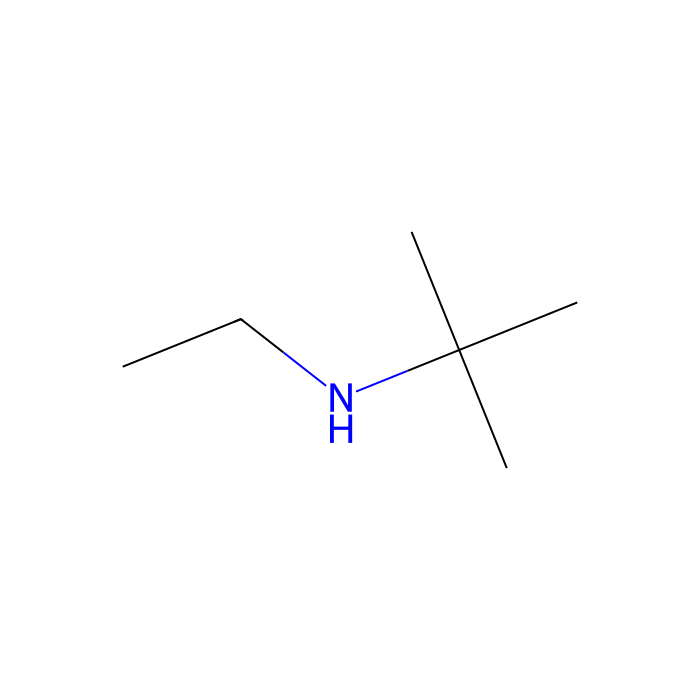
Brief description: N-tert-Butylethylamine is an asymmetric secondary aliphatic amine bearing an ethyl group and a tert‑butyl group on nitrogen; it is a compact, moderately hindered base/nucleophile.
Item-specific (Product Data)
SKU: N158929
CAS: 4432-77-3
InChIKey: 424712 (as provided)
Storage: Room temperature, Argon charged
Shipped in: Normal
Research use: For research use only
Computed/literature identifiers (for reference; not item specifications)
Molecular formula (literature): C6H15N
Molecular weight (literature): ~101.19 g/mol
Preferred IUPAC-style name (literature): N-tert-butylethan-1-amine (secondary amine)
SMILES (literature): CCN(H)C(C)(C)C
Structural features (general chemistry)
Functional group: Secondary amine (one N–H bond, two alkyl substituents)
Substituents: One sterically demanding tert‑butyl (tert‑butan-2-ylidene methane equivalent) and one linear ethyl chain
Basic center: Lone pair on sp3-hybridized nitrogen; expected to be a good Brønsted base and nucleophile, with steric hindrance moderating nucleophilicity relative to less hindered secondary amines
2D description: Central nitrogen bound to an ethyl chain (–CH2–CH3), a quaternary carbon of a tert‑butyl group [C(CH3)3], and one hydrogen (N–H), forming a pyramidal geometry at nitrogen
Notes: Exact stereochemistry is not applicable (no stereocenters). All data not explicitly provided above are literature/general references and should be confirmed against the CoA/Spec Sheet for this item.
Synthetic Utility
Functional group behavior (general)
Acts as a secondary amine nucleophile and Brønsted base. The tert‑butyl substituent imparts steric hindrance, moderating nucleophilicity relative to smaller dialkylamines (e.g., diethylamine) and influencing chemoselectivity in multi-electrophile systems.
Transformations enabled (literature)
Amide/urea formation: Reaction with acid chlorides/anhydrides (Schotten–Baumann or non-aqueous) and with carbonyldiimidazole (CDI) or DSC to form amides/ureas/carbamates.
Sulfonamide synthesis: Efficient capture of sulfonyl chlorides offering bulky, less basic sulfonamides useful as protecting or modulating groups.
Reductive amination: Formation of tertiary amines from carbonyl compounds under NaBH3CN, NaBH(OAc)3, or catalytic hydrogenation conditions.
Alkylation/arylation: Quaternization with alkyl halides; SNAr on activated aryl halides/nitroarenes to install the N-tert-butyl–N-ethyl moiety onto aryl systems.
Auxiliary effects: The bulky N-substituent can bias conformations, potentially benefiting stereocontrol in downstream steps or suppressing over-reaction at crowded centers.
Practical considerations
Select solvents to balance nucleophilicity and heat removal (e.g., DCM, THF, toluene). Control temperature to mitigate over-alkylation.
When used as base only, consider less nucleophilic alternatives (DIPEA, 2,6-lutidine) if nucleophilic side reactions are observed.
Isolation often benefits from forming a crystalline ammonium salt (e.g., HCl, p-TsOH), followed by basification to regenerate the free amine if required.
Target Specificity
Not applicable. This product is a small-molecule chemical reagent, not a biological affinity reagent. No antigen/epitope, species reactivity, clone, or isotype information applies.
We use cookies to ensure the website functions properly and, where permitted, to improve your experience. You can manage your preferences at any time in Settings. Learn more in our Cookie Policy.
Shall we send you a message when we have discounts available?
Remind me later
Thank you! Please check your email inbox to confirm.
Products are supplied to verified businesses, institutions, and qualified professionals for research and development use only. Not for use in humans, animals, diagnosis, or therapy.

 H2514081