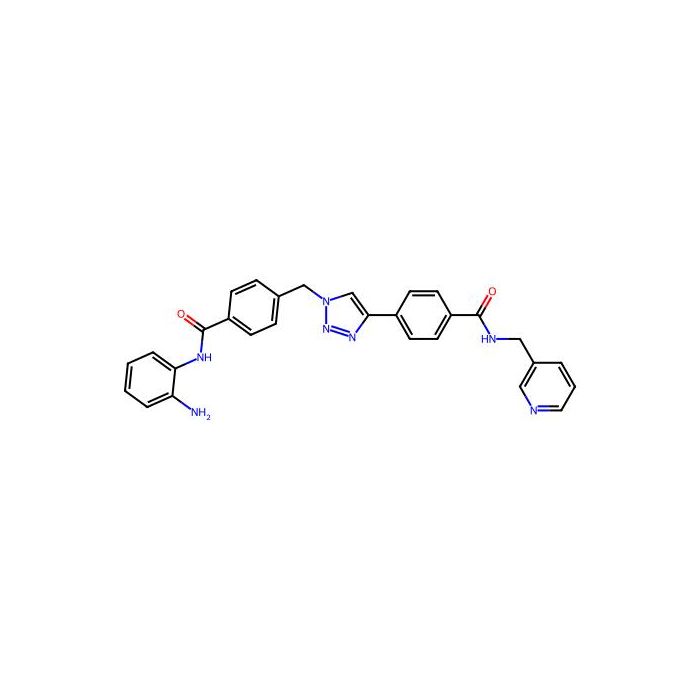
≥99% for sensitive chromatographic and analytical workflows requiring minimal baseline interference.
🌡
Storage & shipping
Store at -20°C Ships Ice chest + Ice pads Check lot-specific COA for exact specifications.
📋
Quality documents
SDS, COA, datasheet, and spec sheet available for download. Lot-specific COA accessible via lot number lookup.
📚
Literature proof
Cited in 0 peer-reviewed publications across chromatography, organic synthesis, and cross-coupling reactions.
Descripción general
Nampt-IN-3 (Compound 35) simultaneously inhibit nicotinamide phosphoribosyltransferase ( NAMPT ) and HDAC with IC 50 s of 31 nM and 55 nM, respectively. Nampt-IN-3 effectively induces cell apoptosis and autophagy and ultimately leads to cell death.
Form:Solid
Specifications
Especificaciones y pureza
≥99%
Mecanismos bioquímicos y fisiológicos
Nampt-IN-3 (Compound 35) simultaneously inhibit nicotinamide phosphoribosyltransferase ( NAMPT ) and HDAC with IC 50 s of 31 nM and 55 nM, respectively. Nampt-IN-3 effectively induces cell apoptosis and autophagy and ultimately leads to cell death.
Condiciones de almacenamiento de almacenamiento
Store at -20°C
Enviado en
Ice chest + Ice pads
Este producto requiere envío en cadena de frío. Los servicios terrestres y otros servicios económicos no están disponibles.
Tipo de acción
ACTIVATOR
Pureza
≥99%
Nombres e identificadores
Peso molecular
503.55
Documentation
📋 Safety Data Sheet (SDS)
Comprehensive hazard, handling, storage, and regulatory compliance document.
Certificados (CoA, COO, BSE/TSE y tabla de análisis)
C of A & Other Certificates(BSE/TSE, COO):
Analytical Chart:
Propiedades químicas y físicas
Solubilidad
DMSO : 130 mg/mL (258.17 mM; Need ultrasonic)
Calculadoras de soluciones
Molarity Calculator
Determine the necessary mass, volume, or concentration for preparing a solution.
Dilution Calculator
Determine the dilution needed to prepare a stock solution.
Reconstitution Calculator
Reseñas
Reseñas de cliente
Application Protocols
The following are example, non-item-specific research workflows commonly used with small-molecule NAMPT inhibitors. Optimize to your system and consult institutional SOPs.
Enzyme activity assay (biochemical):
Prepare a 10 mM DMSO stock of the compound; serially dilute (3-fold) to create a 10-point curve.
Incubate inhibitor with recombinant NAMPT, NAM and PRPP in assay buffer (e.g., 50 mM HEPES pH 7.5, 5 mM MgCl2) at room temp.
Quantify NMN formation by coupled enzymatic readout or LC–MS after defined time (e.g., 30–60 min).
Fit data to determine IC50; include vehicle controls and, if feasible, substrate-competition experiments.
Cell-based NAD depletion assay:
Seed cells (e.g., 96-well plate) and allow to adhere overnight.
Treat with compound at a 10-point dilution series; maintain DMSO ≤0.1% v/v.
Harvest at 4 h and 24 h; measure intracellular NAD+/NADH (enzymatic cycling kit or LC–MS).
Run NMN rescue (e.g., 0.5–1 mM NMN co-treatment) to assess on-target effects.
Viability/phenotypic assays:
Assess ATP (luminescence) or resazurin reduction at 24–72 h, alongside vehicle and rescue controls.
Data quality controls:
Confirm compound integrity by LC–MS pre/post assay.
Monitor precipitation in wells (visual or nephelometry).
Item-specific potencies, assay buffers, and incubation parameters are not provided; adjust empirically.
Biological Roles
Contextual biology (general literature; not item-specific):
NAMPT function: NAMPT (nicotinamide phosphoribosyltransferase) catalyzes the conversion of nicotinamide (NAM) and 5-phosphoribosyl-1-pyrophosphate (PRPP) to nicotinamide mononucleotide (NMN), the rate-limiting step in the NAD+ salvage pathway. Cellular NAD+ fuels redox metabolism and serves as a substrate for sirtuins, PARPs, and ADP-ribosyltransferases.
Pathway impact of inhibition: Chemical inhibition of NAMPT typically leads to NAD+ depletion, impairing glycolysis, TCA cycle-linked dehydrogenases, and mitochondrial function, and modulates signaling/epigenetic processes through decreased sirtuin and PARP activities.
Compensatory routes: Cells can replenish NAD+ via the Preiss–Handler pathway (from nicotinic acid) or via uptake of NR (nicotinamide riboside); media composition and precursor availability strongly influence cellular sensitivity to NAMPT inhibition.
Biochemical readouts:
Time-resolved NAD+/NADH assays (enzymatic cycling or LC–MS) after inhibitor exposure.
Monitoring SIRT1/3 activity, PARylation levels, and AMPK activation as functional correlates of NAD status.
Metabolomics of NMN/NaMN/NAD+ pools to map pathway flux.
Systems considerations: Sensitivity varies across cell types based on metabolic phenotype, expression of salvage enzymes, and extracellular precursor supply.
This section provides mechanistic background to design and interpret laboratory studies employing NAMPT pathway modulation. No clinical or therapeutic claims are implied.
Buffer Applications
Nampt-IN-3 is not a buffering reagent. There are no conventional buffer system recipes associated with this compound.
Practical notes for assay buffers (general, not item-specific):
Prepare working solutions by diluting DMSO stocks into assay buffers such as PBS, HEPES-buffered saline, HBSS, or enzyme assay buffers, maintaining consistent vehicle % across controls and treatments.
Many enzyme and cell assays perform best with ≤0.1–0.5% v/v DMSO; confirm tolerance for your system.
If precipitation occurs on dilution, add the compound stock last under vigorous mixing, or employ a small co-solvent fraction (e.g., 0.05–0.1% Tween-80) if compatible.
For buffer formulation guidance, refer instead to standard buffering reagents (HEPES, Tris, phosphate) and tailor ionic strength and pH to the biological assay.
Green Alternatives
Because Nampt-IN-3 is a bioactive screening compound rather than a process solvent or bulk reagent, green chemistry considerations focus on solvent choice for solution preparation and minimizing environmental footprint during use.
Greener handling strategies (general):
Prefer aqueous-compatible vehicles with minimal DMSO content (≤0.1% v/v in assays) while maintaining solubility.
Where feasible, use ethanol–water mixtures or biocompatible solubilizers (e.g., 2-hydroxypropyl-β-cyclodextrin) to reduce reliance on high-boiling polar aprotics.
Prepare concentrated stocks to minimize total solvent volume shipped and stored; aliquot to reduce waste from freeze–thaw cycles.
Waste minimization:
Consolidate mother liquors and rinses into a single organic waste stream; adopt microscale assay formats (384/1536-well) to reduce chemical use.
Comparison of common vehicles (general, not item-specific):
| Vehicle | Pros | Cons |
|---|---|---|
| DMSO | Excellent solvency; miscible with water; common in HTS | Enhances dermal absorption; persistence in environment |
| Ethanol | Renewable feedstock; lower toxicity profile | Lower solvency for many heteroaromatics; volatility |
| PEG400 | Good co-solvent; low volatility | Viscous; may affect bioassays |
| HP-β-CD (aq) | Improves apparent solubility; aqueous | Requires compatibility testing; inclusion complex variables |
Packaging/operations:
Opt for reusable cold packs and consolidate shipments when possible.
Employ closed-transfer (positive-displacement tips) to reduce exposure and loss.
Always validate any alternative vehicle for assay performance and compound stability prior to adoption.
Pharmaceutical Uses
This product is supplied strictly for laboratory research use and is not intended for human or veterinary applications.
Item-specific regulatory status: Not specified; no pharmacopeial monograph is indicated.
Relevance to pharmaceutical R&D (general, not item-specific):
As a tool compound, a NAMPT inhibitor can be used in target validation, mechanism-of-action studies, and phenotypic screening to interrogate NAD+ metabolism.
In pre-formulation research, exploratory solubility, stability, and permeability experiments can inform medicinal chemistry optimization.
For DMPK method development, the compound can serve as a reference analyte for LC–MS/MS assay setup, stability in plasma/microsomes, and metabolite ID protocols.
Formulation considerations for research models (general):
Vehicle systems commonly evaluated include DMSO/PEG400/saline, Captisol or HP-β-CD in saline, and ethanol–Cremophor EL–saline blends for in vivo method development (where institutionally approved). Validate solubility and tolerability.
No therapeutic claims are made. Any in vivo or ex vivo use requires institutional approvals and risk assessments; this listing does not constitute suitability for such use.
Physical Properties
Item-specific physical constants are not provided in the current record.
Item-specific values (from Product Data):
Appearance: Not specified for this item; refer to CoA/Spec Sheet.
Molecular Weight: Not specified for this item; refer to CoA/Spec Sheet.
Melting point, boiling point, density, refractive index, pKa, logP/logD, UV–Vis maxima: Not specified for this item; refer to CoA/Spec Sheet.
Aqueous solubility: Not specified for this item; refer to CoA/Spec Sheet.
General/literature-level expectations for NAMPT inhibitors (not item-specific):
Often solid at ambient temperature, with low intrinsic aqueous solubility and good solubility in polar aprotic solvents (DMSO, DMF) and mixed aqueous vehicles containing small % DMSO.
Many NAMPT chemotypes exhibit aromatic/heteroaromatic content with moderate to high cLogP; ionizable centers, if present, can modulate solubility and permeability.
Stock solutions are typically prepared at 10–50 mM in anhydrous DMSO; working solutions are made by serial dilution into assay buffer/culture media, maintaining final DMSO ≤0.1–0.5% v/v to protect biological systems.
Practical guidance (general):
If solubility is limited upon dilution, consider warming to 37 °C, brief vortex/sonication, or employing co-solvents (PEG400, ethanol) or solubilizers (0.1–1% Tween-80 or 2-hydroxypropyl-β-cyclodextrin) where compatible with the assay.
Verify concentration by UV–Vis or LC–UV/LC–MS after dilution to ensure no precipitation has occurred.
Always defer to the lot-specific CoA/SDS for authoritative physical data.
Quality and Grades
Item-specific quality information (from Product Data):
Grade/Purity: Not specified for this item; refer to CoA/Spec Sheet.
How to interpret common grades for screening compounds (general guidance):
Screening grade / bioactive compound grade: Typically supplied at high chemical purity (often ≥95% by HPLC/LC–MS) suitable for biochemical and cell-based assays; low levels of residual solvents and well-defined identity (NMR/MS).
HPLC trace and identity confirmation: Reputable screening compounds are accompanied by chromatograms and MS to verify single major component and correct mass.
What to expect from Aladdin Scientific (general):
Each lot is released against internal specifications for identity and purity. For quantitative work, obtain the lot-specific CoA detailing assay method (e.g., HPLC conditions, detection wavelength), purity result, and analytical data.
Stabilizers and form:
If a stabilizer, salt form, or solvate is present, it will be disclosed on the CoA/label. None is specified in the current record; confirm with CoA.
Recommendations for users:
Upon receipt, perform a fit-for-purpose verification: quick HPLC/LC–MS check of purity and mass, especially before HTS or mechanistic studies.
If absolute quantitation is required, consider qNMR or calibrated LC against a primary standard to determine assayable content.
For light/air/moisture-sensitive compounds, minimize exposure during handling and store under recommended conditions.
Reaction and Applications
This product is a bioactive small molecule for research screening, not a synthetic reagent. Accordingly, “reaction applications” pertain to its use in biochemical and cell-based experiments that probe NAD salvage pathway function via NAMPT inhibition.
Target: Nicotinamide phosphoribosyltransferase (NAMPT), the rate-limiting enzyme of the NAD+ salvage pathway converting nicotinamide to NMN.
Readouts: Intracellular NAD+/NADH, ATP levels, SIRT/PARP activity, viability/apoptosis markers, metabolic flux (e.g., lactate, OCR/ECAR), and transcriptional responses to NAD depletion.
Mechanistic controls:NMN supplementation or nicotinamide riboside can rescue NAMPT blockade, providing pathway validation.
Experimental design considerations:
Establish concentration–response curves (e.g., 10-point, 3-fold dilution) to estimate IC50/EC50 in the chosen system.
Control for vehicle (DMSO) effects and exposure time; NAMPT pathway responses are time-dependent (onset within hours; phenotypic effects over 12–72 h).
Consider media NAD precursors (nicotinamide content, serum factors) that modulate sensitivity.
Orthogonal confirmation:
Complement chemical inhibition with genetic perturbation (siRNA/CRISPRi) to support on-target mechanism.
Use target engagement assays (thermal shift/CETSA, activity-based binding if available) to verify binding in cells/lysates.
Note: No therapeutic or clinical claims are made. Use strictly for laboratory research.
Reaction Conditions
Conventional chemical reaction conditions are not applicable, as Nampt-IN-3 is a screening compound rather than a reagent. Instead, the most relevant “conditions” relate to preparing and using solutions in biochemical/cellular assays.
Dissolve in anhydrous DMSO to 10–50 mM. Vortex and, if needed, sonicate briefly. Filter through 0.22 µm PTFE/RC if particulates persist.
Record the exact concentration by weight-in-volume (mg to mmol using true MW when available) and, if critical, confirm by qNMR or LC–UV.
Working solutions and dosing:
Dilute into assay buffer or culture medium to achieve final DMSO ≤0.1–0.5% v/v.
Typical incubation times for NAMPT pathway readouts range from 2–6 h (early NAD+ changes) to 24–72 h (downstream phenotypes). Optimize per system.
Construct concentration–response curves (e.g., 10-point, 3-fold serial dilutions) to determine potency in context.
Stability considerations (general):
Protect from light and prolonged air exposure pending stability knowledge. Avoid strong acids/bases and oxidizers.
Store aliquots at −20 °C and minimize freeze–thaw.
Controls:
Include vehicle-only controls and rescue experiments (e.g., supplement with NMN) to confirm on-pathway effects.
Item-specific kinetic potency, solubility limits, and degradation pathways are not specified; consult CoA/SDS and confirm empirically.
Safety and Handling
Safety information in the current Product Data is incomplete; treat Nampt-IN-3 as a laboratory chemical of unknown hazard profile.
Item-specific hazard data (from Product Data):
Signal Word: Not specified for this item; refer to SDS.
H-Statements: Not specified for this item; refer to SDS.
GHS Classification/Pictograms: Not specified for this item; refer to SDS.
General safety guidance (not item-specific; follow institutional SOPs):
Use in a chemical fume hood or biosafety cabinet as appropriate. Avoid inhalation of dust/aerosols and contact with skin/eyes.
Wear appropriate PPE: lab coat, safety glasses, and nitrile gloves (change regularly). For weighing powders, consider double-gloving and antistatic practices.
Prepare DMSO stock solutions carefully; DMSO can enhance dermal absorption of solutes—avoid skin contact.
Avoid incompatible conditions typical for organic small molecules: strong oxidizers, strong acids/bases, and excessive heat.
First aid (overview; consult SDS):
Skin/eye contact: rinse with water for ≥15 minutes. Remove contaminated clothing.
Inhalation: move to fresh air; seek medical attention if symptoms persist.
Ingestion: rinse mouth; seek medical attention.
Spill/leak response:
Absorb with inert material (vermiculite, silica) and dispose per local regulations. Prevent entry into drains.
Waste:
Collect in properly labeled organic hazardous waste containers. Do not dispose to sink.
Always consult the official SDS for definitive hazard classification and handling instructions.
Solvent Selection
Nampt-IN-3 is provided as a research screening compound; optimal solvent choice centers on preparing concentrated, stable stock solutions and ensuring compatibility with downstream assays.
Item-specific note: No solubility data are provided; follow general best practices and validate experimentally.
General solvent guidance (literature-level, not item-specific):
Primary stock solvent: Anhydrous DMSO (10–50 mM typical). Advantages: excellent solvency for heteroaromatic inhibitors; miscible with water; well-tolerated at ≤0.1–0.5% v/v in many assays.
Alternatives/co-solvents:DMF, ethanol, or PEG400 where DMSO is unsuitable. For aqueous delivery, consider 2-hydroxypropyl-β-cyclodextrin or small % Tween-80.
Buffers/media compatibility: Dilute into PBS, HBSS, or culture media with vigorous mixing; add stock last to minimize local supersaturation. Maintain constant vehicle concentration across controls.
Polarity/miscibility (general expectations for NAMPT inhibitors):
Moderately lipophilic small molecules; poor water solubility is common. Highly miscible with polar aprotic organic solvents.
Practical tips:
Warm solutions to room temp/37 °C and vortex/sonicate if needed.
Filter working solutions (0.22 µm PTFE/RC) if precipitation is observed and compatible with assay.
Avoid prolonged exposure to strong acids/bases and oxidants pending stability data.
Comparison snapshot (general):
DMSO vs ethanol: DMSO dissolves broader chemotypes; ethanol can be preferable for sensitive biological systems but may have lower solubility capacity.
DMSO vs DMF: DMF offers similar solvency but is less favored biologically; reserve DMF for tough solubility cases.
Storage and Reconstitution
Item-specific instructions (from Product Data):
Storage Conditions: Store at −20 °C.
Shipped In: Ice chest + ice pads.
Research Use Note: For research use only.
General reconstitution guidance (not item-specific; verify experimentally):
Allow vial to equilibrate to room temperature in a desiccator before opening to prevent moisture condensation.
Prepare a concentrated stock in anhydrous DMSO (e.g., 10–50 mM). Vortex/sonicate gently to fully dissolve. If needed, warm to 37 °C briefly.
Aliquot into low-bind microtubes to avoid repeated freeze–thaw; purge headspace with inert gas if stability is a concern.
Store aliquots at −20 °C (or below) protected from light. Avoid >3–4 freeze–thaw cycles; thaw on ice or at room temperature just before use.
For aqueous working solutions, dilute into buffer/media with vigorous mixing; maintain final DMSO ≤0.1–0.5% v/v. Use freshly prepared dilutions; discard if precipitation/turbidity occurs.
Stability monitoring:
Periodically check by HPLC/LC–MS to ensure no degradation during storage. Record preparation and expiry dates on aliquots.
For any missing item-specific details (appearance, purity, exact solubility, MW), please consult the CoA/Spec Sheet accompanying your lot.
Structure and Identity
Brief overview: Nampt-IN-3 is listed as a small-molecule inhibitor for chemical biology screening against NAMPT, but structure-level identifiers are not provided in the current item record.
Item-specific identifiers (from Product Data):
Product Name: Nampt-IN-3 (SKU: N647682)
CAS: 2121591-52-2
InChIKey: Not specified for this item; refer to CoA/Spec Sheet.
SMILES: Not specified for this item; refer to CoA/Spec Sheet.
Molecular Formula: Not specified for this item; refer to CoA/Spec Sheet.
Molecular Weight: Not specified for this item; refer to CoA/Spec Sheet.
Structural features (general, literature-level, not item-specific):
NAMPT inhibitors commonly comprise heteroaromatic cores (e.g., pyridines, quinazolines, triazines) with H-bond donor/acceptor arrays to engage the enzyme’s active site and the nicotinamide channel.
Typical motifs include amide/urea linkages, aryl–heteroaryl biaryl axes, and polar substituents to balance potency and solubility. Exact features for Nampt-IN-3 are not provided here.
2D description (general guidance):
Without the SMILES/InChI, a reliable 2D description of ring systems, stereocenters, and functional groups for Nampt-IN-3 cannot be given. Please consult the CoA/SDS/technical data sheet supplied with the lot for definitive structure-related information.
Identity assurance:
For unambiguous identity confirmation, rely on vendor CoA (NMR, HRMS/LC-MS, HPLC purity trace) and match with internal acceptance criteria prior to use in screening assays.
Synthetic Utility
Nampt-IN-3 is positioned as a finished bioactive small molecule for use as a chemical probe; it is not typically employed as a building block or synthetic reagent.
Non-applicability:
The compound does not serve a standard role in bond-forming transformations (e.g., coupling partners, catalysts, ligands). Accordingly, typical organic synthesis applications are limited.
If derivatization is desired (general guidance):
Researchers sometimes functionalize probe molecules to create analytical standards, photoaffinity probes, or biotinylated/fluorescent conjugates for target engagement studies. Such efforts require knowledge of the precise structure, reactive handles, and SAR; these details are not provided in the current item record.
Any semisynthetic modification should consider retention of on-target activity and permeability; validate with biochemical/cellular assays post-modification.
Reference standards:
The neat compound can serve as a reference material for developing LC–MS analytical methods, stability-indicating assays, and impurity profiling in medicinal chemistry campaigns focused on NAMPT inhibitors.
For routine synthetic chemistry tasks, refer to dedicated reagents (coupling agents, catalysts, protecting groups) available elsewhere in the catalog.
Target Specificity
Item-specific targeting data (from Product Data):
None provided. No potency (IC50/Ki), selectivity panel data, or off-target profile are specified for this item; refer to the CoA/technical sheet or primary literature if available.
General, literature-level context for NAMPT inhibitors (not item-specific):
NAMPT inhibitors are designed to engage the catalytic site overlapping the nicotinamide-binding channel, often competing with NAM and stabilizing inactive conformations.
Common selectivity risks include interactions with other NAD+-utilizing enzymes or off-target dehydrogenases at high concentrations; thus, profiling against a broad panel or employing orthogonal readouts is recommended.
Cellular specificity is influenced by NAD precursor availability and transport pathways; rescue with NMN/NR supports on-target NAMPT engagement in cells.
For definitive target specificity of Nampt-IN-3 (SKU N647682), please consult the lot-specific documentation or contact technical support for available data.
Preguntas frecuentes
What is the purity of this product?
This product is supplied at ≥99% purity (chemical assay). Lot-specific values are stated on the Certificate of Analysis.
How should this product be stored?
Store at ?20 °C. Freezer storage is required to maintain the specified shelf life.
How is this product shipped?
This product ships in an insulated container with ice pads. Unpack on arrival and transfer it to the storage condition stated above.
What are the CAS number, molecular formula and molecular weight?
The CAS Number is 2121591-52-2, the molecular formula is C29H25N7O2, and the molecular weight is 503.55 g/mol.
What documentation is provided?
Available product documentation, including Certificates of Analysis (COA), Safety Data Sheets (SDS), and specification sheets, is shown in the product document area. Document availability and access follow the current site policy.
Utilizamos cookies para garantizar el correcto funcionamiento del sitio web y, cuando esté permitido, para mejorar su experiencia. Puede gestionar sus preferencias en cualquier momento en Configuración. Más información en nuestra Política de Cookies.
¿Quieres que te enviemos un mensaje cuando tengamos descuentos disponibles?
Recordármelo más tarde
¡Gracias! Por favor, revisa tu bandeja de entrada de correo electrónico para confirmar.
Products are supplied to verified businesses, institutions, and qualified professionals for research and development use only. Not for use in humans, animals, diagnosis, or therapy.