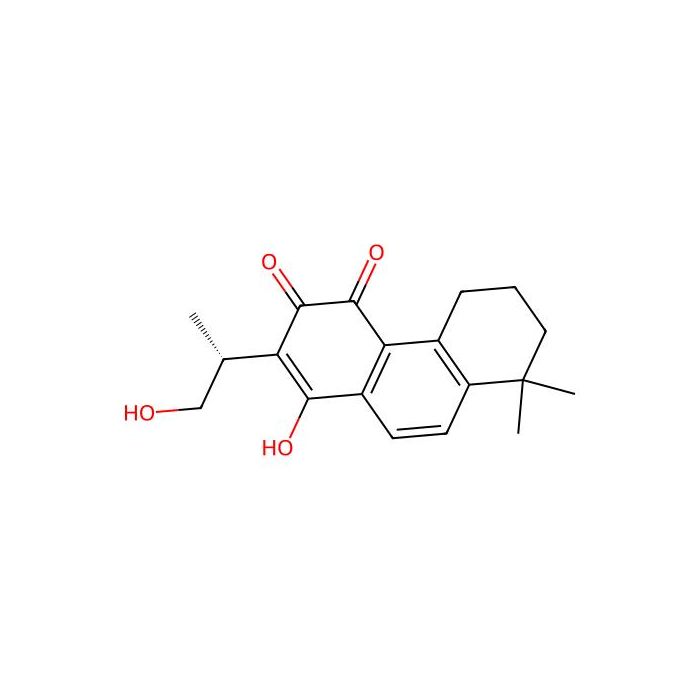
Neocryptotanshinone - ≥98% , CAS No.109664-02-0

CAS: 109664-02-0 Cat. No.: N647917 Fórmula: C19H22O4 Peso molecular: 314.4
Disponible para pedir
CALIDAD & PUREZA ≥98%
Synonyms
(+)-Neocryptotanshinone|1,4-Phenanthrenedione, 5,6,7,8-tetrahydro-3-hydroxy-2-[(1R)-2-hydroxy-1-methylethyl]-8,8-dimethyl-|(R)-3-Hydroxy-2-(1-hydroxypropan-2-yl)-8,8-dimethyl-5,6,7,8-tetrahydrophenanthrene-1,4-dione|1-hydroxy-2-[(2R)-1-hydroxypropan-2-yl]-8,8-dimethyl-6,7-dihydro-5H-phenanthrene-3,4-dione|3-hydroxy-2-[(1R)-2-hydroxy-1-methyl-ethyl]-8,8-dimethyl-6,7-dihydro-5H-phenanthrene-1,4-dione|Neocryptotanshinone
Storage
Protected from light,Store at -80°C
Shipped In
Dry ice packs + Cold packs
★
Talla
Alemania (EU)
USA*
Precio
Cantidad
5mg
N647917-5mg
Fabricado bajo pedido · 8–12 semanas

274,99€

412,96€
Guardar 137,97 € (33.41%)
10mg
N647917-10mg
Fabricado bajo pedido · 8–12 semanas

411,22€

616,88€
Guardar 205,65 € (33.34%)
Enter a quantity for the sizes you want to add.

Descripción general

Neocryptotanshinone, a fatty diterpenoids from Salvia Miltiorrhiza , inhibits lipopolysaccharide-induced inflammation by suppression of NF-κB and iNOS signaling pathways

In Vitro

Neocryptotanshinone exhibits anti-inflammatory effect by suppression of NF-κB and iNOS signaling pathways. Neocryptotanshinone (10 μM and 20 μM, 24 h) inhibits LPS-induced iNOS protein expression in RAW264.7 cells. Neocryptotanshinone (20 μM, 24 h) shows no obvious cytotoxic effect towards murine RAW264.7 macrophages. MCE has not independently confirmed the accuracy of these methods. They are for reference only. Cell Viability AssayCell Line: RAW264.7 cells Concentration: 5, 10 and 20 μM Incubation Time: 24 hours Result: Inhibited LPS-induced cell viability in a dose-dependent manner. Western Blot AnalysisCell Line: RAW264.7 cells Concentration: 20 μM Incubation Time: 24 hours Result: Inhibited LPS-induced activation of NF-κB pathway and down-regulated LPS-induced expression of p-NF-κB p65, p-IκBα and p-IKKβ.

In Vivo

Neocryptotanshinone causes reversals of decreased pain thresholds induced by MSU treatment after 30, 60, and 120 min S. miltiorrhiza Bunge extract treatment (contains single active components). MCE has not independently confirmed the accuracy of these methods. They are for reference only. Animal Model: MSU-induced pain model in male ICR mice (weighing 20-25 g)Dosage: 10, 25, 50 or 100 mg/kg Administration: Oral gavage; for 30, 60, 120 min Result: Inhibited inflammatory symptoms and nociceptive behaviors in a dose-dependent manner.

Form:Solid

IC50& Target:iNOS

Especificaciones

Sinónimos
(+)-Neocryptotanshinone | 1,4-Phenanthrenedione, 5,6,7,8-tetrahydro-3-hydroxy-2-[(1R)-2-hydroxy-1-methylethyl]-8,8-dimethyl- | (R)-3-Hydroxy-2-(1-hydroxypropan-2-yl)-8,8-dimethyl-5,6,7,8-tetrahydrophenanthrene-1,4-dione | 1-hydroxy-2-[(2R)-1-hydroxypropan-2-yl]-8,8-dimethyl-6,7-dihydro-5H-phenanthrene-3,4-dione | 3-hydroxy-2-[(1R)-2-hydro Show more
Especificaciones y pureza
≥98%
Mecanismos bioquímicos y fisiológicos
Neocryptotanshinone, a fatty diterpenoids from Salvia Miltiorrhiza , inhibits lipopolysaccharide-induced inflammation by suppression of NF-κB and iNOS signaling pathways.
Condiciones de almacenamiento de almacenamiento
Protected from light,Store at -80°C
Enviado en
Dry ice packs + Cold packs
Este producto requiere envío en cadena de frío. Los servicios terrestres y otros servicios económicos no están disponibles.
Tipo de acción
INHIBITOR
Pureza
≥98%
Nombres e identificadores
SMILES
CC(CO)C1=C(C2=C(C3=C(C=C2)C(CCC3)(C)C)C(=O)C1=O)O
IUPAC Name
1-hydroxy-2-[(2R)-1-hydroxypropan-2-yl]-8,8-dimethyl-6,7-dihydro-5H-phenanthrene-3,4-dione
InChIKey
LGZFJHSOBYVDLA-JTQLQIEISA-N
InChI
1S/C19H22O4/c1-10(9-20)14-16(21)12-6-7-13-11(5-4-8-19(13,2)3)15(12)18(23)17(14)22/h6-7,10,20-21H,4-5,8-9H2,1-3H3/t10-/m0/s1
Isómeros SMILES
C[C@@H](CO)C1=C(C2=C(C3=C(C=C2)C(CCC3)(C)C)C(=O)C1=O)O
CAS alternativo
109664-02-0
Número NSC
686517
Peso molecular
314.4
Reaxys
37313998
Reaxys-RN_link_address
https://www.reaxys.com/reaxys/secured/hopinto.do?context=S&query=IDE.XRN=37313998&ln=

Datos avanzados

Taxonomic Classification

Taxonomy Tree

KingdomOrganic compounds
SuperclassLipids and lipid-like molecules
ClasePrenol lipids
SubclassDiterpenoids
Intermediate Tree Nodes Not available
Direct ParentTanshinones, isotanshinones, and derivatives
Alternative Parents Phenanthrols  Hydrophenanthrenes  Naphthoquinones  Naphthols and derivatives  Tetralins  Quinones  Aryl ketones  Vinylogous acids  Enols  Primary alcohols  Organic oxides  Hydrocarbon derivatives  
Molecular FrameworkAromatic homopolycyclic compounds
Substituents Tanshinone skeleton - Phenanthrol - Hydrophenanthrene - Phenanthrene - Naphthoquinone - 1-naphthol - Naphthalene - Tetralin - Aryl ketone - Quinone - Benzenoid - Vinylogous acid - Ketone - Cyclic ketone - Enol - Hydrocarbon derivative - Organic oxide - Alcohol - Organic oxygen compound - Carbonyl group - Organooxygen compound - Primary alcohol - Aromatic homopolycyclic compound
DescripciónThis compound belongs to the class of organic compounds known as tanshinones, isotanshinones, and derivatives. These are a group of abietane-type norditerpenoid quinones.
External Descriptors Not available
Estructura 3D
Modelo de Estructura Química Interactiva


Objetivos asociados (humanos)
A498 (42825 Activities)
Activity TypeRelationActivity valueUnitsAction TypeJournalPubMed IddoiAssay Aladdin ID
ACHN (49357 Activities)
Activity TypeRelationActivity valueUnitsAction TypeJournalPubMed IddoiAssay Aladdin ID
CAKI-1 (44928 Activities)
Activity TypeRelationActivity valueUnitsAction TypeJournalPubMed IddoiAssay Aladdin ID
CCRF-CEM (65223 Activities)
Activity TypeRelationActivity valueUnitsAction TypeJournalPubMed IddoiAssay Aladdin ID
COLO 205 (50209 Activities)
Activity TypeRelationActivity valueUnitsAction TypeJournalPubMed IddoiAssay Aladdin ID
DU-145 (51482 Activities)
Activity TypeRelationActivity valueUnitsAction TypeJournalPubMed IddoiAssay Aladdin ID
HL-60 (67320 Activities)
Activity TypeRelationActivity valueUnitsAction TypeJournalPubMed IddoiAssay Aladdin ID
HT-29 (80576 Activities)
Activity TypeRelationActivity valueUnitsAction TypeJournalPubMed IddoiAssay Aladdin ID
K562 (73714 Activities)
Activity TypeRelationActivity valueUnitsAction TypeJournalPubMed IddoiAssay Aladdin ID
KM12 (47707 Activities)
Activity TypeRelationActivity valueUnitsAction TypeJournalPubMed IddoiAssay Aladdin ID
M14 (47487 Activities)
Activity TypeRelationActivity valueUnitsAction TypeJournalPubMed IddoiAssay Aladdin ID
MOLT-4 (49676 Activities)
Activity TypeRelationActivity valueUnitsAction TypeJournalPubMed IddoiAssay Aladdin ID
OVCAR-3 (48710 Activities)
Activity TypeRelationActivity valueUnitsAction TypeJournalPubMed IddoiAssay Aladdin ID
OVCAR-4 (44535 Activities)
Activity TypeRelationActivity valueUnitsAction TypeJournalPubMed IddoiAssay Aladdin ID
OVCAR-5 (45555 Activities)
Activity TypeRelationActivity valueUnitsAction TypeJournalPubMed IddoiAssay Aladdin ID
OVCAR-8 (47708 Activities)
Activity TypeRelationActivity valueUnitsAction TypeJournalPubMed IddoiAssay Aladdin ID
PC-3 (62116 Activities)
Activity TypeRelationActivity valueUnitsAction TypeJournalPubMed IddoiAssay Aladdin ID
RPMI-8226 (44974 Activities)
Activity TypeRelationActivity valueUnitsAction TypeJournalPubMed IddoiAssay Aladdin ID
RXF 393 (41971 Activities)
Activity TypeRelationActivity valueUnitsAction TypeJournalPubMed IddoiAssay Aladdin ID
SF-295 (48000 Activities)
Activity TypeRelationActivity valueUnitsAction TypeJournalPubMed IddoiAssay Aladdin ID
SK-MEL-2 (46422 Activities)
Activity TypeRelationActivity valueUnitsAction TypeJournalPubMed IddoiAssay Aladdin ID
SK-MEL-28 (48833 Activities)
Activity TypeRelationActivity valueUnitsAction TypeJournalPubMed IddoiAssay Aladdin ID
SK-MEL-5 (47095 Activities)
Activity TypeRelationActivity valueUnitsAction TypeJournalPubMed IddoiAssay Aladdin ID
SK-OV-3 (52876 Activities)
Activity TypeRelationActivity valueUnitsAction TypeJournalPubMed IddoiAssay Aladdin ID
SN12C (47755 Activities)
Activity TypeRelationActivity valueUnitsAction TypeJournalPubMed IddoiAssay Aladdin ID
SNB-19 (46794 Activities)
Activity TypeRelationActivity valueUnitsAction TypeJournalPubMed IddoiAssay Aladdin ID
TK-10 (45540 Activities)
Activity TypeRelationActivity valueUnitsAction TypeJournalPubMed IddoiAssay Aladdin ID
U-251 (51189 Activities)
Activity TypeRelationActivity valueUnitsAction TypeJournalPubMed IddoiAssay Aladdin ID
UACC-257 (46019 Activities)
Activity TypeRelationActivity valueUnitsAction TypeJournalPubMed IddoiAssay Aladdin ID
UACC-62 (47335 Activities)
Activity TypeRelationActivity valueUnitsAction TypeJournalPubMed IddoiAssay Aladdin ID
UO-31 (46270 Activities)
Activity TypeRelationActivity valueUnitsAction TypeJournalPubMed IddoiAssay Aladdin ID
786-0 (47912 Activities)
Activity TypeRelationActivity valueUnitsAction TypeJournalPubMed IddoiAssay Aladdin ID
A549 (127892 Activities)
Activity TypeRelationActivity valueUnitsAction TypeJournalPubMed IddoiAssay Aladdin ID
NCI/ADR-RES (33767 Activities)
Activity TypeRelationActivity valueUnitsAction TypeJournalPubMed IddoiAssay Aladdin ID
T47D (39041 Activities)
Activity TypeRelationActivity valueUnitsAction TypeJournalPubMed IddoiAssay Aladdin ID
EKVX (44102 Activities)
Activity TypeRelationActivity valueUnitsAction TypeJournalPubMed IddoiAssay Aladdin ID
NCI-H322M (45589 Activities)
Activity TypeRelationActivity valueUnitsAction TypeJournalPubMed IddoiAssay Aladdin ID
HCT-116 (91556 Activities)
Activity TypeRelationActivity valueUnitsAction TypeJournalPubMed IddoiAssay Aladdin ID
HOP-92 (41141 Activities)
Activity TypeRelationActivity valueUnitsAction TypeJournalPubMed IddoiAssay Aladdin ID
Hs-578T (29457 Activities)
Activity TypeRelationActivity valueUnitsAction TypeJournalPubMed IddoiAssay Aladdin ID
SF-268 (49410 Activities)
Activity TypeRelationActivity valueUnitsAction TypeJournalPubMed IddoiAssay Aladdin ID
IGROV-1 (47897 Activities)
Activity TypeRelationActivity valueUnitsAction TypeJournalPubMed IddoiAssay Aladdin ID
LOX IMVI (44321 Activities)
Activity TypeRelationActivity valueUnitsAction TypeJournalPubMed IddoiAssay Aladdin ID
HOP-62 (47048 Activities)
Activity TypeRelationActivity valueUnitsAction TypeJournalPubMed IddoiAssay Aladdin ID
MDA-MB-435 (38290 Activities)
Activity TypeRelationActivity valueUnitsAction TypeJournalPubMed IddoiAssay Aladdin ID
MDA-N (28205 Activities)
Activity TypeRelationActivity valueUnitsAction TypeJournalPubMed IddoiAssay Aladdin ID
Malme-3M (44254 Activities)
Activity TypeRelationActivity valueUnitsAction TypeJournalPubMed IddoiAssay Aladdin ID
MDA-MB-231 (73002 Activities)
Activity TypeRelationActivity valueUnitsAction TypeJournalPubMed IddoiAssay Aladdin ID
SNB-75 (44215 Activities)
Activity TypeRelationActivity valueUnitsAction TypeJournalPubMed IddoiAssay Aladdin ID
NCI-H226 (44470 Activities)
Activity TypeRelationActivity valueUnitsAction TypeJournalPubMed IddoiAssay Aladdin ID
Objetivos asociados (no humanos)
Tdo2 Tryptophan 2,3-dioxygenase (8 Activities)
Activity TypeRelationActivity valueUnitsAction TypeJournalPubMed IddoiAssay Aladdin ID
Mecanismos de acción
Certificados (CoA, COO, BSE/TSE y tabla de análisis)
C of A & Other Certificates(BSE/TSE, COO):
Analytical Chart:
Propiedades químicas y físicas
SolubilidadDMSO : 100 mg/mL (318.09 mM; Need ultrasonic)
Peso molecular314.4
XLogP33.000
Hydrogen Bond Donor Count2
Hydrogen Bond Acceptor Count4
Rotatable Bond Count2
Exact Mass314.152 Da
Monoisotopic Mass314.152 Da
Topological Polar Surface Area74.600 Ų
Heavy Atom Count23
Formal Charge0
Complexity560.000
Isotope Atom Count0
Defined Atom Stereocenter Count1
Undefined Atom Stereocenter Count0
Defined Bond Stereocenter Count0
Undefined Bond Stereocenter Count0
The total count of all stereochemical bonds0
Covalently-Bonded Unit Count1
Seguridad y peligros (GHS)
Reaxys
37313998
Reaxys-RN_link_address
https://www.reaxys.com/reaxys/secured/hopinto.do?context=S&query=IDE.XRN=37313998&ln=
Calculadoras de soluciones
Reseñas

Reseñas de cliente

Application Protocols

No tested applications or protocols are specified for this item. The following general guidance applies to handling hydrophobic small molecules in research workflows:

  • Stock preparation: Dissolve in anhydrous DMSO to prepare a concentrated stock (e.g., 10–50 mM). Sonication or gentle warming may assist dissolution. Filter through 0.22 µm PTFE if particulates persist.
  • Dosing into aqueous systems: Add stock slowly to vigorously mixed buffers/media to a final DMSO content typically ≤1–2% v/v. Include vehicle controls.
  • Analytical method development: Start with reversed-phase HPLC using C18, water (0.1% formic acid) and acetonitrile or methanol gradient; detect at multiple wavelengths in the 250–500 nm range due to the quinone chromophore.
  • Solid-phase handling: Use amber vials; minimize exposure to bright light. Aliquot to avoid repeated freeze–thaw.

For any application-specific parameters (e.g., concentrations, incubation times), validate empirically. Item-specific, validated protocols are not provided; refer to internal SOPs or peer-reviewed literature.

Biological Roles

Neocryptotanshinone is a natural-product diterpenoid quinone associated with Salvia (Danshen) species. While no biological data are provided for this catalog item, the following context summarizes literature/general knowledge for related tanshinones:

  • Biosynthetic origin: Derived from abietane diterpene precursors via oxidative tailoring steps (P450-mediated oxidations, aromatization, and quinone formation). This yields a fused quinonoid aromatic system typical of the tanshinone family.
  • Chemical biology features: The quinone motif is redox-active and can participate in reversible electron transfer with formation of semiquinone/hydroquinone species in vitro. This property underlies observed reactivity with cellular nucleophiles in chemical biology studies.
  • Spectroscopic marker: Strong visible absorbance and distinctive MS fragmentation (losses associated with terpenoid substituents) make tanshinones convenient markers in metabolomic profiling of Salvia tissues and preparations.
  • Stability considerations in biological media: Hydrophobicity leads to adsorption to plastics and serum proteins; solubilization usually requires cosolvents (DMSO) or carriers (cyclodextrins, lipids). The quinone can undergo reduction in reducing environments.

No claims are made regarding pharmacology, efficacy, or clinical utility. Any use should be confined to research/lab investigations with appropriate controls and solvent management.

Buffer Applications

This small-molecule, hydrophobic quinone is not a buffering agent and is not typically used to formulate aqueous buffer systems. For aqueous work, neocryptotanshinone is generally introduced via organic cosolvents (e.g., DMSO) into pre-existing buffers, with attention to final cosolvent percentage to prevent precipitation.

Practical notes (general):

  • Prepare concentrated DMSO stocks and add slowly to stirred buffer to a final DMSO content typically ≤1–2% v/v for biochemical assays, verifying solubility visually.
  • Use low-binding plastics or glass to mitigate adsorption losses; include vehicle controls.

No buffer composition, pKa, or buffering range is specified for this item.

Green Alternatives

Because neocryptotanshinone is typically handled in organic solvents, greener solvent selection can reduce environmental impact without compromising performance. Choices should be validated experimentally for this substrate.

Comparison of common options (general guidance):

  • DMSO vs DMF:

    • DMSO: higher boiling, low volatility, favorable EHS profile; excellent solubilizer for hydrophobic quinones; widely accepted in bioassays at ≤1–2% v/v.
    • DMF: effective but with greater regulatory scrutiny and worker exposure concerns; prefer DMSO where feasible.
  • Ethyl acetate vs dichloromethane (DCM):

    • EtOAc: biodegradable, lower toxicity; effective for extraction and flash chromatography eluents (often with hexane/heptane).
    • DCM: strong solvency but volatile and regulated; reserve for cases where EtOAc or methyl tert-butyl ether (MTBE) are insufficient.
  • 2-MeTHF/CPME vs THF:

    • 2-MeTHF and CPME offer lower peroxide formation and better lifecycle metrics vs THF; useful as medium-polarity solvents for reactions or crystallizations involving quinones.
  • Alcohols (EtOH, i-PrOH) vs MeOH:

    • Prefer ethanol or isopropanol (renewable options available) when methanol’s toxicity is a concern, provided solubility/performance are adequate.

Trade-offs:

  • Highly conjugated quinones can be sensitive to basic/photolytic conditions; ensure chosen green solvent does not promote degradation. Verify chromatographic compatibility and analyte recovery.
Pharmaceutical Uses

No pharmacopeial grade or excipient role is specified for this item; it is provided strictly for research use only.

General formulation context for hydrophobic quinones in R&D (non-clinical, literature):

  • Solubilization strategies: DMSO stock solutions, cosolvent systems (EtOH/propylene glycol/water), lipid-based carriers, or cyclodextrin inclusion complexes are sometimes used to achieve workable concentrations in preclinical experiments.
  • Analytical control: Due to strong chromophores, HPLC-UV or LC–MS methods are convenient for content uniformity and stability-indicating assays.
  • Stability: Protect from light; avoid prolonged exposure to high pH or strong reducing environments that may convert quinone to hydroquinone.

No claims are made regarding therapeutic use, dosage, or clinical development. For any regulated application, source material with appropriate GMP documentation; this catalog item does not specify such compliance.

Physical Properties

Item-specific physicochemical specifications have not been provided for this SKU. Where useful, general literature descriptors for tanshinone-type abietane quinones are noted for orientation only.

Item-specific data:

  • Appearance: Not specified for this item; refer to CoA/Spec Sheet.
  • Molecular formula: Not specified for this item; refer to CoA/Spec Sheet.
  • Molecular weight: Not specified for this item; refer to CoA/Spec Sheet.

Literature/general properties for related tanshinones (for guidance only; not item specifications):

  • Physical state: typically orange-red to brown crystalline solids or powders due to quinonoid chromophores.
  • Solubility profile: sparingly soluble in water; soluble in polar aprotic and certain protic organic solvents such as DMSO, DMF, acetone, ethanol, and methanol; increased solubility in hot organic solvents.
  • UV/Vis: strong absorption in the visible region (∼400–500 nm) attributable to the quinone chromophore; detailed λmax depends on substitution pattern.
  • logP: generally high (hydrophobic), consistent with limited aqueous solubility for abietane diterpenoids.

If precise values (mp, UV cutoffs, residual solvents, metal content, water/peroxide levels) are required for QC or method development, please request the CoA/Specification Sheet for this lot.

Quality and Grades
  • Grade/Purity: Not specified for this item; refer to CoA/Spec Sheet.

Guidance on interpreting grade (general):

  • Research grade natural products/analogs are typically specified by assay purity (e.g., HPLC area %). Absence of a stated grade or stabilizer means end users should verify suitability with their internal QC methods.
  • For small-molecule screening libraries, low nonvolatile residue and well-defined chromatographic purity are often prioritized, along with identity confirmation (NMR/HRMS).

What to expect for this item:

  • Identity confirmation: For diterpenoid quinones, typical identity packages include 1H/13C NMR and HRMS; some suppliers add optical rotation for stereochemistry and HPLC chromatograms. Please consult the CoA/Spec Sheet for this lot for exact tests performed.
  • Stabilizers: None specified. Quinones can be stable when dry, protected from light, and stored cold; no inhibitor/stabilizer is listed for this item. If long-term storage in solution is needed, consider aliquoting under inert atmosphere.

Recommendations:

  • Verify purity and identity upon receipt if the compound will be used in SAR, bioassays, or as an analytical reference.
  • If chromatography is planned, assess UV profile and potential co-eluting pigments; adjust detection wavelengths accordingly.
  • Any values such as water content, residual solvents, metals, or UV cutoffs are Not specified for this item; refer to CoA/Spec Sheet.
Reaction and Applications

Without item-specific application notes, the following summarizes typical uses of abietane-type quinonoid diterpenes like neocryptotanshinone in research and synthesis (literature/general):

  • Analytical reference/standard: Employed as a reference in phytochemical profiling of Salvia spp. extracts (HPLC/UPLC–MS), aiding dereplication and quality control of natural product libraries.
  • Redox chemistry: Quinone/hydroquinone interconversion enables electrochemical studies, antioxidant capacity assays, and mechanistic redox investigations. Reversible two-electron processes are common.
  • Michael acceptor reactivity: The conjugated carbonyl system can undergo nucleophilic additions (thiols, amines) under mild basic or catalytic conditions, providing adducts for SAR exploration.
  • Diels–Alder and cycloadditions: Quinones are competent dienophiles; neocryptotanshinone’s fused ring system may participate at the quinone ring to generate annulated adducts (substrate-dependent).
  • Semisynthesis/derivatization: Typical transformations include O-alkylation/acylation (if phenolic/hydroxy present after reduction), selective hydrogenation of the quinone to hydroquinone, and halogenation or Friedel–Crafts-type functionalization on the aromatic domain.
  • Photochemistry: Quinone chromophores support photophysical studies (intersystem crossing, triplet states); handle under subdued light to avoid unintended photoreactions.

Practical tips:

  • Maintain anhydrous, oxygen-reduced conditions when reduced forms are targeted; conversely, air can re-oxidize hydroquinones back to quinones.
  • Use amber glassware/foil to limit light exposure. For nucleophilic additions, select non-nucleophilic bases and polar aprotic solvents to manage regioselectivity.
Reaction Conditions

The following are general, literature-based conditions pertinent to quinone-type substrates like neocryptotanshinone; they are not specifications for this item and should be optimized experimentally.

  • Reduction to hydroquinone:

    • Reagents: NaBH4 (MeOH, EtOH, or MeOH/THF) at 0–25 °C; Zn/AcOH at rt to reflux; catalytic hydrogenation (H2, Pd/C) in EtOH/EtOAc.
    • Notes: Control equivalents to avoid over-reduction of additional unsaturation; exclude air if the hydroquinone is desired, as re-oxidation to quinone occurs readily.
  • Michael additions (thiols/amines):

    • Base: Mild organic bases (e.g., DBU, DIPEA) or catalysts (e.g., organocatalysts) in polar aprotic solvents (DMSO, DMF, MeCN) at 0–40 °C.
    • Notes: Regioselectivity and 1,4- vs 1,6-addition depend on substitution; monitor by LC–MS.
  • Diels–Alder cycloadditions:

    • Conditions: Thermal or Lewis acid-catalyzed reactions (e.g., BF3·OEt2, AlCl3) in toluene, 1,2-dichloroethane, or 2-MeTHF at 25–120 °C.
    • Notes: Quinones are strong dienophiles; endo/exo ratios influenced by sterics/electronics.
  • Electrophilic aromatic substitution:

    • Halogenation/acylation under controlled conditions (e.g., NBS/NCS; Ac2O/AcOH with catalyst) considering deactivation by the quinone.

General tips:

  • Use amber glassware and subdued light. Maintain anhydrous solvents for base- or acid-sensitive steps. Apply inert atmosphere when working with reduced intermediates. Typical reaction times range from 0.5–24 h depending on transformation and substrate reactivity.
Safety and Handling

Safety information specific to this item has not been provided. Handle as a research chemical with standard laboratory precautions and consult the SDS for authoritative guidance.

Item-specific storage/shipping:

  • Storage: Protect from light; store at −80 °C (per product data). Minimize freeze–thaw.
  • Shipping: Dry ice packs + cold packs (per product data).

General safety considerations for quinonoid diterpenes (literature/general):

  • Hazards: Quinones can be irritants and may participate in redox cycling; avoid inhalation of dust and contact with skin/eyes.
  • PPE: Use lab coat, safety glasses, and suitable gloves (e.g., nitrile). Handle powders in a fume hood or ventilated enclosure.
  • Incompatibilities: Strong reducing or oxidizing agents may alter quinone redox state; avoid strong bases/acids that could cause decomposition or rearrangement.
  • Light/heat: Quinones may be light- and heat-sensitive; keep protected from light and elevated temperatures.

First-aid overview (general):

  • Skin/eye contact: Rinse with water for several minutes; remove contaminated clothing; seek medical attention if irritation persists.
  • Inhalation: Move to fresh air; obtain medical advice if symptoms occur.
  • Ingestion: Rinse mouth; do not induce vomiting; seek medical attention.

GHS classification, pictograms, signal word, and H-statements: Not specified for this item; refer to the SDS.

Solvent Selection

Neocryptotanshinone is a hydrophobic, quinonoid abietane diterpene. While item-specific solubility data are not provided, literature behavior of related tanshinones informs solvent choice.

  • Polarity/miscibility (literature/general):
    • Poorly soluble in water; good solubility in polar aprotic solvents (DMSO, DMF) and moderate to good solubility in ethanol, methanol, acetone, acetonitrile, ethyl acetate, and chlorinated solvents.
    • Limited solubility in nonpolar alkanes; aromatic solvents (toluene) may dissolve it modestly when warm.
  • Recommended stock solutions (general practice):
    • Prepare concentrated stocks in dry DMSO (e.g., 10–50 mM) for screening workflows; dilute into assay media with vigorous mixing to minimize precipitation. Filter if needed.
    • For synthetic workup or purification, use ethyl acetate or dichloromethane with a small modifier of ethanol or methanol to enhance solubility; avoid aqueous systems until late stages.
  • Spectroscopic work:
    • For UV–Vis or HPLC method development, DMSO, acetonitrile, or methanol are common. Beware of strong adsorption to plastic; prefer glassware.

Quick comparison (general):

  • DMSO: highest solvating power; assay-compatible at low %.
  • MeOH/EtOH: useful for preparative dissolution and UV detection; may promote side reactions under strongly basic conditions.
  • ACN: HPLC-friendly; moderate solubility.

Always confirm solvent choice empirically for your lot; item-specific solubility is Not specified for this item; refer to CoA/Spec Sheet.

Storage and Reconstitution
  • Storage conditions (item-specific):

    • Protect from light; store at −80 °C (per product data).
    • Shipments: Provided on dry ice packs + cold packs to maintain low temperature.
  • General reconstitution guidance (for research use):

    • Solvents: Use anhydrous DMSO for primary stock solutions. Ethanol, methanol, or DMF may also dissolve the solid depending on purity and form.
    • Technique: Allow the container to equilibrate to room temperature in the dark before opening to minimize moisture condensation. Weigh quickly, re-cap promptly. Dissolve with gentle vortexing/sonication; avoid prolonged heating.
    • Aliquoting: Prepare single-use aliquots in amber vials to minimize light exposure and freeze–thaw cycles. Flush headspace with inert gas (N2/Ar) if long-term storage of solutions is necessary.
    • Working solutions: Prepare fresh before use when feasible. For aqueous systems, add DMSO stock gradually with mixing to prevent precipitation.
  • Stability notes:

    • Quinones can be sensitive to light and reducing environments. Maintain cold, dark, dry conditions. Monitor integrity by HPLC/LC–MS over time.

Any item-specific stability limits (e.g., shelf life, solution stability, water/peroxide/metal limits) are Not specified for this item; refer to CoA/Spec Sheet.

Research Use Note: For research use only.

Structure and Identity

Neocryptotanshinone is an abietane-type diterpenoid quinone isolated from Salvia (Danshen) species. It belongs to the tanshinone family of fused polycyclic ortho/para-quinones.

  • CAS: 109664-02-0
  • PubChem CID: 389888 (literature identifier)
  • InChIKey: 199216 (as provided; full standard InChIKey not specified for this item)
  • SMILES: Not specified for this item; refer to CoA/Spec Sheet.
  • Molecular formula: Not specified for this item; refer to CoA/Spec Sheet.
  • Molecular weight: Not specified for this item; refer to CoA/Spec Sheet.

Structural features (general/literature description):

  • Abietane diterpenoid core (tricyclic decalin-like skeleton) fused to a quinonoid aromatic ring system typical of tanshinones.
  • Contains a quinone functional group (conjugated diketone) capable of redox cycling and Michael-type reactivity (literature).
  • Multiple ring junction stereocenters may be present in the abietane core (literature); neocryptotanshinone is an isomeric form related to cryptotanshinone.
  • 2D description (literature): a fused polycyclic framework with a quinone-bearing aromatic ring annulated to a bicyclic terpenoid system; substituents include isopropyl-like or methyl groups characteristic of abietane diterpenes.

Note: Exact atom connectivity (SMILES/InChI) and stereochemical assignments for this specific catalog item are not specified; consult the CoA/SDS for definitive identifiers.

Synthetic Utility

Neocryptotanshinone, as a fused-ring quinone, offers several handles for derivatization and study in synthetic and mechanistic chemistry (literature/general):

  • Quinone core reactivity:
    • Reductions to hydroquinone using chemoselective reagents (e.g., NaBH4, Zn/AcOH, or catalytic hydrogenation), enabling further O-functionalization (etherification/esterification) after tautomerization to phenolic forms.
    • Michael additions of soft nucleophiles (thiols, amines) to the conjugated system, allowing rapid generation of analog libraries for SAR or probe development.
    • Diels–Alder cycloadditions at the quinone ring, forging additional rings and complexity.
  • Aromatic modifications:
    • Electrophilic halogenation or Friedel–Crafts-type acylation on less deactivated positions of the fused aromatic framework (substrate- and condition-dependent), potentially followed by cross-coupling if halide handles are installed.
  • Late-stage diversification:
    • Photoredox or electrochemical methods can modulate quinone redox state and trigger bond-forming events with high selectivity.
  • Analytical utility:
    • Strong UV–Vis absorption assists reaction monitoring by TLC/HPLC; distinctive NMR/HRMS signatures aid structure confirmation and impurity profiling.

These transformations make neocryptotanshinone a useful platform for semisynthetic derivatization of the tanshinone scaffold, exploration of redox-dependent reactivity, and synthesis of analogs for materials or chemical biology studies.

Target Specificity

This product is a small-molecule natural product; no biological target, antigen, epitope, clone, or isotype information applies. Target specificity data are not provided for this item. For chemical biology studies, any target interactions must be established experimentally for each assay system.

Preguntas frecuentes

What is the purity of this product?
This product is supplied at ≥98% purity (chemical assay). Lot-specific values are stated on the Certificate of Analysis.
How should this product be stored?
Store at ?80 °C, protected from light. The material is light-sensitive — keep it in its original opaque or amber container.
How is this product shipped?
This product ships frozen with dry ice and cold packs. Unpack on arrival and transfer it to the storage condition stated above; handle dry ice with insulated gloves in a ventilated area.
What are the CAS number, molecular formula and molecular weight?
The CAS Number is 109664-02-0, the molecular formula is C19H22O4, and the molecular weight is 314.4 g/mol. InChIKey LGZFJHSOBYVDLA-JTQLQIEISA-N.
What documentation is provided?
Available product documentation, including Certificates of Analysis (COA), Safety Data Sheets (SDS), and specification sheets, is shown in the product document area. Document availability and access follow the current site policy.

¿Quieres que te enviemos un mensaje cuando tengamos descuentos disponibles?

Recordármelo más tarde

¡Gracias! Por favor, revisa tu bandeja de entrada de correo electrónico para confirmar.

¡Vaya! Las notificaciones están desactivadas.