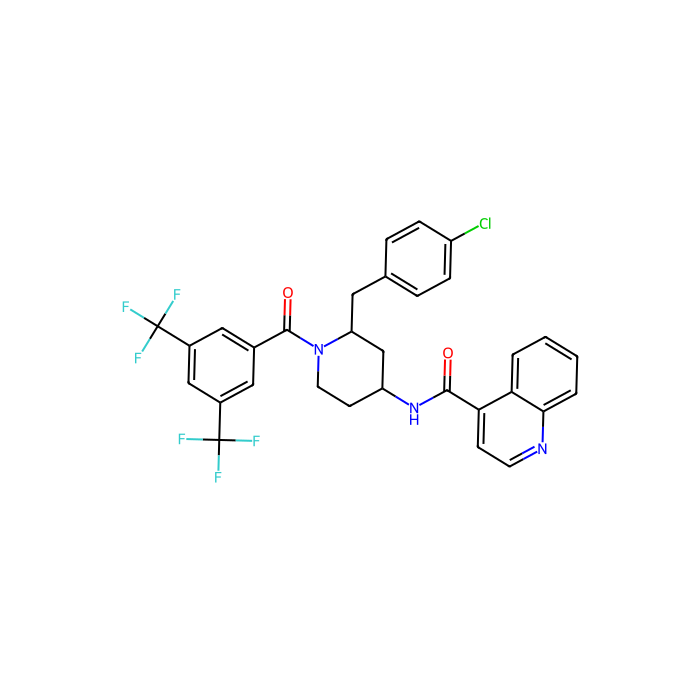
NKP608 is a non-peptidic derivative of 4-aminopiperidine which acts as a selective, specific and potent antagonist at the neurokinin-1 (NK-1) receptor both in vitro and in vivo. In vitro, the binding of NKP608 to bovine retina was characterized by an IC50 of 2.6+/-0.4 nM, whereas the compound's affinity to other receptor binding sites, including NK-2 and NK-3, was much lower. Species differences in IC(50) values with NKP608 were less pronounced than with previously described NK-1 receptor antagonists, being 13+/-2 and 27+/-2 nM in gerbil midbrain and rat striatum, respectively. In vivo, using the hind foot thumping model in gerbils, NKP608 exhibited a potent NK-1 antagonistic activity following oral administration (ID(50)=0.23 mg/kg; 2 h pretreatment), supporting a central activity of NKP608. NKP608 may prove a useful anxiolytic compound.
Condiciones de almacenamiento de almacenamiento
Store at -20°C
Enviado en
Ice chest + Ice pads
Este producto requiere envío en cadena de frío. Los servicios terrestres y otros servicios económicos no están disponibles.
This compound belongs to the class of organic compounds known as 1-benzoylpiperidines. These are compounds containing a piperidine ring substituted at the 1-position with a benzoyl group.
External Descriptors
Not available
1. Djoumbou Feunang Y, Eisner R, Knox C, Chepelev L, Hastings J, Owen G, Fahy E, Steinbeck C, Subramanian S, Bolton E, Greiner R, and Wishart DS. ClassyFire: Automated Chemical Classification With A Comprehensive, Computable Taxonomy. Journal of Cheminformatics, 2016, 8:61.
Utilizamos cookies para garantizar el correcto funcionamiento del sitio web y, cuando esté permitido, para mejorar su experiencia. Puede gestionar sus preferencias en cualquier momento en Configuración. Más información en nuestra Política de Cookies.
¿Quieres que te enviemos un mensaje cuando tengamos descuentos disponibles?
Recordármelo más tarde
¡Gracias! Por favor, revisa tu bandeja de entrada de correo electrónico para confirmar.
Products are supplied to verified businesses, institutions, and qualified professionals for research and development use only. Not for use in humans, animals, diagnosis, or therapy.