GRADE & PURITYMoligand™?Moligand™ — Aladdin's line of ligands and bioactive small molecules. Use for receptor, pathway, and binding studies needing defined small-molecule tools.10 mM in DMSO
Determine the necessary mass, volume, or concentration for preparing a solution.
Dilution Calculator
Determine the dilution needed to prepare a stock solution.
Reconstitution Calculator
Reseñas
Reseñas de cliente
Application Protocols
No item-specific, validated protocols are provided in the Product Data. The following general research-use guidance is common for catecholamine handling; adapt to your assay.
Aqueous stock preparation (general)
Target concentration: 1–100 mM depending on assay sensitivity.
Vehicle: ice-cold, degassed water adjusted to pH ~3 with HCl; optionally add 0.1–1 mM ascorbic acid and 0.1–1 mM EDTA if compatible.
Procedure: weigh quickly, dissolve with gentle mixing under N2/Ar, filter (0.22 µm) if sterility is required, aliquot into amber vials, and store frozen.
Working solutions
Prepare immediately before use by diluting into assay buffer; maintain on ice and protect from light. Discard at first signs of discoloration.
Analytical reference standard
Dry standards should equilibrate to room temperature before opening to avoid moisture condensation. Prepare calibration curves in acidified aqueous media; store standards as single-use aliquots.
These are literature-based best practices. For critical experiments, perform small-scale pilots to confirm stability in your specific setup.
Biological Roles
Literature/general background (not a product specification and not a medical claim):
Endogenous role
Norepinephrine (noradrenaline) is a catecholamine neurotransmitter and hormone synthesized from dopamine by dopamine β-hydroxylase and further metabolized by COMT and MAO pathways.
Acts primarily at adrenergic receptors (α and β subtypes) to modulate intracellular signaling cascades (e.g., cAMP via Gs/Gi, Ca2+ via Gq), influencing neuronal and peripheral cellular physiology.
Transport and storage
Uptake into presynaptic terminals is mediated by the norepinephrine transporter (NET, SLC6A2). Vesicular storage involves VMAT2. Turnover yields metabolites such as normetanephrine and VMA (literature).
Biochemical study relevance
Serves as a reference agonist in receptor pharmacology and a substrate in enzymology (COMT methylation at catechol OH; MAO oxidative deamination of the side-chain amine).
Oxidation to o-quinone species can generate reactive intermediates; experiments often include antioxidants and metal chelators to mimic physiological reducing environments.
Note: This product is intended strictly for research use to study biochemical and cellular mechanisms; it is not for human or veterinary use.
Buffer Applications
Norepinephrine hydrochloride itself is not used as a buffer component. However, its handling in buffered systems is critical for stability and assay performance.
Practical buffer considerations (literature)
Prepare stocks in cold, acidified aqueous media (e.g., pH 2.5–3.5 using HCl) to slow catechol oxidation; dilute into assay buffer immediately before use.
In neutral/physiological buffers (PBS, HBSS, HEPES), oxidation proceeds more rapidly; include antioxidants (ascorbate) and chelators (EDTA) if compatible with the assay.
Exclude oxygen (N2/Ar blanket) and protect from light during preparation and storage.
pKa context (literature)
Ammonium pKa ~9–9.5; phenolic pKa values ~8.6–11. These values inform ionization state across buffer ranges and can affect receptor binding and transporter assays.
If you require a buffering system around physiological pH, select standard buffers (e.g., phosphate, HEPES, MOPS) and treat norepinephrine as an analyte/ligand added to that buffer rather than a buffer component.
Green Alternatives
Because norepinephrine hydrochloride is a specialized bioactive small molecule rather than a commodity solvent or reagent, “green alternatives” focus on greener handling, stabilization, and analytical workflows rather than substituting the molecule itself.
Greener handling strategies (literature/general)
Use aqueous, acidified solutions (water is the greenest solvent) to prepare stocks, avoiding unnecessary organic co-solvents.
Minimize waste by preparing small, single-use aliquots to reduce repeated thaw/oxidation cycles.
Employ inline degassing or N2/Ar sparging instead of chemical oxygen scavengers where feasible.
Analytical workflow options
Prefer aqueous HPLC eluents with mild ion-pairing or volatile buffers (e.g., formate/acetate) compatible with MS, instead of non-volatile salts.
If substitution is necessary for screening paradigms
For stability-stressed assays, consider more oxidation-resistant surrogate agonists with similar pharmacology (e.g., certain non-catechol adrenergic agonists) to reduce waste from degradation; note that pharmacological profiles and selectivity will differ and must be validated (literature caution).
Trade-offs
Acidified aqueous handling improves stability but may impact biological assay conditions and require buffering steps.
Antioxidant additives (ascorbate/bisulfite) can interfere with redox-sensitive readouts; validate compatibility.
Pharmaceutical Uses
This product is supplied for research use only. No therapeutic, diagnostic, or clinical use is intended or implied.
Research/manufacturing context (general)
Often used as an analytical reference standard in quality-control laboratories for method development and system suitability related to catecholamine analysis (literature).
Can serve as a process/degradation marker in stability-indicating methods and as a positive control in bioassays targeting adrenergic pathways.
Regulatory status
Pharmacopeial monographs may exist for related salts or forms; compliance is not implied by this listing. Any pharmacopeial status for this specific item: Not specified; refer to CoA/Spec Sheet if applicable.
Formulation notes
Not applicable as an excipient. For laboratory experiments requiring formulation-like vehicles, prepare aqueous acidic solutions, avoid prolonged storage, and validate compatibility with container/closure systems.
Physical Properties
Item-specific physical specifications are not provided in the Product Data for this listing. The following values are commonly cited for norepinephrine hydrochloride in the literature; they are provided for general guidance only and are not product specifications.
Color: off-white to tan, darkening with oxidation (literature)
Solubility: highly soluble in water; sparingly soluble in polar organics (e.g., methanol, ethanol); practically insoluble in nonpolar solvents (literature)
pKa (approx., free base functional groups; literature)
Phenolic OH (first deprotonation): ~8.6–9.0
Phenolic OH (second): ~10.5–11.0
Ammonium (conjugate acid of the primary amine): ~9–9.5
LogP/logD: strongly hydrophilic; logP (free base) reported near −1 to −0.6; logD at physiological pH strongly negative (literature)
Stability considerations (literature)
Susceptible to air oxidation to o-quinone species, accelerated by alkaline pH, light, and metal ions; stabilizers (e.g., ascorbate, bisulfite) or acidic pH are commonly used for solutions.
Solutions are best prepared in oxygen-reduced, acidic media and stored cold, protected from light.
For exact purity, water/peroxide content, metal limits, UV cutoff, density, or refractive index: Not specified for this item; refer to CoA/Spec Sheet.
Quality and Grades
Grade on this listing: Moligand™ (per Product Data)
Moligand™ is used by Aladdin Scientific to denote compounds curated for ligand- and modulator-focused discovery workflows (screening libraries, biochemical assay development, and probe optimization). It emphasizes identity, suitability for biochemical screening, and data-rich characterization, distinct from bulk commodity or clinical grades.
Unless otherwise specified on the CoA, Moligand™ does not imply pharmacopeial compliance. It is intended for research use only.
What this means in practice
Identity is prioritized (NMR/LC-MS or equivalent), with impurity profiles intended for screening and medicinal chemistry. Exact purity % and impurity thresholds: Not specified for this item; refer to CoA/Spec Sheet.
Low endotoxin/bioburden is not implied unless explicitly stated.
Any stabilizers, residual solvents, or salt forms present will be listed on the CoA; none are specified in the Product Data here.
Related considerations for catecholamines
Catecholamines can undergo oxidative degradation; Moligand™ presentations may favor small pack sizes, desiccation, and cold-chain shipping (as indicated for this item) to preserve integrity.
If enantiomeric purity is critical for your application, verify on the CoA whether the material is racemic or single-enantiomer.
Reaction and Applications
This compound is most commonly used as a biochemical tool compound and analytical reference standard rather than as a general-purpose reagent. Relevant research applications include:
Biochemical/pharmacology research (general)
Endogenous catecholamine agonist used to interrogate adrenergic receptor signaling in cells, membranes, or purified systems; supports receptor profiling, desensitization studies, and second-messenger assays (e.g., cAMP, Ca2+) under controlled research conditions.
Serves as a positive control in transporter uptake/release assays (e.g., NET studies) and MAO/COMT enzymology experiments (literature).
Analytical chemistry
HPLC/UPLC method development and calibration for catecholamine quantification; electrochemical detection (ECD) or fluorescence after derivatization (e.g., OPA) (literature).
Synthetic/derivatization contexts (literature)
Phenolic groups can be protected (e.g., as benzyl or acyl derivatives) to enable further transformations; β-OH and primary amine provide handles for acylation, carbamate/urethane formation, and reductive amination.
Practical tips
Prepare working solutions fresh in cold, acidified aqueous media; purge with inert gas; store briefly on ice and shield from light.
Avoid metal contamination; use plastic tips and chelators as compatible with the assay.
Reaction Conditions
This compound is not commonly used as a reagent in named synthetic reactions without prior protection. The following guidance reflects literature practices for handling and derivatizing catecholamine scaffolds and is not an item specification.
Protection/derivatization
Phenolic protection: benzylation (BnBr/Na2CO3 or BnCl/DMF) or acylation (Ac2O/pyridine) under anhydrous conditions on the free base or suitably neutralized salt.
Amine protection: Boc protection (Boc2O, base) or CBz (Cbz-Cl) after converting to the free base; conduct under inert atmosphere to avoid oxidation.
β-OH transformations: esterification (acyl chlorides/DMAP) or Mitsunobu reactions (DEAD/PPh3) when phenols are protected.
Stability management
Solvents: dry polar aprotics (DMF, DMSO, ACN) or alcohols for protection steps; aqueous workups acidified to pH ≈ 3 to minimize air oxidation.
Temperature: 0–25°C for sensitive steps; avoid prolonged heating in air.
Atmosphere: nitrogen/argon blanket; include antioxidants when compatible (ascorbate, sulfite) for aqueous manipulations.
Analytical tracking
HPLC with aqueous acidic mobile phases and electrochemical or UV detection (280 nm) is common; MS-friendly buffers (formate/acetate) aid LC–MS monitoring.
Expected yields and times vary widely with protection strategy and substrate; consult primary literature protocols for your specific transformation.
Safety and Handling
Product-specific GHS classification and hazard statements are not supplied in the Product Data. Always consult the SDS for authoritative safety information for this item and lot.
GHS/Classification: Not specified for this item; refer to SDS.
Anticipated hazards (literature, general): may cause irritation to skin, eyes, and respiratory tract. Avoid ingestion, inhalation of dust, and contact with skin/eyes.
PPE: lab coat, safety glasses, and nitrile gloves as a minimum. Use a dust mask or work in a fume hood when handling powders.
Incompatibilities and reactive hazards (literature)
Strong oxidizers and bases; alkaline conditions accelerate oxidation of catechol moieties to quinones.
Metal ions (Fe, Cu) catalyze oxidation; use chelators or plasticware/glassware free of metal contamination for solutions.
Light and air promote degradation; minimize exposure by using amber containers and inert gas headspace.
First-aid overview (general)
Skin/eye contact: rinse cautiously with water for several minutes; remove contaminated clothing; seek medical attention if irritation persists.
Inhalation: move to fresh air; seek medical attention if symptoms occur.
Ingestion: rinse mouth; do not induce vomiting; seek medical attention.
Handling tips (practical)
Prepare solutions freshly in cold, degassed, mildly acidic water (e.g., pH ~3 with HCl) and optionally include antioxidant (e.g., ascorbate) per your protocol.
Filter-sterilize if required; avoid autoclaving solutions.
This product is for research use only.
Solvent Selection
Norepinephrine hydrochloride is a highly polar, ionic organic salt. Solvent choice should ensure sufficient solubility while minimizing oxidative degradation.
Polarity/miscibility (literature)
Freely soluble in water and aqueous buffers; solubility enhanced at acidic pH (ammonium form predominates).
Limited solubility in lower alcohols; generally insoluble in aprotic/nonpolar solvents (EtOAc, toluene, hexanes).
Practical solvent guidance
Stock solutions for biochemical work: water or buffer adjusted to pH ~2.5–3.5 (e.g., dilute HCl) often used to slow oxidation; optionally include antioxidants (ascorbate 0.1–1 mM) and metal chelators (EDTA 0.1–1 mM) as permitted by assay.
For organic transformations of protected derivatives, mixed aqueous/organic systems (MeOH/H2O, ACN/H2O) can be used, but the unprotected HCl salt is best handled in water.
Small comparison (literature)
Water (acidified): maximal solubility, best stability against oxidation.
Neutral buffers: convenient for biology, but faster oxidation; use freshly and protect from light/air.
Alcohols: modest solubility; may not sufficiently suppress oxidation and can complicate bioassays.
Always degas solutions and work cold for extended experiments.
Storage and Reconstitution
From Product Data (item-specific)
Storage conditions: Desiccated, Store at -80°C.
Shipped in: Dry ice packs + Cold packs.
General best practices for this compound class (literature; not item specifications)
Protect from light and air to minimize oxidation; use amber, airtight containers with inert gas headspace.
After first opening, promptly re-desiccate and return to -80°C. Consider subdividing into single-use aliquots under dry, inert conditions.
Reconstitution guidance (general)
Solvent: ice-cold, degassed water acidified to pH ~3 (e.g., dilute HCl). Optional stabilizers: ascorbate (0.1–1 mM) and EDTA (0.1–1 mM) if assay-compatible.
Concentration: prepare the highest practical concentration to minimize dissolved oxygen exposure; typical lab stocks 1–100 mM depending on use.
Storage of solutions: keep on ice during use; for longer storage, freeze small aliquots at ≤ −80°C. Avoid repeated freeze–thaw; discard upon discoloration or precipitate formation.
Specifications not provided
Appearance, exact purity, water content, and stabilizers: Not specified for this item; refer to CoA/Spec Sheet.
This product is for research use only.
Structure and Identity
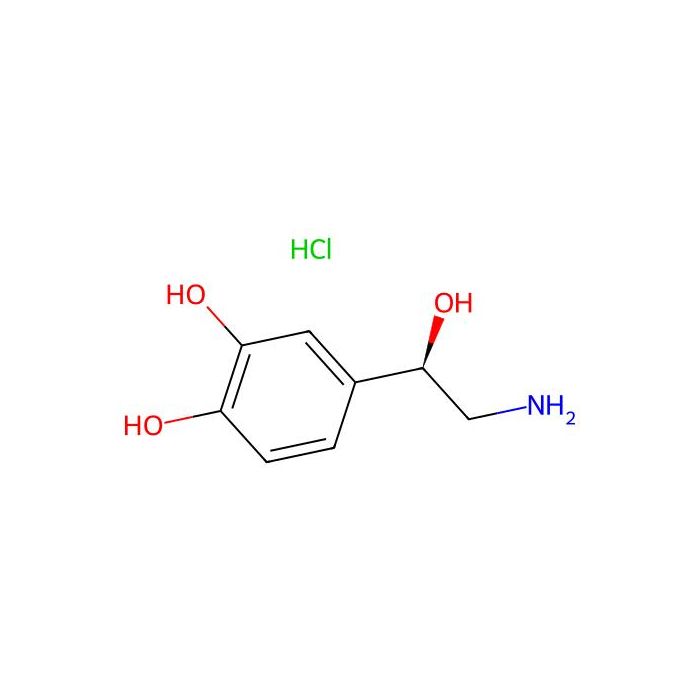
Norepinephrine hydrochloride is the hydrochloride salt of the catecholamine norepinephrine (a phenethylamine bearing a β-hydroxyl and a primary amine). As the HCl salt, it is typically isolated as a crystalline, strongly hydrophilic solid.
Item-specific identifiers (from Product Data)
SKU: N1496556
Product name: Norepinephrine hydrochloride
CAS: 329-56-6
Grade: Moligand™
InChIKey: Not specified for this item; refer to CoA/Spec Sheet.
SMILES: Not specified for this item; refer to CoA/Spec Sheet.
Core scaffold: catechol (1,2-dihydroxybenzene) ring attached to a 2-amino-1-hydroxyethyl side chain (a β-arylethanolamine).
Functional groups: two phenolic OH groups (catechol), one secondary alcohol (β-OH), one primary amine (as ammonium in the HCl salt), and a benzene ring.
Stereochemistry: one chiral center at the β-carbon (the naturally occurring configuration is (R) for the free base); the hydrochloride salt does not define configuration unless specified as a single enantiomer.
Typical literature molecular formula (HCl salt): C8H12ClNO3 (literature)
Typical literature molecular weight (HCl salt): ~205.6 g/mol (literature)
Notes
Structural identifiers (InChI/SMILES), exact stereochemistry, and definitive elemental composition for this specific lot should be confirmed on the CoA/Spec Sheet.
Synthetic Utility
While primarily a bioactive tool compound, norepinephrine hydrochloride and its derivatives can serve as versatile building blocks in synthesis (literature/general):
β-Secondary alcohol: esterification, Mitsunobu-type inversions (with phenol protection), or oxidation/reduction sequences to access related scaffolds.
Catechol phenols: O-alkylation/acylation and protection (benzyl, silyl, carbonate) to mask oxidation-prone sites.
Transformational strategies
Convergent access to β-arylethanolamines from protected catechol derivatives enables SAR exploration across adrenergic chemotypes.
Late-stage diversification via selective O-methylation (COMT-mimetic) or N-alkylation yields analogs with altered receptor selectivity and metabolic stability.
Retrosynthetic value
The scaffold connects to abundant chiral pool/resolution strategies: starting from L-phenylalaninol derivatives or asymmetric β-hydroxylation approaches, enabling enantioenriched materials.
Note: Direct transformations on the unprotected HCl salt can be hampered by high polarity and oxidation; protection and conversion to the free base are typical first steps.
Target Specificity
Not applicable. This product is a small-molecule chemical and not an antibody, enzyme prep, or biological with defined target-binding specifications in this catalog entry.
If used as a biochemical tool, it functions as an endogenous agonist at adrenergic receptors (α/β) and a substrate for NET, COMT, and MAO in research assays (literature), but no product-specific potency/selectivity data are provided here.
Preguntas frecuentes
What is Moligand??
Moligand? is one of Aladdin Scientific's premium product lines, formulated for high-purity applications across multiple workflows. Compared to standard grades in the same workflow, Moligand? products typically offer tighter specifications, more rigorous QC, and stronger lot-to-lot consistency.
How should this product be stored?
Store at ?80 °C, desiccated. Keep the container tightly closed with desiccant — the material is moisture-sensitive.
How is this product shipped?
This product ships frozen with dry ice and cold packs. Unpack on arrival and transfer it to the storage condition stated above; handle dry ice with insulated gloves in a ventilated area.
What are the CAS number, molecular formula and molecular weight?
The CAS Number is 329-56-6, the molecular formula is C8H12ClNO3, and the molecular weight is 205.64 g/mol.
What documentation is provided?
Available product documentation, including Certificates of Analysis (COA), Safety Data Sheets (SDS), and specification sheets, is shown in the product document area. Document availability and access follow the current site policy.
Utilizamos cookies para garantizar el correcto funcionamiento del sitio web y, cuando esté permitido, para mejorar su experiencia. Puede gestionar sus preferencias en cualquier momento en Configuración. Más información en nuestra Política de Cookies.
¿Quieres que te enviemos un mensaje cuando tengamos descuentos disponibles?
Recordármelo más tarde
¡Gracias! Por favor, revisa tu bandeja de entrada de correo electrónico para confirmar.
Products are supplied to verified businesses, institutions, and qualified professionals for research and development use only. Not for use in humans, animals, diagnosis, or therapy.

 F2609217