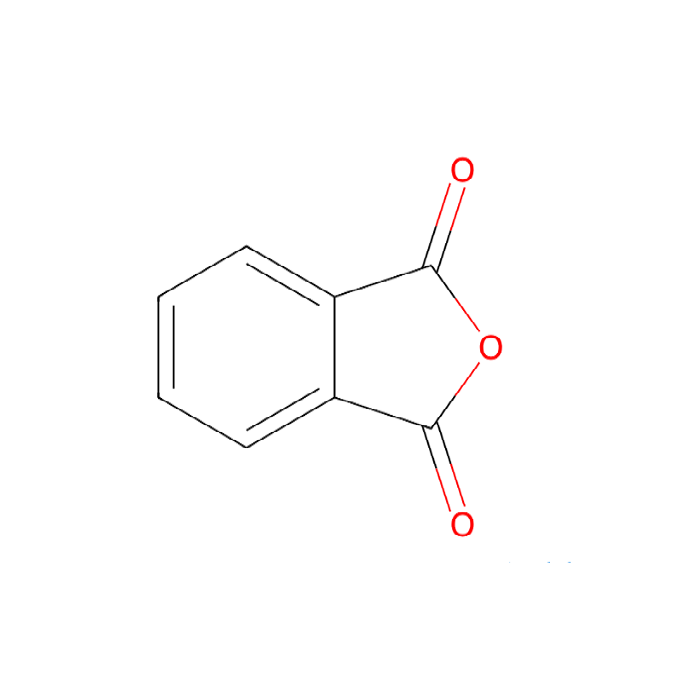
o-Phthalic anhydride - ≥99% , CAS No.85-44-9

CAS: 85-44-9 Cat. No.: P1372019 Fórmula: C8H4O3 Peso molecular: 148.12 Beilstein Registry Number: 118515 Número EC: 201-607-5
Disponible para pedir
CALIDAD & PUREZA ≥99%
Synonyms
PHTHALIC ANHYDRIDE|Wiltrol P|1,3-DIOXOPHTHALANE|Anidride ftalica|pthalic anhydride|RCRA waste number U190|Phthalic anhydride treated gelatin|2-Benzofuran-1,3-dion|1,2-Benzenedicarboxylic anhydride|1,3-Isobenzofurandione|Phthalic acid anhydride
Storage
Room temperature,Argon charged
Shipped In
FedEx DG Service
★
Talla
Alemania (EU)
USA*
Precio
Cantidad
100g
P1372019-100g
1 Disponible
—
8,59€
500g
P1372019-500g
1 Disponible
1 Disponible
15,53€
Enter a quantity for the sizes you want to add.

Descripción general

Phthalic anhydride is an industrially important chemical. It can be prepared from o-xylene or naphthalene. It is widely used for the industrial preparation of plasticizers for PVC (polyvinyl chloride).Phthalic anhydride can be synthesized via oxidation of o-xylene, in the presence of V2O5/TiO2 monolithic catalyst supported by aluminium honeycomb.

Especificaciones

Sinónimos
PHTHALIC ANHYDRIDE | Wiltrol P | 1,3-DIOXOPHTHALANE | Anidride ftalica | pthalic anhydride | RCRA waste number U190 | Phthalic anhydride treated gelatin | 2-Benzofuran-1,3-dion | 1,2-Benzenedicarboxylic anhydride | 1,3-Isobenzofurandione | Phthalic acid anhydride
Especificaciones y pureza
≥99%
Condiciones de almacenamiento de almacenamiento
Room temperature,Argon charged
Enviado en
FedEx DG Service
Pureza
≥99%
Product Line
P1372019-100g
Nombres e identificadores
Pubchem Sid
Pubchem Sid Url
https://pubchem.ncbi.nlm.nih.gov/substance/488180164
SMILES
C1=CC=C2C(=C1)C(=O)OC2=O
IUPAC Name
2-benzofuran-1,3-dione
InChIKey
LGRFSURHDFAFJT-UHFFFAOYSA-N
InChI
1S/C8H4O3/c9-7-5-3-1-2-4-6(5)8(10)11-7/h1-4H
Isómeros SMILES
C1=CC=C2C(=C1)C(=O)OC2=O
WGK Alemania
1
RTECS
TI3150000
Número ONU
2214
Grupo de embalaje
III
Peso molecular
148.12
Beilstein
118515
Reaxys
118515
Reaxys-RN_link_address
https://www.reaxys.com/reaxys/secured/hopinto.do?context=S&query=IDE.XRN=118515&ln=

Datos avanzados

Taxonomic Classification

Taxonomy Tree

KingdomOrganic compounds
SuperclassOrganoheterocyclic compounds
ClaseBenzofurans
SubclassBenzofuranones
Intermediate Tree Nodes Not available
Direct ParentPhthalic anhydrides
Alternative Parents Isobenzofuranones  Dicarboxylic acids and derivatives  Benzenoids  Carboxylic acid anhydrides  Oxacyclic compounds  Organooxygen compounds  Organic oxides  Hydrocarbon derivatives  
Molecular FrameworkAromatic heteropolycyclic compounds
Substituents Phthalic anhydride - Phthalic_anhydride - Isobenzofuranone - Isocoumaran - Benzenoid - Dicarboxylic acid or derivatives - Carboxylic acid anhydride - Oxacycle - Carboxylic acid derivative - Organic oxygen compound - Organic oxide - Hydrocarbon derivative - Organooxygen compound - Aromatic heteropolycyclic compound
DescripciónThis compound belongs to the class of organic compounds known as phthalic anhydrides. These are compounds containing a phthalic anhydride moiety (or a derivative thereof), which consists of a benzene fused to a furan-1,3-dione.
External Descriptors 2-benzofurans - cyclic dicarboxylic anhydride
Estructura 3D
Modelo de Estructura Química Interactiva


Certificados (CoA, COO, BSE/TSE y tabla de análisis)
C of A & Other Certificates(BSE/TSE, COO):
Analytical Chart:

Find and download the COA for your product by matching the lot number on the packaging.

27 results found

Lot NumberCertificate TypeFechaArticulo
J2623871J2623871Certificate of AnalysisOct 26, 2026 P1372019
J2623873J2623873Certificate of AnalysisOct 26, 2026 P1372019
J2623874J2623874Certificate of AnalysisOct 26, 2026 P1372019
I2617199I2617199Certificate of AnalysisSep 22, 2026 P1372019
J2621057J2621057Certificate of AnalysisAug 26, 2026 P1372019
H2612390H2612390Certificate of AnalysisAug 26, 2026 P1372019
H2612389H2612389Certificate of AnalysisAug 19, 2026 P1372019
H2612388H2612388Certificate of AnalysisAug 19, 2026 P1372019
F2602453F2602453Certificate of AnalysisJun 11, 2026 P1372019
F2602452F2602452Certificate of AnalysisJun 11, 2026 P1372019
C2619402C2619402Certificate of AnalysisMar 21, 2026 P1372019
C2619403C2619403Certificate of AnalysisMar 21, 2026 P1372019
C2619396C2619396Certificate of AnalysisMar 21, 2026 P1372019
C2602093C2602093Certificate of AnalysisMar 05, 2026 P1372019
C2602092C2602092Certificate of AnalysisMar 04, 2026 P1372019
C2602091C2602091Certificate of AnalysisMar 04, 2026 P1372019
A2613536A2613536Certificate of AnalysisJan 15, 2026 P1372019
A2613556A2613556Certificate of AnalysisJan 15, 2026 P1372019
A2613539A2613539Certificate of AnalysisJan 15, 2026 P1372019
K2512038K2512038Certificate of AnalysisNov 15, 2025 P1372019
K2512036K2512036Certificate of AnalysisNov 15, 2025 P1372019
J2511027J2511027Certificate of AnalysisAug 07, 2025 P1372019
I2503089I2503089Certificate of AnalysisAug 07, 2025 P1372019
G2530511G2530511Certificate of AnalysisAug 07, 2025 P1372019
G2530462G2530462Certificate of AnalysisAug 07, 2025 P1372019
G2530321G2530321Certificate of AnalysisAug 07, 2025 P1372019
G2530320G2530320Certificate of AnalysisAug 07, 2025 P1372019
Propiedades químicas y físicas
SolubilidadSoluble in water, carbon disulfide, ethanol, acetone and benzene. Slightly soluble in ethyl ether
SensibilidadMoisture sensitive.
Punto de inflamación (°F)305.6 °F
Punto de inflamación (°C)152 °C
Punto de ebullición (°C)295°C
Punto de fusión (°C)130.8°C
Peso molecular148.11
XLogP31.300
Hydrogen Bond Donor Count0
Hydrogen Bond Acceptor Count3
Rotatable Bond Count0
Exact Mass148.016 Da
Monoisotopic Mass148.016 Da
Topological Polar Surface Area43.400 Ų
Heavy Atom Count11
Formal Charge0
Complexity187.000
Isotope Atom Count0
Defined Atom Stereocenter Count0
Undefined Atom Stereocenter Count0
Defined Bond Stereocenter Count0
Undefined Bond Stereocenter Count0
The total count of all stereochemical bonds0
Covalently-Bonded Unit Count1
Seguridad y peligros (GHS)
Pictogramas
GHS05,   GHS07,   GHS08
Señal
Danger
Indicaciones de peligro

H302:Harmful if swallowed

H315:Causes skin irritation

H317:May cause an allergic skin reaction

H318:Causes serious eye damage

H334:May cause allergy or asthma symptoms or breathing difficulties if inhaled

H335:May cause respiratory irritation

H402:Harmful to aquatic life

Precauciones

P261:Avoid breathing dust/fume/gas/mist/vapors/spray.

P264:Wash hands [and …] thoroughly after handling.

P270:Do not eat, drink or smoke when using this product.

P271:Use only outdoors or in a well-ventilated area.

P272:Contaminated work clothing should not be allowed out of the workplace.

P280:Wear protective gloves/protective clothing/eye protection/face protection.

P284:[In case of inadequate ventilation] Wear respiratory protection.

P321:Specific treatment (see ... on this label).

P330:Rinse mouth.

P302+P352:IF ON SKIN: wash with plenty of water.

P304+P340:IF INHALED: Remove person to fresh air and keep comfortable for breathing.

P333+P313:IF SKIN irritation or rash occurs: Get medical advice/attention.

P362+P364:Take off contaminated clothing and wash it before reuse.

P405:Store locked up.

P403+P233:Store in a well-ventilated place. Keep container tightly closed.

P501:Dispose of contents/container to an approved waste disposal plant.

P264+P265:Wash hands [and …] thoroughly after handling. Do not touch eyes.

P301+P317:IF SWALLOWED: Get medical help.

P305+P354+P338:IF IN EYES: Immediately rinse with water for several minutes. Remove contact lenses if present and easy to do. Continue rinsing.

P317:Get emergency medical help.

P332+P317:If skin irritation occurs: Get medical help.

P319:Get medical help if you feel unwell.

P342+P316:If experiencing respiratory symptoms: Get emergence medical help immediately.

WGK Alemania
1
RTECS
TI3150000
Reaxys
118515
Reaxys-RN_link_address
https://www.reaxys.com/reaxys/secured/hopinto.do?context=S&query=IDE.XRN=118515&ln=
Clase
8
Índice Merck
7372
Preguntas frecuentes y artículos
A Complete Guide to Selecting Epoxy Curing Systems: Amines vs. Anhydrides vs. Latent Curing — with Aladdin’s Recommended Selection Table
Phthaloyl: Its Role in Primary Amine Protection and Practical Considerations for Experimental Selection
Unstabilized Azomethine Ylide Chemistry from a Single Precursor: Acceptor-Controlled Divergence and Patterns of Scaffold Outcomes
Polyetherimide (PEI): Structural Features, Main Properties, and Typical Application Directions
Alkyd Resins: From Oil/Fatty-Acid-Modified Polyesters to Autoxidative Drying — Understanding Their Structure and Film-Formation Mechanism
How Do Isocyanates and Polyols Affect the Performance of Polyurethane Coating Films: Structure, Raw Material Selection, and Performance Design Essentials
When Should You Choose Silicone Resin? Selection Comparison with Epoxy, Acrylic, Polyurethane, Fluororesin, and Other Coating Resins
Understanding Polyester Resins for Coatings: Structure Design, Key Indicators, and Coating Film Performance
Phenolic-Modified Alkyd Resin: Performance Enhancement and Applications in Fast-Drying Industrial Coatings
Cashew Nut Shell Liquid (CNSL): From Cashew Processing By-Product to Reactive Bio-Based Raw Material for Coating Resins
Guide to Common Waterborne Resin Types and Application-Based Selection: How to Choose Acrylics, PUD, Waterborne Epoxy, Waterborne Alkyd, VAE, and Related Chemicals
Mechanisms and Control of Coating Yellowing: From Chromophoric Structure Formation to Source Diagnosis and Formulation Optimization
Resin Polarity in Coating Formulations: From Molecular Structure to Dissolution, Compatibility, Interfacial Interactions, and Formulation Design
Hydrogen peroxide urea adduct (UHP)
Citations of This Product
Calculadoras de soluciones
Reseñas

Reseñas de cliente

¿Quieres que te enviemos un mensaje cuando tengamos descuentos disponibles?

Recordármelo más tarde

¡Gracias! Por favor, revisa tu bandeja de entrada de correo electrónico para confirmar.

¡Vaya! Las notificaciones están desactivadas.