This compound belongs to the class of organic compounds known as wax monoesters. These are waxes bearing an ester group at exactly one position.
External Descriptors
Wax monoesters
1. Djoumbou Feunang Y, Eisner R, Knox C, Chepelev L, Hastings J, Owen G, Fahy E, Steinbeck C, Subramanian S, Bolton E, Greiner R, and Wishart DS. ClassyFire: Automated Chemical Classification With A Comprehensive, Computable Taxonomy. Journal of Cheminformatics, 2016, 8:61.
Determine the necessary mass, volume, or concentration for preparing a solution.
Dilution Calculator
Determine the dilution needed to prepare a stock solution.
Reconstitution Calculator
Reseñas
Reseñas de cliente
Application Protocols
No assay protocols are specified for this item. As a small-molecule fatty ester, it is typically handled neat or as solutions in organic solvents for synthetic or materials experiments.
General handling examples (literature/practice):
Preparing a stock solution: Dissolve to 0.1–1.0 M in dry toluene, heptane, or DCM under nitrogen; store in amber glass at 2–8 °C for short-term use.
Biocatalysis setup: Combine substrate with immobilized lipase in hexane or tert-butanol at controlled water activity; agitate gently at 40–50 °C; monitor by GC.
Oxidation reactions: Degas solvent, add antioxidant if compatible, maintain 0–25 °C for peracid epoxidations; quench and perform buffered washes to remove acidic residues.
For analytical methods, GC-FID with nonpolar columns (e.g., DB-5) and derivatization-free injection at elevated inlet temperatures is common. Always validate conditions for your specific instrumentation and safety requirements.
Biological Roles
Item is for research use only.
General biochemical context (literature):
Structural class: Long-chain wax-like monoester. While lauryl oleate itself is not a major endogenous metabolite, wax esters are natural components of sebum and certain marine lipids. The oleic acyl moiety (C18:1 Δ9) and lauryl alcohol backbone are both of biological origin.
Enzymatic turnover: Hydrolyzed by carboxylesterases and lipases to yield oleic acid and lauryl alcohol. These products enter known metabolic pathways—oleic acid can be activated to oleoyl-CoA for β-oxidation or lipid remodeling; lauryl alcohol can be oxidized to lauric acid and further metabolized.
Membrane/colloid behavior: Extremely hydrophobic; partitions into lipid phases, forming oily droplets or monolayers at interfaces. The internal cis double bond disrupts tight packing relative to fully saturated esters, lowering melting points and increasing fluidity.
Analytical use: Serves as a model substrate for profiling lipase specificity, chain-length effects, and unsaturation sensitivity; also used to benchmark LC/GC methods for neutral lipids and to study oxidative stability of unsaturated esters.
Oxidative fate: Under oxidative stress (radicals, singlet oxygen), the olefin can epoxidize or cleave, generating aldehydes/acids—reactions mirrored in lipid peroxidation studies.
Note: No medical or clinical use is implied. Any biological experiments should include appropriate controls and verify absence of confounding stabilizers.
Buffer Applications
Not typically applicable. Lauryl oleate is a highly hydrophobic, water-insoluble neutral ester and does not function as a buffering agent. For aqueous biological work, it is generally formulated as:
Refer instead to the Reaction & Applications and Solvent Selection sections for practical handling guidance in nonaqueous or biphasic systems.
Green Alternatives
Context: Lauryl oleate is itself derivable from bio-based feedstocks (oleic acid from plant oils; lauryl alcohol from coconut/palm kernels). Green considerations focus on solvent choice, energy input, and oxidation control rather than replacing the molecule outright.
Greener positioning (literature/general):
Bio-based origin: Potentially renewable carbon depending on supply chain; biodegradable via lipase/esterase pathways.
Low volatility: Minimizes VOC emissions versus short-chain solvents.
Alternatives and trade-offs (general):
Substitute hydrophobes: 2,2,4-Trimethyl-1,3-pentanediol diisobutyrate (TXIB) or citrate esters offer low toxicity profiles but differ in polarity/plasticization and are not structurally analogous for olefin chemistry.
Saturated analogue (lauryl stearate): Enhanced oxidative stability but loses alkene reactivity—beneficial for long-term stability, detrimental when olefin functionalization is desired.
Medium-chain esters (isopropyl myristate/palmitate): Widely used, bio-based options with lower viscosity; however, altered chain length changes interfacial behavior.
Process intensification and solvent choice:
Favor heptane or 2-MeTHF over chlorinated solvents where feasible; use MTBE or CPME instead of DCM for comparable solvency with improved safety/waste metrics.
Employ continuous removal of byproducts (e.g., reactive distillation or pervaporation) to reduce energy and drive equilibria in ester-exchange, reducing catalyst load.
End-of-life and stability:
Store under inert atmosphere to reduce peroxide formation; antioxidants (e.g., tocopherols) are bio-derived options when compatible.
Pharmaceutical Uses
For research use only. No therapeutic claims.
General formulation context (literature/industry):
Excipient screening: Long-chain fatty esters such as lauryl oleate are evaluated as emollients, lubricants, or hydrophobic vehicles in topical or transdermal formulation research, affecting spreadability, occlusivity, and skin-feel in preclinical prototypes.
Solubilization: Can act as a nonaqueous phase to solubilize lipophilic actives during early-stage screening; often combined with medium-chain triglycerides, isopropyl myristate, or hydrocarbon oils.
Stability considerations: Unsaturation confers susceptibility to oxidation; antioxidants (e.g., tocopherol) and oxygen exclusion improve shelf-life. Saturated analogs offer greater oxidative stability but different sensory and solubilization profiles.
Regulatory status: Pharmacopeial monographs for this specific ester are not common; compendial status for this item is Not specified for this item; refer to CoA/Spec Sheet. Suitability must be established by the end user.
Practical notes:
Verify peroxide/acid values and residual solvent content when formulating.
Assess compatibility with packaging (polyolefins generally suitable; avoid oxidative catalysts in closures).
Physical Properties
Item-specific specifications (this lot):
Appearance, purity, water/peroxide/metal limits, refractive index, density: Not specified for this item; refer to CoA/Spec Sheet.
Literature/general properties for lauryl oleate (for context only; not item specifications):
Physical state: Colorless to pale-yellow oily liquid at ambient temperature (literature).
Melting behavior: Remains fluid well below room temperature due to the internal C=C in the oleoyl chain (literature).
Boiling range: Very high; long-chain fatty esters typically boil >300 °C at atmospheric pressure; often handled under vacuum to avoid thermal decomposition (literature).
Density: Typical fatty-ester liquids are less dense than water (literature qualitative note).
Solubility: Practically insoluble in water; miscible with nonpolar and moderately polar organic solvents such as hexanes, toluene, chloroform, diethyl ether, and isopropanol; limited solubility in acetonitrile; immiscible with highly polar protic solvents at low temperature (literature/generic behavior).
Partitioning: Strongly lipophilic; very high logP is expected for C30 monoester (literature qualitative note).
Refractive index: Long-chain unsaturated esters typically show nD ≈ 1.44–1.46 at 20–25 °C (literature range; not item-specific).
Practical implications (general):
Viscosity decreases notably on gentle warming; warm to 25–40 °C for accurate volumetric handling.
The C=C bond can undergo slow autoxidation; protect from light/air to preserve physical characteristics (odor/color). Always verify exact physical data on the product CoA.
Quality and Grades
Item-specific quality information:
Grade/Purity: Not specified for this item; refer to CoA/Spec Sheet for assay, impurity profile, and any stabilizers.
Stabilizer: Not specified for this item; refer to CoA/Spec Sheet.
Guidance on grades for fatty esters (general, for context):
Research grade: Suitable for most synthetic and materials studies; typical controls include GC purity and acid number. May or may not include antioxidants (e.g., BHT) to limit autoxidation of the C=C bond.
High-purity/low-acid grades: Feature tight limits on free fatty acid (FFA), peroxide value, and moisture—important for catalysis (e.g., transesterification, metathesis) and surface studies.
Chromatography grade (if offered): Emphasizes low UV-absorbing impurities; less common for high-MW esters but occasionally specified for surface-science applications.
What to check on the CoA for this molecule:
Purity by GC/FID or HPLC; identity by MS/FTIR; acid value and peroxide value (key for unsaturated esters); moisture (Karl Fischer) if water sensitivity matters; residual solvents and stabilizer type/concentration if present.
Odor/color: Low color and neutral odor correlate with minimal oxidation.
Practical tips:
If your application is oxidation-sensitive (e.g., metathesis), request freshly packaged material, low peroxide value, and shipment under inert headspace. For biocatalysis, confirm low FFA and absence of inhibitory stabilizers.
Reaction and Applications
Lauryl oleate serves as a versatile model of unsaturated long-chain esters and as a practical hydrophobic component in materials and formulation research.
Representative applications (literature/general):
Biocatalysis: Substrate for lipase-catalyzed hydrolysis, esterification, and interesterification; used to map enzyme selectivity for internal olefins and long chains. Control water activity and use immobilized lipases (e.g., CAL-B) for operational stability.
Transesterification: Base- or enzyme-mediated exchange with short alcohols to generate FAMEs/FAEEs for analytical standards or biodiesel studies. Remove water/alcohol continuously to drive equilibrium.
Double-bond chemistry: Epoxidation (mCPBA, performic/peracetic systems), hydroboration–oxidation, radical thiol–ene addition, ozonolysis (chain-cleavage analytics), and catalytic hydrogenation to the saturated ester (lauryl stearate).
Olefin metathesis: Cross- or self-metathesis using Ru-carbene catalysts; low-coordinating solvents and peroxide-free substrates improve outcomes.
Surface science and tribology: Acts as a boundary lubricant and hydrophobic film-former; used to tune slip, gloss, and spreadability in coatings and cosmetic formulation studies (research use only).
Self-assembly and monolayers: Long-chain amphiphobic esters organize at interfaces; employed in Langmuir–Blodgett experiments to probe packing vs. cis-unsaturation.
Practical handling tips:
Protect the olefin from oxidation: sparge with N2/Ar; consider adding a trace antioxidant if compatible with downstream chemistry.
Avoid strong base/acid when ester integrity is required. For clean functionalization of the C=C, maintain neutral conditions and exclude moisture.
Viscosity management: warm gently (25–40 °C) for accurate dosing and rapid mixing.
Reaction Conditions
General literature guidance (not item specifications):
Epoxidation of the C=C:
Reagents: mCPBA (1.1–1.5 equiv) in DCM or toluene; or in situ peracetic/performic acid.
Temperature/time: 0–25 °C, 1–6 h, monitor by TLC/GC.
Notes: Control exotherm and acidity to limit epoxide opening; wash with Na2SO3/NaHCO3.
Catalytic hydrogenation to lauryl stearate:
Catalyst: 5–10 wt% Pd/C or Ni (5–10 mol% metal relative to C=C).
Conditions: 1–5 bar H2, 20–50 °C, 1–6 h.
Notes: Filter off catalyst under inert atmosphere; confirm full C=C saturation by GC/IR.
Hydroboration–oxidation:
Reagents: 9-BBN or BH3·THF; oxidation with H2O2/NaOH.
Solvent: THF or toluene; 0–25 °C.
Notes: Internal double bond gives Markovnikov/anti-Markovnikov mixtures unless directed; 9-BBN can improve selectivity.
Olefin metathesis:
Catalyst: Grubbs II/Hoveyda–Grubbs (1–5 mol%).
Solvent: Toluene, DCM, or heptane; rigorously degassed, peroxide-free.
Temperature: 25–60 °C; hours-scale.
Notes: Trace peroxides severely inhibit; add BHT scavenger if compatible.
Solvent: Hexane/MTBE/tert-butanol; controlled water activity.
Temperature: 30–60 °C; 2–24 h.
Notes: Remove low-boiling alcohols to drive equilibrium.
Typical yields are substrate- and setup-dependent; consult primary literature and optimize on small scale before scale-up.
Safety and Handling
Authoritative hazard classification for this specific item is not provided here; consult the SDS.
Item-specific (from Product Data):
GHS classification, signal word, H-statements, pictograms: Not specified for this item; refer to SDS.
Storage: Store at -20°C. Shipped in ice chest with ice pads.
General safety information for long-chain fatty esters (literature/industry practice):
Expected hazards: Typically low acute toxicity and low volatility; may be classified as a combustible liquid. Unsaturated esters can undergo slow autoxidation forming peroxides and acids, especially on prolonged exposure to air, heat, or light.
Primary risks: Slippery spill hazard; skin/eye irritation on prolonged contact; aspiration risk is generally low due to high viscosity and low volatility but avoid aerosol formation.
Incompatibilities: Strong oxidizers (peracids, chromates), strong bases or acids (promote hydrolysis/saponification), and strong reducing agents at elevated temperature.
PPE recommendations: Lab coat, safety glasses, and appropriate chemical-resistant gloves (e.g., nitrile). Use in a well-ventilated area; minimize aerosol generation. For scale-up or heated operations, consider face shield and thermal gloves.
First-aid overview: Skin—wash with soap and water; Eye—rinse cautiously with water for several minutes; Inhalation of mists—move to fresh air; Ingestion—rinse mouth, do not induce vomiting; seek medical attention as appropriate. Provide SDS to medical responders.
Fire safety: Use dry chemical, CO2, or foam. Water spray can cool containers. Combustion may generate CO/CO2 and acrid smoke.
Stability: Store tightly sealed under inert gas if possible, protected from light, to limit oxidation of the double bond. Keep cold as specified.
Solvent Selection
This product is a substrate/reagent rather than a solvent. However, solvent choice strongly affects its handling and reactivity.
General solvent compatibility (literature):
Miscible/soluble: Nonpolar and moderately polar organics (hexanes, heptane, toluene, xylene, chloroform, dichloromethane, diethyl ether, MTBE, ethyl acetate, isopropanol). Limited solubility in acetonitrile and MeOH at room temperature but can be improved by warming.
Immiscible: Water and most aqueous buffers at room temperature.
Polarity class: Very nonpolar solute; favor low-dielectric solvents for homogeneous solutions.
Selection by application:
Transesterification (base-catalyzed): Use anhydrous alcohols (MeOH, EtOH, iPrOH) or apolar solvents with phase-transfer catalysts; remove water to suppress hydrolysis.
Lipase-catalyzed reactions: Tert-butanol, MTBE, hexane, or ionic liquids are common; water activity carefully controlled.
Olefin functionalization (epoxidation, hydroboration, metathesis): Use chlorinated solvents (DCM), toluene, or heptane; ensure O2 exclusion to minimize side oxidation.
Surface/tribology testing: Use neat or in hydrocarbon carriers (isodecane, PAO blends) depending on viscosity targets.
Quick comparison (general):
Hexane/heptane: Excellent solubility, inert; low polarity aids metathesis selectivity.
Toluene: Better for reactions needing modestly higher polarity and higher reflux temperature.
DCM/CHCl3: Good solvation and handling at ambient temperature; consider halogenated-waste implications.
Always match solvent dryness/oxygen content to your reaction’s sensitivity; degas and dry as appropriate.
Storage and Reconstitution
Item-specific requirements (from Product Data):
Storage: Store at -20°C.
Shipping: Ice chest with ice pads.
Additional best practices for this class of material (general guidance):
Container: Tightly sealed amber glass bottle with PTFE-lined cap. Minimize headspace and, if possible, blanket with inert gas (N2 or Ar) to reduce oxidation of the internal C=C.
Light/air protection: Protect from light; limit repeated air exposure. If frequent access is expected, consider aliquoting under inert atmosphere.
Temperature: Stable at -20 °C as specified. For routine use, short-term storage at 2–8 °C under inert gas is common; return to -20 °C for long-term.
Handling before use: Warm to ambient temperature or 30–40 °C to reduce viscosity; mix thoroughly to ensure homogeneity before sampling.
Reconstitution: Typically supplied neat (no reconstitution required). To prepare solutions, dissolve in suitable anhydrous organic solvent (e.g., heptane, toluene, DCM) at the desired concentration; degas if required by the application.
Freeze–thaw: The material is liquid and does not crystallize sharply; freeze–thaw cycling primarily affects dissolved oxygen content and potential oxidation rather than physical integrity. Avoid unnecessary cycles by aliquoting.
Always consult the product’s CoA/SDS for definitive stability and handling instructions for your lot.
Structure and Identity
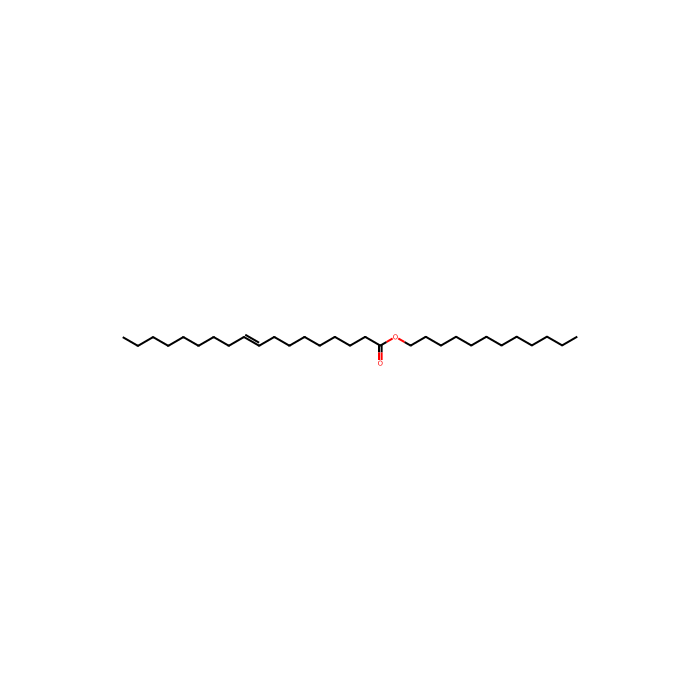
Oleic acid lauryl ester (lauryl oleate) is a long-chain fatty ester featuring a C12 alkyl alcohol esterified to the C18:1 (Δ9) oleic acid backbone.
Item-specific (from Product Data):
SKU: O334386
CAS: 36078-10-1
InChIKey: 270177 (as provided)
Storage: Store at -20°C
Shipped in: Ice chest + ice pads
Grade/Purity: Not specified for this item; refer to CoA/Spec Sheet.
Appearance: Not specified for this item; refer to CoA/Spec Sheet.
Literature/computed identifiers and features (general chemistry):
Synonym: Lauryl oleate; Dodecyl oleate
Molecular formula (literature): C30H58O2 (ester of oleic acid and lauryl alcohol)
Functional groups: One ester (alkyl oleate), one internal cis-alkene (Δ9, typically Z-geometry in natural oleate chains), two long aliphatic chains (C12 alcohol residue; C17 acyl chain beyond carbonyl)
2D structure description: An ester linkage connects a linear dodecyl chain (–(CH2)11–CH3) via oxygen to an oleoyl chain containing an internal C=C approximately mid-chain; both chains are highly hydrophobic and flexible.
Structural implications:
Amphiphobic, nonpolar molecule with low polarity and minimal H-bonding capacity (acceptor = 2; donor = 0).
The internal double bond enables selective transformations (hydrogenation, epoxidation, thiol–ene), while the ester enables transesterification and hydrolysis under suitable conditions.
Synthetic Utility
Functional group leverage:
Ester group: Amenable to transesterification (acidic/basic or enzymatic), alcoholysis, and hydrolysis (saponification). Provides handle for isotopic labeling via exchange or for installation of alternative alcohols.
Internal alkene: Enables epoxidation, dihydroxylation, hydroboration–oxidation, thiol–ene addition, radical additions, halogenation, ozonolysis (diagnostic cleavage), and hydrogenation to the saturated ester.
Prilezhaev epoxidation (peracids) to the monoepoxide; subsequent ring-opening affords vicinal diols/derivatives.
Hydroboration–oxidation to secondary alcohols at the former internal double bond.
Olefin metathesis (Grubbs/Hoveyda catalysts) for chain editing or cross-coupling with α-olefins.
Lipase-catalyzed interesterification (e.g., CAL-B) to exchange the lauryl moiety selectively under mild conditions.
Ozonolysis for structural analysis or to access shorter-chain fragments bearing carbonyl termini.
Strategic roles:
Model substrate for method development in green biocatalysis and oxidative functionalization of unsaturated lipids.
Hydrophobic protecting “environment”: the bulky aliphatic matrix can attenuate over-oxidation when conditions are carefully tuned.
Practical considerations:
Minimize base/acid strength and exposure time if retaining the ester is critical.
Remove dissolved oxygen and peroxides from solvents; pass through activated alumina or use fresh inhibitor-free stocks for metathesis and radical reactions.
Workup: Partition into hydrocarbons; use minimal polar solvents to avoid emulsions.
Target Specificity
Not applicable. This product is a small-molecule fatty ester, not an antibody, probe, or bioactive ligand with defined biological target specificity. No antigen/epitope, clone, isotype, or species reactivity data apply.
We use cookies to ensure the website functions properly and, where permitted, to improve your experience. You can manage your preferences at any time in Settings. Learn more in our Cookie Policy.
Shall we send you a message when we have discounts available?
Remind me later
Thank you! Please check your email inbox to confirm.
Products are supplied to verified businesses, institutions, and qualified professionals for research and development use only. Not for use in humans, animals, diagnosis, or therapy.

 I22081001