GRADE & PURITYMoligand™?Moligand™ — Aladdin's line of ligands and bioactive small molecules. Use for receptor, pathway, and binding studies needing defined small-molecule tools.10 mM in DMSO
Moligand™, 10 mM in DMSO Moligand™ for sensitive chromatographic and analytical workflows requiring minimal baseline interference.
🌡
Storage & shipping
Store at -80°C Ships Dry ice packs + Cold packs Check lot-specific COA for exact specifications.
📋
Quality documents
SDS, COA, datasheet, and spec sheet available for download. Lot-specific COA accessible via lot number lookup.
📚
Literature proof
Cited in 0 peer-reviewed publications across chromatography, organic synthesis, and cross-coupling reactions.
Descripción general
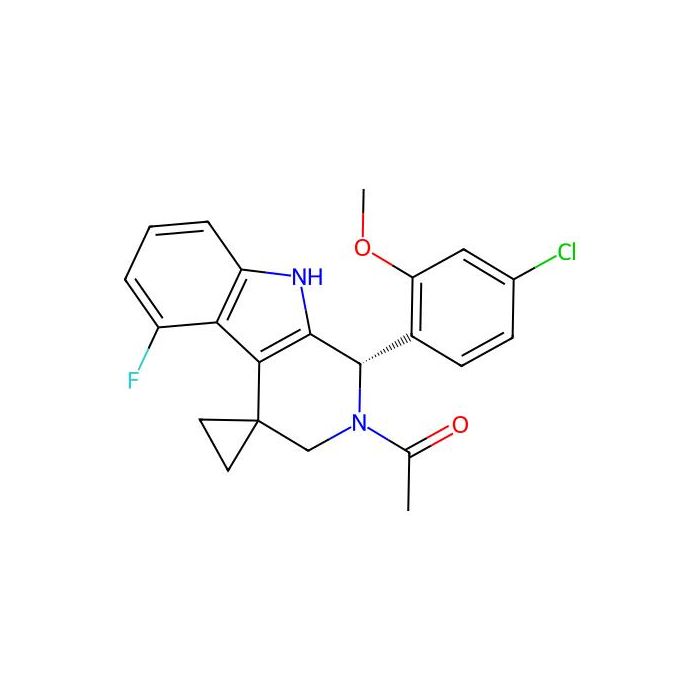
ONO-2952 is a potent, selective and orally active translocator protein 18 kDa (TSPO) antagonist with K i of 0.33-9.30 nM for rat and human TSPO . ONO-2952 is more selective for TSPO than other receptors, transporters, ion channels and enzymes . ONO-2952 exerts its anti-stress effects through inhibition of excessive activation of noradrenergic system in the brain without the amnesic effect. ONO-2952 has the potential for irritable bowel syndrome treatment .
Specifications
Especificaciones y pureza
Moligand™, 10 mM in DMSO
Condiciones de almacenamiento de almacenamiento
Store at -80°C
Enviado en
Dry ice packs + Cold packs
Este producto requiere envío en cadena de frío. Los servicios terrestres y otros servicios económicos no están disponibles.
Certificados (CoA, COO, BSE/TSE y tabla de análisis)
C of A & Other Certificates(BSE/TSE, COO):
Analytical Chart:
Calculadoras de soluciones
Molarity Calculator
Determine the necessary mass, volume, or concentration for preparing a solution.
Dilution Calculator
Determine the dilution needed to prepare a stock solution.
Reconstitution Calculator
Reseñas
Reseñas de cliente
Application Protocols
No manufacturer-validated bioassay protocols are provided for this item. The following are general, non-item-specific workflows suitable for small-molecule screening compounds.
Preparation of stocks: Dissolve ONO-2952 in anhydrous DMSO to 10–50 mM. Vortex and, if needed, sonicate briefly. Filter through 0.22 µm PTFE if particulate persists.
Biochemical assay setup:
Prepare serial dilutions in assay buffer, keeping final DMSO ≤0.5–1% v/v.
Include vehicle controls and, if relevant, detergent controls (0.01–0.02% Tween-20) to detect aggregation artifacts.
Run duplicates/triplicates and span ≥8 concentrations for reliable curve fitting.
Cell-based assay setup:
Pre-screen for cytotoxicity of vehicle and compound at intended exposure time.
Dose-response in half-log steps with appropriate media (serum effects considered).
Confirm compound stability over assay duration via LC–MS sampling of supernatants.
Data integrity checks:
Verify identity/purity of working stock by LC–MS prior to key experiments.
Track freeze–thaw cycles; discard aliquots after excessive handling.
These protocols are suggestions and must be adapted to your specific target, readout, and institutional SOPs.
Biological Roles
Item-specific biological/target data are not included in the Product Data. The following guidance is general and literature-oriented, intended to aid experimental planning. Always verify target information against primary sources before drawing conclusions.
ONO-2952 has been reported in the literature as a small-molecule ligand investigated for CNS-relevant targets. Users often evaluate such compounds for protein binding by biochemical/binding assays and in cell-based models. Exact target class, affinity, and mode of action should be confirmed from primary publications associated with CAS 895169-20-7 or PubChem CID 11524127 (literature).
For basic characterization, consider: determining apparent pKa (potentiometric or UV) to assign the relevant protonation state at assay pH; measuring logD7.4 and passive permeability (e.g., PAMPA) to anticipate cellular exposure; and assessing plasma protein binding if in vitro ADME is of interest in your research program.
Off-target risk management (general): apply broad selectivity panels or orthogonal phenotypic counterscreens when biological readouts are complex.
No medical or clinical claims are made here. This product is supplied strictly for research use only, as specified in the Product Data.
Buffer Applications
This product is a small-molecule screening ligand and is not a buffering agent. Consequently, classic buffer recipes and pH ranges do not apply directly.
Practical notes for assay buffers involving small molecules:
Use biologically compatible buffers (e.g., HEPES, PBS, Tris) appropriate for your target and assay temperature.
Maintain low organic vehicle content (typ. ≤0.5–1% DMSO v/v) and include 0.01–0.05% nonionic surfactant when aggregation is a concern.
Filter buffers (0.22 µm) and equilibrate to temperature to minimize drift in binding/enzymatic measurements.
For compound-specific pH solubility profiles or salt-form preparation, consult the CoA or determine experimentally.
Green Alternatives
As a discovery ligand/tool compound, ONO-2952 is not a solvent or a common synthetic reagent; therefore, classical green-chemistry substitution (e.g., replacing DMF with a greener solvent) is generally inapplicable to the compound itself. Instead, focus on greener choices for the surrounding assay or formulation system:
Prefer aqueous buffers with minimal DMSO (≤0.5% v/v) when solubility allows.
For necessary organic vehicles, consider EtOH over higher-toxicity amide solvents, keeping the final concentration low and validating assay tolerance.
Minimize material usage: adopt miniaturized assay formats (384/1536-well) to reduce solvent and compound consumption.
Waste reduction: consolidate solvent rinses, employ microscale analytics (UPLC), and segregate halogenated vs non-halogenated waste streams.
If this compound is used as a synthetic substrate in custom chemistry:
Evaluate greener solvents (e.g., 2-MeTHF or cyclopentyl methyl ether) where mechanistically appropriate, acknowledging potential trade-offs in solubility and reaction rates.
Use flow chemistry or microwave heating to decrease energy input and reaction times.
Note: No item-specific environmental metrics (biodegradability, EHS scores) are provided; consult your EHS team for life-cycle considerations.
Pharmaceutical Uses
No pharmacopeial or excipient role is provided for this item. ONO-2952 is offered as a research-use-only small molecule (Moligand™) and is not intended for human or veterinary use.
Formulation considerations for research contexts (non-clinical, non-GLP):
Prepare DMSO master stocks (10–50 mM); for in vivo exploratory research (if applicable in your institution), scientists typically reformulate using biocompatible vehicles (e.g., PEG400/saline/cremophor), but such use falls outside the scope of this catalog entry—consult institutional guidelines.
For in vitro studies, ensure vehicle-matched controls and confirm compound stability in the chosen medium (e.g., measure by LC–MS after incubation at 37°C for assay duration).
No medical, therapeutic, or clinical claims are made. This product is not certified to any pharmacopeia and is not an API/excipient.
Physical Properties
Item-specific physico-chemical constants are not supplied in the Product Data. Provide experimental determinations or consult the batch CoA as needed for critical method development.
Appearance: Not specified for this item; refer to CoA/Spec Sheet.
Molecular Weight (exact): Not specified for this item; refer to CoA/Spec Sheet.
Molecular Formula: Not specified for this item; refer to CoA/Spec Sheet.
Melting point (mp): Not specified for this item; refer to CoA/Spec Sheet.
Boiling point (bp): Not applicable for most high-MW screening ligands; specific value not provided.
Density: Not specified for this item; refer to CoA/Spec Sheet.
Refractive index: Not applicable/typically not measured for solids; not specified.
Solubility (water/organics): Not specified for this item; refer to CoA/Spec Sheet.
logP/logD, pKa(s): Not specified for this item; consult literature via CAS 895169-20-7 or calculate in silico for assay design.
Practical guidance (general):
For plate-based screening, prepare 10–50 mM DMSO master stocks, then dilute into aqueous assay buffers ensuring final DMSO ≤0.5–1% v/v to limit vehicle effects.
If limited aqueous solubility is observed, consider co-solvent systems (DMSO:buffer, 1:9), surfactant (0.01–0.05% Tween-20), or pH adjustment if compatible with the compound’s ionizable groups (verify by calculation/experiment).
Quality and Grades
Grade/Purity: Moligand™ (from Product Data)
What Moligand™ signifies:
Screening-grade small molecule: Intended for discovery research (target engagement, binding, phenotypic screening). Emphasis is on identity and suitability for biochemical/cellular assays rather than process chemistry.
Analytical verification: Typically includes identity confirmation (e.g., LC–MS/HRMS, NMR) and purity assessment appropriate for screening; exact specifications (e.g., assay %, residual solvents, counter-ions) are batch-dependent and provided on CoA when available. Specific numeric purity is not provided here and should be verified if critical to your assay window.
Impurity considerations: For SAR or target deconvolution, we recommend orthogonal analytics (LC–UV at multiple wavelengths, LC–MS, qNMR) to confirm absence of confounding impurities, especially if unusually potent/pleiotropic readouts occur.
Stabilizers/antioxidants: Not specified for this item; refer to CoA/Spec Sheet.
Fit-for-purpose guidance:
For biophysical assays (ITC, SPR, DSF), confirm solubility and optical clarity at working concentrations.
For cell-based assays, test vehicle controls and perform titration of DMSO to exclude solvent artifacts.
For photolabile or hygroscopic compounds, minimize light/moisture exposure; verify if such properties apply to your lot via CoA.
Reaction and Applications
This product is positioned as a screening ligand rather than a synthetic reagent. Consequently, traditional reaction applications (as a reagent, catalyst, or building block) are not the primary use-case.
Research applications (general for Moligand™ items):
Target engagement assays: Thermal shift (DSF), CETSA, fluorescence polarization, or TR-FRET to assess binding to protein targets of interest.
Biochemical activity assays: Enzyme inhibition/activation studies, with robust controls for aggregation and redox artifacts.
Biophysical characterization: SPR/ITC to quantify affinity and thermodynamics if sufficient solubility and stability are confirmed.
Practical tips:
Confirm compound integrity by LC–MS before critical studies, especially after multiple freeze–thaw cycles.
Include detergent controls (e.g., 0.01–0.02% Triton X-100 or Tween-20) to rule out colloidal aggregation artifacts in biochemical assays.
Use serial dilutions (½–¼ log steps) spanning at least 8–10 points for reliable curve fitting and Hill-slope evaluation.
If synthetic transformation of this molecule is desired (e.g., for analoging), first verify the exact structure and functional groups from CoA/literature; then consult the Synthetic Utility section.
Reaction Conditions
Classical reaction-condition guidance is not directly applicable because ONO-2952 is supplied as a screening ligand rather than a reagent. No item-specific reactivity or transformation data are provided in the Product Data.
If the compound is to be modified (research derivatization):
Choose solvents and bases/acids compatible with the confirmed functional groups (once structure is verified). For heteroaromatic systems, amide solvents (DMF, NMP) or green ethers (2-MeTHF) are often used; for cross-couplings, consider toluene/EtOH/water blends.
Typical temperatures for cross-coupling or amidation span room temperature to 120°C (literature, general). Employ inert atmosphere if air/moisture-sensitive steps are involved.
Reaction times vary from minutes (microwave) to 16–24 h (thermal). Monitor by LC–MS/UPLC and adjust conditions accordingly.
These are general literature guidelines and not specific to this item. Verify the exact structure and functional group compatibility before any synthetic manipulation.
Safety and Handling
Safety data specific to this item are not provided in the Product Data and may vary by batch. Always review the SDS before handling.
GHS Classification: Not specified for this item; refer to SDS.
Signal Word / H-Statements / Pictograms: Not specified for this item; refer to SDS.
General laboratory precautions for small-molecule screening ligands:
PPE: Lab coat, safety glasses, and appropriate chemically resistant gloves. Avoid skin/eye contact and inhalation of dust or aerosols.
Engineering controls: Handle powders in a fume hood or ventilated enclosure; use dust-minimizing techniques (weighing boats with antistatic measures).
Incompatibilities: Avoid strong oxidizers and strong acids/bases until the compound’s functional groups are confirmed. Keep away from ignition sources when using organic solvents.
First aid (overview): If inhaled, move to fresh air; for skin/eye contact, rinse with water for ≥15 min; if ingested, rinse mouth. Seek medical attention per SDS guidance.
Spill/accidental release: Avoid dust formation. Absorb solutions with inert material, collect in chemical waste. Decontaminate surfaces with suitable solvent/detergent.
Waste: Dispose according to institutional and local regulations for organic chemical waste.
Note: No medical or clinical use. For research use only, as stated in the Product Data.
Solvent Selection
Because item-specific solubility data are not provided, select solvents using general best practices for discovery ligands:
Primary stock solvent: DMSO is recommended for master stocks (10–50 mM) due to broad solvency and assay compatibility at ≤0.5–1% v/v final.
Secondary solvents/co-solvents:
DMF or NMP: higher solvency for polar/heteroaromatic scaffolds; verify cell compatibility at low percentages.
Ethanol or methanol: acceptable for some biochemical assays; monitor volatility and enzyme sensitivity.
Aqueous buffers: feasible if the compound bears ionizable groups; determine pKa and prepare at pH where ionization enhances solubility without compromising target binding.
Miscibility profile: DMSO is miscible with water and most organics, simplifying serial dilutions into assay buffers.
When to choose alternatives: If precipitation occurs upon dilution, pre-dilute the DMSO stock into buffer stepwise (e.g., 1:10 into buffer containing 0.01–0.05% nonionic surfactant), maintain gentle mixing, and avoid high local concentrations.
Quick comparison (general):
DMSO: highest success rate for discovery ligands; low UV cutoff but acceptable for most plate readers.
DMF/NMP: stronger solvency; greater cytotoxicity risk—use sparingly in cells.
Alcohols: convenient but can denature proteins at higher %; monitor controls.
Storage and Reconstitution
Storage Conditions: Store at −80°C (from Product Data).
Shipping: Dry ice packs + Cold packs (from Product Data) to maintain low temperature during transit.
Handling and reconstitution (general best practices for small-molecule ligands):
Upon receipt, allow the sealed container to equilibrate to room temperature in a desiccator before opening to prevent moisture condensation.
If supplied as a solid, prepare anhydrous DMSO master stocks (10–50 mM). If supplied in solution, verify concentration by UV/LC–MS and aliquot immediately.
Aliquot stocks into single-use volumes (e.g., 10–50 µL) in inert, low-bind tubes. Avoid repeated freeze–thaw; track the number of cycles.
Store DMSO stocks at −20 to −80°C (−80°C preferred for long-term). Protect from light if the scaffold is potentially photosensitive (confirm from structure/literature).
Prior to assay, thaw aliquots quickly at room temperature, mix, and inspect for precipitation. If precipitated, warm gently and vortex/sonicate briefly; avoid prolonged heating.
Specifications not provided for this item:
Stabilizers, water content, residual solvents, and exact purity: Not specified for this item; refer to CoA/Spec Sheet.
Note: For research use only.
Structure and Identity
Concise identity information for ONO-2952 suitable for screening-library and medicinal chemistry workflows.
Product Name: ONO-2952 (Moligand™ series)
CAS: 895169-20-7 (from Product Data)
PubChem CID: 11524127 (from Product Data)
InChIKey: Not specified for this item; refer to CoA/Spec Sheet.
SMILES: Not specified for this item; refer to CoA/Spec Sheet.
Molecular Formula: Not specified for this item; refer to CoA/Spec Sheet.
Molecular Weight: Not specified for this item; refer to CoA/Spec Sheet.
Structural features (general guidance):
Item-specific functional groups, ring systems, and stereochemical descriptors are not provided in the Product Data. When structure-resolved experimentation is required (e.g., docking, QSAR), source the structure from the cited CAS/CID and confirm via primary literature or our CoA.
2D representation: Not provided here. Users may retrieve the 2D/3D record from the CID (literature reference) and verify exact tautomer/protonation state suitable for their assay pH.
Notes on identifiers:
When using external databases (e.g., PubChem via CID 11524127), ensure the registered form (free base vs. salt, specific polymorph) matches your experimental plan. Cross-check against our batch-specific documentation where available.
Synthetic Utility
ONO-2952 is supplied as a finished small-molecule ligand and is not primarily intended as a synthetic building block. Without item-specific structural details in the Product Data, actionable retrosynthetic analysis or functional-group transformation guidance cannot be provided here.
If derivatization is desired in a research setting:
Retrieve the exact structure from authoritative sources (CAS 895169-20-7; CID 11524127) and verify by NMR/HRMS.
Map liabilities for late-stage diversification (e.g., halogens, heteroaryl handles, amide/urea linkages) and assess tolerance to coupling conditions.
For probe development, consider installing reporter handles (alkyne/azide for click chemistry, photoaffinity motifs) at positions shown by SAR to be permissive—guided by literature.
General tips:
Use microscale scouting reactions with LC–MS monitoring to establish chemoselectivity prior to scale-up.
Confirm purity and identity of any derivatives with orthogonal methods (qNMR, LC–HRMS).
Target Specificity
Target/epitope/clone/isotype data are applicable to biological macromolecules (e.g., antibodies), not to small molecules like ONO-2952. No target specificity information is provided in the Product Data for this item.
Item-specific target annotations: Not specified for this item; refer to primary literature associated with CAS 895169-20-7 or PubChem CID 11524127 if needed for your research.
For screening use, determine target specificity empirically via binding assays, selectivity panels, or chemoproteomic profiling as appropriate.
Need help choosing the grade?
Our grade selection guide covers purity, stabilizer status, and application suitability for all variants in our catalog.
We use cookies to ensure the website functions properly and, where permitted, to improve your experience. You can manage your preferences at any time in Settings. Learn more in our Cookie Policy.
Shall we send you a message when we have discounts available?
Remind me later
Thank you! Please check your email inbox to confirm.
Products are supplied to verified businesses, institutions, and qualified professionals for research and development use only. Not for use in humans, animals, diagnosis, or therapy.