Determine the necessary mass, volume, or concentration for preparing a solution.
| Activity Type | Relation | Activity value | Units | Action Type | Journal | PubMed Id | doi | Assay Aladdin ID |
|---|

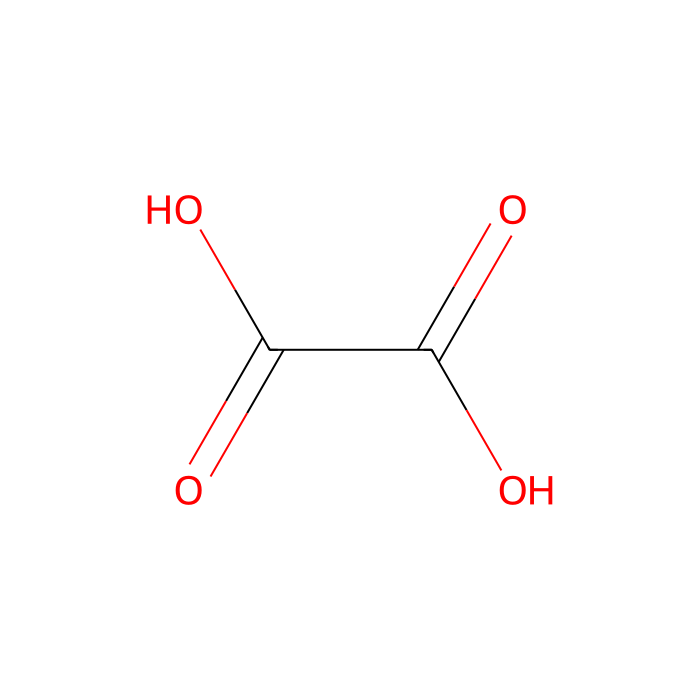
Oxalic acid is present as potential impurity in some active pharmaceutical ingredients.
Oxalic acid was used: · in the synthesis of hemicellulose hydrolysates of yellow poplars; · in the synthesis of three-dimensionally ordered macroporous metal oxides or carbonates via templating with polystyrene spheres; · as supporting electrolyte in the electrochemical synthesis of polyaniline-polypyrrole composite coatings.
Taxonomy Tree
| Kingdom | Organic compounds |
|---|---|
| Superclass | Organic acids and derivatives |
| Clase | Carboxylic acids and derivatives |
| Subclass | Dicarboxylic acids and derivatives |
| Intermediate Tree Nodes | Not available |
| Direct Parent | Dicarboxylic acids and derivatives |
| Alternative Parents | Carboxylic acids Organic oxides Hydrocarbon derivatives Carbonyl compounds |
| Molecular Framework | Aliphatic acyclic compounds |
| Substituents | Dicarboxylic acid or derivatives - Carboxylic acid - Organic oxygen compound - Organic oxide - Hydrocarbon derivative - Organooxygen compound - Carbonyl group - Aliphatic acyclic compound |
| Descripción | This compound belongs to the class of organic compounds known as dicarboxylic acids and derivatives. These are organic compounds containing exactly two carboxylic acid groups. |
| External Descriptors | alpha,omega-dicarboxylic acid |
| Activity Type | Relation | Activity value | Units | Action Type | Journal | PubMed Id | doi | Assay Aladdin ID |
|---|
| Activity Type | Relation | Activity value | Units | Action Type | Journal | PubMed Id | doi | Assay Aladdin ID |
|---|
Find and download the COA for your product by matching the lot number on the packaging.
| Lot Number | Certificate Type | Fecha | Articulo |
|---|---|---|---|
 J2218353 | Certificate of Analysis | Jul 03, 2026 | O421641 |
| Sensibilidad | Moisture sensitive. |
|---|---|
| Punto de inflamación (°F) | 200.1℉ |
| Punto de inflamación (°C) | 93.4℃ |
| Punto de fusión (°C) | 189-191°C |
| Peso molecular | 90.03 |
| XLogP3 | -0.300 |
| Hydrogen Bond Donor Count | 2 |
| Hydrogen Bond Acceptor Count | 4 |
| Rotatable Bond Count | 1 |
| Exact Mass | 89.9953 Da |
| Monoisotopic Mass | 89.9953 Da |
| Topological Polar Surface Area | 74.600 Ų |
| Heavy Atom Count | 6 |
| Formal Charge | 0 |
| Complexity | 71.500 |
| Isotope Atom Count | 0 |
| Defined Atom Stereocenter Count | 0 |
| Undefined Atom Stereocenter Count | 0 |
| Defined Bond Stereocenter Count | 0 |
| Undefined Bond Stereocenter Count | 0 |
| The total count of all stereochemical bonds | 0 |
| Covalently-Bonded Unit Count | 1 |
H318:Causes serious eye damage
H402:Harmful to aquatic life
H302+H312:Harmful if swallowed or in contact with skin
P264:Wash hands [and …] thoroughly after handling.
P270:Do not eat, drink or smoke when using this product.
P273:Avoid release to the environment.
P280:Wear protective gloves/protective clothing/eye protection/face protection.
P362+P364:Take off contaminated clothing and wash it before reuse.
P501:Dispose of contents/container to an approved waste disposal plant.
P302+P352+P312:IF ON SKIN: Wash with plenty of water.Call a POISON CENTER/ doctor if you feel unwell.
P301+P312+P330:IF SWALLOWED: Call a POISON CENTER/ doctor if you feel unwell. Rinse mouth.
P305+P351+P338+P310:IF IN EYES: Rinse cautiously with water for several minutes. If contact lenses are worn and can be easily removed, remove Contact lenses. Continue rinsing. Immediately call an emergency center/doctor.