CALIDAD & PUREZAMoligand™?Moligand™ — Aladdin's line of ligands and bioactive small molecules. Use for receptor, pathway, and binding studies needing defined small-molecule tools.10 mM in DMSO
Phenanthrene is an orally active polycyclic aromatic hydrocarbon (PAH) that induces inflammation, oxidative stress, and apoptosis . Additionally, phenanthrene is commonly used to detect or assess PAH pollution in the environment .
Especificaciones
Especificaciones y pureza
Moligand™, 10 mM in DMSO
Condiciones de almacenamiento de almacenamiento
Store at -80°C
Enviado en
Dry ice packs + Cold packs
Este producto requiere envío en cadena de frío. Los servicios terrestres y otros servicios económicos no están disponibles.
Determine the necessary mass, volume, or concentration for preparing a solution.
Dilution Calculator
Determine the dilution needed to prepare a stock solution.
Reconstitution Calculator
Reseñas
Reseñas de cliente
Application Protocols
No vendor-validated bioassay protocols are provided for this small molecule. Typical research uses include small-molecule screening, photophysical measurements, and materials synthesis.
General starting points (research use only; literature/practice-based):
Stock preparation: Dissolve phenanthrene in toluene, DMF, or DMSO to 10–50 mM. Sonication and mild warming (≤40 °C) aid dissolution. Filter (0.2 µm PTFE) for spectroscopic work.
Fluorescence measurement: Prepare ~1–10 µM solutions in spectroscopic-grade toluene or acetonitrile; degas by freeze–pump–thaw (3 cycles) or sparge with argon. Use quartz cuvettes and minimize stray light.
Binding/partition assays: Make concentrated DMSO stocks; dilute into buffer with ≤1% v/v DMSO final (or per assay tolerance). Include solvent-only controls. Equilibrate sufficiently to avoid precipitation.
Any application-specific, lot-specific recommendations: Not specified for this item; refer to CoA/Spec Sheet.
Biological Roles
Phenanthrene is not a biomolecule; however, as a representative polycyclic aromatic hydrocarbon, it is frequently used in environmental toxicology and biochemistry research (literature/general).
Metabolic processing (literature):
Oxidatively metabolized by cytochrome P450 monooxygenases to epoxides, dihydrodiols, and phenanthrenequinone derivatives; downstream conjugation (e.g., glucuronidation, sulfation) facilitates excretion.
Model substrate:
Serves as a probe for studying aryl hydrocarbon receptor (AhR) interactions and induction of xenobiotic metabolism pathways in vitro.
Partitioning/biophysics:
Employed as a hydrophobic marker for membrane partitioning, protein binding in hydrophobic cavities, and sorption to natural organic matter and engineered carbons.
Ecotoxicology:
Used to assess bioaccumulation, phototoxicity, and PAH degradation by microbial consortia and enzymes (dioxygenases) under controlled laboratory conditions.
Note: Research use only. No clinical or therapeutic claims are made or implied.
Buffer Applications
Phenanthrene is a nonpolar hydrocarbon with extremely low aqueous solubility and does not function as a buffering agent.
It is not typically used to prepare buffer systems. For experiments requiring aqueous handling, prepare concentrated stocks in a miscible organic co-solvent (e.g., DMSO or DMF) and dilute into buffer while keeping final organic content within assay tolerance.
For binding or partition studies, use co-solvent controls and ensure thorough mixing/sonication to avoid precipitation or micelle partitioning artifacts.
Green Alternatives
While phenanthrene itself is the target analyte/scaffold and not easily substituted in PAH-specific studies, greener choices can be made in the surrounding workflow.
Solvent selection (literature/general):
Prefer toluene, anisole, or 2-methyltetrahydrofuran (2-MeTHF) over dichloromethane/chloroform when feasible.
Use alcohols (ethanol, isopropanol) or ethyl acetate for workups in place of halogenated solvents if solubility permits.
Oxidations (literature/general):
Replace Cr(VI)-based oxidants with safer alternatives such as DDQ, IBX, or catalytic aerobic systems (e.g., Cu/air) for forming phenanthrenequinone where compatible.
Halogenation/coupling (literature/general):
Employ NBS under photoredox or mild radical conditions instead of Br2/FeBr3; for cross-coupling, use nickel catalysis and aqueous micellar media (e.g., surfactant-enabled) to reduce organic solvent demand.
Energy and emissions:
Consider flow photochemistry for controlled halogenations or oxidations, improving heat/mass transfer and reducing solvent volumes.
Trade-offs:
Greener solvents may reduce solubility or reaction rates for PAHs; careful optimization (temperature, catalyst loading) is required.
Micellar catalysis can limit substrate concentration for highly hydrophobic PAHs; co-solvents or surfactant choice may be necessary.
Pharmaceutical Uses
Phenanthrene is not used as a pharmaceutical excipient or active in approved formulations; however, in research and development contexts it may serve analytical or materials roles (literature/general).
Potential R&D roles:
Fluorescence/UV standard for instrument qualification and method development.
Hydrophobic probe to challenge formulations (e.g., studying solubilization by surfactants, cyclodextrins, or lipid-based systems) in pre-formulation research.
Structural motif: the phenanthrene ring system appears in certain APIs as part of larger frameworks, but phenanthrene itself is not formulated for therapeutic use.
Regulatory status and pharmacopeia monographs: Not specified for this item; refer to CoA/Spec Sheet.
Note: For research use only; not for human or veterinary use.
Physical Properties
The following properties are literature values or general references; they are not product specifications for this specific lot.
Appearance: Not specified for this item; refer to CoA/Spec Sheet.
Melting point: ~99–101 °C (literature)
Boiling point: ~340–342 °C at 1 atm (literature)
Density: ~1.18 g/cm³ at 25 °C (literature)
Vapor pressure: very low at ambient temperature (literature)
Water solubility: ~1–1.3 mg/L at 25 °C (very low) (literature)
Solubility in organics: soluble in benzene, toluene, xylene, chloroform, dichloromethane, carbon disulfide; sparingly soluble in ethanol and acetonitrile (literature)
logP (octanol/water): ~4.5–4.6 (literature)
pKa: not applicable (non-ionizable hydrocarbon) (literature)
UV/Vis: strong π→π* absorption in the near-UV; structured fluorescence with emission in the blue region (literature)
Notes for practitioners (general):
Low volatility and high hydrophobicity facilitate handling as a solid; however, dust control is advisable.
Due to strong π-conjugation, phenanthrene is fluorescent and light-absorbing; for photophysical work, use spectroscopic-grade solvents and control dissolved oxygen for reproducibility.
Quality and Grades
Grade/Purity: Moligand™ (per Product Data)
About Moligand™ (context):
Moligand™ denotes inclusion in a curated small-molecule/ligand screening collection intended for research discovery, cheminformatics, and assay development. It emphasizes identity, library compatibility, and handling suitability rather than analytical-chromatography solvent grades.
What this means in practice:
Identity confirmation and library readiness are prioritized (e.g., structure-verified for screening). Specific impurity profiles, residual solvent limits, metal content, or spectrophotometric cutoffs are not implied by the Moligand™ designation.
Item-specific assays such as water content (KF), residual peroxide, metal traces, or UV cutoff: Not specified for this item; refer to CoA/Spec Sheet.
When to choose Moligand™ phenanthrene:
Suitable for high-throughput screening, binding studies in hydrophobic pockets, host–guest testing, photophysics benchmarking, or as a nonpolar probe in partition experiments.
For trace-analysis calibration, regulatory submission, or materials manufacturing where defined impurity limits are critical, consult the CoA/Spec Sheet or request a lot with the required specification.
Stabilizers/additives:
None stated. Any stabilizer or inhibitor content: Not specified for this item; refer to CoA/Spec Sheet.
Reaction and Applications
Phenanthrene serves as a prototypical PAH scaffold in synthesis, materials, and analytical chemistry.
Scaffold in organic materials:
Used to construct extended π-systems via Scholl cyclodehydrogenation or oxidative coupling, enabling graphene nanoribbon and OLED/OPV component synthesis (literature).
Electrophilic substitution (literature):
The 9,10-positions exhibit enhanced reactivity; halogenation, nitration, and Friedel–Crafts acylation preferentially occur there under controlled conditions.
Halogenation and cross-coupling (literature):
9-Bromophenanthrene prepared via Br2/FeBr3, NBS, or radical conditions is a versatile partner for Suzuki, Stille, Negishi, and Kumada couplings to elaborate PAHs.
Directed metalation (literature):
9-Lithiophenanthrene forms with n-BuLi (often with TMEDA) at low temperature; subsequent quench with electrophiles affords 9-substituted derivatives.
Oxidation (literature):
Oxidation at 9,10 yields phenanthrene-9,10-quinone, a valuable intermediate for further nucleophilic additions and annulations.
Hydrogenation (literature):
Partial hydrogenation gives dihydro/tetrahydro derivatives for reactivity studies and as intermediates.
Analytical/photophysical uses (literature):
Employed as a fluorescence standard, probe for solvatochromism, and model for π–π interactions and host–guest inclusion (e.g., cyclodextrins, MOFs).
Manufacturer Applications: None provided beyond inclusion in a small-molecule/compound library. Typical expansions include its use as a hydrophobic probe ligand in biophysical binding and as a rigid aromatic core in fragment-based materials discovery (research use only).
Reaction Conditions
Representative literature conditions for transforming phenanthrene (guidance only; optimize per system):
9-Bromination (electrophilic):
Br2 (1.0–1.2 equiv) in CCl4 or CHCl3, catalytic FeBr3 or light; 0–25 °C; hours. Alternative: NBS (1.1–1.5 equiv) with AIBN or photochemical initiation in CCl4/CH2Cl2.
9-Lithiation/electrophile trapping:
n-BuLi (1.1–1.3 equiv) in THF or Et2O at −78 to −40 °C, often with TMEDA; quench with DMF (formylation), Me3SiCl (silylation), B(OMe)3 then oxidative workup (borylation). Typical times: 0.5–2 h lithiation; yields variable (50–80%).
Oxidation to phenanthrene-9,10-quinone:
DDQ or nitric acid/acetic acid; 0–25 °C to reflux depending on reagent; or catalytic Cu/air under oxidative conditions. Monitor by TLC/UV.
Cross-coupling from 9-bromophenanthrene:
Suzuki–Miyaura: Pd(PPh3)4 or Pd2(dba)3/XPhos; base K2CO3/K3PO4 in toluene/H2O or dioxane/H2O, 80–110 °C, 4–16 h.
Stille/Negishi: standard Pd catalysts in DMF/toluene; 60–110 °C.
Hydrogenation:
H2 (1–5 bar) over Pd/C in ethanol or ethyl acetate at ambient to 50 °C; control equivalents/time to achieve di- vs tetrahydro products.
Scholl cyclization (ring fusion):
FeCl3 or AlCl3 in dichloromethane/nitromethane/CS2 at 0–25 °C to reflux; inert atmosphere; water-sensitive.
General tips:
Ensure complete dissolution in an appropriate solvent before initiating reactions; gentle heating and sonication help.
Protect from strong light during radical brominations unless photoinitiated intentionally.
For photophysical assays, rigorously degas to avoid oxygen quenching.
Safety and Handling
Safety information below provides general guidance for phenanthrene (PAH) handling. Item-specific hazards, GHS classification, and pictograms: Not specified for this item; refer to SDS.
Anticipated hazards (general, literature):
Polycyclic aromatics may be harmful if inhaled or ingested; dust may irritate eyes/skin/respiratory tract.
Environment: hazardous to aquatic organisms; prevent release to the environment.
Combustible solid; burning may produce soot and irritating fumes.
Storage conditions: Store at −80 °C (per Product Data). Protect from light and sources of ignition. Keep container tightly closed.
Incompatibilities (general): strong oxidizers (risk of vigorous oxidation); nitrating mixtures; halogens under catalytic conditions.
Engineering controls: handle in a fume hood; minimize dust formation; use closed transfers for solutions when possible.
PPE: safety glasses or goggles, lab coat, appropriate chemically resistant gloves (e.g., nitrile); consider double-gloving for extended handling of PAHs.
First aid (general overview; defer to SDS):
Inhalation: move to fresh air; seek medical attention if symptoms persist.
Skin contact: wash with soap and water; remove contaminated clothing.
Eye contact: rinse cautiously with water for several minutes; seek medical advice if irritation continues.
Ingestion: rinse mouth; do not induce vomiting; seek medical attention.
Waste: collect solids/solutions as hazardous organic waste; avoid drains; follow institutional and local regulations.
Solvent Selection
Phenanthrene is highly hydrophobic and non-ionizable; solvent choice centers on achieving adequate solubility and matrix compatibility.
For stock solutions in screening: DMSO is often used, but phenanthrene has limited solubility in DMSO at room temperature; pre-warm (≤40 °C) and sonicate to reach 10–50 mM, or use DMF/toluene as primary stock then back-dilute.
For photophysical measurements: use spectroscopic-grade toluene, cyclohexane, or acetonitrile depending on polarity needs; rigorously degas to minimize oxygen quenching of fluorescence.
For electrophilic substitution or radical halogenation: aromatic solvents (toluene) or chlorinated solvents (DCM/CHCl3) are common; choose based on catalyst and safety constraints.
Comparison (general):
Toluene vs DCM: toluene is less volatile/toxic and often dissolves PAHs well; DCM provides faster mass transfer and lower viscosity but with higher EHS burden.
Cyclohexane/hexanes useful when precipitation or crystallization is desired after reaction or for fluorescence in nonpolar medium.
Storage and Reconstitution
Storage conditions (per Product Data): Store at −80 °C. Keep container tightly sealed. Protect from light to preserve photophysical integrity.
Shipping: Shipped with dry ice packs + cold packs (per Product Data), supporting maintenance of low temperature during transit.
Stability: Phenanthrene is a stable PAH; at ambient conditions it is not especially labile, but low-temperature storage can help maintain consistent properties for screening libraries. Long-term stability or retest period: Not specified for this item; refer to CoA/Spec Sheet.
Reconstitution/preparation:
For screening stocks: Prepare in dry DMSO, DMF, or toluene at 10–50 mM. Sonication and mild heating (≤40 °C) can assist dissolution. Store aliquots in amber vials to minimize light exposure; backfill with inert gas if possible.
Avoid repeated freeze–thaw of stock solutions; aliquot upon first dissolution. For DMSO stocks, store at −20 to −80 °C depending on assay cadence; verify solubility upon thaw.
Handling after thaw:
Warm to room temperature before opening to prevent moisture condensation. Mix thoroughly and inspect for crystallization/precipitate; if present, re-warm and sonicate to redissolve.
Research Use Note: For research use only. Not for human or veterinary use.
Structure and Identity
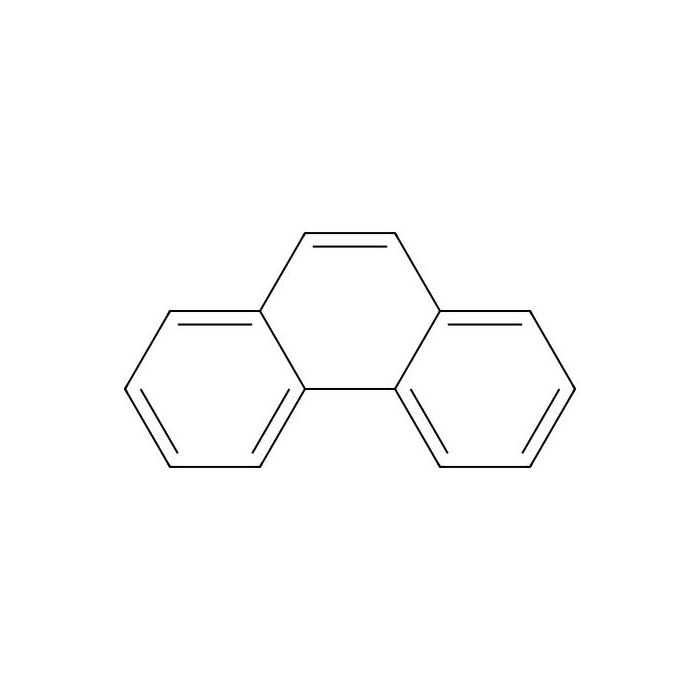
Phenanthrene is a polycyclic aromatic hydrocarbon (PAH) composed of three fused benzene rings in an angular arrangement.
2D description in words: two outer benzene rings share individual edges with a central ring, forming a bent tricyclic framework; the most reactive positions are typically the bridgehead-like 9 and 10 carbons.
Item-specific identifiers or specifications not listed above: Not specified for this item; refer to CoA/Spec Sheet.
Synthetic Utility
The rigid, angular, π-rich phenanthrene core is a valuable building block for PAH elaboration and functional materials (literature/general).
Key reactivity handles:
9,10-positions: enhanced reactivity enables selective halogenation, oxidation to quinones, and addition reactions.
Directed metalation: formation of 9-lithiophenanthrene allows installation of electrophiles (formylation, silylation, borylation via trapping strategies).
Named/typical transformations:
Scholl cyclodehydrogenation to generate larger fused aromatics and nanographenes.
Radical bromination/chlorination leading to cross-coupling handles for Suzuki–Miyaura, Stille, Negishi, Sonogashira.
Oxidation to phenanthrene-9,10-quinone followed by nucleophilic additions (e.g., Wittig-like annulations) to craft heteroacenes.
Photochemical reactions (e.g., [4+4] dimerizations under constrained conditions) as mechanistic probes.
Retrosynthetic value:
Readily available, stable, and scalable; its derivatives serve as synthons toward helicenes, phenacenes, and donor–acceptor architectures by sequential halogenation/coupling and oxidative ring fusion.
Materials interface:
Phenanthrene derivatives tune HOMO/LUMO levels and packing for OFETs, OLEDs, and OPVs; substitution patterns at 3,6- or 9,10-positions modulate solid-state π–π stacking and emission.
Target Specificity
This product is a small molecule (phenanthrene), not an antibody or biological targeting reagent. No target specificity data (antigen, epitope, clone, isotype, species reactivity) apply.
Targeting details: Not applicable.
Any item-specific bioactivity panel: Not specified for this item; refer to CoA/Spec Sheet.
Nuestra guía de selección de calidades cubre la pureza, el estado del estabilizador y la idoneidad de la aplicación para todas las variantes de nuestro catálogo.
Utilizamos cookies para garantizar el correcto funcionamiento del sitio web y, cuando esté permitido, para mejorar su experiencia. Puede gestionar sus preferencias en cualquier momento en Configuración. Más información en nuestra Política de Cookies.
¿Quieres que te enviemos un mensaje cuando tengamos descuentos disponibles?
Recordármelo más tarde
¡Gracias! Por favor, revisa tu bandeja de entrada de correo electrónico para confirmar.
Products are supplied to verified businesses, institutions, and qualified professionals for research and development use only. Not for use in humans, animals, diagnosis, or therapy.