This compound belongs to the class of organic compounds known as alpha amino acids and derivatives. These are amino acids in which the amino group is attached to the carbon atom immediately adjacent to the carboxylate group (alpha carbon), or a derivative thereof.
External Descriptors
Not available
1. Djoumbou Feunang Y, Eisner R, Knox C, Chepelev L, Hastings J, Owen G, Fahy E, Steinbeck C, Subramanian S, Bolton E, Greiner R, and Wishart DS. ClassyFire: Automated Chemical Classification With A Comprehensive, Computable Taxonomy. Journal of Cheminformatics, 2016, 8:61.
Determine the necessary mass, volume, or concentration for preparing a solution.
Dilution Calculator
Determine the dilution needed to prepare a stock solution.
Reconstitution Calculator
Reseñas
Reseñas de cliente
Application Protocols
Not applicable. No biological assay applications (WB, IHC, IF, FC) or tested protocols are provided for this small-molecule reagent. For synthetic applications, see the Reaction Conditions and Reaction & Applications sections for literature-based guidance.
Biological Roles
This product is a synthetic organic building block; it is not intended for biological use as supplied. No biological roles are provided in the Product Data.
General context (literature/chemistry knowledge):
Aryl boronic acids can interact reversibly with 1,2- and 1,3-diols to form boronate esters, a principle exploited in saccharide sensing and affinity separations. The MIDA ester, however, masks the boronic acid, preventing diol binding until hydrolyzed.
In chemical biology workflows, MIDA boronates are used upstream to assemble complex probes, linkers, and labeling reagents via cross-coupling, with the boron handle introduced/removed orthogonally through protection strategies.
Boron-containing motifs appear in several bioactive small molecules; nonetheless, this MIDA ester serves as a precursor in synthesis rather than a functional biological ligand.
Research-use caveat (from Product Data): For research use only. No medical, diagnostic, or therapeutic applications are intended or implied.
Buffer Applications
This compound is not a buffering reagent and is not typically used to prepare biological buffers. If used in aqueous media, it is generally in the context of hydrolysis/release under basic conditions during synthetic reactions (e.g., Suzuki couplings) rather than for pH control. For buffer-related needs, consider dedicated buffering systems (phosphate, carbonate, borate) selected for the required pH range and compatibility with your reaction or assay.
Green Alternatives
Perspective on greener choices (general guidance; not product specifications):
Solvent optimization:
Replace dioxane/toluene with 2-MeTHF or CPME where possible—these bio-derived ethers often support Suzuki couplings and offer better EHS profiles and easier solvent recovery.
Aqueous micellar media (e.g., TPGS-750-M) can promote Suzuki couplings of boronic acids; for MIDA boronates, ensure hydrolysis kinetics are compatible.
Base and additive choices:
Use carbonate or phosphate bases (K2CO3, K3PO4) in water-rich media to minimize caustic waste compared to concentrated NaOH, while still enabling controlled release.
Reagent selection:
Consider direct use of phenylboronic acid (if stability permits) to avoid the protection–deprotection cycle.
Alternatively, employ potassium aryltrifluoroborates (PhBF3K) for water-tolerant couplings; they are salt-like, nonvolatile, and often safer to handle. Tradeoff: fluoride-containing waste and, in some cases, slower transmetalation.
Small comparison (general, qualitative):
MIDA boronate: high bench stability; enables iterative synthesis; may require mixed organic/aqueous solvents and bases; generates boron-containing aqueous waste upon hydrolysis.
Pinacol boronate (Bpin): broadly used; good solubility in green ethers; more sensitive to protodeboronation with some substrates.
Aryltrifluoroborate salt: solid, often very stable; compatible with aqueous conditions; introduces fluoride waste stream and sometimes needs phase-transfer additives.
Process considerations:
Favor catalytic loadings <1 mol% Pd with modern ligands to reduce precious metal use and simplify downstream metal removal.
Implement solvent swaps to greener media during scale-up (e.g., THF to 2-MeTHF; DCM to EtOAc) when reaction performance allows.
Pharmaceutical Uses
No pharmacopeial grade or excipient role is provided in the Product Data for this item.
General context (manufacturing/synthetic chemistry; no therapeutic claims):
Role in process chemistry: Phenylboronic acid MIDA ester and related MIDA boronates are commonly employed as stable, isolable intermediates in the convergent assembly of aryl scaffolds used in drug substance synthesis. The MIDA protection facilitates telescoped sequences and iterative cross-couplings with reduced risk of boron handle loss.
Benefits to route design: improved bench stability over free boronic acids; crystalline solids that can simplify isolation, drying, and material handling; potential for controlled release of boronic acid in aqueous base during Pd-catalyzed couplings.
Considerations for downstream compliance: when transitioning to GMP, control of residual metals, inorganic salts from hydrolysis (e.g., phosphates/carbonates), and boron-containing impurities is essential. Validate cleaning procedures due to the potential for boron residues to persist on glassware.
Alternative handles: For highly water-tolerant processes, aryltrifluoroborates or Bpin esters may be selected based on performance, impurity profiles, and waste treatment capabilities.
Physical Properties
Item-specific physico-chemical data from Product Data:
Appearance: Not specified for this item; refer to CoA/Spec Sheet.
Molecular weight: Not specified for this item; refer to CoA/Spec Sheet.
Literature/general properties for phenylboronic acid MIDA ester (for context; not product specifications):
Physical state: typically a white to off-white crystalline solid; many MIDA boronates are bench-stable powders.
Thermal behavior: MIDA boronates generally exhibit high thermal stability relative to free boronic acids and pinacol boronates; melting points are often substantially above ambient (literature, compound-dependent). Exact MP for this item: Not specified.
Solubility trends: poor solubility in water; moderate solubility in polar aprotic organics (THF, MeCN, EtOAc, DCM); limited solubility in alkanes/hexanes. Solubility increases with polar co-solvents or mild base due to partial hydrolysis (general trend).
Partitioning: expected moderate polarity compared to pinacol boronates due to the amide-containing chelate; consequently, higher Rf in polar eluents and stronger interaction with silica via H-bonding (general chromatography behavior).
Stability: resistant to protodeboronation and air/moisture under neutral conditions; hydrolyzes to phenylboronic acid under aqueous basic conditions (e.g., hydroxide, carbonate, phosphate) with controlled, often rate-limited release (literature).
Spectroscopic notes: B–O and amide C=O stretches visible in IR; 11B NMR typically broad resonance in the +9 to +15 ppm range for tricoordinate boron; aryl signals in 1H/13C NMR appear as expected for unsubstituted phenyl (literature).
Quality and Grades
Grade/Purity (Product Data): Not specified for this item; refer to CoA/Spec Sheet.
How to interpret grades for this reagent class (general guidance):
Research-grade MIDA boronates are typically specified by assay (e.g., HPLC or qNMR), with limits on residual solvents, inorganic salts, and free boronic acid content. Where provided, stabilizers are usually unnecessary because MIDA boronates are intrinsically air/moisture stable; absence/presence of stabilizer should be explicitly stated in the CoA.
Chromatographic suitability: High-purity material reduces side reactions in Pd-catalyzed couplings (e.g., less homocoupling and protodeboronation). If an HPLC or LC-UV grade is offered, it typically implies low UV-active impurities beneficial for analytical work-up.
Trace metals: For cross-couplings, low residual palladium/nickel/copper from prior processing is preferred; such limits should be consulted in the CoA if critical for catalysis or for downstream GMP-like steps.
Water content: Although MIDA boronates tolerate atmospheric moisture, Karl Fischer moisture limits—if provided—help assess reproducibility of hydrolysis-release kinetics. For this item, any such data are Not specified; refer to CoA/Spec Sheet.
Recommendation: If you require defined release kinetics in iterative couplings, verify assay (%), free boronic acid content, and residual inorganic salts on the supplied CoA for this specific lot.
Reaction and Applications
Key roles of phenylboronic acid MIDA ester in synthesis (literature/general; expand as practical guidance):
Protected boronic acid for cross-coupling:
Suzuki–Miyaura coupling: functions as a bench-stable, controlled-release precursor to phenylboronic acid. Under aqueous basic conditions (e.g., K3PO4, K2CO3, NaOH), gradual hydrolysis liberates the boronic acid at the catalyst interface, often reducing protodeboronation and enabling iterative couplings.
Iterative cross-coupling (ICC): MIDA protection enables orthogonal strategies—stable to many conditions (amines, acids, mild bases), then deprotected on demand to reveal the boron for the next coupling step (Baran/Flow chemistry literature).
Transesterification and conversions:
Conversion to pinacol boronate (Bpin) via transesterification with pinacol under azeotropic removal of methanol/water or in the presence of molecular sieves and base.
Hydrolysis to free phenylboronic acid with aqueous base (NaOH, K2CO3, K3PO4). Acidic workup gives the boronic acid, which can be crystallized or used in situ.
Other transformations:
Chan–Lam coupling after deprotection (aryl boronic acid to form aryl–N/O/S bonds with Cu catalysis).
Oxidation to phenol (post-deprotection) using H2O2/NaOH or Oxone, providing phenol derivatives when the aryl partner is present.
Protodeboronation as a deliberate endgame to remove the boron handle when needed, typically with aqueous acid/heat after coupling sequences.
Practical tips:
Use well-degassed solvent for Pd-catalyzed couplings; employ bases that balance hydrolysis rate and catalyst stability (K3PO4 often reliable). Maintain modest water content (e.g., 1–3 equiv solvent volume) to avoid over-hydrolysis before oxidative addition.
Monitor by LC/MS or 11B NMR to track MIDA-to-boronic acid conversion in optimization studies.
Reaction Conditions
General, literature-based guidance for phenylboronic acid MIDA ester (not item specifications):
Hydrolysis/deprotection to phenylboronic acid:
Typical: THF/H2O or dioxane/H2O (1:1 to 4:1 v/v), 1–3 equiv base (K3PO4, K2CO3, Na2CO3, or 1–2 M NaOH aq), 20–60 °C, 0.5–6 h depending on base strength and solvent composition. Monitor by LC/MS or TLC.
Workup: neutralize carefully, extract into organic solvent (EtOAc), dry, and use immediately or isolate as needed.
Suzuki–Miyaura coupling (in situ release):
Catalyst: 0.5–3 mol% Pd(PPh3)4, Pd(dppf)Cl2, or Pd2(dba)3 with monodentate/bidentate ligands (e.g., SPhos/XPhos).
Base: K3PO4 (2–3 equiv) or K2CO3 (2–3 equiv).
Solvent: dioxane/H2O, THF/H2O, 2-MeTHF/H2O; 50–100 °C.
Time/yield: 2–16 h; moderate to high yields commonly reported for aryl–aryl couplings under these conditions (substrate-dependent; verify on small scale).
Transesterification to Bpin:
Pinacol (2–4 equiv), toluene or THF, catalytic acid or base (e.g., MgSO4 or molecular sieves to remove water/methanol), 60–110 °C; removal of volatiles drives equilibrium.
Practical notes:
Water content controls the hydrolysis rate—too little may stall release; too much can lead to premature full hydrolysis and phase issues. Aqueous base concentration and temperature are the main levers.
Halide order of reactivity: Ar–I > Ar–Br ≫ Ar–Cl; for chlorides, use more active catalysts/ligands and higher temperatures.
Minimize air-sensitive catalyst decomposition by degassing and using dry organic solvents; however, MIDA boronates themselves are typically air/moisture stable.
Safety and Handling
Authoritative safety information must be taken from the SDS for this exact catalog item.
GHS classification and hazard statements (Product Data): Not specified for this item; refer to SDS.
Signal word / pictograms (Product Data): Not specified for this item; refer to SDS.
General laboratory safety guidance for aryl MIDA boronates (literature/practice; not product-specific):
Expected hazards: typically low acute toxicity and low volatility; dust may cause mechanical irritation to eyes/respiratory tract. Avoid ingestion and prolonged skin contact.
PPE: safety glasses, lab coat, and nitrile gloves as a minimum. Handle powders in a fume hood to control dust.
Incompatibilities: avoid strong bases in the presence of water (promotes hydrolysis to free boronic acid); avoid strong oxidizers. Under strongly acidic aqueous conditions, gradual hydrolysis or degradation can also occur.
Special risks: finely divided organic solids can pose combustible dust hazards; keep away from ignition sources and minimize dust generation. Boron compounds may interfere with some colorimetric assays for diols once hydrolyzed.
First aid (overview):
Inhalation: move to fresh air; seek medical advice if symptoms persist.
Skin: wash with soap and water; remove contaminated clothing.
Eyes: rinse cautiously with water for several minutes; remove contact lenses if present and easy to do; seek medical attention for persistent irritation.
Ingestion: rinse mouth; do not induce vomiting; seek medical attention.
Disposal: collect solids and contaminated materials as organic chemical waste; follow institutional and local regulations. Consult SDS for precise classification.
Solvent Selection
Phenylboronic acid MIDA ester is a moderately polar, crystalline solid with an amide-containing chelate. Solvent choice is driven by the operation (storage, hydrolysis, or coupling):
Polarity/miscibility (literature/general):
Good: THF, 1,4-dioxane, EtOAc, DCM, MeCN, DMF, DMSO (often heated or with sonication for full dissolution).
Limited: toluene, ethyl ether (solubility varies; may require heating).
Poor: alkanes/hexanes; water (insoluble to sparingly soluble under neutral pH).
Typical use scenarios:
Suzuki–Miyaura with in situ release: biphasic THF/H2O or dioxane/H2O with inorganic base (K3PO4, K2CO3, NaOH) promotes controlled hydrolysis to the active phenylboronic acid while maintaining organic solubility of substrates.
Pre-deprotection then coupling: hydrolyze in THF/H2O or MeOH/H2O with base, then transfer to coupling solvent (dioxane, toluene/water, or MeCN/water) after neutralization.
Purification: silica gel chromatography typically employs EtOAc/hexanes or DCM/MeOH gradients. The MIDA ester often elutes more slowly than the corresponding pinacol boronate due to polarity/H-bonding.
When to choose alternatives:
For highly lipophilic partners or low-temperature couplings, toluene/dioxane may outperform THF.
If hydrolysis is undesired (e.g., for storage or non-aqueous transformations), avoid aqueous solvents and strong bases; use dry DCM, THF, or MeCN.
Small comparison (general): MIDA boronate vs pinacol boronate—MIDA favors polar aprotic media and controlled aqueous basic conditions; pinacol boronates dissolve better in nonpolar media but are more prone to protodeboronation with some substrates.
Storage and Reconstitution
Storage conditions (from Product Data): Store at room temperature. Shipped under normal conditions.
Physical handling: Keep container tightly closed in a dry place. Although MIDA boronates tolerate ambient humidity, best practice is to minimize prolonged exposure to moisture to maintain consistent hydrolysis kinetics lot-to-lot.
Incompatibilities: Avoid storage with strong bases or strong oxidizers. Do not store in aqueous solutions; prepare solutions fresh in dry organic solvents (THF, DCM, MeCN, EtOAc) as needed.
Solution stability (general): Solutions in dry aprotic solvents are typically stable over a working day under inert atmosphere. For longer-term solution storage, evaluate stability by HPLC; many users prefer to store as a solid.
Reconstitution: If supplied as a solid, no reconstitution is required. To prepare stock solutions, dissolve the required amount in an appropriate dry solvent with gentle warming or sonication if needed. Filter through a PTFE syringe filter (0.45 µm) to remove particulates before use in catalysis.
Freeze–thaw: Not applicable for solids. Avoid repeated warming/cooling of solutions; prepare fresh to ensure reproducible performance in coupling reactions.
Research use note: For research use only (per Product Data).
Structure and Identity
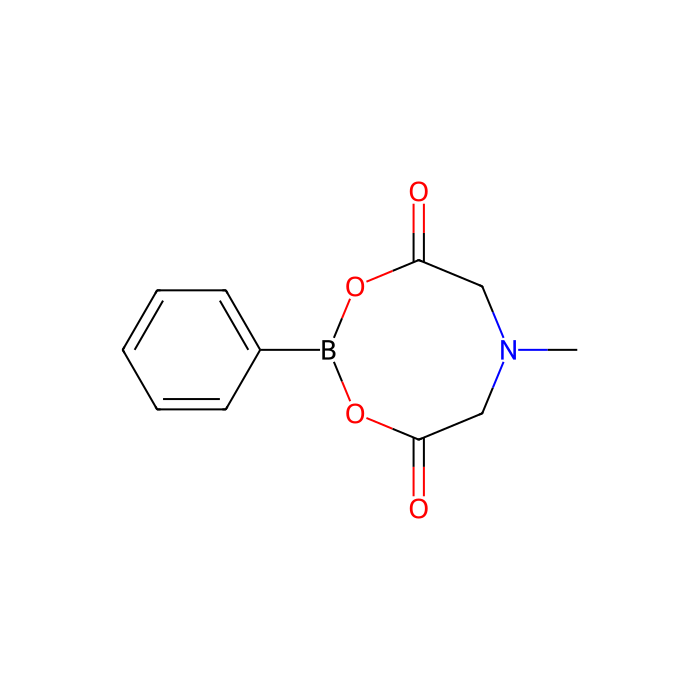
Intro: Phenylboronic acid MIDA ester is the N-methyliminodiacetic acid (MIDA) cyclic boronate of phenylboronic acid, widely used as a protected/controlled-release boron reagent in cross-coupling chemistry.
Item-specific identifiers (from Product Data):
CAS: 109737-57-7
SKU: P165896
InChIKey: Not specified for this item; refer to CoA/Spec Sheet. (Product Data lists "6606", which is incomplete for an InChIKey.)
SMILES: Not specified for this item; refer to CoA/Spec Sheet.
Molecular formula: Not specified for this item; refer to CoA/Spec Sheet.
Molecular weight: Not specified for this item; refer to CoA/Spec Sheet.
Structural description (general/literature):
Core motif: an sp2-hybridized phenyl ring bound to boron (B–Ph).
Boron protection: boron is chelated by the bidentate N-methyliminodiacetate (MIDA) ligand, forming a five-membered cyclic boronate with two B–O bonds to the diacetic acid oxygens; the tertiary amide nitrogen (N-methyl) coordinates weakly through its lone pair but is not covalently bound to B.
Functional groups: aryl C–B bond, cyclic boronate diester, tertiary amide (within MIDA), and two carboxylate-derived ester linkages in the chelate ring.
Stereochemistry: achiral overall (no stereocenters); planar aryl ring and trigonal boron center within a constrained chelate.
2D structure in words (general): a benzene ring attached to a trigonal-planar boron. The boron is incorporated into a five-membered chelate ring derived from N-methyliminodiacetate, closing through two oxygen atoms; the N-methyl amide sits adjacent to the chelate backbone.
Synthetic Utility
Functional features and reactivity (literature/general):
Protected boron handle: The MIDA chelate renders the aryl–B bond robust to many reaction conditions (amines, mild acids, some oxidants), enabling orthogonal manipulation elsewhere in the molecule.
Deprotection on demand: Under aqueous basic conditions, the B–O chelate hydrolyzes to regenerate phenylboronic acid, which then participates in transmetalation with Pd(II) during Suzuki–Miyaura coupling.
Compatibility: Often survives electrophilic aromatic substitution on other rings (when present), many N- and O-acylations, and some radical conditions, allowing late-stage diversification.
Typical transformations after deprotection:
Suzuki–Miyaura C(sp2)–C(sp2/sp3) couplings with aryl/vinyl halides and pseudohalides (Ar–Br/Cl/OTf) using Pd catalysts (e.g., Pd(PPh3)4, Pd(dppf)Cl2, or Buchwald-type ligands).
Chan–Lam couplings to form Ar–N/O/S bonds under Cu catalysis in air.
Oxidation (Fleming–Tamao-type variants) to phenols after conversion to appropriate intermediates.
Conversion to alternative boron species: Bpin via transesterification; trifluoroborate salts via treatment of the free boronic acid with KHF2.
Retrosynthetic value:
MIDA boronates enable modular assembly strategies where boron-containing fragments can be carried through multiple steps without protective-group juggling, then unveiled for the key C–C bond formation. Phenyl as the aryl unit is a versatile synthon for constructing biaryl and aryl–alkyl motifs.
Target Specificity
Not applicable. This product is a small-molecule building block and not a biological targeting reagent (no antigen/epitope/clone/isotype information). No item-specific data are provided in the Product Data.
We use cookies to ensure the website functions properly and, where permitted, to improve your experience. You can manage your preferences at any time in Settings. Learn more in our Cookie Policy.
Shall we send you a message when we have discounts available?
Remind me later
Thank you! Please check your email inbox to confirm.
Products are supplied to verified businesses, institutions, and qualified professionals for research and development use only. Not for use in humans, animals, diagnosis, or therapy.

 L2209140