Determine the necessary mass, volume, or concentration for preparing a solution.
Mw 100KDa para flujos de trabajo cromatográficos y analíticos sensibles que requieren una interferencia mínima de la línea base.
Protected from light,Room temperature Envío Normal. Consulte el COA específico del lote para conocer las especificaciones exactas.
SDS, COA, ficha técnica y hoja de especificaciones disponibles para descargar. COA específico del lote accesible mediante búsqueda por número de lote.
Citado en 459 publicaciones revisadas por pares sobre cromatografía, síntesis orgánica y reacciones de acoplamiento cruzado.
Documento completo sobre peligros, manipulación, almacenamiento y cumplimiento normativo.
<<<<<<< HEAD Descargar SDS → ======= Descargar SDS → >>>>>>> release248-p3Datos de calidad específicos del lote. Introduzca su número de lote para obtener el COA exacto.
Buscar COA →Resumen de referencia rápida de las especificaciones y aplicaciones del producto.
Ver ficha técnica →Atributos de calidad completos y criterios de aceptación para esta calidad.
Ver hoja de especificaciones →Find and download the COA for your product by matching the lot number on the packaging.
| Lot Number | Certificate Type | Fecha | Articulo |
|---|---|---|---|
| Certificate of Analysis | Sep 29, 2026 | P1506434 | |
| Certificate of Analysis | Sep 29, 2026 | P1506434 | |
| Certificate of Analysis | Nov 10, 2025 | P1506434 | |
| Certificate of Analysis | Nov 10, 2025 | P1506434 |
| Índice de refracción | 1.49 |
|---|---|
| Punto de inflamación (°F) | >250 ℉ |
| Punto de inflamación (°C) | >121.11℃ |
The following generic protocols are provided as literature-based guidance for processing PMMA; they are not specifications or performance claims for this SKU. Adjust parameters to your material’s molecular weight and additives (not specified here).
Safety note: Manage flammable solvents with appropriate ventilation and ignition control. For lithography or device fabrication, run small trials to calibrate thickness and quality.
PMMA is a synthetic, non-ionic thermoplastic with no intrinsic biological role or metabolic pathway. It is widely regarded as chemically inert under physiological conditions, and it does not participate in cellular signaling or enzymatic processes.
Research context (literature/general)
Note: No biological function or clinical claim is implied for this SKU; it is provided strictly for research and laboratory use, as stated in the Product Data.
Not typically applicable. PMMA is a hydrophobic polymeric solid and does not serve as a buffering agent. For research workflows, refer instead to sections on Solvent Selection, Reaction & Applications, and Application Protocols for guidance on dissolving, processing, or coating PMMA.
Greener considerations focus on solvent/process choices and potential polymer substitutes. The polymer itself is a durable, non-biodegradable thermoplastic; selection should weigh performance vs. environmental impact.
Solvent and process substitutions (literature/general)
Potential material alternatives (application-dependent)
Trade-off snapshot (general)
Note: Choice of alternative depends on optical demands, thermal budget, and solvent infrastructure; pilot trials are recommended.
Item-specific regulatory/grade status
Materials/formulation context (literature/general)
Practical considerations
No therapeutic or clinical claims are made for this product. It is supplied strictly for research use only, per the Product Data.
Item-specific specifications (this SKU)
Literature/general polymer properties (typical ranges; not product specifications)
Note: For processing-critical parameters (Mw, PDI, residual monomer, additive content), consult the item’s CoA/Spec Sheet.
Item-specific grade/purity information
How PMMA quality is typically defined (literature/general guidance)
Interpreting the CoA (practical tips)
Primary use domains (literature/general for PMMA)
Chemical transformations on PMMA (polymer-level reactions)
Practical tips
Note: No specific application testing is claimed for this SKU; use cases above are general for PMMA.
General processing and modification conditions for PMMA (literature; not product-specific)
Dissolution for film formation
Spin coating (positive-tone PMMA resists as a general example)
Hydrolysis/surface activation
Thermal processing
Always confirm compatibility of solvents and conditions with your specific PMMA lot (Mw, additives), which are not specified here.
GHS and hazard information (this SKU)
General safety considerations for PMMA (literature/general)
PPE and handling
Storage incompatibilities and precautions
First aid (overview; defer to SDS)
Always consult the product SDS for authoritative safety data and emergency procedures.
Applicability
Solubility profile (literature/general)
Selection by application
Practical considerations
Note: Exact dissolution behavior and recommended solvents for this SKU are not specified; consult the CoA/Spec Sheet and conduct a small-scale solubility screen.
Item-specific storage/shipping (from Product Data)
General best practices for PMMA (literature/general)
Reconstitution / solution preparation
Note: If this SKU includes specific molecular weight or additive information, follow the CoA/Spec Sheet for any storage nuances (e.g., avoid specific solvents, solution shelf life).
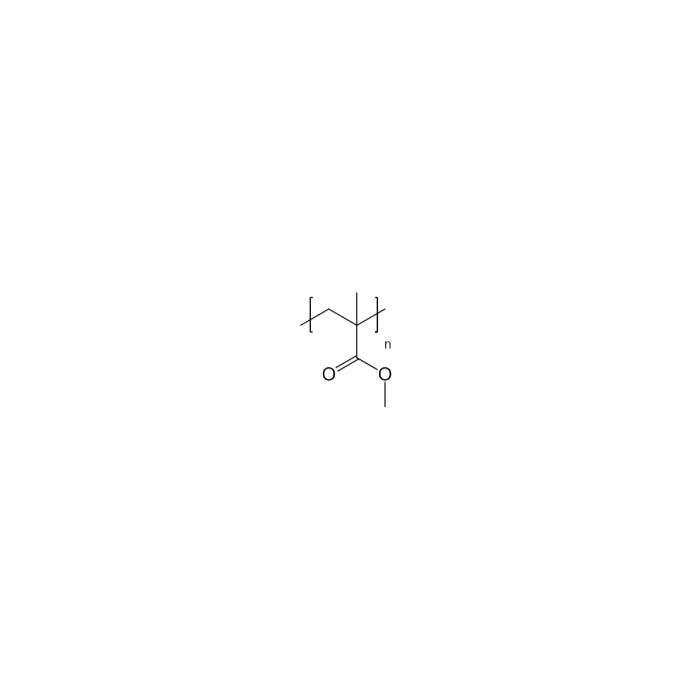
Poly(methyl methacrylate) (PMMA) is an amorphous vinyl polymer derived from the methyl methacrylate (MMA) monomer.
Item-specific identifiers (from Product Data)
Structural description (literature/general)
Key features
While PMMA is not a small-molecule reagent, it provides valuable synthetic utility as a functional materials scaffold and polymer-chemistry platform (literature/general):
Caveats
Not applicable. PMMA is a synthetic polymeric material and does not possess biological target specificity (no antigen/epitope/isotype attributes). This section is relevant to antibodies or affinity reagents, not to materials like PMMA.