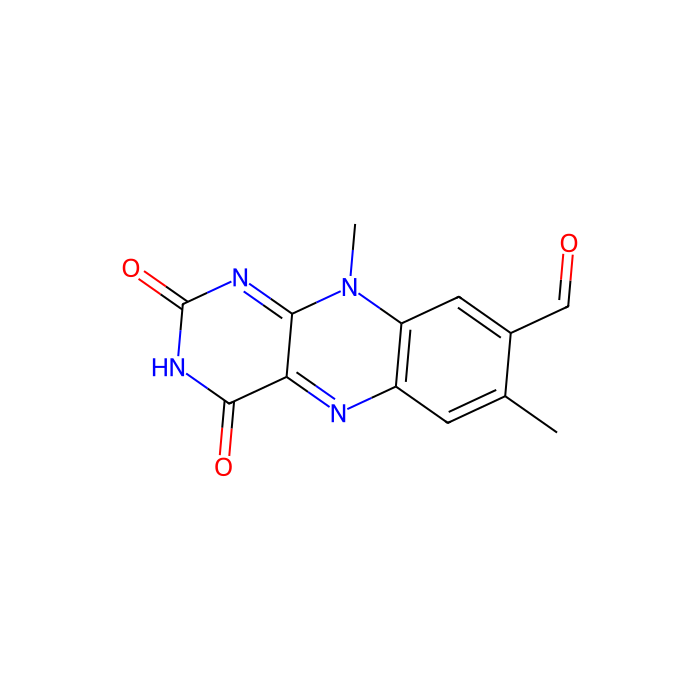
Inhibidor no peptídico del NGF que se une al dímero del NGF (KD~ 1μM) causando posiblemente un cambio conformacional. Inhibe selectivamente la unión del NGF a p75NTR en concentraciones submicromolares, y tanto a p75NTR como a TrkA en concentraciones > 5μM
This compound belongs to the class of organic compounds known as flavins. These are compounds containing a flavin (7,8-dimethyl-benzo[g]pteridine-2,4-dione) moiety, with a structure characterized by an isoalloaxzine tricyclic ring.
External Descriptors
Not available
1. Djoumbou Feunang Y, Eisner R, Knox C, Chepelev L, Hastings J, Owen G, Fahy E, Steinbeck C, Subramanian S, Bolton E, Greiner R, and Wishart DS. ClassyFire: Automated Chemical Classification With A Comprehensive, Computable Taxonomy. Journal of Cheminformatics, 2016, 8:61.
Determine the necessary mass, volume, or concentration for preparing a solution.
Dilution Calculator
Determine the dilution needed to prepare a stock solution.
Reconstitution Calculator
Reseñas
Reseñas de cliente
Application Protocols
Only manufacturer-validated application details from Product Data can be listed. For this SKU, none are provided.
Tested applications: Not specified for this item.
Recommended working concentrations/dilutions: Not specified for this item.
Positive/negative controls: Not specified for this item.
General guidance (not item-specific):
When using small-molecule tool compounds, establish a solvent control curve and confirm absence of vehicle effects. Titrate over a broad range (e.g., 10-point half-log dilution series) to map response and identify non-specific effects at high concentrations.
Confirm compound stability in your assay matrix and over the experimental time course (e.g., by LC-MS at t=0 and end-point).
Please refer to the CoA/Spec Sheet and SDS for any product-specific protocols or constraints.
Biological Roles
Item-specific biological activity data are not provided in the Product Data for this SKU. The following statements reflect literature/general knowledge associated with the name Ro 08-2750 and are not manufacturer-verified claims for this lot.
Literature context: Ro 08-2750 has been reported as a small-molecule chemical probe used to interrogate RNA-binding proteins in cell and biochemical systems. Publications describe its use to study modulation of RNA–protein interactions and downstream gene-expression programs.
Typical experimental roles for such probes:
Tool compound in target validation, often combined with genetic perturbations (e.g., RNAi/CRISPR) to test on-target congruence.
Chemical starting point for structure–activity relationship (SAR) programs aimed at improving potency, selectivity, or DMPK properties.
Control ligand in biophysical binding assays (e.g., thermal shift, MST, SPR) and competition experiments.
Data quality considerations:
Confirm compound identity and purity for each lot before biological testing (LC-MS/HPLC). Assess aggregation or assay interference (e.g., detergent-sensitivity, redox cycling, fluorescence overlap) to reduce false positives.
Include orthogonal assays to corroborate target engagement and cellular mechanism.
Important: These roles are provided as general literature context. No specific potency, selectivity, or target engagement parameters are specified for this item; consult the primary literature and generate in-house confirmation data for your system.
Buffer Applications
Ro 08-2750 is not a buffering reagent and is not typically used to prepare pH buffer systems. Accordingly:
Buffer system guidance: Not applicable to this compound. Select buffer components (e.g., HEPES, PBS, Tris) based on your assay’s pH and ionic-strength needs.
Practical note: When dosing this compound into buffered media, pre-dissolve in a compatible co-solvent (e.g., DMSO or ethanol, as permitted by your assay) and maintain consistent final co-solvent percentage across control and treated samples to avoid confounding effects.
For any item-specific compatibility or stability in particular buffers, refer to the CoA/Spec Sheet or determine empirically.
Green Alternatives
This product is a research tool compound, not a process solvent or bulk reagent where green-replacement strategies are typically discussed. Consequently, there are no direct “green alternatives” to the molecule itself.
Nevertheless, greener practice can be applied to how you handle and use the compound:
Solvent choices: when making stocks or performing extractions, prefer lower-toxicity, renewable, or safer solvents where compatible (e.g., ethanol, 2-methyltetrahydrofuran) instead of higher-hazard options; confirm solubility first.
Minimize DMSO/DMF volumes: keep final assay co-solvent levels to the minimum required; validate assay performance at those levels.
Waste minimization: plan experiments to use small-scale stocks and avoid repeated thaw-freeze cycles; consolidate solvent waste streams for proper disposal.
Energy use: perform dissolutions at ambient temperature when possible; avoid unnecessary heating or prolonged sonication.
Trade-offs:
Substituting greener solvents may reduce solubility or assay compatibility; always run side-by-side controls to ensure data quality.
Summary: No compound-level green substitute is applicable; focus on greener solvents, minimal volumes, and efficient experimental design to reduce environmental impact.
Pharmaceutical Uses
This product is supplied strictly for research use only and is not intended for human or veterinary use.
Excipient/formulation role: None specified for this item.
Pharmacopeia status: Not specified for this item; refer to CoA/Spec Sheet.
Manufacturing/CMC context: As a research tool compound, it is not provided with pharmacopeial compliance documentation (e.g., USP/EP) unless expressly stated in the CoA.
If preparing solutions for in vitro studies, use analytical-grade solvents and sterile-filter if sterility is required by the assay. Record solvent type, concentration, and lot information for data traceability.
For in vivo or ex vivo research (non-clinical), ensure formulations and vehicles are justified and approved by institutional oversight; this item provides no dosage or toxicological guidance.
No clinical, diagnostic, or therapeutic claims are made or implied for this product.
Physical Properties
Item-specific physicochemical specifications were not provided.
Reported/available from Product Data for this SKU:
Appearance: Not specified for this item; refer to CoA/Spec Sheet.
Molecular weight: Not specified for this item; refer to CoA/Spec Sheet.
Commonly requested properties (for this item):
Melting point: Not specified for this item; refer to CoA/Spec Sheet.
Boiling point: Not specified for this item; refer to CoA/Spec Sheet.
Density: Not specified for this item; refer to CoA/Spec Sheet.
Solubility: Not specified for this item; refer to CoA/Spec Sheet.
LogP/logD: Not specified for this item; refer to CoA/Spec Sheet.
Refractive index: Not applicable/typically not reported for solids; Not specified for this item; refer to CoA/Spec Sheet.
pKa: Not specified for this item; refer to CoA/Spec Sheet.
Ro 08-2750 is discussed in the literature as a small-molecule probe used in biochemical and cellular assays. Such compounds are frequently prepared as concentrated stock solutions in polar aprotic organic solvents for assay use. Exact solubility limits and partition properties are compound- and lot-dependent and should be verified experimentally.
Practical guidance:
If no physico-chemical data are available, perform a micro-scale solubility screen (e.g., DMSO, DMF, ethanol, aqueous buffer with co-solvent) and document outcome (clear solution, partial precipitate). Verify concentration by UV-Vis or quantitative NMR as appropriate.
Quality and Grades
Item-specific grade and purity are not provided for this SKU.
From Product Data:
Grade/Purity: Not specified for this item; refer to CoA/Spec Sheet.
Guidance on grades (general, not item-specific):
Research grade: suitable for general laboratory research. Purity may be defined by HPLC/GC or NMR; residual solvents/water/metal contents may not be tightly controlled unless specified.
Analytical/HPLC grade: tighter control of UV-absorbing impurities and particulates; typically accompanied by absorbance specifications across key wavelengths.
Bioactive/tool compound grade: may include orthogonal purity metrics (e.g., quantitative 1H NMR, LC-MS purity) and documentation of identity.
What to request when grade/purity are critical:
Current Certificate of Analysis (CoA) listing assay method (e.g., HPLC area%), identity confirmation (LC-MS/HRMS/NMR), and impurity thresholds.
If your application is binding/biophysical, consider asking for: counter-ion content, water content (Karl Fischer), and stability data under storage and assay conditions.
Stabilizers/additives:
Not specified for this item; refer to CoA/Spec Sheet. If the compound is hygroscopic or light-sensitive, suppliers may recommend amber vials, desiccation, or inert atmosphere—verify with the CoA/SDS before long-term storage protocols.
Reaction and Applications
This product is not primarily supplied as a synthetic reagent but rather as a research tool compound. Consequently, classical synthetic reaction use (e.g., as a coupling partner, catalyst, or stoichiometric reagent) is not the typical application.
Research applications (general/literature context):
Chemical biology probe: Ro 08-2750 is reported in peer-reviewed literature as a small-molecule tool in studies of RNA-binding proteins. It has been used in biochemical and cellular assay formats to interrogate RNA–protein interactions.
Assay modalities where such probes are commonly deployed:
Fluorescence polarization/anisotropy or EMSA competition assays to assess disruption of RNA–protein binding.
Thermal shift/DSF or CETSA-style stability assays to evaluate ligand engagement in lysate or cells.
Pull-down/affinity capture competition to confirm on-target engagement.
Phenotypic cell assays with careful control of solvent percent and cytotoxicity.
Practical tips (general):
Prepare fresh, analytically confirmed stock solutions; filter if needed (PTFE, 0.2 µm) and avoid adsorptive plastics.
Include matched vehicle controls and, where available, orthogonal probe or inactive analog controls.
Validate concentration by an orthogonal method if extinction coefficient is unknown.
Note: The above constitute literature/general practices and not item-specific performance claims. For this SKU, no manufacturer-verified application data are provided in the Product Data.
Reaction Conditions
Not typically applicable. This product is supplied as a research tool compound rather than a synthetic reagent or catalyst, and item-specific reaction condition data are not provided.
If your work involves derivatization or analog synthesis (general guidance only):
Choose reaction solvents and temperatures compatible with the functional groups of the parent scaffold (consult literature linked to the CAS/CID).
Use analytical spot-checks (TLC/LC-MS) to monitor transformation and to detect degradation of the parent core under acidic/basic or oxidative conditions.
Protect potentially labile moieties (e.g., sensitive heterocycles) during multi-step sequences and avoid prolonged high-temperature exposure unless validated.
These notes are generic and should not be construed as specifications for this item.
Safety and Handling
Safety information specific to this SKU is limited in the Product Data. Always consult the Safety Data Sheet (SDS) for authoritative guidance.
From Product Data:
GHS classification, signal word, pictograms, and H-statements: Not specified for this item; refer to SDS.
Storage: Store at -20°C. Shipped in an ice chest with ice pads.
General laboratory precautions (not a substitute for SDS):
Personal protective equipment: laboratory coat, safety glasses, and appropriate chemical-resistant gloves.
Engineering controls: handle in a fume hood when weighing, dissolving, or transferring powders/solutions to avoid inhalation of dust/aerosols.
Incompatibilities: Not specified for this item; refer to SDS. As a precaution, avoid strong oxidizers and reactive acylation/alkylation conditions when identity is unknown.
Hygiene measures: avoid skin contact and ingestion; wash thoroughly after handling; do not pipette by mouth.
First-aid overview (general):
Eye/skin contact: rinse with water for several minutes, remove contaminated clothing, seek medical advice if irritation persists.
Inhalation: move to fresh air; seek medical attention if symptoms occur.
Ingestion: rinse mouth; seek medical attention.
Spill and waste:
Contain small spills with inert absorbent; place waste in appropriate sealed container for hazardous disposal per institutional and local regulations.
Special risks/notes:
If preparing concentrated stocks in organic solvents, avoid aerosol formation and label containers clearly with solvent, concentration, and date. Protect from repeated freeze–thaw to minimize degradation.
Solvent Selection
Item-specific solubility is not provided. The following is practical, general guidance for small-molecule tool compounds; verify experimentally for your lot.
Primary stock solvents (general practice):
DMSO or DMF: commonly used to prepare concentrated stocks for biochemical assays due to broad solvating ability and miscibility with aqueous buffers at low percentages.
Ethanol or isopropanol: alternative co-solvents when DMSO is contraindicated; solubility must be confirmed.
Aqueous use:
If aqueous delivery is required, prepare a DMSO stock and dilute into buffered media, keeping the final organic fraction as low as assay tolerates (e.g., ≤0.1–0.5% v/v; follow assay-specific tolerances).
Solubility screening workflow:
Begin with 10–20 mg/mL in DMSO; inspect clarity; sonicate or gently heat (≤40°C) if needed. Prepare serial dilutions into assay buffer to check for precipitation.
Polarity considerations:
Without a confirmed structure, treat as an unknown hydrophobic ligand: avoid premature aqueous dissolution attempts; use co-solvents and surfactants only after compatibility checks with your assay.
Important notes:
None of the above are item-specific specifications. For rigorous work (ITC, SPR, enzymology), determine exact solubility and concentration by analytical methods (e.g., UV-Vis with extinction coefficient, quantitative NMR, or LC-UV).
Storage and Reconstitution
From Product Data (item-specific):
Storage conditions: Store at -20°C.
Shipping: Shipped in ice chest with ice pads.
Reconstitution and handling (general guidance; not item-specific specifications):
Work quickly at ambient temperature to avoid moisture uptake or degradation. Allow the container to equilibrate to room temperature before opening to prevent condensation.
If solid: prepare concentrated stock solutions in a suitable solvent (commonly a polar aprotic solvent for hydrophobic tool compounds). Filter-sterilize through 0.2 µm PTFE if sterility is needed and solvent-compatible.
Aliquoting: dispense single-use aliquots to minimize freeze–thaw cycles. Clearly label solvent, concentration, and date.
Stability: without item-specific stability data, avoid prolonged exposure to light, heat, and air. Store solutions at -20°C or lower in tightly sealed, inert-gas–blanketed vials when feasible.
Disposal and documentation:
Dispose of unused solutions per institutional chemical waste procedures. Retain CoA/SDS and preparation records (solvent, lot, concentration) for traceability.
For any exact solubility, pH compatibility, or long-term stability parameters, refer to the CoA/Spec Sheet for this lot.
Structure and Identity
Brief overview: Ro 08-2750 is supplied as a research-use-only small-molecule tool compound. Item-specific structural details are not included in the product data for this SKU.
SKU: R288247
Product name: Ro 08-2750 (research-use only)
CAS: 37854-59-4 (from Product Data)
PubChem CID: 17756791 (from Product Data)
InChIKey: 157283 (from Product Data; note: atypical format as provided)
SMILES: Not specified for this item; refer to CoA/Spec Sheet.
Molecular formula: Not specified for this item; refer to CoA/Spec Sheet.
Molecular weight: Not specified for this item; refer to CoA/Spec Sheet.
Structural features (general/literature context):
Ro 08-2750 is described in the chemical biology literature as a small organic molecule used as a tool compound in RNA-binding protein studies. Detailed functional group annotations and exact 2D atom connectivity are not provided in this item’s Product Data. Please consult primary literature (associated with the CAS/CID above) for canonical structural depictions if needed.
2D structure description (based on item data availability):
Not specified for this item; refer to CoA/Spec Sheet or authoritative databases linked to the CAS/CID. If structural confirmation is critical to your application (e.g., docking, QSAR), we recommend retrieving the vendor CoA and cross-validating with independent spectral or database references prior to use.
Synthetic Utility
Ro 08-2750 is offered as a finished research tool compound rather than a synthetic building block. As such, it is not commonly used as a reagent or intermediate in routine organic synthesis.
General considerations (method-development/SAR programs):
If analogs or derivatives are pursued for SAR, typical medicinal chemistry tactics may involve modifications to heteroatom-containing motifs, aromatic substituents, or linker regions (consult primary literature for the parent scaffold). Reaction classes might include selective electrophilic aromatic substitutions, cross-couplings (e.g., Suzuki, Buchwald–Hartwig), or amide/urea formations, depending on the scaffold.
Purification and analytics: LC-MS-guided purification and quantitative NMR are commonly used to confirm purity and identity for bioactivity testing. Remove reactive impurities (e.g., residual coupling reagents) that can confound biological assays.
Note: Because the exact functional groups and connectivity are not provided in the Product Data for this SKU, the above points remain general and literature-based. For concrete synthetic routes or retrosynthetic analysis, consult published procedures associated with the CAS or CID listed and adapt to your lab’s capabilities.
Target Specificity
Only information from Product Data may be presented here.
Target/antigen: Not specified for this item.
Epitope or binding site: Not specified for this item.
Species reactivity or selectivity: Not specified for this item.
Clone/isotype (if applicable): Not applicable; not specified for this item.
For detailed target information (if required for your application), consult the item’s CoA/Spec Sheet or the primary literature associated with the listed CAS/CID. Any literature targets should be independently verified in your assay system.
Utilizamos cookies para garantizar el correcto funcionamiento del sitio web y, cuando esté permitido, para mejorar su experiencia. Puede gestionar sus preferencias en cualquier momento en Configuración. Más información en nuestra Política de Cookies.
¿Quieres que te enviemos un mensaje cuando tengamos descuentos disponibles?
Recordármelo más tarde
¡Gracias! Por favor, revisa tu bandeja de entrada de correo electrónico para confirmar.
Products are supplied to verified businesses, institutions, and qualified professionals for research and development use only. Not for use in humans, animals, diagnosis, or therapy.