≥99% for sensitive chromatographic and analytical workflows requiring minimal baseline interference.
🌡
Storage & shipping
Store at 2-8°C,Argon charged,Desiccated Ships Wet ice Check lot-specific COA for exact specifications.
📋
Quality documents
SDS, COA, datasheet, and spec sheet available for download. Lot-specific COA accessible via lot number lookup.
📚
Literature proof
Cited in 0 peer-reviewed publications across chromatography, organic synthesis, and cross-coupling reactions.
Descripción general
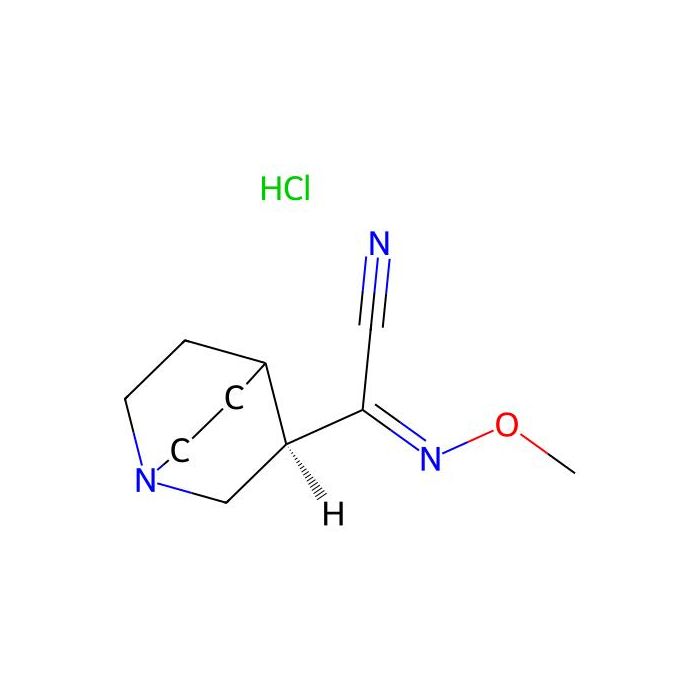
Sabcomeline (SB-202026) hydrochloride is a potent and functionally selective muscarinic M1 receptor partial agonist that improve cognition. Sabcomeline hydrochloride can be used for Alzheimer's disease research
Form:Solid
IC50& Target:Muscarinic M1 receptor
Specifications
Especificaciones y pureza
≥99%
Mecanismos bioquímicos y fisiológicos
Sabcomeline (SB-202026) hydrochloride is a potent and functionally selective muscarinic M1 receptor partial agonist that improve cognition. Sabcomeline hydrochloride can be used for Alzheimer's disease research.
Condiciones de almacenamiento de almacenamiento
Store at 2-8°C,Argon charged,Desiccated
Enviado en
Wet ice
Este producto requiere envío en cadena de frío. Los servicios terrestres y otros servicios económicos no están disponibles.
Pureza
≥99%
Nombres e identificadores
Sonrisas canónicas
CO/N=C(\C#N)/[C@H]1CN2CCC1CC2.Cl
Isómeros SMILES
CO/N=C(\C#N)/[C@H]1CN2CCC1CC2.Cl
PubChem CID
9577994
Peso molecular
229.71
Documentation
📋 Safety Data Sheet (SDS)
Comprehensive hazard, handling, storage, and regulatory compliance document.
Certificados (CoA, COO, BSE/TSE y tabla de análisis)
C of A & Other Certificates(BSE/TSE, COO):
Analytical Chart:
Propiedades químicas y físicas
Solubilidad
H2O : 125 mg/mL (544.16 mM; Need ultrasonic)
Calculadoras de soluciones
Molarity Calculator
Determine the necessary mass, volume, or concentration for preparing a solution.
Dilution Calculator
Determine the dilution needed to prepare a stock solution.
Reconstitution Calculator
Reseñas
Reseñas de cliente
Application Protocols
No item-specific, validated application protocols are provided in the Product Data for this SKU. The following are general, non-binding guidelines for small-molecule tool compounds in cell-based assays:
• Stock solution preparation:
Dissolve in anhydrous DMSO to 10–50 mM under dry, inert conditions. Vortex until clear; if needed, sonicate briefly. Filter through 0.22 µm PTFE for sterility.
Aliquot into amber vials or PCR tubes (e.g., 10–50 µL) and store at ≤−20 °C to minimize freeze–thaw.
• Working solution:
Dilute the DMSO stock into pre-warmed assay buffer or media to the desired final concentration; keep final DMSO constant (≤0.1–0.5% v/v).
• Dose–response setup:
Prepare 10-point half-log serial dilutions. Include vehicle controls and, if available, a reference agonist/antagonist for benchmarking.
• Plate handling:
Use polypropylene plates or BSA-treated plastics to reduce adsorption of cationic compounds. Maintain consistent equilibration times before readout.
These are general recommendations and should be optimized for each biological system.
Biological Roles
• Research role (general/literature characterization of sabcomeline class):
Sabcomeline is known in the literature as a muscarinic acetylcholine receptor agonist with M1 preference. The hydrochloride salt is used for in vitro and ex vivo studies of cholinergic signaling, receptor coupling (Gq/11), and downstream second messengers (e.g., IP3/Ca2+).
• Experimental contexts:
Cell-based assays expressing human or rodent muscarinic receptor subtypes (M1–M5) for selectivity profiling.
Tissue preparations to probe cholinergic tone and receptor-mediated responses.
• Mechanistic notes (general):
Activation of M1 typically engages PLCβ via Gq/11, leading to PIP2 hydrolysis and Ca2+ mobilization; readouts include calcium fluorescence, IP1 accumulation, and ERK phosphorylation.
• Cautions:
Avoid extrapolating in vitro potency to physiological/clinical outcomes. This product is provided strictly for research use only.
Item-specific biological data (EC50, Ki, selectivity ratios) are not provided here; consult primary literature or perform in-house profiling as needed.
Buffer Applications
Sabcomeline hydrochloride is not a buffering reagent. However, its performance in biological assays depends on the buffer system.
• Suitable assay buffers (general guidance):
HEPES- or PBS-based buffers at physiological pH (7.2–7.4) are commonly used for GPCR assays; include Ca2+/Mg2+ as required by the cell system.
For calcium flux assays, HBSS + 20 mM HEPES + 0.1% BSA is typical; keep DMSO constant across wells.
• pH considerations:
Maintain near-neutral pH to keep the compound predominantly protonated and soluble. Strongly basic buffers may reduce solubility by shifting to the free base.
• Additives:
0.1% fatty-acid–free BSA can reduce nonspecific adsorption to plastics; verify it does not alter receptor activity.
No item-specific buffer compatibility data are provided; optimize empirically for your assay format.
Green Alternatives
Because sabcomeline hydrochloride is a target bioactive, “green alternatives” relate to solvent and handling practices rather than substituting the molecule itself.
• Greener solvent choices for preparation and assay:
Prefer water or buffered saline for final working solutions when compatible with potency and stability.
Use ethanol as an alternative co-solvent to reduce reliance on high-boiling dipolar aprotics (when biology allows), while monitoring potential effects on membranes.
• DMSO stewardship:
Minimize DMSO to ≤0.1–0.5% v/v in final assays to reduce environmental and biological impact.
Aliquot and store frozen to reduce freeze–thaw cycles and waste.
• Operational improvements:
Scale stocks to experimental need to minimize expired chemical waste.
Employ microplate-based serial dilutions to reduce solvent volumes.
Comparison (general):
DMSO: maximal solubility; not benign but widely used. Tradeoff: biological effects above ~0.5%.
Water/buffer: most benign; may limit solubility at neutral pH if free-base forms.
Ethanol: greener than DMF/DMAC; flammable and can affect cells at >0.5–1%.
No greener “substitute compound” is suggested because biological selectivity is molecule-specific.
Pharmaceutical Uses
This product is supplied for research use only and is not intended for human or veterinary use.
• Formulation roles (general, non-clinical R&D):
As a tool compound, sabcomeline HCl may be formulated in simple aqueous vehicles (saline, buffered saline) for preclinical research or in vitro dosing solutions.
The hydrochloride salt typically provides improved aqueous solubility versus the free base, facilitating stock preparation and accurate dosing.
• Pharmacopeial status: Not specified for this item; no compendial monograph is indicated here.
• Manufacturing/CMC research considerations (general):
Confirm salt stoichiometry, polymorph, and water content (KF) for reproducible dosing.
Evaluate solution stability across intended pH and temperature ranges; avoid prolonged storage in basic media.
No therapeutic or clinical claims are made or implied.
Physical Properties
Item-specific values are not provided in the Product Data. When planning experiments, use the following guidance:
• Appearance: Not specified for this item; refer to CoA/Spec Sheet.
• Melting point (literature/general for many small-molecule HCl salts): often crystalline solids with mp typically >120 °C; exact value for sabcomeline HCl not provided here.
• Solubility (general expectations for amine hydrochloride salts):
Water: high solubility expected due to ammonium chloride formation (literature/general). Quantitative value: Not specified for this item; refer to CoA/Spec Sheet.
Alcohols: moderate to high solubility in methanol/ethanol (literature/general).
DMSO: typically freely soluble (literature/general). For bioassays, prepare concentrated DMSO stocks (e.g., 10–50 mM) then dilute into aqueous buffer.
• pKa/logP (literature/general expectations):
Conjugate acid pKa for tertiary amines often ~8–10; exact pKa for sabcomeline not specified here.
Cationic salts exhibit reduced apparent logP in water; exact logP/logD not specified here.
• Hygroscopicity: Many amine HCl salts are mildly hygroscopic; handle under dry conditions as indicated in Storage.
• UV/Vis: No item-specific UV cutoff or epsilon provided. Not specified for this item; refer to CoA/Spec Sheet.
Always treat the above as general guidance; confirm any critical parameter with primary literature or the CoA/SDS for this SKU.
Quality and Grades
• Grade/purity: Not specified for this item; refer to CoA/Spec Sheet.
• What grade typically implies (general guidance):
Research-grade small molecules are suitable for discovery biology, target validation, and screening. If a specific purity (e.g., ≥98% HPLC) is listed on the CoA, it generally reflects area% by HPLC/UPLC with limits on major related substances.
Low residual solvents/heavy metals, water content, and volatile impurities are often controlled by specification; item-specific limits are not provided here.
• Stabilizers/additives: Not specified for this item. Many amine hydrochloride salts are provided neat without stabilizers; verify on the CoA if any anti-caking agents or residual counter-ions are reported.
• Batch documentation:
For data-critical work (e.g., SAR, pharmacology), request the lot-specific CoA for: purity method/trace, identity confirmation (NMR/HRMS/IR), and water/volatile content (e.g., KF).
If UV-critical assays are planned, check for chromatographic purity trace and any noted chromophores.
• Fitness-for-use considerations:
Confirm salt form and counterion stoichiometry (mono-HCl vs. di-HCl if applicable) on the CoA; dosing calculations should be based on the exact molecular weight of the supplied salt.
Reaction and Applications
This product is primarily a bioactive small molecule used as a research tool rather than as a synthetic reagent.
• Research applications (general for sabcomeline-class ligands):
Tool compound for studying muscarinic receptor pharmacology, especially M1-preferring agonism in cell-based signaling assays (e.g., calcium mobilization, phosphoinositide turnover) and electrophysiology.
Useful in target engagement, pathway validation, and comparative profiling with other cholinergic ligands.
• Assay implementation notes:
Prepare concentrated DMSO stocks under dry conditions; filter-sterilize aqueous working solutions through 0.22 µm if sterility is required.
Titrate dosing across several logs (e.g., 10−12 to 10−4 M) to capture full CRCs; maintain constant DMSO across wells.
Include antifoam or surfactant only if validated not to perturb GPCR signaling.
• Synthetic chemistry: Not typically used as a reagent/starting material; if derivatization is attempted for probe development, transformations should preserve the protonated amine pharmacophore and avoid strong base/oxidants that can degrade amine-containing scaffolds.
Note: No manufacturer application notes were provided for this SKU; the above are general research-use suggestions.
Reaction Conditions
This compound is not typically deployed as a reagent in synthetic reactions; therefore, no canonical “reaction conditions” apply.
• If transforming or formulating the compound for research purposes (general guidance):
Free-basing: Treat an aqueous solution with a mild base (e.g., NaHCO3) and extract into an immiscible organic solvent; keep temperature low and exclude air/moisture as appropriate. Confirm identity by NMR/MS.
Salt formation: Dissolve the free base in anhydrous ether/EtOAc and introduce dry HCl (g) or HCl in dioxane to regenerate the HCl salt; isolate under inert atmosphere and dry thoroughly.
Solution stability: Prepare single-use aliquots in dry DMSO and store frozen (see Storage); avoid repeated freeze–thaw.
• Analytical conditions (general):
LC–MS: Positive ESI mode; acidic mobile phase (e.g., 0.1% formic acid in water/ACN).
Solid-state: Verify moisture content (KF) and chloride content (silver titration or ion chromatography) if salt stoichiometry is critical.
No literature yields or reaction times are applicable for this finished reference compound.
Safety and Handling
• GHS/SDS status for this SKU:
Signal word: Not specified for this item; refer to SDS.
Hazard statements, pictograms, and classification: Not specified for this item; refer to SDS.
• General laboratory precautions (good practice for small-molecule bioactives):
Wear appropriate PPE: lab coat, safety glasses, and chemical-resistant gloves (e.g., nitrile). Work in a fume hood to avoid inhalation of dust or aerosols.
Avoid contact with skin and eyes; do not ingest or inhale. Prevent aerosolization when weighing.
Because amine hydrochloride salts can be hygroscopic, keep containers tightly closed and minimize exposure to ambient humidity.
• Storage incompatibilities (general):
Avoid strong oxidizers and strong bases that may liberate the free base or degrade the compound.
Separate from moisture; use desiccation as specified.
• First-aid overview (general; defer to SDS):
Inhalation: Move to fresh air; seek medical attention if symptoms persist.
Skin/eye contact: Rinse with water for at least 15 minutes; remove contaminated clothing; seek medical attention if irritation persists.
Ingestion: Rinse mouth; do not induce vomiting; seek medical attention.
• Waste disposal: Collect in accordance with institutional and local regulations for organic laboratory chemicals; do not discharge to drains.
Authoritative safety information for this item is provided in the SDS; always consult the SDS before use.
Solvent Selection
Sabcomeline hydrochloride is a cationic amine salt; solvent selection focuses on achieving full dissolution without base-promoted degradation.
• Polarity/miscibility (general expectations):
Highly polar protic solvents (water) and polar aprotic solvents (DMSO, DMF) typically provide excellent solubility for amine hydrochloride salts.
Alcohols (MeOH, EtOH) often dissolve the salt well, especially with gentle warming.
• Recommended choices for common workflows:
Bioassay stock solutions: DMSO (anhydrous) at 10–50 mM, then dilute into aqueous buffer (final DMSO ≤0.1–0.5% v/v to avoid biological interference).
Aqueous work: Dissolve directly in water or physiological buffers (e.g., PBS, HBSS) if pH is near neutral; avoid high-pH buffers that can free-base and alter apparent potency/solubility.
• Avoid/Use with caution:
Strongly basic media can convert the salt to the free base, which may have lower aqueous solubility and different partitioning/adsorption.
Nonpolar solvents (hexanes, toluene) are generally unsuitable for the HCl salt.
• Quick comparison (general):
Water: best biocompatibility; watch pH.
DMSO: maximal solubilization, convenient for frozen aliquots; limit final assay %.
MeOH/EtOH: useful for intermediate stock solutions; consider volatility and assay compatibility.
Storage and Reconstitution
• Storage conditions (item-specific from Product Data):
Store at 2–8 °C.
Argon charged.
Desiccated.
Shipped on wet ice.
• Rationale and best practices:
The argon charge and desiccation minimize oxidative and hydrolytic degradation and limit moisture uptake common to amine hydrochloride salts.
After receipt, allow the container to equilibrate to room temperature before opening to prevent moisture condensation. Reseal promptly; purge headspace with inert gas if possible.
• Reconstitution (general guidance for bioassays):
For concentrated stocks, dissolve in dry DMSO to 10–50 mM. Alternatively, dissolve directly in sterile water or buffer if high aqueous solubility is confirmed for your application.
Filter-sterilize aqueous solutions (0.22 µm) if sterility is required. Prepare single-use aliquots and store frozen (e.g., −20 to −80 °C) to avoid repeated freeze–thaw.
• Stability after reconstitution:
Aqueous solutions are typically most stable at neutral pH and 2–8 °C for short-term use (hours to a day). For longer-term storage, prefer frozen aliquots. Exact stability for this item is not specified; verify empirically.
• Research use note: For research use only; not for human or veterinary use.
Structure and Identity
• Item-specific identifiers:
Molecular formula: Not specified for this item; refer to CoA/Spec Sheet.
Molecular weight: Not specified for this item; refer to CoA/Spec Sheet.
SMILES: Not specified for this item; refer to CoA/Spec Sheet.
InChIKey: Not specified for this item; refer to CoA/Spec Sheet.
CAS: 159912-58-0 (sabcomeline hydrochloride; literature identifier)
PubChem CID: 9577994 (literature identifier)
• Structural features (general/literature description):
Sabcomeline is a small-molecule muscarinic receptor agonist; the hydrochloride is its protonated salt form used to improve aqueous solubility and handling.
Typical features for this class include a tertiary amine center (protonated in the HCl salt) and heteroatom-containing substituents that tune M1 selectivity. The HCl salt exists as an ammonium chloride with counterion Cl−.
• 2D structure (general description):
The molecule comprises an amine-bearing scaffold with polar substituents and a single cationic center in the salt, lacking extended aromatic systems. The HCl salt is represented formally as [R3NH]+ Cl−.
Note: For exact structural identifiers (SMILES/InChIKey) and elemental formula of this specific lot, consult the certificate of analysis (CoA) or specification sheet.
Synthetic Utility
Sabcomeline hydrochloride is a finished small-molecule tool compound rather than a general-purpose synthetic building block.
The protonated amine pharmacophore is central to muscarinic activity; modifications typically explore substituent changes around the amine-bearing scaffold to tune subtype selectivity and CNS penetration.
Prodrug or salt-switch strategies may adjust solubility/permeability but risk altering receptor interactions.
• Handling in synthesis workflows:
If used as a reference standard or intermediate for analog generation, convert to the free base under controlled, mildly basic conditions, then perform chemoselective transformations that avoid over-alkylation/oxidation of the amine.
Protecting groups for amines (e.g., Boc, Cbz) may be considered during multistep synthesis of analogs; final deprotection must restore the tertiary amine and correct salt form.
• Purification/analysis:
Analytical HPLC with acidic modifiers (e.g., 0.1% TFA or formic acid) improves peak shape for cationic amines. Use MS-compatible modifiers for LC–MS.
No item-specific reactive handles or named-reaction utility are claimed for this SKU.
Target Specificity
Only item-specific target information should be stated here; none is provided in the Product Data for this SKU.
• Target/antigen name: Not specified for this item; refer to CoA/Spec Sheet.
• Tested species reactivity/assay targets: Not specified for this item; refer to CoA/Spec Sheet.
• Clone/isotype (if antibody): Not applicable.
General note: In the literature, sabcomeline is described as a muscarinic acetylcholine receptor agonist with M1 preference; however, no potency/selectivity data are provided here for this catalog item.
We use cookies to ensure the website functions properly and, where permitted, to improve your experience. You can manage your preferences at any time in Settings. Learn more in our Cookie Policy.
Shall we send you a message when we have discounts available?
Remind me later
Thank you! Please check your email inbox to confirm.
Products are supplied to verified businesses, institutions, and qualified professionals for research and development use only. Not for use in humans, animals, diagnosis, or therapy.