GRADE & PURITYMoligand™?Moligand™ — Aladdin's line of ligands and bioactive small molecules. Use for receptor, pathway, and binding studies needing defined small-molecule tools.10 mM in DMSO
Moligand™, 10 mM in DMSO Moligand™ for sensitive chromatographic and analytical workflows requiring minimal baseline interference.
🌡
Storage & shipping
Protected from light,Argon charged,Store at -80°C Ships Dry ice packs + Cold packs Check lot-specific COA for exact specifications.
📋
Quality documents
SDS, COA, datasheet, and spec sheet available for download. Lot-specific COA accessible via lot number lookup.
📚
Literature proof
Cited in 0 peer-reviewed publications across chromatography, organic synthesis, and cross-coupling reactions.
Descripción general
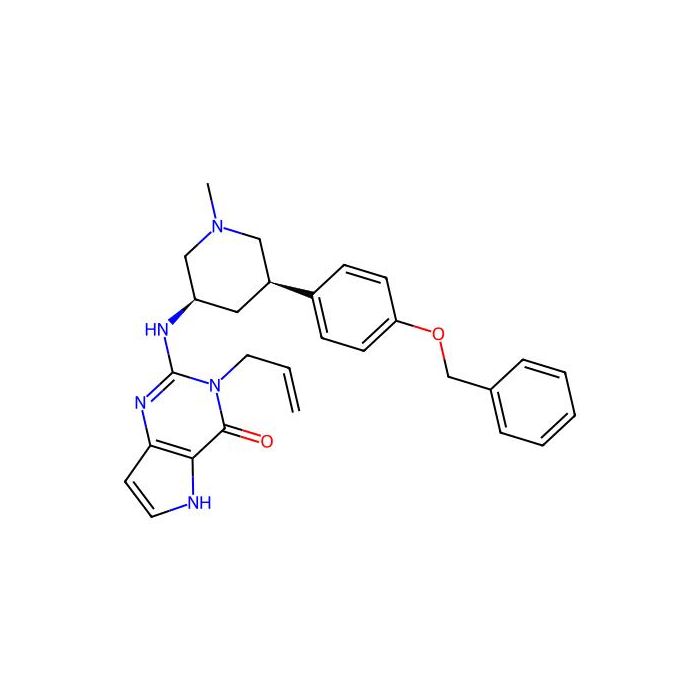
SETDB1-TTD-IN-1 is a potent, selective and endogenous binder competitive ligand of SET domain bifurcated protein 1 tandem tudor domain (SETDB1-TTD) that binds to TTD, with a K d of 88 nM. SETDB1-TTD-IN-1 increases SETDB1 methyltransferase activity. SETDB1-TTD-IN-1 can be used for the research of biological functions and disease associations of SETDB1-TTD .
Specifications
Especificaciones y pureza
Moligand™, 10 mM in DMSO
Condiciones de almacenamiento de almacenamiento
Protected from light,Argon charged,Store at -80°C
Enviado en
Dry ice packs + Cold packs
Este producto requiere envío en cadena de frío. Los servicios terrestres y otros servicios económicos no están disponibles.
Grado
Moligand™
Nombres e identificadores
Peso molecular
469.58
Documentation
📋 Safety Data Sheet (SDS)
Comprehensive hazard, handling, storage, and regulatory compliance document.
Certificados (CoA, COO, BSE/TSE y tabla de análisis)
C of A & Other Certificates(BSE/TSE, COO):
Analytical Chart:
Calculadoras de soluciones
Molarity Calculator
Determine the necessary mass, volume, or concentration for preparing a solution.
Dilution Calculator
Determine the dilution needed to prepare a stock solution.
Reconstitution Calculator
Reseñas
Reseñas de cliente
Application Protocols
No manufacturer-validated protocols or tested applications are provided for this SKU.
General example workflows (for small-molecule reader-domain ligands; not item-specific)
Preparing DMSO stocks
Dissolve compound in dry DMSO to 10–50 mM. Vortex/sonicate briefly. Aliquot into inert-gas–backfilled vials, protect from light, and store at −80 °C.
TR-FRET/HTRF binding assay (example template)
Buffer: 25 mM HEPES pH 7.5, 150 mM NaCl, 0.01% Tween-20, 1 mM DTT. Final DMSO ≤0.5%.
Incubate protein, labeled tracer/antibody, and serially diluted ligand (n≥10 points) for 1–2 h at room temperature; read TR-FRET ratio and fit to a 4PL model.
MST/SPR
Verify sample monodispersity; use matched DMSO for references. Perform serial dilutions spanning 0.1× to 10× expected KD.
Counterscreens
Assess autofluorescence/inner-filter effects; include detergent to mitigate aggregation; run off-target reader domains to check selectivity.
For this item, recommended dilutions, positive controls, and validated assay conditions are Not specified for this item; refer to CoA/Spec Sheet.
Biological Roles
Context (literature/general knowledge; not item-specific claims)
SETDB1 (also known as ESET/KMT1E) is a histone H3 lysine 9 (H3K9) methyltransferase involved in transcriptional silencing and heterochromatin formation. Its tandem Tudor domain (TTD) functions as a reader module that recognizes specific methyl-lysine marks on histone tails, coordinating recruitment and localization with writer activity.
Small-molecule ligands targeting Tudor or other reader domains are used as chemical biology tools to probe epigenetic recognition, dissect domain-specific functions, and potentially modulate chromatin states in vitro.
Relevance of TTD ligands (general)
By engaging the TTD pocket(s), ligands can perturb histone mark recognition, enabling mechanistic studies of chromatin remodeling and protein–protein interactions.
Ligands also support development of biochemical/biophysical assays for screening and for validating binding hypotheses suggested by structural or computational studies.
This item
The product name suggests relevance to SETDB1’s tandem Tudor domain; however, specific biological targets, affinities, and cellular effects are Not specified for this item; refer to CoA/Spec Sheet and primary literature.
Good practice
Use appropriate negative controls (inactive analogs) and orthogonal assays to confirm on-target engagement when deploying reader-domain ligands in research settings.
Buffer Applications
This product is a small-molecule ligand and is not itself a buffering agent. Therefore, standard buffer system formulation (pH range, capacity) is not typically applicable.
Practical notes for assay buffers (general, not item-specific)
Common assay buffers for protein–ligand binding studies include HEPES (20–50 mM, pH 7.4–8.0) or phosphate (10–50 mM, pH 7.0–7.5) with 100–200 mM NaCl, 0.5–2 mM TCEP or DTT as needed, and 0.01–0.05% nonionic detergent to mitigate aggregation.
Maintain final DMSO at ≤0.5–1.0% to protect protein stability and prevent vehicle artifacts.
Filter and degas buffers for biophysical techniques (ITC, SPR) to minimize noise and bubbles.
Item-specific buffer compatibility and solubility are Not specified for this item; consult the CoA or perform a small-scale solubility/compatibility screen before large experiments.
Green Alternatives
This item is a small-molecule research ligand rather than a process solvent or bulk reagent, so the concept of greener replacements is not directly applicable to the compound itself.
Greener handling considerations (general, not item-specific)
Solvent minimization: prepare the highest practical concentration DMSO stock to reduce overall solvent volumes in assays; keep final DMSO ≤0.5–1% v/v.
Preferred solvents: when feasible, replace DMF/DMAC with DMSO or aqueous buffer systems; avoid chlorinated solvents in sample prep and cleanup.
Waste reduction: consolidate analytical injections, apply microplate-based assays, and use low-dead-volume LC systems.
Energy use: store only necessary aliquots at −80°C; maintain inventory to limit freezer door openings and dry ice consumption during shipments.
If a greener probe is desired
Consider ligands with higher intrinsic aqueous solubility to reduce DMSO usage, provided they meet the same mechanistic objectives.
Note: No item-specific eco-profile or solvent requirements are supplied for this SKU; refer to your institutional green-chemistry guidelines for assay design.
Pharmaceutical Uses
This item is designated for research use only and is not manufactured to GMP standards. No pharmacopeial monographs or excipient roles are provided.
Regulatory status: research-grade Moligand™; not for human or veterinary use, diagnostic procedures, or clinical applications.
Formulation role: Not applicable. If used in preclinical laboratory studies (e.g., biochemical assays), solutions are typically prepared in DMSO and diluted into assay media; this does not constitute a pharmaceutical formulation.
Compendial status: Not specified for this item; refer to CoA/Spec Sheet.
If translation toward formulation research is contemplated, obtain comprehensive stability, solubility, and impurity data under an appropriate quality system. For this SKU, such information is not provided and should not be inferred.
Physical Properties
Item-specific physicochemical properties are not provided for this listing.
Appearance: Not specified for this item; refer to CoA/Spec Sheet.
Melting point: Not specified for this item; refer to CoA/Spec Sheet.
Boiling point: Not specified for this item; refer to CoA/Spec Sheet.
Density: Not specified for this item; refer to CoA/Spec Sheet.
Solubility: Not specified for this item; refer to CoA/Spec Sheet.
LogP/logD: Not specified for this item; refer to CoA/Spec Sheet.
pKa: Not specified for this item; refer to CoA/Spec Sheet.
Refractive index: Not applicable/unknown for a solid; if liquid, not specified for this item; refer to CoA/Spec Sheet.
General laboratory guidance (literature/practice, not item-specific)
Stock preparation for screening ligands is commonly done in anhydrous DMSO at 5–50 mM, followed by dilution into assay buffers to ≤1% v/v DMSO to minimize vehicle effects.
If the compound contains basic centers (typical for methyl-lysine reader ligands), aqueous solubility may depend on buffer pH and ionic strength; confirm with the item’s CoA or run a small-scale solubility screen.
Notes
Do not infer properties for this SKU without documentation. For method development (HPLC, LC–MS), request UV spectrum, extinction coefficient, and purity profile from the CoA.
Quality and Grades
Supplied grade: Moligand™ (per Product Data)
Moligand™ denotes a research-grade small-molecule ligand intended for biochemical/biophysical screening, target engagement, and chemical biology studies. It prioritizes identity and purity suitable for discovery workflows rather than GMP or clinical use.
What this means in practice
Intended use: in vitro research only; not for human or veterinary use. See Research Use Note.
Purity/impurities: Item-specific purity metrics (HPLC area %, NMR, residual solvents, water, metals) are Not specified for this item; refer to CoA/Spec Sheet.
UV profile: Not specified for this item; refer to CoA/Spec Sheet (important for HPLC/UPLC method development).
Stabilizers/additives: None stated; if present, they will be listed on the CoA.
Quality control recommendations
Verify identity by orthogonal methods where possible (e.g., HRMS and 1H NMR). Compare to CoA spectral data.
For screening campaigns, document lot number and maintain a frozen master DMSO stock to minimize variability across assays.
If using in biophysical assays (e.g., DSF, MST, ITC), run counterscreens to exclude aggregation or fluorescence interference.
Documentation
For certificates and analytical traces, request the current CoA/Spec Sheet for SKU S1496898.
Reaction and Applications
This product is not positioned as a synthetic reagent; it is supplied as a Moligand™ screening ligand. As such, classical organic reaction applications (e.g., coupling, reductions) are not the primary use-case.
Research applications (general, literature-based, not item-specific)
Biochemical assays: evaluation of binding to histone reader domains (e.g., tandem Tudor domains) using TR-FRET/HTRF, fluorescence polarization, AlphaScreen, or enzymatic counterscreens.
Biophysical characterization: MST, SPR, ITC, DSF to quantify affinity and thermodynamics and to assess ligand-induced stabilization.
Structural biology: co-crystallization or cryo-EM soaking to define binding poses; requires high-purity ligand and solubility in crystallization-compatible solvents.
Cell-free target engagement: CETSA/TPP in lysates to observe thermal stabilization; note that cell-based work demands additional safety and compatibility assessments.
Practical guidance
Prepare a concentrated, single-use DMSO master stock; avoid repeated freeze–thaw.
Include detergent (e.g., 0.01–0.05% Tween-20) in assay buffer to reduce nonspecific aggregation, where compatible.
Employ orthogonal counterscreens (e.g., AMP dehydrogenase aggregation assay or red-shifted fluorophores) to identify assay interference.
Note: No item-specific potency, selectivity, or assay-validated applications are provided in the Product Data; consult the CoA or primary literature before designing experiments with SKU S1496898.
Reaction Conditions
Not applicable in the conventional synthetic sense: this SKU is a research ligand, not a reagent intended for performing chemical reactions.
Assay-condition guidance (general, not item-specific)
Biochemical binding assays: 20–50 mM HEPES pH 7.4–8.0, 150 mM NaCl, 0.5–2 mM TCEP or DTT as compatible with the protein, 0.01–0.05% Tween-20, 25 °C; final DMSO ≤0.5–1% v/v.
ITC: degassed buffer, ligand at 5–20× protein concentration; verify c-value (nKa[Mt]) between 1–1000 for optimal isotherms.
DSF/CETSA: keep consistent vehicle percentage across samples; include appropriate negative and positive controls.
Expected outcomes (general)
Well-behaved ligands show dose-dependent signals without evidence of aggregation or fluorescence interference. Use orthogonal readouts to validate hits.
Item-specific temperatures, solvents, or catalytic conditions are Not specified for this item; refer to CoA/Spec Sheet for any stability constraints during assay setup.
Safety and Handling
Authoritative safety information for this specific item has not been provided in the Product Data.
GHS classification: Not specified for this item; refer to SDS.
Signal word/Pictograms/H-statements: Not specified for this item; refer to SDS.
General laboratory precautions (good practice)
Handle inside a chemical fume hood or ventilated enclosure; avoid inhalation of powders/aerosols and contact with skin/eyes.
Recommended PPE: lab coat, safety glasses or face shield, and appropriate chemical-resistant gloves (e.g., nitrile). Change gloves frequently when working with DMSO solutions, as DMSO enhances dermal absorption.
Storage incompatibilities: Keep separate from strong oxidizers and acids/bases until compatibility is verified. Avoid moisture uptake and repeated freeze–thaw of stock solutions.
Light/oxygen sensitivity: Product Data specifies protection from light and argon charging; minimize air exposure during handling by working quickly, capping promptly, and backfilling with inert gas if possible.
First aid (overview, defer to SDS): rinse skin/eyes with water for ≥15 minutes upon contact; move to fresh air if inhaled; seek medical attention if symptoms persist. If ingested, do not induce vomiting; obtain medical assistance.
Always consult the item-specific SDS for definitive hazards, spill response, and disposal guidance before use.
Solvent Selection
Item-specific solubility is not provided. The following guidance reflects general practice for small-molecule screening ligands and should be verified empirically for this SKU.
Primary solvent for stocks (general): anhydrous DMSO is commonly used due to broad solubilizing power and assay compatibility at ≤1% v/v.
Alternative solvents (general): DMF, ethanol, or acetonitrile can be considered if DMSO is unsuitable, noting impacts on assay readouts and protein stability.
Aqueous buffers: Many reader-domain ligands require co-solvent for dissolution; typical working solutions are prepared by serial dilution of a DMSO stock into buffer (e.g., 20–50 mM HEPES, pH 7.4–8.0, 150 mM NaCl) while keeping final DMSO ≤0.5–1.0%.
Comparison (general considerations)
DMSO: highest solvency; may affect protein stability or fluorescence at higher %.
Ethanol: volatile, less polar; can perturb membranes/proteins at ≥1–2%.
DMF: strong solvent but more cytotoxic; use sparingly in biochemical assays.
ACN: good for LC–MS sample prep; limited protein compatibility.
Practical tips
Warm gently (room temperature) and vortex/sonicate to aid dissolution. Avoid heating above protein-assay temperatures.
Filter 0.2 µm if preparing for HPLC/LC–MS.
Confirm absence of precipitation after dilution into assay buffer by visual inspection or DLS.
Note: For this item, specific solvent recommendations are Not specified for this item; refer to CoA/Spec Sheet.
Storage and Reconstitution
Storage conditions (from Product Data)
Store at −80 °C.
Protect from light.
Argon charged (maintain inert atmosphere where possible).
Shipping (from Product Data)
Shipped on dry ice packs + cold packs to preserve low temperature.
Reconstitution and handling (general guidance; verify with CoA)
Allow container to equilibrate to room temperature in a desiccator before opening to avoid moisture condensation.
If supplied as a solid: prepare a concentrated stock in anhydrous DMSO (e.g., 10–50 mM). Mix gently to dissolve; avoid heating.
If supplied as a solution: inspect for precipitates or phase separation; mix gently under inert gas.
Aliquot single-use volumes (e.g., 10–50 µL) in amber, inert-gas–backfilled vials. Refreeze immediately at −80 °C after preparation.
Avoid repeated freeze–thaw cycles. Thaw on ice or at room temperature briefly, then return unused material to −80 °C promptly.
Stability notes
Item-specific stability, hygroscopicity, and light sensitivity parameters are Not specified for this item; refer to CoA/Spec Sheet.
Document lot number, preparation date, solvent, and concentration on each aliquot for traceability.
Research use only: see Product Data statement.
Structure and Identity
Brief overview: SETDB1-TTD-IN-1 is supplied as a Moligand-class small-molecule screening ligand intended for research on epigenetic reader domains. No compound-specific structural identifiers are provided for this catalog entry.
Item-specific identifiers (from Product Data)
CAS: 2755823-12-0
InChIKey: Not specified for this item; refer to CoA/Spec Sheet.
SMILES: Not specified for this item; refer to CoA/Spec Sheet.
Molecular formula: Not specified for this item; refer to CoA/Spec Sheet.
Molecular weight: Not specified for this item; refer to CoA/Spec Sheet.
Structure notes (general)
Based on the product name, this item likely belongs to a class of small-molecule ligands designed for the tandem Tudor domain (TTD) of the histone methyl-lysine reader protein SETDB1; however, the exact scaffold, stereochemistry, and functional groups are not provided in the Product Data and should be confirmed from the CoA or primary literature for this specific SKU.
Without a provided 2D structure, no assertions can be made about ring systems, heteroatoms, or hydrogen-bond donors/acceptors for this specific item.
Best practice
Cite the SKU (S1496898) and CAS when cross-referencing databases. Obtain the full structural record (SMILES/InChI) from the item’s CoA or request from technical support prior to computational docking, property prediction, or analytical method development.
Synthetic Utility
This product is supplied as a finished small-molecule ligand for biochemical research, not as a synthetic building block. Consequently, its use in general organic synthesis is limited.
Potential uses in analytical chemistry (general, not item-specific)
Reference standard in LC–MS method development for compound tracking in biochemical assays, once identity and purity are confirmed via the CoA.
Positive control for binding assays during assay validation, provided the target engagement of this specific item is documented in your lab.
Why not a general reagent?
Without disclosed functional groups or reactivity, it is inappropriate to position this item for transformations such as coupling, protection, or ring-forming reactions.
If derivatization is desired
Consider obtaining structural information (SMILES/InChI, NMR) from the CoA, then plan modifications guided by SAR or by linking handles suitable for biotinylation/fluorophore conjugation. Verify that intellectual property constraints permit such work.
Item-specific reactive handles, named-reaction compatibility, and retrosynthetic value are Not specified for this item; refer to CoA/Spec Sheet.
Target Specificity
Only item-specific target information explicitly provided in the Product Data may be listed here.
Target/epitope/clone/isotype/species reactivity: Not specified for this item; refer to CoA/Spec Sheet.
Note
The product name (“SETDB1-TTD-IN-1”) suggests a design intent toward the tandem Tudor domain of SETDB1; however, no validated specificity, affinity, or selectivity data are provided in the Product Data for SKU S1496898. Consult the CoA or primary literature before relying on target assignment.
Need help choosing the grade?
Our grade selection guide covers purity, stabilizer status, and application suitability for all variants in our catalog.
We use cookies to ensure the website functions properly and, where permitted, to improve your experience. You can manage your preferences at any time in Settings. Learn more in our Cookie Policy.
Shall we send you a message when we have discounts available?
Remind me later
Thank you! Please check your email inbox to confirm.
Products are supplied to verified businesses, institutions, and qualified professionals for research and development use only. Not for use in humans, animals, diagnosis, or therapy.