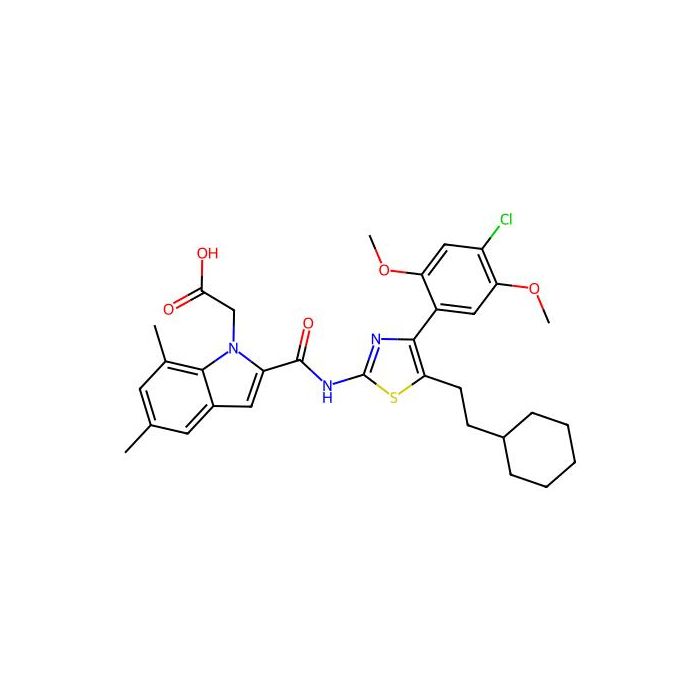
SR 146131 is a potent, orally available, and selective nonpeptide ( cholecystokinin 1 ) receptor agonist.
In Vitro
SR 146131 inhibits in the binding of [ 125 I]-BH-CCK-8S to CCK1sites on 3T3-hCCK1 cell membranes with an IC 50 value of 0.56 ± 0.10 nM. At much higher concentrations, SR 146131 also inhibits the binding of radiolabeled CCK to CCK2sites in CHO-hCCK2 membranes with an IC 50 of 162 ± 27 nM. SR 146131 is a potent CCK1 agonist on several intracellular events linked to CCK1 receptor activation in various cell types: on [Ca 2+ ]i release and IP1 formation, SR 146131 appears as a full CCK1 receptor agonist in the 3T3-hCCK1 cells, but a partial CCK1receptor agonist on MAPK activation and early gene expression in this cell line. SR 146131 also acts as a partial agonist in the two neuroblastoma cell lines. MCE has not independently confirmed the accuracy of these methods. They are for reference only.
In Vivo
SR 146131 completely inhibits gastric and gallbladder emptying in mice (ED 50 of 66 and 2.7 μg/kg p.o., respectively). SR 146131 dose dependently reduces food intake in fasted rats (from 0.1 mg/kg p.o.), in nonfasted rats in which food intake has been highly stimulated by the administration of neuropeptide Y (1–36) (from 0.3 mg/kg p.o.), in fasted gerbils (from 0.1 mg/kg p.o.), and in marmosets maintained on a restricted diet (from 3 mg/kg p.o.). SR 146131 (10 mg/kg p.o.) also increases the number of Fos-positive cells in the hypothalamic paraventricular nucleus of rats. Locomotor activity of mice is reduced by orally administered SR 146131 (from 0.3 mg/kg p.o.) . MCE has not independently confirmed the accuracy of these methods. They are for reference only.
Form:Solid
IC50& Target:Cholecystokinin 1 receptor
Especificaciones
Especificaciones y pureza
≥98%
Mecanismos bioquímicos y fisiológicos
SR 146131 is a potent, orally available, and selective nonpeptide ( cholecystokinin 1 ) receptor agonist.
Condiciones de almacenamiento de almacenamiento
Store at -20°C
Enviado en
Ice chest + Ice pads
Este producto requiere envío en cadena de frío. Los servicios terrestres y otros servicios económicos no están disponibles.
This compound belongs to the class of organic compounds known as indolyl carboxylic acids and derivatives. These are compounds containing a carboxylic acid chain (of at least 2 carbon atoms) linked to an indole ring.
External Descriptors
Not available
1. Djoumbou Feunang Y, Eisner R, Knox C, Chepelev L, Hastings J, Owen G, Fahy E, Steinbeck C, Subramanian S, Bolton E, Greiner R, and Wishart DS. ClassyFire: Automated Chemical Classification With A Comprehensive, Computable Taxonomy. Journal of Cheminformatics, 2016, 8:61.
Certificados (CoA, COO, BSE/TSE y tabla de análisis)
C of A & Other Certificates(BSE/TSE, COO):
Analytical Chart:
Propiedades químicas y físicas
Solubilidad
DMSO : 250 mg/mL (409.73 mM; Need ultrasonic)
Peso molecular
610.2
XLogP3
8.600
Hydrogen Bond Donor Count
2
Hydrogen Bond Acceptor Count
7
Rotatable Bond Count
10
Exact Mass
609.206 Da
Monoisotopic Mass
609.206 Da
Topological Polar Surface Area
131.000 Ų
Heavy Atom Count
42
Formal Charge
0
Complexity
925.000
Isotope Atom Count
0
Defined Atom Stereocenter Count
0
Undefined Atom Stereocenter Count
0
Defined Bond Stereocenter Count
0
Undefined Bond Stereocenter Count
0
The total count of all stereochemical bonds
0
Covalently-Bonded Unit Count
1
Calculadoras de soluciones
Molarity Calculator
Determine the necessary mass, volume, or concentration for preparing a solution.
Dilution Calculator
Determine the dilution needed to prepare a stock solution.
Reconstitution Calculator
Reseñas
Reseñas de cliente
Application Protocols
No tested application protocols are provided for this item in the Product Data.
General protocol framework for small-molecule testing (not item-specific)
Stock preparation: Dissolve in anhydrous DMSO to 10–50 mM. Vortex and, if necessary, brief sonication. Filter through 0.2 μm PTFE for sensitive assays.
Working solutions: Serially dilute in assay buffer/media to achieve desired final concentrations, maintaining constant and acceptable final DMSO (commonly 0.1–0.5% v/v).
Controls: Include vehicle control (DMSO alone) and, if available, a recognized reference compound for the pathway of interest.
Plate handling: Use low-binding polypropylene plates for hydrophobic compounds. Mix thoroughly after dosing; minimize edge effects by equilibrating plates and using consistent incubation conditions.
Data quality: Run replicates (≥3 technical, ≥3 biological where possible). Assess signal-to-background, Z′ factor (for HTS), and check for precipitation or color/fluorescence interference.
Please adapt conditions to your specific assay and confirm solubility/stability for SR 146131 experimentally.
Biological Roles
Item-specific biological function and target information for SR 146131 are not provided in the Product Data. No claims are made here regarding mechanism, potency, or selectivity. For research planning, consult primary literature linked to the CAS (221671-61-0) or PubChem CID (9852833), and verify against the CoA/SDS.
General considerations for small-molecule research tools (not item-specific)
Potential roles: May act as an agonist, antagonist, inhibitor, or modulator of a specific receptor/enzyme/ion channel. Always confirm the intended target and species selectivity from peer-reviewed sources before designing experiments.
Off-targets: Many bioactives display concentration-dependent polypharmacology. Employ profiling panels or secondary assays to confirm specificity.
ADME features: Solubility, permeability (e.g., PAMPA/Caco-2), and microsomal stability impact observed cellular potency. Establish these experimentally for robust interpretation.
Controls: Use structural analogs and inactive controls where available; implement DMSO-only controls to account for solvent effects.
Ethical and regulatory note
This product is provided strictly for research use only. It is not intended for human or veterinary use, diagnostics, or therapeutic applications.
Buffer Applications
This product is a small-molecule research compound and is not a buffering agent. Therefore, classic buffer system guidance (e.g., phosphate, Tris, HEPES recipes and pH ranges) does not directly apply.
Practical notes for assay buffers (general; not item-specific)
When dosing from DMSO stocks, select a buffer system compatible with the biological target (e.g., HEPES or phosphate-buffered saline for many enzyme/cell assays) and maintain final DMSO at tolerated levels (commonly ≤0.5–1% v/v).
If precipitation occurs on dilution, consider:
Increasing buffer ionic strength or adding minimal co-solvent (0.1–1% DMSO or ethanol).
Using serum or carrier proteins (e.g., 0.1% BSA) to enhance apparent solubility, noting possible binding effects.
Filter buffers (0.22 μm) for sensitive optical or cellular applications to reduce particulates.
Specifications such as pKa and exact solubility that drive buffer choice are Not specified for this item; refer to CoA/Spec Sheet and confirm experimentally.
Green Alternatives
Because this product is a small-molecule research compound (not a solvent or bulk reagent), green chemistry considerations focus on solvent selection and process minimization during handling. No item-specific environmental data are provided.
Greener solvent choices for dissolution (general guidance)
Prefer lower-toxicity, higher-safety solvents when feasible.
Comparison (general, not item-specific)
DMSO: Widely accepted in bioassays; low volatility and good safety profile relative to DMF/NMP. Trade-off: Can interfere with some enzymes at >1–2% v/v.
Ethanol/IPA: Renewable sources available; miscible with water; often acceptable up to 0.5–1% v/v in assays. Trade-off: Potential biological effects; lower solubilizing power for very lipophilic compounds.
2-Methyltetrahydrofuran (2-MeTHF) or Cyrene for synthetic operations: Greener replacements for traditional ethers/DMF, respectively, if any preparative work is performed around the compound. Trade-off: Solubility profiles differ; water miscibility and stability must be considered.
Operational tips
Use micro-scale preparations and high-concentration stocks to minimize solvent volumes.
Implement closed-vial dissolution with vortex/sonication to reduce exposure and losses.
Segregate and properly label DMSO/DMF waste; evaluate aqueous compatibility before drain disposal per institutional policy.
Pharmaceutical Uses
No pharmaceutical excipient status, compendial listings, or formulation roles are specified for this item. This product is supplied strictly for research use only.
General R&D context (not item-specific)
Preclinical formulation screening for small molecules often explores:
Solubilization: DMSO stock with aqueous dilution, cosolvent systems (PEG400/EtOH/Saline), or cyclodextrin inclusion complexes.
Solid forms: Free base/acid versus salt selection; polymorph screening; amorphous dispersions. Any such work requires the confirmed structure and salt form from the CoA.
Analytical support: Establish stability-indicating HPLC methods and forced-degradation studies (acid/base/oxidative/thermal/light) during formulation feasibility.
Compliance note
No claims are made regarding clinical safety, efficacy, or therapeutic use. For any work beyond exploratory research, additional qualification and regulatory documentation would be required.
Physical Properties
Item-specific properties
Appearance: Not specified for this item; refer to CoA/Spec Sheet.
Molecular weight: Not specified for this item; refer to CoA/Spec Sheet.
Molecular formula: Not specified for this item; refer to CoA/Spec Sheet.
Melting point (spec): Not specified for this item; refer to CoA/Spec Sheet.
Boiling point (spec): Not applicable/rarely reported for complex bioactive solids; Not specified for this item; refer to CoA/Spec Sheet.
Density: Not specified for this item; refer to CoA/Spec Sheet.
Refractive index: Not applicable (solid) unless otherwise stated; Not specified for this item; refer to CoA/Spec Sheet.
Solubility: Not specified for this item; refer to CoA/Spec Sheet.
General literature guidance for drug-like small molecules (not item-specific)
Many SR-series small molecules are obtained as crystalline solids with moderate to high lipophilicity. Solubility is often improved in polar aprotic solvents such as DMSO, DMF, or NMP, with subsequent dilution into aqueous buffers containing co-solvent (0.1–1% DMSO) or surfactant (e.g., 0.01–0.1% Tween 80) for biological assays.
Typical stock solutions: 10–50 mM in anhydrous DMSO (filter if needed). Assess and limit final DMSO to assay-tolerated levels.
pKa/logP: Not specified for this item; check CoA or compute from the confirmed structure before planning permeability/solubility experiments.
Important
Do not treat general values as product specifications. For exact, batch-specific physical property data, use the CoA/Spec Sheet and SDS.
Quality and Grades
Item-specific quality information
Grade/Purity: Not specified for this item; refer to CoA/Spec Sheet.
Stabilizers/antioxidants: Not specified for this item; refer to CoA/Spec Sheet.
How to interpret common grades (general guidance; not item-specific)
Research grade: Suitable for discovery research and screening; typical identification by NMR/LC–MS and purity report (e.g., HPLC area%).
HPLC grade (for solvents) or LC–MS grade do not apply to solid bioactives; instead, look for assay-specific purity (≥95% or ≥98% HPLC), water content (Karl Fischer), and residual solvent limits. For this product, such values are Not specified for this item; refer to CoA/Spec Sheet.
Low-UV impurities are important if using UV detection; request chromatograms when needed.
Documentation and lot control
For regulated workflows, obtain: CoA (identity, purity method, lot), analytical traces (1H/13C NMR, LC–MS, HPLC), residual solvent data, and where relevant, salt form/water of crystallization.
If the compound is provided as a salt or solvate, ensure calculations for dosing are adjusted to free-base/free-acid equivalents.
Bottom line
As the Product Data does not state a grade/purity, consult the CoA/Spec Sheet for the lot you receive to determine suitability for your application (screening vs. mechanistic studies vs. in vivo exploratory research).
Reaction and Applications
Manufacturer applications: Not provided in the Product Data.
Context and likely usage (general; not item-specific)
SR 146131 is listed under a small-molecule/compound library category and is typically handled as a bioactive research tool rather than as a synthetic reagent. Such compounds are commonly used in target validation, pathway interrogation, and assay development as reference ligands or hits/leads in screening campaigns.
If used in discovery biology
Employ a validated stock solution protocol (e.g., DMSO stocks) and confirm assay compatibility at the intended final concentration of solvent and compound.
Include appropriate positive/negative controls and perform concentration–response experiments to estimate potency parameters (e.g., IC50/EC50) where applicable.
If used in analytical method development
Utilize LC–MS for identity/purity confirmation; develop gradient methods that separate potential isomers/degradants. Consider using HRMS for exact-mass confirmation once the definitive formula/structure is obtained from the CoA.
Synthetic chemistry note
This product is not typically used as a reagent, catalyst, or building block. If derivatization is desired (e.g., for probe conjugation), obtain the precise structure and functional group map from the CoA to plan compatible transformations.
Reaction Conditions
This product is not primarily intended as a reagent for chemical reactions; therefore, standard reaction conditions (catalysts, temperatures, yields) are not applicable.
If conducting analytical or preparative work (general; not item-specific)
Dissolution: Prepare concentrated stocks in anhydrous DMSO or another suitable solvent, then dilute as needed.
Stability checks: Run accelerated stress tests (e.g., 40–60 °C in solvent, exposure to light/air) on small aliquots to understand degradation pathways prior to larger-scale studies.
Chromatography: For reverse-phase HPLC, typical mobile phases are water/acetonitrile or water/methanol with 0.1% formic acid or ammonium acetate; optimize gradients to separate potential isomers/degradants.
Solid handling: If the compound is hygroscopic or photosensitive (unknown here), work quickly under dry, low-light conditions until stability is confirmed.
All numeric parameters (temperatures, times, yields) should be established experimentally for this specific compound once the definitive structure is confirmed. No item-specific reaction data are provided.
Safety and Handling
Item-specific safety
GHS classification: Not specified for this item; refer to SDS.
Signal word: Not specified for this item; refer to SDS.
Hazard statements (H-codes): Not specified for this item; refer to SDS.
Pictograms: Not specified for this item; refer to SDS.
General handling guidance for small-molecule research compounds (not item-specific)
PPE: Wear lab coat, safety glasses, and appropriate chemically resistant gloves (e.g., nitrile). Avoid inhalation and contact with skin/eyes. Use in a fume hood, especially when weighing fine powders or preparing concentrated solutions.
Avoid creating dust/aerosols. If supplied as a solid, consider anti-static measures during weighing.
Storage incompatibilities: Keep away from strong oxidizers and strong acids/bases unless stability data indicate compatibility. Protect from moisture and light until stability is confirmed.
First aid (overview; consult SDS):
Inhalation: Move to fresh air; seek medical attention if symptoms persist.
Skin/eye contact: Rinse with water for several minutes; remove contaminated clothing; seek medical attention if irritation persists.
Ingestion: Rinse mouth; do not induce vomiting unless directed by medical personnel.
Spill response: Collect solids with minimal dust generation. For solutions, absorb with inert material and dispose per institutional hazardous waste procedures.
Special notes
No specific sensitization, carcinogenicity, or reproductive toxicity data are provided in the Product Data. Defer to SDS and institutional EHS guidance.
Solvent Selection
Item-specific solubility and solvent recommendations are not provided in the Product Data. Refer to the CoA/Spec Sheet. The guidance below is general for hydrophobic, drug-like SR-series small molecules and should not be treated as specifications.
General dissolution strategy
Primary stock solvent: Anhydrous DMSO (common choice due to broad solvating power and biological assay compatibility at low final %).
Alternatives: DMF or NMP for difficult cases; ethanol or isopropanol when aqueous dilution is planned and assay tolerability allows.
Aqueous work: Prepare concentrated DMSO stock, then dilute into buffer with rapid mixing. Maintain final DMSO at 0.1–1% v/v depending on assay tolerance. Consider using co-solvents or surfactants (e.g., 0.01–0.1% Tween 80) if precipitation is observed.
Polarity/miscibility context (general)
DMSO: Highly polar aprotic; miscible with water and organics; good for most neutral/weakly basic compounds.
DMF/NMP: Strong solvents for challenging solutes; higher boiling points may complicate removal.
Ethanol: Protic, miscible with water; may affect biological membranes and enzymes—validate controls.
Practical tips
Filter stock solutions (0.2 μm PTFE) to remove particulates for optical/biological assays.
Verify concentration by UV–Vis or quantitative NMR when critical; determine extinction coefficient experimentally if unknown.
Stability screening: Assess solution stability at room temperature and 4 °C over 24–72 h before high-throughput use.
Storage and Reconstitution
Item-specific storage and shipping
Storage Conditions: Store at -20°C (from Product Data). Keep tightly closed, in a dry, inert atmosphere, and protected from light until stability is confirmed.
Shipped In: Ice chest + ice pads (from Product Data) to maintain a cold chain during transit.
General reconstitution guidance for small-molecule solids (not item-specific)
Equilibrate the vial to room temperature in a desiccator before opening to minimize moisture condensation.
Prepare concentrated stock solutions in anhydrous DMSO (typical 10–50 mM). Record solvent, concentration, and date on the vial.
Aliquot stocks into small, single-use volumes to avoid repeated freeze–thaw cycles. Store aliquots at -20°C or below, protected from light.
Thawing: Warm to room temperature before opening; vortex to ensure homogeneity. Inspect for precipitation or discoloration; discard if degradation is suspected.
Shelf life and stability
Specific shelf-life, water content, and stability-in-solution data are Not specified for this item; refer to CoA/Spec Sheet and SDS. Verify stability under your conditions (e.g., LC–MS at time 0 and after storage) before critical experiments.
Research use note
For research use only. Not for human or veterinary use, diagnostic, or therapeutic applications.
Structure and Identity
Overview for SR 146131 (SKU S647898; CAS 221671-61-0; CID 9852833)
Item-specific identifiers (from Product Data):
CAS: 221671-61-0
PubChem CID: 9852833
InChIKey: 236937 (note: this does not resemble a standard 27-character InChIKey; verify on CoA/SDS)
SMILES: Not specified for this item; refer to CoA/Spec Sheet.
Molecular formula: Not specified for this item; refer to CoA/Spec Sheet.
Molecular weight: Not specified for this item; refer to CoA/Spec Sheet.
Structural description:
2D/functional features: Not specified for this item; refer to CoA/Spec Sheet.
Stereochemistry: Not specified for this item; refer to CoA/Spec Sheet.
Naming and classification:
Product Name: SR 146131 (small-molecule research compound; listed under 全部 / 可售 / 小分子和化合物库)
Chemical name (IUPAC): Not specified for this item; refer to CoA/Spec Sheet.
Notes
Where exact structural details are required (e.g., for spectral interpretation or regulatory filings), consult the certificate of analysis (CoA) and the SDS. If needed, confirm the identity against the provided CAS and CID using an authoritative chemical registry prior to use.
Synthetic Utility
SR 146131 is offered as a finished small-molecule research compound. It is not typically employed as a reagent, catalyst, or general building block in synthetic chemistry.
Guidance if derivatization is intended (general; not item-specific)
Confirm the exact structure, functional groups, and salt form from the CoA before planning transformations.
Map potential handles for conjugation (e.g., free amines, phenols, carboxylates) and assess their pKa/chemoselectivity. Without the structure, this cannot be specified for the current item.
Protecting group strategy: Choose conditions orthogonal to sensitive motifs (e.g., avoid strong acids/bases if the scaffold is labile). Conduct small-scale scouting reactions and monitor by LC–MS.
Purification: Reverse-phase preparative HPLC is often preferred for polar/lipophilic bioactives; verify UV absorbance profile to set detection wavelengths.
Caveat
No item-specific reactivity, functional group content, or spectral data are provided. Treat any synthetic modification plans as exploratory until validated experimentally.
Target Specificity
Target, mechanism, and selectivity information for SR 146131 are not provided in the Product Data. No claims are made regarding biological targets, binding constants, or selectivity profiles for this item.
General guidance (not item-specific)
Before use in target-based assays, verify the intended target and reference potency from primary literature corresponding to CAS 221671-61-0 or PubChem CID 9852833.
Evaluate species cross-reactivity where relevant (e.g., human vs. rodent orthologs).
Use orthogonal assay formats (biochemical vs. cellular) and concentration–response studies to assess specificity and rule out assay interference.
Note
If your application requires defined target specificity, request or generate profiling data (e.g., broad receptor/enzyme panel) under your assay conditions.
Preguntas frecuentes
What is the purity of this product?
This product is supplied at ≥98% purity (chemical assay). Lot-specific values are stated on the Certificate of Analysis.
How should this product be stored?
Store at ?20 °C. Freezer storage is required to maintain the specified shelf life.
How is this product shipped?
This product ships in an insulated container with ice pads. Unpack on arrival and transfer it to the storage condition stated above.
What are the CAS number, molecular formula and molecular weight?
The CAS Number is 221671-61-0, the molecular formula is C32H36ClN3O5S, and the molecular weight is 610.16 g/mol. InChIKey NFDFTMICKVDYLQ-UHFFFAOYSA-N.
What documentation is provided?
Available product documentation, including Certificates of Analysis (COA), Safety Data Sheets (SDS), and specification sheets, is shown in the product document area. Document availability and access follow the current site policy.
Utilizamos cookies para garantizar el correcto funcionamiento del sitio web y, cuando esté permitido, para mejorar su experiencia. Puede gestionar sus preferencias en cualquier momento en Configuración. Más información en nuestra Política de Cookies.
¿Quieres que te enviemos un mensaje cuando tengamos descuentos disponibles?
Recordármelo más tarde
¡Gracias! Por favor, revisa tu bandeja de entrada de correo electrónico para confirmar.
Products are supplied to verified businesses, institutions, and qualified professionals for research and development use only. Not for use in humans, animals, diagnosis, or therapy.