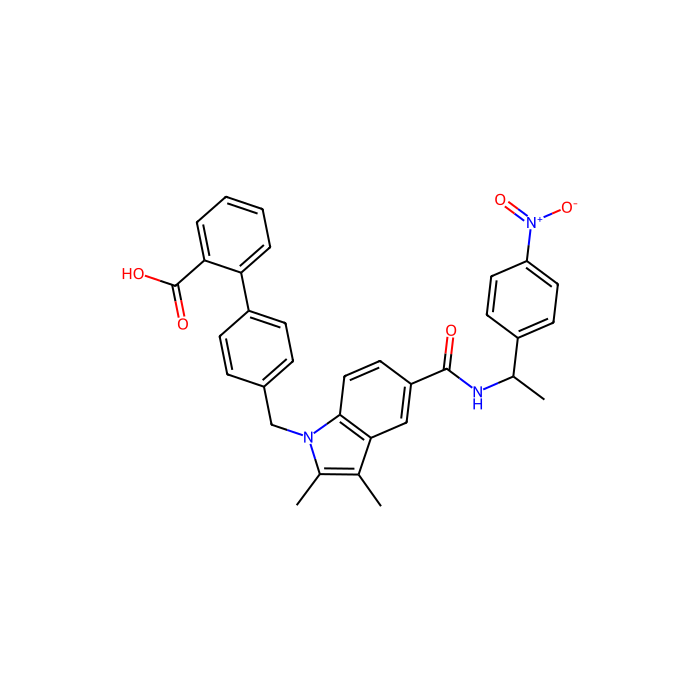
Antidiabetic agent; binds to PPARγand potently inhibits Cdk5-mediated PPARγphosphorylation (IC50= 80 nM; Ki= 28.67 nM) without exhibiting PPARγagonist activity. Does not inhibit Cdk5-dependent phosphorylation of Rb. Reduces fasting insulin levels and improves insulin sensitivity in a mouse model of diabetes.
Condiciones de almacenamiento de almacenamiento
Store at -20°C
Enviado en
Ice chest + Ice pads
Este producto requiere envío en cadena de frío. Los servicios terrestres y otros servicios económicos no están disponibles.
This compound belongs to the class of organic compounds known as indolecarboxamides and derivatives. These are compounds containing a carboxamide group attached to an indole.
External Descriptors
Not available
1. Djoumbou Feunang Y, Eisner R, Knox C, Chepelev L, Hastings J, Owen G, Fahy E, Steinbeck C, Subramanian S, Bolton E, Greiner R, and Wishart DS. ClassyFire: Automated Chemical Classification With A Comprehensive, Computable Taxonomy. Journal of Cheminformatics, 2016, 8:61.
Solvent:DMSO, Max Conc. mg/mL: 54.76, Max Conc. mM: 100; Solvent:ethanol, Max Conc. mg/mL: 54.76, Max Conc. mM: 100
Peso molecular
547.6
XLogP3
6.500
Hydrogen Bond Donor Count
2
Hydrogen Bond Acceptor Count
5
Rotatable Bond Count
7
Exact Mass
547.211 Da
Monoisotopic Mass
547.211 Da
Topological Polar Surface Area
117.000 Ų
Heavy Atom Count
41
Formal Charge
0
Complexity
922.000
Isotope Atom Count
0
Defined Atom Stereocenter Count
1
Undefined Atom Stereocenter Count
0
Defined Bond Stereocenter Count
0
Undefined Bond Stereocenter Count
0
The total count of all stereochemical bonds
0
Covalently-Bonded Unit Count
1
Seguridad y peligros (GHS)
WGK Alemania
3
RIDADR
NONHforallmodesoftransport
Calculadoras de soluciones
Molarity Calculator
Determine the necessary mass, volume, or concentration for preparing a solution.
Dilution Calculator
Determine the dilution needed to prepare a stock solution.
Reconstitution Calculator
Reseñas
Reseñas de cliente
Application Protocols
Only application details from Product Data may be presented here.
Tested applications: Not specified for this item; refer to CoA/Spec Sheet.
Recommended concentrations/dilutions: Not specified for this item; refer to CoA/Spec Sheet.
Positive/negative controls: Not specified for this item; refer to CoA/Spec Sheet.
General suggestions (non-item-specific)
Prepare a small set of pilot concentrations (e.g., half-log series) to determine effective ranges in your assay. Maintain consistent vehicle concentration across all wells/tubes.
Include orthogonal readouts to confirm on-target effects and run counterscreens for common off-targets.
Document lot number, stock concentration, and preparation date for reproducibility.
Biological Roles
Important: This section summarizes general literature context for compounds known as “SR 1664” and is not an item-specific claim. Verify suitability for your application with primary references and the CoA/SDS.
General/literature overview
SR 1664 has been reported in the literature as a selective modulator targeting nuclear receptor pathways, used as a chemical probe in metabolic and transcriptional studies. Researchers employ it to study receptor conformational control, co-regulator recruitment, and downstream gene expression without relying on classical full agonism. These uses are in vitro/in cellulo research contexts.
Use in experimental systems
Typical applications include dose–response profiling in cell lines expressing the receptor of interest, transcriptomic or reporter assays to differentiate agonism vs modulation, and phospho-state analyses in signaling nodes implicated by the receptor pathway. Assay designs often monitor off-target liabilities through parallel counterscreens.
Caveats and controls
Confirm on-target effects with orthogonal readouts (e.g., binding vs functional assays). Include vehicle controls (DMSO), positive controls (reference ligands), and negative controls.
No clinical or diagnostic use
SR 1664 is supplied strictly for research use. No claims are made regarding therapeutic efficacy, safety in humans/animals, or diagnostic performance.
Buffer Applications
SR 1664 is a small-molecule probe rather than a buffering agent. Consequently, it is not used to set or maintain pH. For experiments incorporating SR 1664, buffer choice should support solubility and biological compatibility.
Practical guidance (general, not item-specific)
Common biological buffers: PBS, HEPES, or Tris-buffered saline are frequently used for cell-based or biochemical assays. Maintain physiological ionic strength and pH suitable for the target system.
Vehicle management: Dilute DMSO stocks into buffer to a final DMSO fraction typically ≤0.1–1% v/v. Mix thoroughly to avoid local supersaturation. Consider adding 0.1% BSA to reduce nonspecific adsorption for hydrophobic compounds.
Filtration: Pass final working solutions through 0.22 µm filters if compatible with the compound and assay.
For buffer recipes and pH ranges, consult your assay SOPs. Item-specific solubility and compatibility must be verified experimentally or via the CoA.
Green Alternatives
As SR 1664 is a finished bioactive, “greener alternatives” pertain mainly to solvent choices and handling practices rather than substitution of the active itself. The following are general, non-item-specific recommendations.
Greener solvent considerations for solution prep and assay work
Prefer water-based vehicles where feasible, with minimal DMSO (≤0.1–1% v/v) consistent with assay tolerance.
If organic cosolvents are necessary, ethanol or 2‑propanol can be considered for some systems due to lower toxicity relative to DMF/NMP; confirm solubility and assay compatibility.
For any upstream synthesis or scale-up (if performed in-house), consider swapping chlorinated solvents with greener ethers (2‑MeTHF) or esters (EtOAc) where compatible, and adopt catalytic conditions to minimize waste.
Ethanol: Greener, but may limit maximum stock concentration.
DMF/NMP: Powerful but with higher reproductive toxicity concerns; avoid for routine biological dilution if possible.
Operational greening
Use micro-aliquots to reduce thaw–freeze cycles, thereby cutting waste.
Implement closed, low-evaporation containers to minimize fugitive emissions.
Segregate waste streams to enable safer and more efficient disposal/recycling per institutional guidelines.
Pharmaceutical Uses
This product is supplied strictly for research use only. No medical, clinical, or diagnostic uses are claimed.
Formulation context (general, non-item-specific)
In preclinical research, small-molecule probes like SR 1664 may be formulated as DMSO-based stocks for in vitro work. For in vivo method development (where permitted under institutional approvals), solubilization systems might include cosolvent blends and surfactants; however, such uses are outside the scope of this catalog listing and are not endorsed for this item.
Excipient status: SR 1664 is not an excipient. There is no pharmacopeial monograph for SR 1664.
Manufacturing and QC considerations for research supply
Confirm identity and purity on the lot’s CoA. Document salt form/solvate state, residual solvent levels, and water content if reported. These influence reproducibility in research settings.
Regulatory note
Not for human or veterinary use. Not for diagnostic procedures. Handle under appropriate laboratory approvals and dispose according to regulations.
Physical Properties
Item-specific specifications
Appearance: Not specified for this item; refer to CoA/Spec Sheet.
Molecular weight: Not specified for this item; refer to CoA/Spec Sheet.
Molecular formula: Not specified for this item; refer to CoA/Spec Sheet.
Melting point: Not specified for this item; refer to CoA/Spec Sheet.
Boiling point: Not applicable/unknown for a non-volatile solid probe; specific value not specified for this item.
Density, refractive index, pKa, logP/logD, UV-Vis cutoff: Not specified for this item; refer to CoA/Spec Sheet.
Solubility (item-specific): Not specified for this item; refer to CoA/Spec Sheet.
General/literature guidance (non-specification)
Many bioactive small molecules of this class are handled as off-white to light-colored solids with limited aqueous solubility and are routinely prepared as DMSO stock solutions (e.g., 10–50 mM), then diluted into assay buffers with carrier proteins or co-solvents. This is general guidance only and not a specification for this SKU.
If the compound contains aromatic and heteroatom-rich motifs (typical for receptor ligands), expect higher solubility in polar aprotic solvents (DMSO, DMF, NMP) relative to water. Confirm with actual solubility data on the CoA.
Practical notes
Prior to use, verify physical constants on the lot-specific CoA. For analytical confirmation, LC–MS and 1H NMR in DMSO‑d6 or CD3OD are common choices for similar research compounds. Always filter or centrifuge working solutions to remove particulates before biological or screening assays.
Quality and Grades
Item-specific information
Grade/Purity: Not specified for this item; refer to CoA/Spec Sheet.
Research Use Note: For research use only (not for human or veterinary use; not for diagnostic or therapeutic applications).
What the grade typically implies (general guidance)
Research grade small molecules are generally suitable for discovery biology, screening, and chemical biology studies. Purity for such probes commonly exceeds 95% by HPLC/LC–MS, with identity verified by MS and NMR; however, these are NOT specifications for this SKU. Consult the lot-specific CoA for exact purity and analytical methods used.
UV-transparency, residual solvent content, water content (Karl Fischer), and counterion/solvate state can influence assay performance. These parameters, when reported, are lot-specific and should be checked on the CoA.
Stabilizers and additives
Stabilizers/inhibitors: Not specified for this item; refer to CoA/Spec Sheet. In general, bioactives are supplied neat unless otherwise noted.
Practical recommendations
For quantitative biology/chemistry, document the exact purity, form (free base/salt, solvate), and any stabilizers from the CoA. Adjust weighed amounts for potency if assay demands molar accuracy. Retain CoA with your lab records to ensure traceability.
Reaction and Applications
Context: SR 1664 is sold as a finished small-molecule research probe. It is not primarily a synthetic reagent. Accordingly, reaction-oriented applications are limited; instead, use is typically in biochemical or cell-based assays. The following notes are general and not item-specific specifications.
Assay-focused applications (general/literature)
Chemical biology: Utilized as a ligand/probe in target-engagement studies, dose–response assays, and pathway interrogation. Stocks are commonly prepared in DMSO and serially diluted for HTS or targeted assays.
Biophysical characterization: Suitable for thermal shift assays (DSF), isothermal titration calorimetry (ITC), or surface plasmon resonance (SPR) if the compound is sufficiently pure and soluble under assay conditions.
Cellular studies: Employed in cell culture assays with careful control of vehicle concentration and appropriate exposure times; adsorption to plastics can be mitigated by BSA supplementation or low-binding plates.
Analytical methods
Purity and identity verification by LC–MS and NMR before critical studies is prudent. Establish stability-indicating LC methods to monitor degradation under storage and assay conditions.
If attempting synthetic modifications
Without a provided structure, route planning cannot be specified. For SAR work, retrieve the authoritative structure (CAS 1338259-05-4) and consult primary literature for feasible derivatizations and protecting-group strategies.
Reaction Conditions
Not typically applicable. SR 1664 is sold as a research probe, not as a reagent for promoting or catalyzing transformations. No reaction conditions are specified for this item.
General guidance for handling in solution (non-item-specific)
Stock preparation: Dissolve in anhydrous DMSO to prepare concentrated stocks (e.g., 10–50 mM), then aliquot and store at −20°C.
Working solutions: Dilute into assay buffer immediately before use, maintaining a consistent vehicle percentage across controls and treatments. Mix gently to avoid precipitation.
Stability checks: Employ LC–MS or HPLC to monitor solution stability over relevant time frames and temperatures. Avoid repeated freeze–thaw by using single-use aliquots.
If you intend to use SR 1664 within a chemical reaction setting (e.g., as a substrate for derivatization), you must consult the definitive structure and rely on literature precedents for that scaffold; no generalized reaction conditions can be recommended without the structural details.
Safety and Handling
Authoritative source: Always consult the product’s Safety Data Sheet (SDS) for definitive hazard, first-aid, and disposal guidance.
Item-specific hazard data from Product Data
Signal word: Not specified for this item; refer to SDS.
H-statements: Not specified for this item; refer to SDS.
GHS classification: Not specified for this item; refer to SDS.
Pictograms: Not specified for this item; refer to SDS.
General laboratory precautions (not item-specific)
PPE: Use appropriate lab coat, safety glasses, and chemical-resistant gloves (e.g., nitrile). Handle in a fume hood to minimize inhalation exposure to dusts or aerosols.
Avoid ingestion, inhalation, and skin/eye contact. Wash thoroughly after handling.
Storage incompatibilities: Until specific incompatibilities are known, segregate from strong oxidizers and acids/bases. Keep container tightly closed, dry, and protected from light.
Spill/accidental release: Collect solids carefully to avoid dust generation; for solutions, absorb with inert material. Dispose according to institutional and local regulations.
Fire safety: For organic solids, use CO2, dry chemical, or foam; avoid high-pressure water streams that may spread material. Check SDS for specific extinguishing media.
Disposal: Treat as organic laboratory chemical waste; follow local environmental and institutional protocols.
Special notes
Bioactive small molecules can have unknown toxicological profiles. Implement conservative exposure controls and use small working quantities. Defer to SDS for any chronic hazard information or environmental precautions.
Solvent Selection
Item-specific solubility is not provided; consult the CoA/Spec Sheet. The following guidance reflects common practice for hydrophobic research probes and is not a specification.
Preferred stock solvent (general): DMSO is typically the first-choice solvent for small-molecule probes, supporting high-concentration stocks (e.g., 10–50 mM) with good stability.
Secondary options: DMF, NMP, or ethanol can be used depending on functional groups. For aqueous assays, dilute DMSO stocks into buffer while keeping final DMSO ≤0.1–1% v/v to minimize biological confounds.
Co-solvent systems: For poorly soluble compounds, consider DMSO:water with surfactants (0.01–0.1% Tween-20) or carrier proteins (0.1–0.5% BSA) as appropriate for your assay. Verify that vehicles do not affect readouts.
Solubility testing: Establish a solubility curve by incremental addition of solvent with visual inspection and LC–UV/LC–MS confirmation. Filter 0.22 µm before use.
Polarity considerations: Receptor-targeted ligands often display moderate-to-high lipophilicity; expect poor water solubility and better dissolution in polar aprotic media.
Quick comparison (general)
DMSO: maximal solvating power, assay-compatible at low %.
DMF: strong solvent but more hygroscopic/odorous; consider only if DMSO insufficient.
Ethanol: biocompatible; solubility often lower than DMSO.
2‑MeTHF or CPME: greener but usually not favored for aqueous assay feeds; useful for synthetic steps if applicable.
Storage and Reconstitution
Item-specific storage and shipping
Storage conditions: Store at −20°C (as provided in Product Data). Keep container tightly closed in a dry, well-ventilated place. Protect from light and moisture.
Shipped in: Ice chest + ice pads (as provided in Product Data) to maintain a low-temperature chain.
Reconstitution guidance (general, not item-specific)
Solvent: In the absence of item-specific solubility data, dissolve in anhydrous DMSO to prepare concentrated stocks (e.g., 10–50 mM), then aliquot into low-bind tubes.
Aliquoting: Prepare single-use aliquots to avoid repeated freeze–thaw cycles. Label with compound name, concentration, solvent, lot number, and date.
Storage of solutions: Store DMSO stocks at −20°C in the dark. Allow to equilibrate to room temperature before opening to minimize moisture ingress; promptly recap and return to freezer.
Stability: Specific stability/shelf-life is not provided for this item; refer to CoA/Spec Sheet. Confirm integrity by LC–MS or HPLC before critical experiments.
Additional notes
Inspect solids for discoloration or clumping; if observed, assess purity by analytical methods before use.
For aqueous working solutions, prepare fresh on the day of use and discard remaining solution according to institutional chemical waste procedures.
Structure and Identity
Brief overview: SR 1664 is a cataloged small-molecule research probe (SKU S286705) supplied for laboratory research use only.
Product identifiers
SKU: S286705
Product name: SR 1664
CAS: 1338259-05-4
PubChem CID: 53239854
InChIKey (as provided): 141780
SMILES: Not specified for this item; refer to CoA/Spec Sheet.
Composition
Molecular formula: Not specified for this item; refer to CoA/Spec Sheet.
Molecular weight: Not specified for this item; refer to CoA/Spec Sheet.
Structure features (general/literature context, not item-specific specs)
SR 1664 is described in the literature as a synthetic small molecule used as a receptor modulator/chemical probe. Without a provided structure string, specific ring systems, substituents, and stereochemical elements cannot be confirmed for this catalog lot. Please consult the product CoA/SDS for definitive structural representation.
2D structure description
Not specified in the supplied Product Data. For a 2D depiction (functional groups, ring topology, heteroatoms), see the official CoA or database entry corresponding to the CAS 1338259-05-4 and CID 53239854.
Note: All item-specific identifiers above reflect the Product Data; structural annotations beyond these should be verified against the CoA/Spec Sheet for this SKU.
Synthetic Utility
SR 1664 is provided as a finished bioactive small molecule rather than a versatile synthetic building block or reagent. Without a disclosed structure in the Product Data, it is not feasible to make reliable claims about its functional group compatibility, coupling handles, or retrons.
General considerations (non-item-specific)
If pursuing structure–activity relationship (SAR) studies, consult peer-reviewed literature corresponding to CAS 1338259-05-4 to identify modifiable positions, core scaffold, and key pharmacophoric elements. Typical medicinal chemistry workflows may involve amide couplings, heteroaryl cross-couplings, or late-stage functionalizations when compatible with the core.
Protecting-group strategy, oxidation state manipulations, and chemoselectivity will depend on the actual functional groups present in SR 1664, which must be verified from authoritative structural data.
Recommendation
Use the supplied compound as a probe/standard in assays. For synthetic derivatization or analog generation, obtain the definitive structure and leverage standard medchem design rules to plan routes and prioritize substitutions. Always confirm identity and purity of any derivatives by LC–MS/NMR prior to biological testing.
Target Specificity
Only information from Product Data may be presented here.
Target, epitope, clone/isotype, or species reactivity: Not specified for this item; refer to CoA/Spec Sheet.
Note: While literature may discuss biological targets for compounds named SR 1664, this catalog entry does not specify any target specificity. Users should verify target engagement independently using appropriate biochemical or biophysical assays.
Preguntas frecuentes
What is the purity of this product, and how is it determined?
This product is supplied at ≥97% purity, determined by HPLC. Lot-specific values are stated on the Certificate of Analysis.
How should this product be stored?
Store at ?20 °C. Freezer storage is required to maintain the specified shelf life.
How is this product shipped?
This product ships in an insulated container with ice pads. Unpack on arrival and transfer it to the storage condition stated above.
What are the CAS number, molecular formula and molecular weight?
The CAS Number is 1338259-05-4, the molecular formula is C??H??N?O?, and the molecular weight is 547.6 g/mol. InChIKey IIJDFXNUWZTHIM-NRFANRHFSA-N.
What documentation is provided?
Available product documentation, including Certificates of Analysis (COA), Safety Data Sheets (SDS), and specification sheets, is shown in the product document area. Document availability and access follow the current site policy.
Utilizamos cookies para garantizar el correcto funcionamiento del sitio web y, cuando esté permitido, para mejorar su experiencia. Puede gestionar sus preferencias en cualquier momento en Configuración. Más información en nuestra Política de Cookies.
¿Quieres que te enviemos un mensaje cuando tengamos descuentos disponibles?
Recordármelo más tarde
¡Gracias! Por favor, revisa tu bandeja de entrada de correo electrónico para confirmar.
Products are supplied to verified businesses, institutions, and qualified professionals for research and development use only. Not for use in humans, animals, diagnosis, or therapy.

 I2623070