Determine the necessary mass, volume, or concentration for preparing a solution.
| Activity Type | Activity Value -log(M) | Mechanism of Action | Activity Reference | Publications (PubMed IDs) |
|---|

Taxonomy Tree
| Kingdom | Organic compounds |
|---|---|
| Superclass | Organic acids and derivatives |
| Clase | Carboxylic acids and derivatives |
| Subclass | Amino acids, peptides, and analogues |
| Intermediate Tree Nodes | Amino acids and derivatives - Alpha amino acids and derivatives - N-acyl-alpha amino acids and derivatives |
| Direct Parent | N-acyl-alpha amino acids |
| Alternative Parents | Phenylpyrazoles Chloroquinolines Dimethoxybenzenes Phenoxy compounds Anisoles Alkyl aryl ethers Pyridines and derivatives Aryl chlorides Heteroaromatic compounds Propargyl-type 1,3-dipolar organic compounds Azacyclic compounds Monocarboxylic acids and derivatives Carboximidic acids Carboxylic acids Hydrocarbon derivatives Carbonyl compounds Organic oxides Organochlorides Organonitrogen compounds Organopnictogen compounds |
| Molecular Framework | Aromatic heteropolycyclic compounds |
| Substituents | N-acyl-alpha-amino acid - Phenylpyrazole - Chloroquinoline - Haloquinoline - M-dimethoxybenzene - Dimethoxybenzene - Quinoline - Phenol ether - Methoxybenzene - Anisole - Phenoxy compound - Alkyl aryl ether - Pyridine - Aryl halide - Monocyclic benzene moiety - Benzenoid - Aryl chloride - Azole - Heteroaromatic compound - Pyrazole - Organoheterocyclic compound - Azacycle - Propargyl-type 1,3-dipolar organic compound - Organic 1,3-dipolar compound - Carboximidic acid - Carboximidic acid derivative - Carboxylic acid - Monocarboxylic acid or derivatives - Ether - Organooxygen compound - Organic oxygen compound - Organohalogen compound - Organochloride - Carbonyl group - Hydrocarbon derivative - Organic nitrogen compound - Organic oxide - Organopnictogen compound - Organonitrogen compound - Aromatic heteropolycyclic compound |
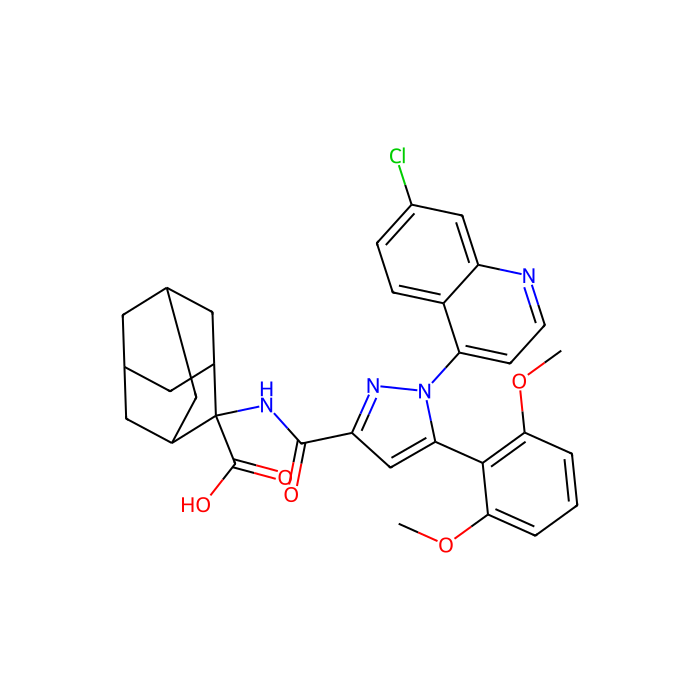
| Descripción | This compound belongs to the class of organic compounds known as n-acyl-alpha amino acids. These are compounds containing an alpha amino acid which bears an acyl group at its terminal nitrogen atom. |
| External Descriptors | Not available |
| Activity Type | Activity Value -log(M) | Mechanism of Action | Activity Reference | Publications (PubMed IDs) |
|---|
| Activity Type | Activity Value -log(M) | Mechanism of Action | Activity Reference | Publications (PubMed IDs) |
|---|
| Activity Type | Activity Value -log(M) | Mechanism of Action | Activity Reference | Publications (PubMed IDs) |
|---|
| Activity Type | Relation | Activity value | Units | Action Type | Journal | PubMed Id | doi | Assay Aladdin ID |
|---|
| Activity Type | Relation | Activity value | Units | Action Type | Journal | PubMed Id | doi | Assay Aladdin ID |
|---|
| Activity Type | Relation | Activity value | Units | Action Type | Journal | PubMed Id | doi | Assay Aladdin ID |
|---|
| Activity Type | Relation | Activity value | Units | Action Type | Journal | PubMed Id | doi | Assay Aladdin ID |
|---|
| Activity Type | Relation | Activity value | Units | Action Type | Journal | PubMed Id | doi | Assay Aladdin ID |
|---|
| Activity Type | Relation | Activity value | Units | Action Type | Journal | PubMed Id | doi | Assay Aladdin ID |
|---|
| Activity Type | Relation | Activity value | Units | Action Type | Journal | PubMed Id | doi | Assay Aladdin ID |
|---|
| Activity Type | Relation | Activity value | Units | Action Type | Journal | PubMed Id | doi | Assay Aladdin ID |
|---|
| Activity Type | Relation | Activity value | Units | Action Type | Journal | PubMed Id | doi | Assay Aladdin ID |
|---|
| Activity Type | Relation | Activity value | Units | Action Type | Journal | PubMed Id | doi | Assay Aladdin ID |
|---|
| Activity Type | Relation | Activity value | Units | Action Type | Journal | PubMed Id | doi | Assay Aladdin ID |
|---|
| Activity Type | Relation | Activity value | Units | Action Type | Journal | PubMed Id | doi | Assay Aladdin ID |
|---|
| Activity Type | Relation | Activity value | Units | Action Type | Journal | PubMed Id | doi | Assay Aladdin ID |
|---|
| Activity Type | Relation | Activity value | Units | Action Type | Journal | PubMed Id | doi | Assay Aladdin ID |
|---|
| Activity Type | Relation | Activity value | Units | Action Type | Journal | PubMed Id | doi | Assay Aladdin ID |
|---|
| Activity Type | Relation | Activity value | Units | Action Type | Journal | PubMed Id | doi | Assay Aladdin ID |
|---|
| Activity Type | Relation | Activity value | Units | Action Type | Journal | PubMed Id | doi | Assay Aladdin ID |
|---|
| Activity Type | Relation | Activity value | Units | Action Type | Journal | PubMed Id | doi | Assay Aladdin ID |
|---|
| Activity Type | Relation | Activity value | Units | Action Type | Journal | PubMed Id | doi | Assay Aladdin ID |
|---|
| Activity Type | Relation | Activity value | Units | Action Type | Journal | PubMed Id | doi | Assay Aladdin ID |
|---|
| Activity Type | Relation | Activity value | Units | Action Type | Journal | PubMed Id | doi | Assay Aladdin ID |
|---|
| Activity Type | Relation | Activity value | Units | Action Type | Journal | PubMed Id | doi | Assay Aladdin ID |
|---|
| Activity Type | Relation | Activity value | Units | Action Type | Journal | PubMed Id | doi | Assay Aladdin ID |
|---|
| Activity Type | Relation | Activity value | Units | Action Type | Journal | PubMed Id | doi | Assay Aladdin ID |
|---|
| Activity Type | Relation | Activity value | Units | Action Type | Journal | PubMed Id | doi | Assay Aladdin ID |
|---|
| Activity Type | Relation | Activity value | Units | Action Type | Journal | PubMed Id | doi | Assay Aladdin ID |
|---|
| Activity Type | Relation | Activity value | Units | Action Type | Journal | PubMed Id | doi | Assay Aladdin ID |
|---|
| Activity Type | Relation | Activity value | Units | Action Type | Journal | PubMed Id | doi | Assay Aladdin ID |
|---|
| Activity Type | Relation | Activity value | Units | Action Type | Journal | PubMed Id | doi | Assay Aladdin ID |
|---|
| Activity Type | Relation | Activity value | Units | Action Type | Journal | PubMed Id | doi | Assay Aladdin ID |
|---|
| Activity Type | Relation | Activity value | Units | Action Type | Journal | PubMed Id | doi | Assay Aladdin ID |
|---|
| Activity Type | Relation | Activity value | Units | Action Type | Journal | PubMed Id | doi | Assay Aladdin ID |
|---|
| Activity Type | Relation | Activity value | Units | Action Type | Journal | PubMed Id | doi | Assay Aladdin ID |
|---|
| Solubilidad | Solvent:DMSO, Max Conc. mg/mL: 11.74, Max Conc. mM: 20 |
|---|---|
| Peso molecular | 587.100 g/mol |
| XLogP3 | 5.800 |
| Hydrogen Bond Donor Count | 2 |
| Hydrogen Bond Acceptor Count | 7 |
| Rotatable Bond Count | 7 |
| Exact Mass | 586.198 Da |
| Monoisotopic Mass | 586.198 Da |
| Topological Polar Surface Area | 116.000 Ų |
| Heavy Atom Count | 42 |
| Formal Charge | 0 |
| Complexity | 991.000 |
| Isotope Atom Count | 0 |
| Defined Atom Stereocenter Count | 0 |
| Undefined Atom Stereocenter Count | 0 |
| Defined Bond Stereocenter Count | 0 |
| Undefined Bond Stereocenter Count | 0 |
| The total count of all stereochemical bonds | 0 |
| Covalently-Bonded Unit Count | 1 |
No item-specific, vendor-validated protocols are provided. Below are general, literature-style protocols for using small-molecule GPCR antagonists like SR 48692.
Controls:
Note: Optimize temperature, buffer composition, and incubation times for your specific cell line and detection platform.
SR 48692 is a pharmacological antagonist used to interrogate the neurotensin (NT) signaling axis.
Target pathway (literature/general):
Research utility:
Experimental considerations:
Note: No medical or clinical claims are made. This product is for laboratory research on neurotensin receptor signaling only.
This compound is not a buffering agent and is not used to set or maintain pH. Accordingly, classic buffer system recipes (e.g., phosphate, HEPES, Tris) do not apply.
Practical guidance for assay buffers (general):
Green chemistry considerations for SR 48692 focus on solvent choices and waste minimization during solution preparation and assays, as the compound itself is a fixed structure tool molecule.
Prefer greener solvents for handling/cleanup:
Micro-scale and high-throughput practices:
Energy/light:
Illustrative comparison (general):
Trade-offs:
SR 48692 is provided strictly for research use only and is not intended for human or veterinary use, diagnostic procedures, or as an API.
Formulation-related roles in research (general):
Regulatory/pharmacopeia status:
Practical considerations:
Note: No therapeutic or clinical claims are made. Use is limited to laboratory research.
Item-specific physical constants are not provided for this catalog entry. Where helpful, literature/general guidance is noted for planning experiments.
Practical handling characteristics (literature/general):
Important: Do not treat literature trends as item specifications. When method validation requires numeric constants, obtain them from the CoA/Spec Sheet or determine experimentally for the lot in hand.
What Moligand™ implies (general description):
How to use this grade effectively:
Item-specific notes:
Documentation:
This product is primarily a pharmacological tool compound rather than a synthetic reagent. Accordingly, its value lies in receptor pharmacology and signaling studies rather than in promoting chemical transformations.
Research applications (literature/general):
Assay implementation tips:
Note: If your need is for a reaction solvent or reagent, this compound is not typically applicable. See our solvent/reagent categories for suitable alternatives.
Not applicable as a chemical reagent: SR 48692 is a pharmacological tool compound rather than a substrate, catalyst, or solvent used to drive chemical reactions.
Assay conditions (literature/general) for its intended use:
Note: The above are general literature practices and are not item-specific specifications.
Safety information specific to this item is not fully specified in the Product Data. Handle using best laboratory practices for small-molecule bioactives and consult the SDS for authoritative guidance.
Recommended PPE and practices:
Storage and incompatibilities:
First aid (overview; defer to SDS):
Waste: Dispose of solutions/solids as organic hazardous waste in accordance with institutional and local regulations.
SR 48692 is commonly used as a hydrophobic research ligand. While item-specific solubility data are not provided, the following literature/general guidance applies to this compound class.
Practical tips:
Comparison (general):
Storage conditions (item-specific): Store at 2–8°C. Keep container tightly closed. Minimize exposure to moisture and light. Shipped on wet ice.
Reconstitution (general guidance for small-molecule ligands):
Stability (item-specific): Not specified for this item; refer to CoA/Spec Sheet for any stability or retest date information.
Working solutions: Prepare fresh on the day of use when possible. Maintain consistent vehicle content across samples. Discard solutions showing precipitation or discoloration.
Documentation: Record lot number, stock concentration, preparation date, and solvent to support reproducibility in screening campaigns.
For authoritative safety and stability guidance, consult the product SDS and CoA.
SR 48692 is a well-known small-molecule tool compound used as a nonpeptidic antagonist of the neurotensin receptor (primarily NTSR1) in pharmacological research.
Product identifiers (item-specific):
Structural features (general/literature description):
2D structural description (literature/generic):
Note: For definitive structural string identifiers (SMILES/InChI) and exact elemental composition for the supplied lot, consult the CoA/Spec Sheet.
SR 48692 is an end-use bioactive ligand and is not typically employed as a reagent, catalyst, or building block in synthetic chemistry.
For researchers interested in analog synthesis (literature/general):
If your goal is to perform synthetic reactions, consult our reagents and catalysts portfolio. This product should be reserved for pharmacological studies and analytical standards work.
Item-specific bioassay validations are not provided. The following reflects literature/general knowledge about SR 48692 as a tool compound.
For this item, no vendor-verified target panel or activity data are provided—consult primary literature or generate in-house validation under your assay conditions.
Nuestra guía de selección de calidades cubre la pureza, el estado del estabilizador y la idoneidad de la aplicación para todas las variantes de nuestro catálogo.
Ver la guía de calidades Moligand™ →