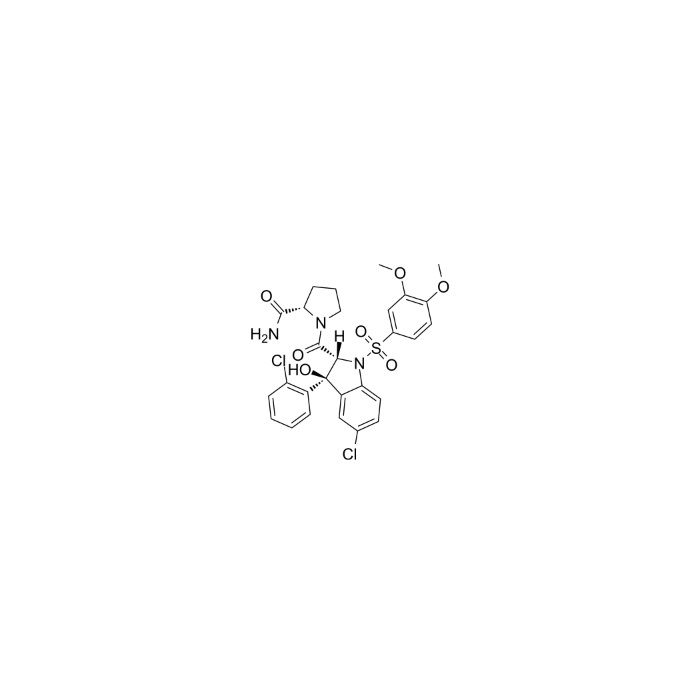
SR 49059 - Moligand™, ≥99%(HPLC) , Antagonist of OT receptor;Antagonist of V 1A receptor;Antagonist of V 1B receptor;Antagonist of V 2 receptor, CAS No.150375-75-0, Antagonist of OT receptor;Antagonist of V 1A receptor;Antagonist of V 1B receptor;Antagonist of V 2 receptor

CAS: 150375-75-0 Cat. No.: S288449 Fórmula: C28H27Cl2N3O7S Peso molecular: 620.5 PubChem CID: 60943
Disponible para pedir
CALIDAD & PUREZA Moligand™ ? Moligand™ — Aladdin's line of ligands and bioactive small molecules. Use for receptor, pathway, and binding studies needing defined small-molecule tools. ≥99%(HPLC)
Synonyms
SR49059|1-[5-Chloro-3-(2-chloro-phenyl)-1-(3,4-dimethoxy-benzenesulfonyl)-3-hydroxy-2,3-dihydro-1H-indole-2-carbonyl]-pyrrolidine-2-carboxylic acid amide|(2S)-1-[(2R,3S)-5-chloro-3-(2-chlorophenyl)-1-(3,4-dimethoxybenzenesulfonyl)-3-hydroxy-2,3-dihydro-1H-indole-2-carbonyl]-pyrrolidine-2-carboxamide|SR-49059|Relcovaptan [INN]|(S)-1-[(2R,3S)-5-Chloro-3-(2-chloro-phenyl)-1-(3,4-dimethoxy-benzenesulfonyl)-3-hydroxy-2,3-dihydro-1H-indole-2-carbonyl]-pyrrolidine-2-carboxylic acid amide|[3H]relcovaptan|(2S)-1-[(2R,3S)-5-chloro-3-(2-chlorophenyl)-1-(3,4-dimethoxyphenyl)sulfonyl-3-hydroxy-2H-indole-2-carbonyl]pyrrolidine-2-carboxamide|(2S)-1-[(2R,3S)-5-chloro-3-(2-chlorophenyl)-1-(3,4-dimethoxyphenyl)sulfonyl-3-hydroxy2H-indole-2-carbonyl]pyrrolidine-2-carboxamide|(2S)-1-(((2R,3S)-5-Chloro-3-(o-chlorophenyl)-1-((3,4-dimethoxyphenyl)sulfonyl)-3-hydroxy-2-indolinyl)carbonyl)-2-pyrrolidinecarboxamide|2-Pyrrolidinecarboxamide,1-[[(2R,3S)-5-chloro-3-(2-chlorophenyl)-1-[(3,4-dimethoxyphenyl)sulfonyl]-2,3-dihydro-3-hydroxy-1H-indol-2-yl]carbonyl]-,(2S)-|(S)-1-((2R,3S)-5-chloro-3-(2-chlorophenyl)-1-(3,4-dimethoxyphenylsulfonyl)-3-hydroxyindoline-2-carbonyl)pyrrolidine-2-carboxamide|1-(5-Chloro-3-(2-chlorophenyl)-1-(3,4-dimethoxybenzenesulfonyl)-3-hydroxy-2,3-dihydro-1H-indole-2-carbonyl)pyrrolidine-2-carboxamide|2-PYRROLIDINECARBOXAMIDE, 1-(((2R,3S)-5-CHLORO-3-(2-CHLOROPHENYL)-1-((3,4-DIMETHOXYPHENYL)SULFONYL)-2,3-DIHYDRO-3-HYDROXY-1H-INDOL-2-YL)CARBONYL)-, (2S)-|(2S)-1-[[(2R,3S)-5-CHLORO-3-(2-CHLOROPHENYL)-1-[(3,4-DIMETHOXYPHENYL)SULFONYL]-2,3-DIHYDRO-3-HYDROXY-1H-INDOL-2-YL]CARBONYL]-2-PYRROLIDINECARBOXAMIDE|(S)-1-((2R,3S)-5-Chloro-3-(2-chlorophenyl)-1-((3,4-dimethoxyphenyl)sulfonyl)-3-hydroxyindoline-2-carbonyl)pyrrolidine-2-carboxamide|SR 49059|2-Pyrrolidinecarboxamide, 1-[[(2R,3S)-5-chloro-3-(2-chlorophenyl)-1-[(3,4-dimethoxyphenyl)sulfonyl]-2,3-dihydro-3-hydroxy-1H-indol-2-yl]carbonyl]-, (2S)-|Relcovaptan
Storage
Protected from light,Store at -20°C
Shipped In
Ice chest + Ice pads
★
Talla
Alemania (EU)
USA*
Precio
Cantidad
5mg
S288449-5mg
Fabricado bajo pedido · 8–12 semanas
329,65€
10mg
S288449-10mg
Fabricado bajo pedido · 8–12 semanas
577,83€
25mg
S288449-25mg
Fabricado bajo pedido · 8–12 semanas
1.213,01€
50mg
S288449-50mg
Fabricado bajo pedido · 8–12 semanas
2.061,66€
Enter a quantity for the sizes you want to add.

Descripción general

SR 49059 (SR-49059) is a potent, orally active, selective Vasotocin V1a antagonist with a Ki vaule of 1.4 nM.

Application:

SR 49059 has been used to study the V1AR (Vasotocin type 1A receptor) signaling mediated β adrenergic receptor responsiveness and its contribution to the development of heart failure. SR 49059 may be used in Arginine Vasotocin (AVP) V1a-receptor-mediated cell signaling studies.  

Especificaciones

Sinónimos
SR49059 | 1-[5-Chloro-3-(2-chloro-phenyl)-1-(3,4-dimethoxy-benzenesulfonyl)-3-hydroxy-2,3-dihydro-1H-indole-2-carbonyl]-pyrrolidine-2-carboxylic acid amide | (2S)-1-[(2R,3S)-5-chloro-3-(2-chlorophenyl)-1-(3,4-dimethoxybenzenesulfonyl)-3-hydroxy-2,3-dihydro-1H-indole-2-carbonyl]-pyrrolidine-2-carboxamide | SR-49059 | Relcovaptan [INN] | (S Show more
Especificaciones y pureza
Moligand™, ≥99%(HPLC)
Mecanismos bioquímicos y fisiológicos
SR 49059 is a potent and selective Arginine Vasotocin (AVP) V1a-receptor antagonist. AVP is a hormone that plays an important part in circulatory and water homoeostasis and is important in renal hemodynamic alterations, water retention, and cardiac remode
Condiciones de almacenamiento de almacenamiento
Protected from light,Store at -20°C
Enviado en
Ice chest + Ice pads
Este producto requiere envío en cadena de frío. Los servicios terrestres y otros servicios económicos no están disponibles.
Grado
Moligand™
Tipo de acción
ANTAGONIST
Mecanismo de acción
Antagonist of OT receptor;Antagonist of V 1A receptor;Antagonist of V 1B receptor;Antagonist of V 2 receptor
Pureza
≥99%(HPLC)
Propiedades del producto
ALogP
3.8
Nombres e identificadores
Sonrisas canónicas
COC1=C(C=C(C=C1)S(=O)(=O)N2C(C(C3=C2C=CC(=C3)Cl)(C4=CC=CC=C4Cl)O)C(=O)N5CCCC5C(=O)N)OC
IUPAC Name
(2S)-1-[(2R,3S)-5-chloro-3-(2-chlorophenyl)-1-(3,4-dimethoxyphenyl)sulfonyl-3-hydroxy-2H-indole-2-carbonyl]pyrrolidine-2-carboxamide
InChIKey
CEBYCSRFKCEUSW-NAYZPBBASA-N
INCHI
1S/C28H27Cl2N3O7S/c1-39-23-12-10-17(15-24(23)40-2)41(37,38)33-21-11-9-16(29)14-19(21)28(36,18-6-3-4-7-20(18)30)25(33)27(35)32-13-5-8-22(32)26(31)34/h3-4,6-7,9-12,14-15,22,25,36H,5,8,13H2,1-2H3,(H2,31,34)/t22-,25-,28+/m0/s1
Isómeros SMILES
COC1=C(C=C(C=C1)S(=O)(=O)N2[C@H]([C@](C3=C2C=CC(=C3)Cl)(C4=CC=CC=C4Cl)O)C(=O)N5CCC[C@H]5C(=O)N)OC
CAS alternativo
150375-75-0
PubChem CID
60943
Términos de entrada MeSH
1-(5-chloro-3-(2-chlorophenyl)-1-(3,4-dimethoxybenzenesulfonyl)-3-hydroxy-2,3-dihydro-1H-indole-2-carbonyl)pyrrolidine-2-carboxamide;2-Pyrrolidinecarboxamide, 1-((5-chloro-3-(2-chlorophenyl)-1-((3,4-dimethoxyphenyl)sulfonyl)-2,3-dihydro-3-hydroxy-1H-indol
Peso molecular
620.5

Datos avanzados

Taxonomic Classification

Taxonomy Tree

KingdomOrganic compounds
SuperclassOrganic acids and derivatives
ClaseCarboxylic acids and derivatives
SubclassAmino acids, peptides, and analogues
Intermediate Tree Nodes Peptides
Direct ParentDipeptides
Alternative Parents Proline and derivatives  Alpha amino acid amides  Indolecarboxylic acids and derivatives  Benzenesulfonamides  Dimethoxybenzenes  Benzenesulfonyl compounds  Anisoles  Pyrrolidinecarboxamides  N-acylpyrrolidines  Phenoxy compounds  Alkyl aryl ethers  Chlorobenzenes  Organosulfonamides  Aryl chlorides  Tertiary carboxylic acid amides  Sulfonyls  Tertiary alcohols  Primary carboxylic acid amides  Azacyclic compounds  Organochlorides  Organic oxides  Hydrocarbon derivatives  Carbonyl compounds  Organonitrogen compounds  Organopnictogen compounds  
Molecular FrameworkAromatic heteropolycyclic compounds
Substituents Alpha-dipeptide - Proline or derivatives - Alpha-amino acid amide - Indolecarboxylic acid derivative - Dimethoxybenzene - O-dimethoxybenzene - Alpha-amino acid or derivatives - Benzenesulfonamide - Indole or derivatives - Benzenesulfonyl group - Phenoxy compound - Methoxybenzene - Pyrrolidine carboxylic acid or derivatives - Pyrrolidine-2-carboxamide - Phenol ether - N-acylpyrrolidine - Anisole - Alkyl aryl ether - Chlorobenzene - Halobenzene - Benzenoid - Organosulfonic acid amide - Aryl chloride - Aryl halide - Monocyclic benzene moiety - Organic sulfonic acid or derivatives - Pyrrolidine - Tertiary alcohol - Tertiary carboxylic acid amide - Sulfonyl - Organosulfonic acid or derivatives - Primary carboxylic acid amide - Carboxamide group - Organoheterocyclic compound - Azacycle - Ether - Organosulfur compound - Alcohol - Organic nitrogen compound - Carbonyl group - Organic oxide - Hydrocarbon derivative - Organohalogen compound - Organochloride - Organopnictogen compound - Organic oxygen compound - Organonitrogen compound - Organooxygen compound - Aromatic heteropolycyclic compound
DescripciónThis compound belongs to the class of organic compounds known as dipeptides. These are organic compounds containing a sequence of exactly two alpha-amino acids joined by a peptide bond.
External Descriptors Not available
Estructura 3D
Modelo de Estructura Química Interactiva


Objetivos asociados (humanos)
AVPR1A Tclin Vasopressin V1a receptor (10 Activities)
Activity TypeActivity Value -log(M)Mechanism of ActionActivity ReferencePublications (PubMed IDs)
AVPR1B Tclin Vasopressin V1b receptor (0 Activities)
Activity TypeActivity Value -log(M)Mechanism of ActionActivity ReferencePublications (PubMed IDs)
AVPR2 Tclin Vasopressin V2 receptor (0 Activities)
Activity TypeActivity Value -log(M)Mechanism of ActionActivity ReferencePublications (PubMed IDs)
OXTR Tclin Oxytocin receptor (0 Activities)
Activity TypeActivity Value -log(M)Mechanism of ActionActivity ReferencePublications (PubMed IDs)
ABL1 Tclin Tyrosine-protein kinase ABL (18331 Activities)
Activity TypeRelationActivity valueUnitsAction TypeJournalPubMed IddoiAssay Aladdin ID
ADRB2 Tclin Beta-2 adrenergic receptor (11824 Activities)
Activity TypeRelationActivity valueUnitsAction TypeJournalPubMed IddoiAssay Aladdin ID
ADRA2A Tclin Alpha-2a adrenergic receptor (9450 Activities)
Activity TypeRelationActivity valueUnitsAction TypeJournalPubMed IddoiAssay Aladdin ID
TSHR Tclin Thyroid stimulating hormone receptor (29986 Activities)
Activity TypeRelationActivity valueUnitsAction TypeJournalPubMed IddoiAssay Aladdin ID
AVPR2 Tclin Vasopressin V2 receptor (2912 Activities)
Activity TypeRelationActivity valueUnitsAction TypeJournalPubMed IddoiAssay Aladdin ID
AGTR1 Tclin Type-1 angiotensin II receptor (5176 Activities)
Activity TypeRelationActivity valueUnitsAction TypeJournalPubMed IddoiAssay Aladdin ID
AVPR1A Tclin Vasopressin V1a receptor (5412 Activities)
Activity TypeRelationActivity valueUnitsAction TypeJournalPubMed IddoiAssay Aladdin ID
GSK3B Tclin Glycogen synthase kinase-3 beta (11785 Activities)
Activity TypeRelationActivity valueUnitsAction TypeJournalPubMed IddoiAssay Aladdin ID
CSNK1D Tchem Casein kinase I delta (4546 Activities)
Activity TypeRelationActivity valueUnitsAction TypeJournalPubMed IddoiAssay Aladdin ID
S1PR1 Tclin Sphingosine 1-phosphate receptor Edg-1 (5806 Activities)
Activity TypeRelationActivity valueUnitsAction TypeJournalPubMed IddoiAssay Aladdin ID
CDK2 Tchem Cyclin-dependent kinase 2 (9050 Activities)
Activity TypeRelationActivity valueUnitsAction TypeJournalPubMed IddoiAssay Aladdin ID
GLP1R Tclin Glucagon-like peptide 1 receptor (111429 Activities)
Activity TypeRelationActivity valueUnitsAction TypeJournalPubMed IddoiAssay Aladdin ID
ALOX15 Tchem Arachidonate 15-lipoxygenase (7108 Activities)
Activity TypeRelationActivity valueUnitsAction TypeJournalPubMed IddoiAssay Aladdin ID
C5AR1 Tclin C5a anaphylatoxin chemotactic receptor (2677 Activities)
Activity TypeRelationActivity valueUnitsAction TypeJournalPubMed IddoiAssay Aladdin ID
CYP3A4 Tclin Cytochrome P450 3A4 (53859 Activities)
Activity TypeRelationActivity valueUnitsAction TypeJournalPubMed IddoiAssay Aladdin ID
AURKA Tchem Serine/threonine-protein kinase Aurora-A (10240 Activities)
Activity TypeRelationActivity valueUnitsAction TypeJournalPubMed IddoiAssay Aladdin ID
Homo sapiens (32628 Activities)
Activity TypeRelationActivity valueUnitsAction TypeJournalPubMed IddoiAssay Aladdin ID
U2OS (164939 Activities)
Activity TypeRelationActivity valueUnitsAction TypeJournalPubMed IddoiAssay Aladdin ID
CX3CR1 Tchem C-X3-C chemokine receptor 1 (1686 Activities)
Activity TypeRelationActivity valueUnitsAction TypeJournalPubMed IddoiAssay Aladdin ID
FPR2 Tchem Lipoxin A4 receptor (3472 Activities)
Activity TypeRelationActivity valueUnitsAction TypeJournalPubMed IddoiAssay Aladdin ID
FFAR4 Tchem G-protein coupled receptor 120 (2999 Activities)
Activity TypeRelationActivity valueUnitsAction TypeJournalPubMed IddoiAssay Aladdin ID
BRD4 Tchem Bromodomain-containing protein 4 (13122 Activities)
Activity TypeRelationActivity valueUnitsAction TypeJournalPubMed IddoiAssay Aladdin ID
GPR35 Tchem G-protein coupled receptor 35 (2643 Activities)
Activity TypeRelationActivity valueUnitsAction TypeJournalPubMed IddoiAssay Aladdin ID
PMP22 Tbio Peripheral myelin protein 22 (699 Activities)
Activity TypeRelationActivity valueUnitsAction TypeJournalPubMed IddoiAssay Aladdin ID
TRIM24 Tchem Transcription intermediary factor 1-alpha (2087 Activities)
Activity TypeRelationActivity valueUnitsAction TypeJournalPubMed IddoiAssay Aladdin ID
BRPF1 Tchem Peregrin (2217 Activities)
Activity TypeRelationActivity valueUnitsAction TypeJournalPubMed IddoiAssay Aladdin ID
HEK-293T (167025 Activities)
Activity TypeRelationActivity valueUnitsAction TypeJournalPubMed IddoiAssay Aladdin ID
Objetivos asociados (no humanos)
Cruzipain (33337 Activities)
Activity TypeRelationActivity valueUnitsAction TypeJournalPubMed IddoiAssay Aladdin ID
Aplnr Apelin receptor (201 Activities)
Activity TypeRelationActivity valueUnitsAction TypeJournalPubMed IddoiAssay Aladdin ID
Mapk1 MAP kinase ERK2 (650 Activities)
Activity TypeRelationActivity valueUnitsAction TypeJournalPubMed IddoiAssay Aladdin ID
Hdac6 Histone deacetylase 6 (222 Activities)
Activity TypeRelationActivity valueUnitsAction TypeJournalPubMed IddoiAssay Aladdin ID
Fgfr3 Fibroblast growth factor receptor 3 (21 Activities)
Activity TypeRelationActivity valueUnitsAction TypeJournalPubMed IddoiAssay Aladdin ID
Plasmodium falciparum (966862 Activities)
Activity TypeRelationActivity valueUnitsAction TypeJournalPubMed IddoiAssay Aladdin ID
rep Replicase polyprotein 1ab (378 Activities)
Activity TypeRelationActivity valueUnitsAction TypeJournalPubMed IddoiAssay Aladdin ID
Gpr119 Glucose-dependent insulinotropic receptor (270 Activities)
Activity TypeRelationActivity valueUnitsAction TypeJournalPubMed IddoiAssay Aladdin ID
Rorc Nuclear receptor ROR-gamma (89407 Activities)
Activity TypeRelationActivity valueUnitsAction TypeJournalPubMed IddoiAssay Aladdin ID
ffp 4'-phosphopantetheinyl transferase ffp (24982 Activities)
Activity TypeRelationActivity valueUnitsAction TypeJournalPubMed IddoiAssay Aladdin ID
SARS-CoV-2 (38078 Activities)
Activity TypeRelationActivity valueUnitsAction TypeJournalPubMed IddoiAssay Aladdin ID
Mecanismos de acción
Certificados (CoA, COO, BSE/TSE y tabla de análisis)
C of A & Other Certificates(BSE/TSE, COO):
Analytical Chart:
Propiedades químicas y físicas
SolubilidadSolvent:DMSO, Max Conc. mg/mL: 18.61, Max Conc. mM: 30
Sensibilidadlight & Moisture sensitive
Peso molecular620.500 g/mol
XLogP33.800
Hydrogen Bond Donor Count2
Hydrogen Bond Acceptor Count8
Rotatable Bond Count7
Exact Mass619.095 Da
Monoisotopic Mass619.095 Da
Topological Polar Surface Area148.000 Ų
Heavy Atom Count41
Formal Charge0
Complexity1090.000
Isotope Atom Count0
Defined Atom Stereocenter Count3
Undefined Atom Stereocenter Count0
Defined Bond Stereocenter Count0
Undefined Bond Stereocenter Count0
The total count of all stereochemical bonds0
Covalently-Bonded Unit Count1
Calculadoras de soluciones
Reseñas

Reseñas de cliente

Application Protocols

No item-specific, validated application protocols are provided in the Product Data. The following general frameworks are commonly used for small-molecule GPCR antagonists and should be adapted and validated by the user.

  • Calcium mobilization assay (general outline):

    1. Load cells expressing AVPR1A with a Ca2+ indicator dye.
    2. Preincubate with SR 49059 or vehicle for 15–30 min at 37°C.
    3. Stimulate with AVP; record real-time fluorescence. Analyze rightward shift and depression of maximal response vs. vehicle.
  • IP1 accumulation or PLC activity assay:

    1. Preincubate cells with test compound.
    2. Challenge with AVP.
    3. Quantify IP1 or downstream markers per kit instructions; generate concentration–response curves.
  • Binding assay (radioligand or BRET-based):

    1. Prepare membranes/cells expressing AVPR1A.
    2. Perform competition binding against a validated V1a tracer.
    3. Derive affinity estimates, ensuring proper controls and nonspecific binding determination.

Notes:

  • Define and control final DMSO concentration.
  • Use replicate wells and multiple independent experiments.
  • Protect solutions and plates from light as indicated in the Product Data.

All protocols must be optimized for the specific cell line, receptor expression level, and instrumentation.

Biological Roles

Context from literature (not item-specific claims):

  • SR 49059 is widely cited as a selective, nonpeptide antagonist of the vasopressin V1a receptor (AVPR1A), a class A GPCR that signals predominantly via Gq/11, phospholipase C activation, IP3 generation, and intracellular Ca2+ mobilization.

Applications enabled by V1a antagonism:

  • Dissecting AVPR1A function in vascular smooth muscle, liver, CNS, and other tissues expressing V1a, by blocking endogenous arginine vasopressin (AVP) responses.
  • Establishing receptor selectivity in pharmacology panels, differentiating V1a from V1b (AVPR1B) and V2 (AVPR2) mediated pathways.
  • Mapping downstream signaling (e.g., Ca2+ flux, ERK phosphorylation) and transcriptional responses to V1a blockade in cells or tissue preparations.

Experimental considerations:

  • Conduct concentration–response studies in the presence of AVP to determine functional antagonism (e.g., rightward shift in agonist curves). Report vehicle composition and temperature, as these influence GPCR assay results.
  • Consider receptor reserve and expression level: apparent potency can vary across systems. Use radioligand binding or BRET-based binding where available to complement functional readouts.
  • Off-target risk management: Incorporate secondary pharmacology panels or control ligands to ensure observed effects are V1a-specific for the system under study.

All uses are for research only. No claims are made regarding therapeutic properties or clinical performance.

Buffer Applications

This item is a bioactive small-molecule ligand, not a buffering agent. It does not define or maintain pH and is not used to formulate classical biological buffers.

Practical note:

  • When used in biological assays, prepare SR 49059 working solutions in your existing buffer system (e.g., HEPES, PBS, assay-specific media) using an appropriate co-solvent such as DMSO. Validate that the final solvent percentage does not perturb pH or assay performance.

For buffer recipes and pH ranges, refer to standard buffering agents rather than this ligand.

Green Alternatives

As a finished bioactive ligand, SR 49059 is not typically interchangeable with “green alternative” chemicals in the way solvents or common reagents are. However, greener choices can be made around its use:

  • Solvent considerations (general):

    • Prefer the minimum effective DMSO percentage in working solutions; evaluate ethanol or aqueous cosolvent systems when compatible with the assay to reduce DMSO usage.
    • Use micro-scale assay formats to minimize chemical and solvent consumption.
  • Process and waste minimization:

    • Consolidate screening plates and replicate runs to reduce waste.
    • Implement solvent recycling for analytical development where feasible.
  • Alternatives at the biology level (literature context):

    • If the scientific objective is “functional V1a antagonism,” alternative tool compounds with comparable selectivity profiles may be considered to confirm findings via chemotype diversity. Selection should be driven by potency, selectivity, solubility, and safety data in the literature, not by environmental attributes alone.

There are no direct “greener chemical substitutes” for SR 49059 itself without changing the pharmacological probe. Optimize handling, solvent choice, and experimental design to improve sustainability.

Pharmaceutical Uses

This product is provided strictly for research use only.

Context (general, non-clinical):

  • SR 49059 is recognized in the literature as a pharmacological tool compound for the vasopressin V1a receptor. In pharmaceutical R&D settings, such ligands may serve as reference standards in assay development, target validation, SAR benchmarking, and DMPK method development.

Formulation/analytical considerations (general):

  • Reference standards are often stored as dry material or DMSO concentrates and used to qualify bioassays (e.g., potency controls), LC–MS quantitation methods, or receptor binding formats.
  • Excipient status or pharmacopeial monographs: Not specified for this item; verify compendial listing if regulated development is intended (this listing is research-grade Moligand).

No therapeutic, diagnostic, or clinical claims are made for this item. Any use beyond laboratory research must be independently validated and fall under appropriate regulatory oversight.

Physical Properties

Item-specific physicochemical specifications are not supplied in the Product Data for this listing.

  • Appearance: Not specified for this item; refer to CoA/Spec Sheet.
  • Molecular weight: Not specified for this item; refer to CoA/Spec Sheet.
  • Molecular formula: Not specified for this item; refer to CoA/Spec Sheet.
  • Melting point, boiling point, density, refractive index, pKa, logP/logD, UV cutoff: Not specified for this item; refer to CoA/Spec Sheet.
  • Solubility: Not specified for this item; refer to CoA/Spec Sheet.

General literature guidance for small-molecule GPCR ligands (context, not item-specific specifications):

  • Many V1a antagonists are moderately lipophilic and are commonly handled as DMSO stock solutions for in vitro assays; aqueous solubility can be formulation-dependent.
  • If analytical characterization is needed, typical panels include HPLC purity, HRMS, 1H/13C NMR, and water content by Karl Fischer; obtain values from the item’s CoA.

Practical notes:

  • Before preparing solutions, consult the specific CoA/SDS for this item to determine actual solubility limits, stability in aqueous buffers, and any light sensitivity beyond the storage note provided.
  • For spectroscopic or bioassay method development, verify extinction coefficients and assay-compatible solvent systems empirically for this exact lot/item.
Quality and Grades
  • Grade/Purity (from Product Data): Moligand™.

About Moligand (general description of the grade/series):

  • Moligand is Aladdin’s line for research-grade small-molecule ligands intended for in vitro/in vivo exploratory research, screening, target validation, and pharmacology method development. It emphasizes identity confirmation and appropriate purity for biochemical and cell-based assays.

What this means for the user:

  • Analytical characterization: Expect standard identity/purity characterization (e.g., HPLC/LC–MS, NMR) appropriate for a research ligand. Exact acceptance criteria (purity %, residual solvents, water content, heavy metals) are item-specific and not provided here. For quantitative needs, request the lot-specific CoA.
  • Stabilizers/additives: Not specified for this item; refer to CoA/Spec Sheet. If stabilizers are present, they may influence UV baselines and bioassay backgrounds.
  • UV/fluorescence behavior: Not specified for this item; verify if using absorbance/fluorescence readouts.

Recommendations:

  • For screening campaigns, document lot number and retain CoA to ensure reproducibility.
  • For GLP/GMP or regulatory studies, this research-grade material may not be suitable; consider sourcing to the required standard and verify compendial status if applicable.
Reaction and Applications

This product is supplied as a bioactive research ligand rather than a synthetic reagent.

  • Synthetic reaction use: SR 49059 is not typically employed as a reagent, catalyst, or building block in preparative organic synthesis. Accordingly, there are no standard reaction families or named transformations in which it serves as a substrate.

  • Research applications (general, literature-based context):

    • Used as a selective antagonist tool compound to interrogate vasopressin V1a (AVPR1A) signaling in biochemical and cellular assays.
    • Supports studies of GPCR-mediated Gq/PLC/IP3–Ca2+ pathways, receptor pharmacology, and target validation where V1a antagonism is required.

Practical tips for assay use (general guidance):

  • Prepare fresh DMSO stock solutions, protect from light, and minimize freeze–thaw cycles.
  • Include vehicle controls and, where possible, orthogonal readouts to confirm on-target effects.
  • Validate concentration–response relationships and perform counter-screens to exclude interference with detection modalities.

For users seeking synthetic methodology content, refer instead to the sections on Biological Roles, Target Specificity, and Application Protocols, which are most relevant for this compound type.

Reaction Conditions

Not typically applicable. SR 49059 is a finalized bioactive ligand and is not used as a reagent in standard organic reactions.

Assay preparation conditions (general, literature-based guidance):

  • Stock preparation: Commonly prepared in anhydrous DMSO at high millimolar concentrations; protect from light as indicated by Product Data. Verify actual solubility for this item/lot.
  • Working concentrations: Determined empirically based on assay sensitivity and desired receptor coverage; include vehicle controls.
  • Temperature: Conduct physiological assays at 37°C where relevant; binding assays may be performed at room temperature or 4°C depending on protocol.
  • Stability: Minimize freeze–thaw cycles by aliquoting stocks; monitor for precipitation or potency drift over time.

These conditions are general recommendations for small-molecule GPCR ligands. For chemical reaction conditions (e.g., coupling, reductions), there is no standard use case for this product.

Safety and Handling

Safety details specific to this item are not provided in the Product Data.

  • GHS classification, signal word, pictograms, hazard statements: Not specified for this item; consult the SDS for authoritative information.
  • Storage conditions (from Product Data): Store at −20°C, protected from light. Shipped in ice chest with ice pads.

General laboratory precautions (non-item-specific, good practice):

  • PPE: lab coat, safety glasses, and appropriate chemical-resistant gloves. Work in a fume hood when handling powders or preparing concentrated solutions.
  • Avoid inhalation of dust/aerosols and contact with skin/eyes. Wash thoroughly after handling.
  • Incompatibilities and reactivity: Absent item-specific data, avoid strong oxidizers and strong acids/bases until compatibility is confirmed via SDS/CoA.
  • Light sensitivity: Product Data indicates protect from light; minimize exposure during weighing and solution prep (e.g., amber vials, foil wrap).

First-aid overview (consult SDS for details):

  • Skin/eye contact: Rinse with water for at least 15 minutes; remove contaminated clothing; seek medical evaluation.
  • Inhalation: Move to fresh air; monitor for symptoms; seek medical attention if unwell.
  • Ingestion: Rinse mouth; do not induce vomiting unless directed; seek medical attention.

Waste: Collect in organic solid/liquid waste according to institutional and local regulations.

Solvent Selection

Item-specific solubility data are not provided.

Practical guidance for small-molecule GPCR ligands (general, literature-based):

  • Primary solvent: DMSO is commonly used to prepare concentrated stocks (e.g., 10–50 mM) due to broad solubilizing power for lipophilic ligands. Confirm maximum solubility for this item from the CoA or by a small-scale test.
  • Working solutions: Dilute DMSO stocks into assay buffers or media, keeping final DMSO typically ≤0.1–0.5% v/v to minimize vehicle effects; verify tolerance for your system.
  • Alternative solvents: DMF or ethanol may be suitable for some assays or analytical preparations; assess compatibility with your biology/analytics.
  • Aqueous systems: If aqueous solubility is limited, consider co-solvent strategies, cyclodextrin inclusion, or surfactant-assisted delivery (ensuring biological compatibility and appropriate controls).

Comparison (general considerations, not item-specific):

  • DMSO: highest solvency; potential cytotoxicity at higher %.
  • Ethanol: easier evaporation, but lower solvency for very lipophilic compounds.
  • PBS/aqueous buffer: best biological compatibility but may require co-solvents.

Always confirm actual solubility, stability, and adsorption to plastics/glass for this specific item/lot under your conditions.

Storage and Reconstitution
  • Storage conditions (from Product Data): Store at −20°C, protected from light. Shipment: ice chest with ice pads.

  • Reconstitution (general guidance for small-molecule ligands; not item-specific specifications):

    • Use dry, oxygen-free DMSO to prepare a concentrated stock solution. If water or buffer stocks are required, determine solubility empirically and consider co-solvents.
    • Filter sterilize through a low-protein-binding 0.2 µm membrane if sterility is required for cell assays (confirm no adsorption loss).
    • Aliquot into amber or foil-wrapped microtubes to avoid repeated freeze–thaw and light exposure.
  • Handling and stability:

    • Allow vials to equilibrate to room temperature in a desiccated environment before opening to prevent moisture condensation.
    • Record preparation date, solvent, and concentration on each aliquot. Monitor for precipitation or color change.
  • Solution storage (general):

    • DMSO stocks are commonly stored at −20°C (or below) protected from light. Avoid multiple freeze–thaw cycles; thaw on ice when possible.

Item-specific parameters such as exact solubility, hygroscopicity, and solution stability are not specified for this item; refer to the lot-specific CoA and SDS for definitive guidance.

Structure and Identity

SR 49059 is a small-molecule research ligand supplied under Aladdin’s Moligand series. Item-specific identifiers provided are limited; see notes below.

  • Item identifiers (from Product Data)

    • SKU: S288449
    • Product name: SR 49059
    • CAS: 150375-75-0
    • PubChem CID: 60943 (as provided)
    • InChIKey: 41839 (as provided)
    • SMILES: Not specified for this item; refer to CoA/Spec Sheet.
    • Molecular formula: Not specified for this item; refer to CoA/Spec Sheet.
    • Molecular weight: Not specified for this item; refer to CoA/Spec Sheet.
  • Structural features (general literature description, not item-specific specs)

    • SR 49059 (also known in literature as a nonpeptide vasopressin V1a receptor antagonist) is an aromatic, drug-like small molecule designed to target the AVPR1A receptor. Detailed ring systems, substituents, and stereochemistry are not provided in the Product Data and should be verified against the CoA/SDS or primary literature if required.
  • 2D structure (descriptive, literature-based)

    • The compound is reported in the literature to be a multi-ring, heteroatom-containing small molecule typical of GPCR antagonists. Exact atom connectivity for this catalog item is not specified here and should be confirmed from the supplier’s CoA/structure file before computational or analytical work.
Synthetic Utility

SR 49059 is supplied as a bioactive, target-directed small molecule and is not typically used as a synthetic intermediate or reagent.

  • Functional group reactivity: Not characterized here for preparative chemistry purposes; refer to CoA/SDS if chemical modification is contemplated.
  • Derivatization: While literature strategies sometimes derivatize tool compounds for probes (e.g., biotinylation, photoaffinity tags), such work requires full structural confirmation, protection of key pharmacophores, and rigorous SAR verification. No item-specific guidance is provided.

If your objective is chemical synthesis or conjugation:

  • Obtain definitive structure files (SMILES/SDF) and confirm reactive handles.
  • Perform small-scale feasibility studies to ensure biological activity is retained after modification.

For most users, the primary value of this product lies in its role as a selective receptor antagonist in biological assays rather than as a building block.

Target Specificity

Target information from literature (contextual; not item-specific testing data):

  • Primary target: Vasopressin V1a receptor (AVPR1A), a Gq/11-coupled GPCR activated by arginine vasopressin (AVP).
  • Pharmacological profile: Reported as a selective antagonist for V1a over V1b (AVPR1B) and V2 (AVPR2) in published studies. Exact Ki/IC50 values and selectivity ratios are system- and assay-dependent and are not provided for this catalog item.

Implications for experimental design:

  • Use AVP as an agonist control to demonstrate competitive/functional antagonism and to distinguish V1a from V2/V1b responses.
  • Incorporate secondary assays or orthogonal readouts (e.g., Ca2+ mobilization vs. ERK phosphorylation) to confirm on-target effects.
  • If target engagement in cells or tissues is required, consider CETSA, NanoBRET, or radioligand binding approaches using validated tracers.

Item-specific bioactivity testing, clone/isotype, species cross-reactivity, and epitope data are not applicable, as this is a small molecule and not an antibody or biologic. For verified potency/selectivity values, consult primary literature or the lot-specific CoA if provided.

Preguntas frecuentes

What is the purity of this product, and how is it determined?
This product is supplied at ≥99% purity, determined by HPLC. Lot-specific values are stated on the Certificate of Analysis.
What is Moligand??
Moligand? is one of Aladdin Scientific's premium product lines, formulated for high-purity applications across multiple workflows. Compared to standard grades in the same workflow, Moligand? products typically offer tighter specifications, more rigorous QC, and stronger lot-to-lot consistency.
How should this product be stored?
Store at ?20 °C, protected from light. The material is light-sensitive — keep it in its original opaque or amber container.
How is this product shipped?
This product ships in an insulated container with ice pads. Unpack on arrival and transfer it to the storage condition stated above.
What are the CAS number, molecular formula and molecular weight?
The CAS Number is 150375-75-0, the molecular formula is C??H??Cl?N?O?S, and the molecular weight is 620.5 g/mol. InChIKey CEBYCSRFKCEUSW-NAYZPBBASA-N.
What documentation is provided?
Available product documentation, including Certificates of Analysis (COA), Safety Data Sheets (SDS), and specification sheets, is shown in the product document area. Document availability and access follow the current site policy.

¿Quieres que te enviemos un mensaje cuando tengamos descuentos disponibles?

Recordármelo más tarde

¡Gracias! Por favor, revisa tu bandeja de entrada de correo electrónico para confirmar.

¡Vaya! Las notificaciones están desactivadas.