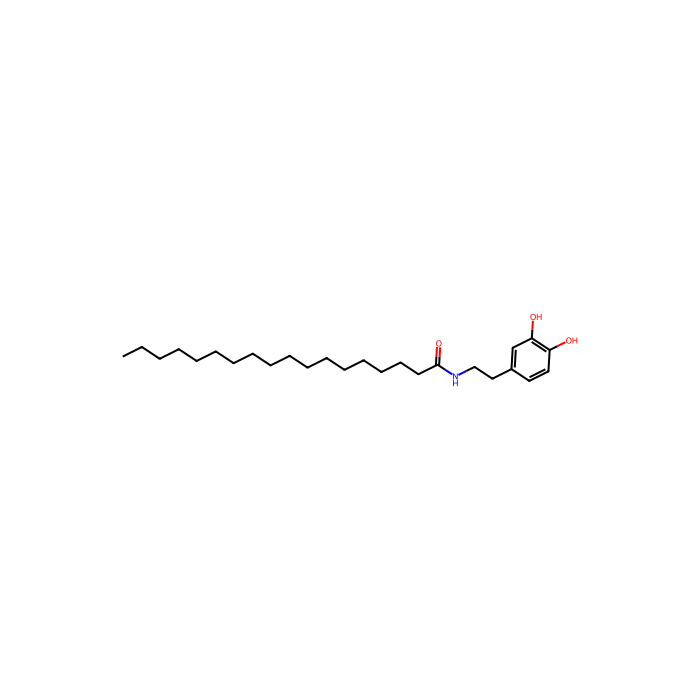
STEARDA inhibits arachidonate 5-LO (5-lipoxygenase) with an IC|50|of 16 nM. Adiditionally, is an ndogenous fatty acid dopamide that displays 'entourage' effects on endovanilloids NADA and anandamide. STEARDA is inactive at TRPV1 and CB1 receptors (at concentrations up to 5 μM) and does not inhibit AMT or FAAH (IC50 > 25 μM). However, STEARDA potentiates TRPV1-mediated effects of NADA in vitro and in vivo; enhances effects on intracellular Ca2+ (EC50 lowered 3-fold) and nociception. Also, STEARDA inhibits arachidonate 5-lipoxygenase (IC50 = 16 nM).
application:
STEARDA is a novel, endogenous capsaicin-like lipid that produces hyperalgesia.
This compound belongs to the class of organic compounds known as n-acyldopamines. These are aromatic heterocyclic compounds containing a dopamine, in which the amine group is acylated.
External Descriptors
Not available
1. Djoumbou Feunang Y, Eisner R, Knox C, Chepelev L, Hastings J, Owen G, Fahy E, Steinbeck C, Subramanian S, Bolton E, Greiner R, and Wishart DS. ClassyFire: Automated Chemical Classification With A Comprehensive, Computable Taxonomy. Journal of Cheminformatics, 2016, 8:61.
P264:Wash hands [and …] thoroughly after handling.
Calculadoras de soluciones
Molarity Calculator
Determine the necessary mass, volume, or concentration for preparing a solution.
Dilution Calculator
Determine the dilution needed to prepare a stock solution.
Reconstitution Calculator
Reseñas
Reseñas de cliente
Application Protocols
Item-specific facts (from Product Data)
No tested applications or protocols are provided for this item.
General recommendations
For plate-based screening: Prepare 10–50 mM DMSO stocks, dispense via acoustic or pin tooling, cap/seal plates, and store at −20°C. Verify concentration by UV–Vis or qNMR where applicable.
For analytical reference use: Prepare accurately weighed standards, document purity correction, and store aliquots to avoid repeated freeze–thaw.
Biological Roles
Item-specific facts (from Product Data)
No biological function, target, or pathway information is provided for this item.
General considerations
As a member of a small-molecule/compound library, Stearda may be evaluated for modulation of biochemical pathways or phenotypes in research assays. Any observed biological effect should be considered preliminary until orthogonal confirmation, counter-screening, and artifact controls (e.g., redox cycling, aggregation, fluorescence interference) are performed.
Research use only: Not for human or veterinary use. No claims are made regarding therapeutic utility or diagnostic performance.
Buffer Applications
This section is not typically applicable to an undefined small-molecule library member.
Practical notes for assay context (general)
If Stearda is used in biochemical assays, dissolve in DMSO to make a concentrated stock and dilute into the assay buffer (e.g., HEPES, Tris, PBS) keeping final DMSO ≤1–2% v/v to preserve enzyme/cell viability.
Pre-screen for compound precipitation upon dilution by visual inspection and UV–Vis/LC–MS; adjust buffer pH/ionic strength or include solubilizing excipients (e.g., 0.01–0.05% Tween-20) if compatible with the assay.
Green Alternatives
Context
No specific solvent or process is defined for this item. The guidance below outlines greener choices you can adopt when dissolving, purifying, or processing small molecules.
Greener solvent substitutions (general knowledge)
Replace chlorinated solvents (DCM, CHCl3) with ethyl acetate, Me-THF, CPME, or toluene where feasible.
Swap hexane with heptane or cyclohexane to reduce neurotoxicity and improve environmental profile.
Favor MeCN or EtOAc over DCM for extractions when partitioning allows.
For polar media, prefer water/EtOH or water/MeCN systems and supercritical CO2 for certain separations.
Small comparison (general)
DCM vs. EtOAc: EtOAc offers lower toxicity and better biodegradability; note slightly higher polarity and boiling point.
THF vs. 2-MeTHF/CPME: 2-MeTHF and CPME are less prone to peroxide formation and often allow reduced energy input due to favorable boiling points.
Operational tips
Design solvent screening to include at least one green candidate in each polarity class.
Recycle solvents via distillation where purity permits; document recovery to support green metrics (PMI, E-factor).
Minimize DMSO carryover in biological assays by preparing high-concentration stocks and low final assay percentages.
Pharmaceutical Uses
Item-specific facts (from Product Data)
No pharmacopeial status, excipient role, or formulation information is provided for this item.
General guidance
This product is supplied strictly for research use only. It is not approved as an API, excipient, or for any clinical application.
If used as an internal standard or reference in pharmaceutical R&D, document traceability (CAS/CID), purity, and stability. Establish handling procedures to avoid cross-contamination and to ensure data integrity in regulated environments.
Physical Properties
Item-specific facts (from Product Data)
Appearance: Not specified for this item; refer to CoA/Spec Sheet.
Typical/literature or computed properties
Boiling point, melting point, density, refractive index, logP, pKa, aqueous solubility: Not specified for this item; refer to CoA/Spec Sheet.
General chemistry guidance
Without a disclosed structure, key handling properties (volatility, hygroscopicity, acid/base behavior) cannot be assumed. Determine:
Phase/volatility by gentle warming under N2 and observing mass loss and odor; avoid inhalation.
Solubility screen across DMSO, DMF, MeOH, ACN, EtOH, acetone, EtOAc, toluene, and buffered aqueous media (pH 2–9) to inform assay vehicles and crystallization.
Acid/base character via small-scale titration or predictive software against the CAS/CID record.
If chromatography is planned, perform a quick TLC solvent ladder to estimate polarity and guide normal vs. reverse-phase purification.
Quality and Grades
Item-specific facts (from Product Data)
Grade/purity: Not specified for this item; refer to CoA/Spec Sheet.
What to expect on CoA (general)
Typical small-molecule CoAs include: purity by HPLC/GC, 1H NMR identity, LC–MS/HRMS, water content (KF), and residual solvents. Some entries may include elemental analysis or chiral purity when relevant.
Absence of a declared stabilizer implies none added; if a stabilizer is present it will be listed explicitly on the CoA/SDS.
Guidance on grades (general knowledge)
Research-grade reagents are suitable for discovery chemistry, screening, and method development. Where HPLC-grade or spectrophotometric grade is required (e.g., for trace analysis or photophysics), confirm UV cutoffs and low-UV impurity profiles on the CoA.
If your application is moisture/air sensitive (e.g., organometallic catalysis), consider in situ drying or purchase of anhydrous/sealed packaging if available.
Recommended verification
Before critical use, verify lot-specific purity, identity, and stability against your analytical method. Record and retain chromatograms/spectra for compliance and reproducibility.
Reaction and Applications
Item-specific facts (from Product Data)
Manufacturer applications: Not provided.
General research applications for small-molecule library members
Hit identification and profiling: Use Stearda as part of a screening deck for enzymatic or cell-based assays. Track lot identity vs. screening results to ensure data integrity.
SAR exploration: If Stearda shows activity, acquire structural data (NMR/MS) and consider analog-by-catalog or simple medicinal chemistry transforms around identified motifs.
Reference material: May serve as a reference standard in analytical method development once purity and identity are confirmed.
Practical tips (general)
Prepare a mother plate in anhydrous DMSO, seal with pierceable films, and store at −20°C or below to minimize freeze–thaw. Use inert gas backfill for hygroscopic or air-sensitive entities.
Assess stability by LC–MS after repeated thaw cycles; set an internal limit (e.g., ≤3 freeze–thaw events) unless stability data support more.
If synthetic elaboration is intended, consult the structure via the CAS/CID to map reactive handles and plan protecting-group strategies.
Reaction Conditions
Item-specific facts (from Product Data)
No reaction conditions or transformations are specified for this item.
General guidance
Use the CAS (105955-10-0) and CID (10025103) to retrieve literature procedures and typical conditions relevant to the actual functional groups present in Stearda.
Prior to any transformation, conduct small-scale scouting to evaluate solvent, temperature, catalyst/base/acid, and time. Monitor by TLC and LC–MS.
If moisture/air sensitivity is suspected, employ inert atmosphere (N2/Ar), anhydrous solvents, and oven-dried glassware. Validate sensitivity with control experiments.
Record stability-indicating chromatograms before and after reactions to detect degradation pathways.
Safety and Handling
Item-specific facts (from Product Data)
Storage conditions: Store at −20°C.
Shipping: Ice chest with ice pads.
GHS signal word, hazard statements, classification, pictograms: Not specified for this item; refer to SDS.
General safety guidance (consult SDS for authoritative information)
Handle in a chemical fume hood with appropriate PPE: lab coat, safety glasses or goggles, and nitrile gloves. Upgrade to splash shield and double-glove for unknown toxicity.
Avoid inhalation, ingestion, and skin contact. Use closed transfer or weigh boats in a ventilated balance enclosure for powders.
Incompatibilities are unknown; as a precaution, keep away from strong oxidizers, strong acids/bases, and ignition sources until specific data are available.
First aid (general):
Inhalation: Move to fresh air; seek medical attention if symptoms persist.
Skin/eye contact: Rinse with water for at least 15 minutes; remove contaminated clothing; seek medical attention for irritation.
Ingestion: Rinse mouth; do not induce vomiting; seek medical attention.
Waste: Collect as organic chemical waste. Do not discharge to drains.
Note: If the compound is an ether or olefin, consider peroxide formation risk; if an acyl halide/isocyanate, moisture sensitivity is likely. Verify via SDS/CoA before scale-up.
Solvent Selection
Item-specific facts (from Product Data)
No solubility or polarity data are provided for this item.
General solvent selection framework for small molecules (general chemistry knowledge)
Start with DMSO as a universal screening solvent for stock solutions (10–100 mM), then dilute into assay buffers with final DMSO ≤1–2% v/v when biological testing is planned.
Build a solubility panel: DMSO, DMF, MeOH, EtOH, ACN, acetone, ethyl acetate, toluene, MTBE, CPME, 2-MeTHF, water (pH-adjusted).
For purification:
Normal-phase TLC/flash: hexane/EtOAc or toluene/EtOAc gradients; add 0.1–1% Et3N or AcOH for basic/acidic analytes to improve peak shape.
Reverse-phase: C18 with water/MeCN or water/MeOH and 0.1% formic acid or NH4OAc as needed.
If the compound has ionizable groups, adjust pH to manipulate solubility and partitioning during workup (acid-base extraction heuristics).
Avoid protic solvents if the compound is moisture-sensitive or contains reactive acyl/halide functionalities; confirm by test reactions or SDS notes.
Storage and Reconstitution
Item-specific facts (from Product Data)
Storage conditions: Store at −20°C.
Shipped in: Ice chest with ice pads.
Appearance: Not specified for this item; refer to CoA/Spec Sheet.
General guidance for small molecules
Upon receipt: Allow the sealed container to equilibrate to room temperature before opening to avoid condensation. Inspect for signs of degradation (discoloration, precipitation in oils/solutions) and verify identity/purity if critical.
Reconstitution: If solid, dissolve in anhydrous DMSO to make a concentrated stock (e.g., 10–100 mM). If an oil or solution, standardize concentration gravimetrically or by qNMR.
Aliquoting: Prepare single-use aliquots in inert vials or 96/384-well plates; backfill headspace with dry N2/Ar. Minimize light exposure if the structure suggests photosensitivity; otherwise store in amber containers as a precaution.
Freeze–thaw: Avoid repeated freeze–thaw cycles; thaw on ice and keep exposure to ambient moisture minimal. Record number of thaws per aliquot.
Stability: Without item-specific data, recheck by LC–MS/HPLC after 3–6 months of frozen storage, or sooner if used in bioassays.
Disposal: Follow institutional guidelines for organic chemical waste.
Structure and Identity
Item-specific facts (from Product Data)
Product name: Stearda (SKU S334621)
CAS: 105955-10-0
PubChem CID: 10025103
InChIKey: 185169 (as provided)
SMILES: Not specified for this item; refer to CoA/Spec Sheet.
Molecular formula: Not specified for this item; refer to CoA/Spec Sheet.
Molecular weight: Not specified for this item; refer to CoA/Spec Sheet.
Notes and general guidance
Structural description: The detailed 2D/3D structure (ring systems, functional groups, stereochemistry) is not provided in the product data. Consult the CoA/SDS or public databases using the CAS or CID for full structural details.
Identity confirmation: For research use, common orthogonal methods include 1H/13C NMR, HRMS, LC–MS purity profile, and, where relevant, IR and melting behavior (for solids). Match spectra to reference data indexed to the CAS/CID above.
Data integrity: If you observe discrepancies (e.g., abbreviated InChIKey), prioritize the Certificate of Analysis and spectral package that ship with the lot.
Synthetic Utility
Item-specific facts (from Product Data)
Structural class and functional groups are not provided; specific synthetic reactivity cannot be described for this item without its structure.
General approaches (how to proceed once structure is retrieved via CAS/CID)
Map functional handles (e.g., aryl halides for cross-coupling, carbonyls for addition/condensation, amines/alcohols for protection/derivatization) and plan late-stage diversification to generate analogs.
If chiral, evaluate enantiopurity and consider asymmetric routes or chiral resolution strategies.
For scale-up, perform a DoE around key steps to balance yield, impurity profile, and green metrics.
Establish robust analytical methods (HPLC/UPLC, LC–MS, NMR) to track transformations and impurities across the route.
Target Specificity
Item-specific facts (from Product Data)
No target, binding data, or selectivity profile is provided.
General note
If Stearda is evaluated in target-based assays, characterize specificity via concentration–response curves across target families, orthogonal assay formats, and counterscreens to deconvolute assay interference.
Preguntas frecuentes
What is the purity of this product?
This product is supplied at ≥92% purity (chemical assay). Lot-specific values are stated on the Certificate of Analysis.
How should this product be stored?
Store at ?20 °C. Freezer storage is required to maintain the specified shelf life.
How is this product shipped?
This product ships in an insulated container with ice pads. Unpack on arrival and transfer it to the storage condition stated above.
What are the CAS number, molecular formula and molecular weight?
The CAS Number is 105955-10-0, the molecular formula is C26H45NO3, and the molecular weight is 419.64 g/mol. InChIKey KOCSVLPLQCBIGW-UHFFFAOYSA-N.
What documentation is provided?
Available product documentation, including Certificates of Analysis (COA), Safety Data Sheets (SDS), and specification sheets, is shown in the product document area. Document availability and access follow the current site policy.
Utilizamos cookies para garantizar el correcto funcionamiento del sitio web y, cuando esté permitido, para mejorar su experiencia. Puede gestionar sus preferencias en cualquier momento en Configuración. Más información en nuestra Política de Cookies.
¿Quieres que te enviemos un mensaje cuando tengamos descuentos disponibles?
Recordármelo más tarde
¡Gracias! Por favor, revisa tu bandeja de entrada de correo electrónico para confirmar.
Products are supplied to verified businesses, institutions, and qualified professionals for research and development use only. Not for use in humans, animals, diagnosis, or therapy.

 K2211535