This compound belongs to the class of organic compounds known as oligopeptides. These are organic compounds containing a sequence of between three and ten alpha-amino acids joined by peptide bonds.
External Descriptors
Not available
1. Djoumbou Feunang Y, Eisner R, Knox C, Chepelev L, Hastings J, Owen G, Fahy E, Steinbeck C, Subramanian S, Bolton E, Greiner R, and Wishart DS. ClassyFire: Automated Chemical Classification With A Comprehensive, Computable Taxonomy. Journal of Cheminformatics, 2016, 8:61.
Soluble in water (10 mg/ml-clear, colorless solution).
Índice de refracción
n20D~1.53 (Predicted)
Peso molecular
354.900 g/mol
XLogP3
Hydrogen Bond Donor Count
5
Hydrogen Bond Acceptor Count
5
Rotatable Bond Count
10
Exact Mass
354.149 Da
Monoisotopic Mass
354.149 Da
Topological Polar Surface Area
153.000 Ų
Heavy Atom Count
22
Formal Charge
0
Complexity
363.000
Isotope Atom Count
0
Defined Atom Stereocenter Count
2
Undefined Atom Stereocenter Count
0
Defined Bond Stereocenter Count
0
Undefined Bond Stereocenter Count
0
The total count of all stereochemical bonds
0
Covalently-Bonded Unit Count
2
Calculadoras de soluciones
Molarity Calculator
Determine the necessary mass, volume, or concentration for preparing a solution.
Dilution Calculator
Determine the dilution needed to prepare a stock solution.
Reconstitution Calculator
Reseñas
Reseñas de cliente
Application Protocols
Item-specific validated applications and dilutions: Not specified for this item; refer to CoA/Spec Sheet.
General protocols (for SP fragments; adjust per assay)
Preparation of stock: Equilibrate vial to room temperature before opening to avoid condensation. Dissolve peptide in sterile water or 0.1% acetic acid to a convenient concentration (e.g., 1–10 mM). If needed, add a minimal volume of DMSO, then dilute with buffer. Vortex gently and, if necessary, sonicate briefly. Filter-sterilize (0.22 µm) for cell-based assays.
Aliquoting: Divide into single-use aliquots to avoid freeze–thaw cycles. Label with concentration, solvent, and date.
Binding assays: Prepare serial dilutions in binding buffer with protease inhibitors as appropriate. Include controls with full-length Substance P for comparison.
Functional assays: For calcium mobilization or contractility, start with a broad concentration range (e.g., 1 nM to 100 µM) to establish efficacy relative to SP; adjust based on observed responses.
Stability monitoring: Check for Met oxidation by LC–MS if loss of activity is observed; prepare fresh solutions frequently and store under inert gas in amber containers.
These are general recommendations; optimize for your specific receptor system and readouts.
Biological Roles
Context (literature/general)
Substance P is a tachykinin neuropeptide functioning as a neurotransmitter/modulator in the central and peripheral nervous systems. The C‑terminal motif (residues 7–11, especially 9–11) is central to activation of neurokinin receptors, primarily NK1 (TACR1).
SP(9–11) represents the minimal C‑terminal tripeptide (Gly–Leu–Met, often amidated in the native peptide) that contributes to receptor recognition and efficacy. Although much less potent than full-length SP, it is useful for dissecting C‑terminal contributions to activity.
Biochemical properties
Charge state depends on terminal functionalities; amidation of the C‑terminus neutralizes a negative charge, generally favoring receptor interactions found in native SP.
Susceptibility to proteases is reduced relative to longer peptides simply by shorter length, but exopeptidases can still degrade N‑ or C‑termini; inclusion of peptidase inhibitors or rapid assay workflows is recommended.
Experimental roles
Tool for mapping ligand–receptor interactions at NK1, screening of analogs, and as a control in studies of desensitization/internalization pathways initiated by tachykinins.
Note: This section summarizes literature biology; it does not imply any clinical utility. This product is for research use only.
Buffer Applications
This product is a bioactive peptide fragment rather than a buffering agent. It does not serve as a pH buffer system in routine biochemistry.
Practical note
Prepare in an appropriate biological buffer (e.g., phosphate-buffered saline, HEPES, or acetate buffer) selected for your assay. Maintain pH near neutrality to preserve peptide integrity and receptor compatibility.
If adsorption or solubility is problematic, consider adding a small percentage of compatible co‑solvent or carrier protein consistent with your assay design.
Green Alternatives
For a peptide reagent like Substance P (9–11), green considerations focus on solvent and workflow rather than substituting the molecule itself.
Greener solvent strategies (general)
Prefer water and buffered aqueous systems as primary media for preparation and assays.
If an organic co‑solvent is required, minimize DMSO or acetonitrile content (≤10–20% v/v for stock; ≤1% in assays) and scale volumes appropriately.
Avoid chlorinated solvents; for peptide HPLC, use water–acetonitrile with volatile acids (formic or acetic acid) instead of non-volatile ion-pairing reagents when compatible with detection.
Process considerations
Use lyophilized aliquots to reduce repeated freeze–thaw and waste.
Employ low‑bind labware to minimize losses and re-preparations.
Comparison (general)
Water/buffer: renewable, low hazard; ideal for dissolution and assays.
Ethanol as co-solvent: can sometimes replace acetonitrile in sample handling; compatibility must be verified for bioassays and chromatography.
Note: The molecular-level “green replacement” concept is not applicable for target-specific bioactive peptides; instead, optimize solvent use, minimize organic content, and streamline handling to reduce environmental footprint.
Pharmaceutical Uses
Item-specific pharmacopeial status and excipient roles: Not specified for this item; refer to CoA/Spec Sheet.
General information (non-clinical; research/manufacturing context only)
SP(9–11) is mainly a research tool peptide for in vitro and ex vivo studies of tachykinin receptor pharmacology. It is not used as a standard excipient.
In preformulation and delivery research, short peptides like SP fragments may be explored to study peptide stability (oxidation of methionine, aggregation) and analytics (LC–MS method development), informing manufacturing controls for peptide drug substances.
Any application in drug product development would require rigorous quality attributes (identity, purity, residual solvents/counter‑ions, microbial/endotoxin limits) defined by internal specifications; such attributes for this item are not specified here and must be verified on the CoA.
No therapeutic or clinical claims are made or implied.
Physical Properties
Item-specific physico-chemical data
Appearance: Not specified for this item; refer to CoA/Spec Sheet.
Molecular Weight: Not specified for this item; refer to CoA/Spec Sheet.
Molecular Formula: Not specified for this item; refer to CoA/Spec Sheet.
Other specifications (mp, solubility, pKa, logP, UV): Not specified for this item; refer to CoA/Spec Sheet.
Literature/general properties for SP(9–11) peptides (context only; not item specifications)
Physical state: typically supplied as lyophilized solid; hygroscopicity can vary with counter‑ions (e.g., TFA salt).
Solubility profile: small polar peptides are usually soluble in water and aqueous buffers; initial dissolution may be aided by a minimal volume of sterile water, 0.1% acetic acid, or dilute ammonium bicarbonate, followed by buffer. If needed, co‑solvents like DMSO or acetonitrile (≤10–20% v/v) can assist.
UV absorbance: lacks strong aromatic chromophores; primary absorbance arises from peptide bond at ~214–220 nm (literature). If Met is present, weak absorbance near 230–235 nm may be observed.
pKa considerations: N‑terminal amine pKa typically ~8–9; C‑terminus pKa ~2–4 when free acid (literature). Amidation removes C‑terminal acidity.
Stability: susceptible to oxidation at Met (sulfoxide formation) under oxidative conditions; protect from light/air and use antioxidants or inert atmosphere if preparing concentrated solutions (literature guidance).
Quality and Grades
Item-specific grade/purity: Not specified for this item; refer to CoA/Spec Sheet.
Crude vs. purified: Research peptides are commonly offered as purified (e.g., >95% by HPLC) or as crude for screening. Purity impacts assay background and dosing accuracy, especially for receptor pharmacology.
Identity confirmation: Typically established by LC–MS and analytical HPLC; additional tests may include amino acid analysis and, if applicable, counter‑ion content (e.g., TFA) and residual solvent levels. Consult this item’s CoA for methods and acceptance criteria.
Counter‑ions/salts: Many peptides are isolated as TFA salts; alternative counter‑ions (acetate, chloride) may be specified to reduce TFA interference in bioassays. Verify the salt form in the CoA, as it affects MW and solubility.
Residual water/peroxide/metal limits, UV cutoffs: Not specified for this item; refer to CoA/Spec Sheet. Never assume these values for a peptide without documentation.
Practical implications
For quantitative pharmacology, choose higher HPLC purity and confirm exact molecular weight/salt to calculate molarity correctly.
If performing MS-based studies, request or check for low salt/TFA content to minimize ion suppression.
Reaction and Applications
Research applications (literature/general)
Pharmacology: SP(9–11) captures the C‑terminal pharmacophore of Substance P implicated in neurokinin (NK) receptor activation, especially NK1. Used in binding displacement, calcium flux, and contractility assays as a minimal agonist/partial agonist reference.
Structure–activity studies: Serves as a scaffold to probe C‑terminal modifications (amidation state, methionine oxidation to sulfoxide, Leu substitutions) and their impact on NK1 affinity/efficacy.
Analytical: Calibration standard for LC–MS method development for tachykinin fragments; oxidation monitoring at Met.
Conjugation: N‑terminal tagging with fluorophores/biotin or attachment to carriers for imaging and pull‑down experiments.
Practical tips
Oxidation control: Work under low‑oxygen conditions; add 0.1–1 mM methionine or use degassed buffers as sacrificial scavengers when needed.
Adsorption minimization: Peptides can adsorb to plastic; use low‑bind tubes or pre‑rinse with buffer containing 0.1% BSA or 0.01–0.1% Tween for analytical workflows (if compatible with assay).
Quantification: Determine concentration by amino acid analysis or validated UV at 214 nm using an empirically established response factor; aromatic-based 280 nm methods are not suitable.
Manufacturer Applications
No specific applications were provided for this item; the above reflects common research uses of SP fragments.
Reaction Conditions
SPPS assembly (literature/general)
Resin: Rink amide (for C‑terminal amide) or Wang (for free acid), 0.4–0.8 mmol/g.
Coupling: Fmoc deprotection with 20% piperidine/DMF (v/v); couplings using HBTU/HOBt or Oxyma/DIC in DMF or NMP, 1.5–3.0 equiv amino acid, 5–30 min per coupling.
Cleavage: TFA-based cocktails (e.g., 95% TFA with scavengers like TIS, water, EDT for Met protection), 0.5–2 h at rt. Minimize oxidative conditions to protect Met.
Post-synthetic handling
Precipitate in cold ether, wash, and lyophilize from aqueous acetonitrile. Purify by RP‑HPLC (C18), water–acetonitrile gradient with 0.1% TFA or formic acid; detect at 214 nm.
Oxidation control: Include 1–2% EDT in cleavage to protect Met; avoid prolonged air exposure; store fractions cold and under inert gas prior to lyophilization.
Typical assay preparations
Stock solutions: 1–10 mM in water, 0.1% acetic acid, or minimal DMSO; filter-sterilize (0.22 µm) if for cell work. Dilute into assay buffer immediately to working concentrations (nM–µM range depending on assay and desired efficacy).
These conditions are general literature guidance for tripeptide preparation and handling; they are not product specifications.
Safety and Handling
GHS classification and hazard statements
Signal Word: Not specified for this item; refer to SDS.
H‑Statements: Not specified for this item; refer to SDS.
GHS Classification/Pictograms: Not specified for this item; refer to SDS.
General laboratory safety for peptides (literature/general guidance)
Handle as a laboratory chemical of unknown toxicity. Avoid inhalation of powders and contact with eyes/skin.
Recommended PPE: lab coat, safety glasses, and appropriate disposable gloves (e.g., nitrile). Use a dust mask or handle in a fume hood/ventilated enclosure when weighing lyophilized powders.
First aid overview: in case of contact, rinse skin/eyes with water for 15 minutes; if inhaled, move to fresh air; if ingested, rinse mouth with water. Seek medical attention as needed. Always defer to SDS for authoritative instructions.
Incompatibilities and special risks: Met-containing peptides can oxidize; minimize exposure to oxidants and air. Avoid strong acids/bases and strong oxidizers. For solutions, use sterile, oxygen-reduced solvents when feasible and store under inert gas in amber vials to limit photo/air oxidation.
Waste: dispose according to institutional peptide/chemical waste procedures; do not release to drains.
Research use only: this product is for laboratory research use; not for human or veterinary use.
Solvent Selection
Substance P (9–11) is a short, polar peptide; solvent choice focuses on achieving complete dissolution while preserving integrity.
General polarity and miscibility (literature)
Polarity: high; multiple hydrogen-bond donors/acceptors enable good aqueous compatibility.
Primary solvent: water or buffered aqueous solutions (pH 4–8), optionally with 0.1% acetic acid to facilitate initial wetting.
Co-solvents: DMSO or acetonitrile (typically ≤10–20% v/v) can assist if aggregation is observed; dilute immediately into buffer to working concentration.
Practical workflow
Pre-wet the lyophilized peptide with a small volume of water or 0.1% acetic acid, then bring to volume with buffer.
Avoid strong bases/acids that may promote racemization or hydrolysis. If pH adjustment is needed, perform gently near neutral.
Comparison (general)
Water/buffer: biocompatible, minimal background; best for receptor assays.
DMSO: maximal solubilization for stock solutions; may affect cell assays; keep final DMSO ≤0.5–1%.
Acetonitrile: helpful for HPLC and some in vitro assays; volatile for easy removal.
Note: Item-specific solubility and recommended solvents are not specified for this item; consult the CoA/SDS and perform a small-scale solubility test.
Storage and Reconstitution
Item-specific storage and shipping
Storage Conditions: Store at -20°C (as provided in Product Data).
Upon receipt, allow the sealed container to warm to room temperature before opening to prevent moisture condensation on the peptide.
For long-term storage, keep lyophilized material dry, protected from light, and under inert atmosphere if possible. For solutions, store at ≤-20°C in small, single-use aliquots; avoid repeated freeze–thaw cycles.
Reconstitution: Use sterile, oxygen-reduced water or buffer. If solubility is limited, dissolve first in a small volume of water or 0.1% acetic acid; DMSO may be used sparingly before dilution with buffer. Record the exact solvent composition for future reference.
Stability considerations: Met oxidation can occur; minimize air exposure, consider adding an antioxidant or working under inert gas, and use amber vials. Prepare fresh working solutions immediately prior to use when feasible.
Specifications not provided for this item
Appearance, exact solubility, concentration limits, and shelf life: Not specified for this item; refer to CoA/Spec Sheet.
Research use only: not for human or veterinary use.
Structure and Identity
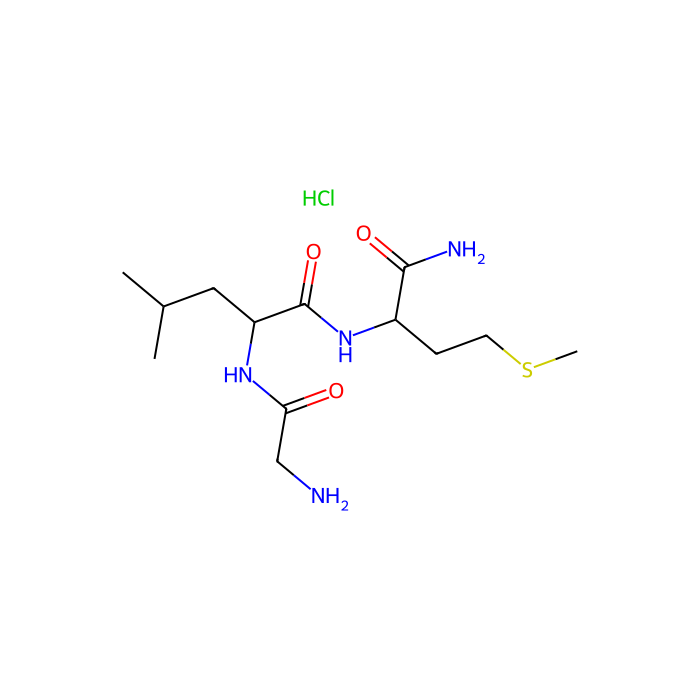
Substance P (9–11) is a short tachykinin peptide fragment corresponding to the C‑terminal tripeptide of Substance P.
Item-specific identifiers (from Product Data)
SKU: S339386
CAS: 40297-96-9
InChIKey: 214765 (as provided)
SMILES: Not specified for this item; refer to CoA/Spec Sheet.
Molecular Formula: Not specified for this item; refer to CoA/Spec Sheet.
Molecular Weight: Not specified for this item; refer to CoA/Spec Sheet.
Literature/General structural information (for context; not item specification)
Parent peptide: Substance P (RPKPQQFFGLM-NH2), an undecapeptide tachykinin.
Fragment assignment: SP(9–11) corresponds to residues 9–11 of Substance P: Gly–Leu–Met; in the native peptide the C-terminus is amidated. Suppliers may offer either free-acid (–COOH) or amide (–CONH2) termini; confirm on CoA.
Functional groups: peptide backbone (amide bonds), side chains: Gly (nonpolar, no side chain), Leu (branched aliphatic), Met (thioether). Overall neutral near physiological pH if C-terminus is amidated; otherwise acidic free acid.
2D description: a linear tripeptide with two peptide amide linkages linking Gly–Leu–Met; terminal N-terminus as –NH2 (protonation state pH-dependent); C-terminus free acid or amide depending on product.
Stereochemistry (literature): L-configuration at Leu and Met is typical for natural tachykinins; verify on CoA for this item.
Synthetic Utility
Role in synthesis (general)
SP(9–11) can serve as a minimal pharmacophore module for structure–activity studies. It is a convenient starting point for N‑terminal modifications (acylation, PEGylation, fluorophore/biotin labeling) to generate probes while retaining the C‑terminal recognition elements.
Solid-phase peptide synthesis (SPPS): The tripeptide can be assembled efficiently using Fmoc/tBu chemistry. Side-chain protection is minimal (Leu none, Gly none, Met thioether inert to standard acidolysis), simplifying synthesis.
Transformations and derivatizations
N‑terminal acylation or incorporation of non-natural amino acids (e.g., norleucine for Met isostere) to modulate oxidation liability and receptor activity.
C‑terminal variants: free acid vs. amide; amidation often enhances biological mimicry of native SP.
Conjugation strategies: NHS ester labeling at the N‑terminus; click chemistry handles introduced via azidoacyl caps for chemo-selective ligations.
Analytical considerations
Monitor identity/purity by LC–MS and RP‑HPLC; track Met oxidation state (M vs. M[O]) as separate peaks/masses.
Quantify content via amino acid analysis or validated UV at 214 nm with appropriate calibration, as aromatic absorbance is minimal.
Target Specificity
Item-specific target/clone/isotype data: Not specified for this item; refer to CoA/Spec Sheet.
Literature context
The C‑terminal region of Substance P, including SP(9–11), contributes to binding and activation of neurokinin receptors, with NK1 (TACR1) being the primary physiological target of full-length Substance P.
SP(9–11) itself is significantly less potent than SP(1–11) but retains elements of the NK1 recognition motif, making it useful as a minimal fragment control in receptor binding and functional assays.
Note: Actual potency/affinity of this specific lot/formulation is not established here; consult experimental data or literature appropriate to your system.
Preguntas frecuentes
What is the purity of this product?
This product is supplied at ≥98% purity (chemical assay). Lot-specific values are stated on the Certificate of Analysis.
How should this product be stored?
Store at ?20 °C. Freezer storage is required to maintain the specified shelf life.
How is this product shipped?
This product ships in an insulated container with ice pads. Unpack on arrival and transfer it to the storage condition stated above.
What are the CAS number, molecular formula and molecular weight?
The CAS Number is 40297-96-9, the molecular formula is C13H26N4O3S?HCl, and the molecular weight is 354.93 g/mol. InChIKey MBMAGTQNPFSIDF-IYPAPVHQSA-N.
What documentation is provided?
Available product documentation, including Certificates of Analysis (COA), Safety Data Sheets (SDS), and specification sheets, is shown in the product document area. Document availability and access follow the current site policy.
Utilizamos cookies para garantizar el correcto funcionamiento del sitio web y, cuando esté permitido, para mejorar su experiencia. Puede gestionar sus preferencias en cualquier momento en Configuración. Más información en nuestra Política de Cookies.
¿Quieres que te enviemos un mensaje cuando tengamos descuentos disponibles?
Recordármelo más tarde
¡Gracias! Por favor, revisa tu bandeja de entrada de correo electrónico para confirmar.
Products are supplied to verified businesses, institutions, and qualified professionals for research and development use only. Not for use in humans, animals, diagnosis, or therapy.
 B2309435
