GRADE & PURITYMoligand™?Moligand™ — Aladdin's line of ligands and bioactive small molecules. Use for receptor, pathway, and binding studies needing defined small-molecule tools.10 mM in DMSO
Certificados (CoA, COO, BSE/TSE y tabla de análisis)
C of A & Other Certificates(BSE/TSE, COO):
Analytical Chart:
Calculadoras de soluciones
Molarity Calculator
Determine the necessary mass, volume, or concentration for preparing a solution.
Dilution Calculator
Determine the dilution needed to prepare a stock solution.
Reconstitution Calculator
Reseñas
Reseñas de cliente
Application Protocols
Only protocols provided in the product data can be listed. For this item, no application protocols are specified.
Item-specific note: Not specified for this item; refer to CoA/Spec Sheet.
General reminder:
Establish assay-specific procedures for compound handling (stock preparation, dilution schemes, plate setup, and readout timing) within your laboratory’s SOP framework, and document solvent percentages and controls alongside biological results.
Biological Roles
General/literature context (no medical claims):
TAS4464 is reported as a selective, ATP-competitive inhibitor of the NEDD8-activating enzyme (NAE), a key E1 enzyme in the neddylation cascade. Neddylation modulates the activity of cullin-RING ligases (CRLs), thereby influencing ubiquitin-mediated protein turnover.
Utility in chemical biology:
Serves as a tool compound to acutely suppress neddylation, enabling studies of CRL substrate stabilization, proteostasis, and downstream signaling. Readouts may include changes in cullin neddylation status, accumulation of CRL substrates, and transcriptional responses indicative of proteotoxic stress.
Facilitates target-validation experiments by linking biochemical inhibition of NAE to phenotypic outcomes in cellular systems.
Experimental considerations:
Potency and selectivity observed in literature may vary across assay formats and biological systems; confirm under your conditions. Assess off-target liabilities with counterscreens where selectivity is critical.
For chemoproteomics or target engagement, consider CETSA, DARTS, or NanoBRET approaches to confirm on-target action and cellular permeability.
Notes:
This product is provided for research use only. No therapeutic or clinical use is implied. For definitive biological property data (IC50/Ki, selectivity panels), consult peer-reviewed publications and generate lab-specific confirmation data.
Buffer Applications
Not typically applicable. TAS4464 is a bioactive small molecule and not a buffering agent.
Practical note:
When deploying in biochemical or cell-based assays, select a buffer system validated for your target (e.g., HEPES, Tris, or phosphate) and confirm that the final solvent composition (DMSO percentage and any co-solvents/surfactants) does not alter buffer capacity, pH, or the assay readout.
Green Alternatives
Context: As a bioactive screening compound, TAS4464 itself is not replaced by a “greener” reagent; however, greener practices can be adopted for its handling, particularly in solvent choices and waste minimization.
Greener handling strategies (general guidance):
Prefer water-miscible, lower-toxicity solvents for analytics and sample prep when compatible (e.g., acetonitrile over DMF/NMP; aqueous buffers with minimal DMSO).
Minimize DMSO concentration in assays (≤0.1–0.5% v/v typical) to reduce solvent burdens and environmental impact of solvent waste streams.
Use micro-scale preparations and high-concentration master stocks to limit total solvent volume.
Comparison of common solvents (general, not item-specific):
DMSO: Low volatility, widely accepted in bioassays; moderate environmental impact. Disposal as hazardous waste required.
Acetonitrile vs methanol (for LC): Acetonitrile generally offers better chromatographic performance and is recoverable via solvent recycling; methanol is more benign toxicologically but may reduce MS sensitivity in some methods.
Avoid NMP/DMF for biology-facing work when possible due to toxicity profiles; retain for necessary sample processing only.
Operational improvements:
Implement solvent recycling for ACN/MeOH where infrastructure exists.
Use 96/384-well low-dead-volume plates and acoustic dispensing to further reduce solvent usage.
Plan stability/solubility screens to pre-empt failed assays that generate unnecessary waste.
Pharmaceutical Uses
Formulation and analytical contexts (no therapeutic claims):
As a research-use-only small molecule, TAS4464 may serve as a reference standard in ADME, bioanalytical method development, or target-engagement assay qualification within discovery research.
In preclinical research settings, compounds of this class are typically formulated for in vitro work as DMSO stocks and for ex vivo matrices using appropriate cosolvent systems determined by solubility/stability screens. Any in vivo formulation or dosing discussions must be supported by institutionally approved protocols and are outside the scope of this catalog entry.
Analytical considerations:
Establish a validated LC–MS/MS method using stable internal standards if quantitation in biological matrices is required. Assess matrix effects and recovery.
Document stability in relevant media (buffer, cell culture medium, plasma surrogate) and define freeze–thaw stability if long-term studies are anticipated.
Regulatory note:
This product is labeled For research use only. It is not produced under cGMP, not qualified to pharmacopeial monographs, and not intended for human or veterinary use.
Physical Properties
Item-specific numerical specifications (for this catalog entry):
Appearance: Not specified for this item; refer to CoA/Spec Sheet.
Molecular weight: Not specified for this item; refer to CoA/Spec Sheet.
Molecular formula: Not specified for this item; refer to CoA/Spec Sheet.
Melting point (MP): Not specified for this item; refer to CoA/Spec Sheet.
Boiling point (BP): Not applicable for most high-MW bioactive solids; not specified for this item.
Density: Not specified for this item; refer to CoA/Spec Sheet.
UV/Vis characteristics: Not specified for this item; refer to CoA/Spec Sheet.
LogP/logD, pKa: Not specified for this item; refer to CoA/Spec Sheet.
Solubility: Not specified for this item; refer to CoA/Spec Sheet.
General/literature context (non-spec, for planning only):
Small-molecule NAE inhibitors such as TAS4464 are typically solid at ambient conditions and are commonly formulated as DMSO stock solutions for screening (e.g., 10–50 mM). Actual solubility and stability are compound- and lot-dependent.
For analytical development, begin with a generic reverse-phase LC method (C18, 0.1% formic acid in water/acetonitrile) and adjust gradient and pH per observed retention and peak shape. Confirm absence of significant degradation at autosampler temperature over assay time.
Notes:
Use the Certificate of Analysis for the definitive physical property values for your lot. Do not extrapolate literature values to product specifications.
Quality and Grades
Grade/Purity: Moligand™
What Moligand™ generally signifies (program-level description):
Curated small-molecule/ligand collection grade suitable for screening and chemical biology workflows. Typical attributes for this grade (informational, not item-specific specs):
Identity verified by orthogonal techniques (e.g., LC–MS, NMR where applicable).
High assay purity suitable for HTS/hit validation and mechanism studies.
Packaged and shipped to minimize thermal and moisture exposure.
Item-specific qualifiers:
Exact purity percentage, residual solvent profile, and analytical method set are not specified for this item; refer to CoA/Spec Sheet for the supplied lot.
Implications for use:
Suitable for creation of DMSO stocks for biochemical or cell-based assays, reference standard usage in analytical method development, and as a comparator compound in target-validation experiments.
For SAR or in vivo enabling studies, request or generate extended characterization (full 1H/13C NMR, HRMS, water content by KF, and stability data in relevant matrices) to complement the provided CoA.
Documentation and traceability:
Retain lot-specific CoA and any in-house confirmatory data with project records. If low-UV absorbance or special impurity thresholds are required (e.g., for LC-UV or LC-MS quantitation), specify these prior to ordering.
Reaction and Applications
This product is supplied as a bioactive small molecule for research use rather than as a synthetic reagent. Consequently, it is not typically employed as a reagent or catalyst in organic synthesis.
Research applications (general/literature context):
TAS4464 is described in the literature as a potent, selective inhibitor of the NEDD8-activating enzyme (NAE), used to interrogate the ubiquitin-like neddylation pathway in chemical biology. Applications include mechanistic studies, pathway validation, and use as a positive control compound in target-engagement assays.
Assay modalities where such compounds are commonly deployed (planning guidance):
Prepare and qualify DMSO stocks (e.g., 10–50 mM), then perform serial dilutions in assay buffer immediately before use to minimize compound degradation and adsorption.
Confirm lot-specific potency under your assay conditions, as assay format, substrate concentrations, and protein sources can influence apparent IC50/Ki.
Note: No item-specific activity values are provided here; consult the primary literature for reference data and use your in-house assays to generate definitive performance metrics.
Reaction Conditions
Not applicable. TAS4464 is not typically used as a reagent or catalyst in synthetic transformations, so no preparative reaction conditions are provided for this product.
For laboratory handling conditions (general, non-reaction):
Prepare concentrated DMSO stocks under ambient laboratory conditions in a fume hood. Protect from prolonged light and moisture exposure. Keep dilutions cold as needed for stability during assay setup.
Refer to the CoA/SDS for any item-specific handling limits or environmental conditions.
Safety and Handling
GHS/SDS information for this item:
Signal word: Not specified for this item; refer to SDS.
Hazard statements (H-phrases): Not specified for this item; refer to SDS.
GHS classification and pictograms: Not specified for this item; refer to SDS.
General laboratory precautions (best practices):
Handle in a chemical fume hood with appropriate PPE: lab coat, safety glasses, and nitrile gloves. Avoid inhalation of dust/particles and contact with skin or eyes. Prevent aerosolization when making DMSO stocks.
Avoid incompatible materials typical for organic compounds (strong oxidizers, strong acids/bases) unless compatibility has been evaluated.
For weighing potent bioactives, use antistatic measures and micro-spatulas; consider a ventilated balance enclosure for fine powders.
First-aid overview (defer to SDS for authoritative guidance):
Skin/eye contact: Rinse with water for at least 15 minutes; remove contaminated clothing; seek medical attention if irritation persists.
Inhalation: Move to fresh air; seek medical attention if symptoms occur.
Ingestion: Rinse mouth; seek medical attention.
Special risks and housekeeping:
Prepare small-volume DMSO stocks inside a hood; wipe surfaces to remove any residues.
Clearly label with compound name, concentration, solvent, and date. Maintain records linking assay data to lot and stock IDs.
Dispose of waste following institutional and regulatory guidelines; DMSO solutions of bioactives are typically collected as hazardous organic waste.
Solvent Selection
Practical solvent guidance for TAS4464 as a screening-grade bioactive (general guidance, not item-specific specs):
Primary stock solvent: DMSO is typically preferred due to broad solubilizing power and compatibility with biochemical/cell-based assays at low final percentages (≤0.1–0.5% v/v commonly).
Cosolvent strategies for assay buffers:
Combine DMSO stocks with aqueous buffers (e.g., PBS, HEPES) while keeping final DMSO low to minimize solvent effects.
If precipitation occurs on dilution, add modest amounts of co-solvent (e.g., acetonitrile) or a surfactant system validated for the assay.
Analytical solvents: Water/acetonitrile or water/methanol with 0.1% formic acid (or ammonium formate/acetate for MS) are typical starting points for LC methods.
Comparison (general, for planning):
DMSO vs DMF: DMSO is more assay-compatible and less volatile; DMF can be considered for sample prep but is less favored for biological testing.
DMSO vs NMP: NMP dissolves many hydrophobic compounds but is usually avoided in biology-facing assays; reserve for synthetic/analytical steps.
Operational tips:
Warm to ambient and vortex/sonicate briefly to ensure dissolution; filter through 0.2 µm PTFE for analytical injections if needed.
Document precipitation or turbidity upon aqueous dilution and adjust solvent composition accordingly. Validate that solvent levels do not affect assay readouts.
Storage and Reconstitution
Item-specific storage and shipping:
Storage conditions: Store at -80°C.
Shipped in: Dry ice packs + Cold packs.
Reconstitution:
Not specified for this item; refer to CoA/Spec Sheet.
General handling guidance (informational, not item-specific specifications):
Allow vials shipped on dry ice to equilibrate to room temperature inside a desiccated environment before opening to prevent moisture condensation.
For bioassay use, many laboratories prepare concentrated DMSO stocks (e.g., 10–50 mM) and aliquot into low-bind tubes to minimize freeze–thaw cycles; verify solubility and stability for your lot.
Record concentration, solvent, and preparation date on each aliquot label. Store working stocks at low temperature consistent with stability data and institutional SOPs.
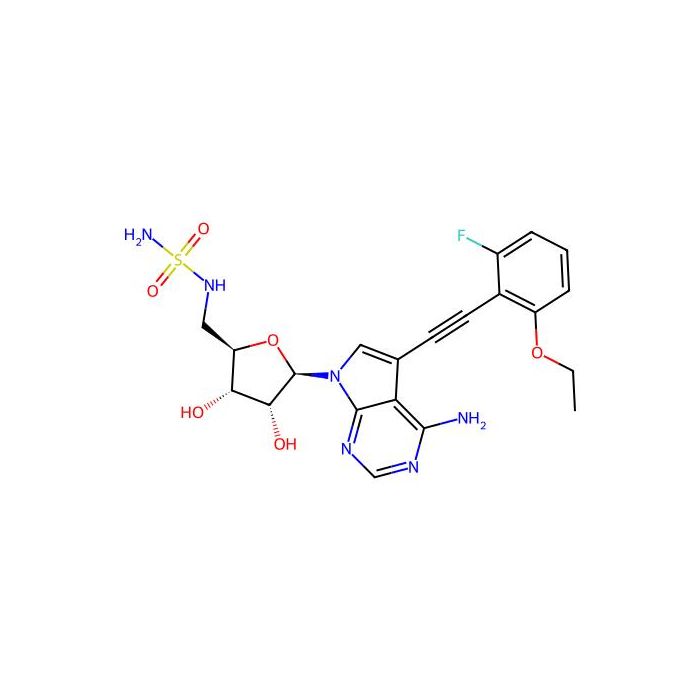
Structure and Identity
Product name: TAS4464 (SKU: T1495895)
CAS: 1848959-10-3
CID: 124121703
Molecular formula: Not specified for this item; refer to CoA/Spec Sheet.
Molecular weight: Not specified for this item; refer to CoA/Spec Sheet.
SMILES: Not specified for this item; refer to CoA/Spec Sheet.
InChIKey: Not specified for this item; refer to CoA/Spec Sheet.
TAS4464 is described in the literature as a small-molecule, ATP-competitive inhibitor of the NEDD8-activating enzyme (NAE) used as a chemical biology tool compound. Detailed atom-level structure, stereochemistry, and substituent pattern should be verified against the primary reference or the CoA.
How to visualize (practical guidance):
For cheminformatics workflows, request the supplier’s SDF/MOL file or retrieve the structure from the referenced CID where licensing permits. Validate the 2D structure, tautomeric state, and protonation form relevant to your assay pH before docking, QSAR, or inventory registration.
Identity confirmation (best practices):
Confirm by orthogonal methods (e.g., HPLC/UPLC purity profile, high-resolution MS for exact mass, and 1H/13C NMR). For bioassay work, also document lot-specific identity and purity on the same report as potency data to ensure traceability.
Synthetic Utility
Not a general-purpose synthetic reagent. TAS4464 is supplied as a finished bioactive small molecule for use in screening and mechanistic studies rather than for use as a building block or catalyst.
If synthetic investigation is required (general guidance):
Any derivatization, metabolite synthesis, or linker installation for probe development should be guided by primary literature disclosures and supported by full analytical characterization (NMR, HRMS, HPLC purity, and, where applicable, chiral analyses).
For making affinity probes or tagged derivatives, structure–activity relationships from literature should be consulted to identify positions tolerant to modification without significant loss of activity.
Inventory control:
Maintain the parent compound as a reference standard when synthesizing analogs; cross-validate retention times and MS signatures to ensure identity across series.
Target Specificity
This section is typically applicable to biologics (e.g., antibodies) with defined antigen/epitope specificity. For this small-molecule product, no target specificity details are provided in the product data.
Item-specific note: Not specified for this item; refer to CoA/Spec Sheet.
General context (not product-specific specifications): Literature describes TAS4464 as an inhibitor of the NEDD8-activating enzyme (NAE). Users should confirm target engagement and selectivity under their own assay conditions.
Need help choosing the grade?
Our grade selection guide covers purity, stabilizer status, and application suitability for all variants in our catalog.
We use cookies to ensure the website functions properly and, where permitted, to improve your experience. You can manage your preferences at any time in Settings. Learn more in our Cookie Policy.
Shall we send you a message when we have discounts available?
Remind me later
Thank you! Please check your email inbox to confirm.
Products are supplied to verified businesses, institutions, and qualified professionals for research and development use only. Not for use in humans, animals, diagnosis, or therapy.