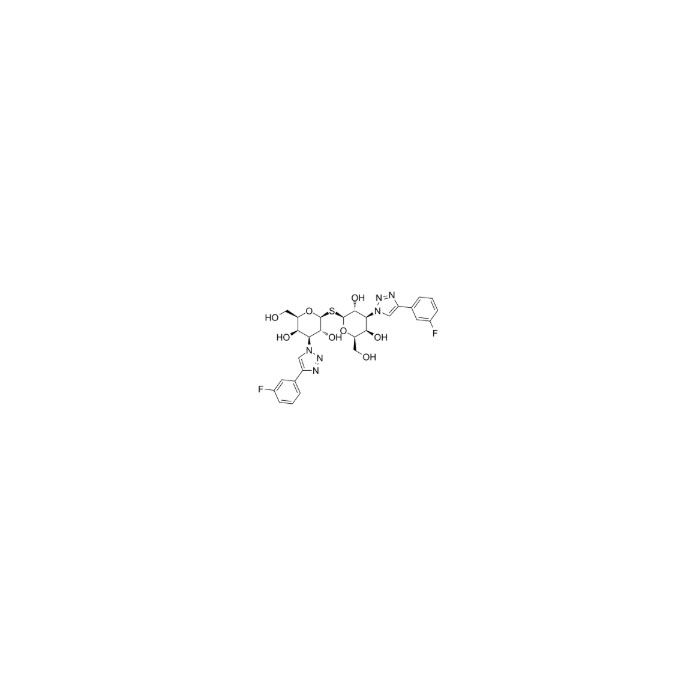
 I2515577
Determine the necessary mass, volume, or concentration for preparing a solution.
| Activity Type | Relation | Activity value | Units | Action Type | Journal | PubMed Id | doi | Assay Aladdin ID |
|---|

Moligand™, ≥99% Moligand™ para flujos de trabajo cromatográficos y analíticos sensibles que requieren una interferencia mínima de la línea base.
Store at -20°C,Argon charged Envío Ice chest + Ice pads. Consulte el COA específico del lote para conocer las especificaciones exactas.
SDS, COA, ficha técnica y hoja de especificaciones disponibles para descargar. COA específico del lote accesible mediante búsqueda por número de lote.
Citado en 0 publicaciones revisadas por pares sobre cromatografía, síntesis orgánica y reacciones de acoplamiento cruzado.
Information
TD-139 TD-139 (GB0-139) is a potent and selective inhibitor of galectin-3 with Kd of 0.036 µM over galectin-1 and galectin-7 with Kd of 2.2 µM and 32 µM, respectively. TD-139 is used potentially for the treatment of idiopathic pulmonary fibrosis (IPF).
Targets
galectin-3 (Cell-free assay); galectin-1 (Cell-free assay); galectin-7 (Cell-free assay) 0.036 μM(Kd); 2.2 μM(Kd); 32 μM(Kd)
Documento completo sobre peligros, manipulación, almacenamiento y cumplimiento normativo.
<<<<<<< HEAD Descargar SDS → ======= Descargar SDS → >>>>>>> release248-p3Datos de calidad específicos del lote. Introduzca su número de lote para obtener el COA exacto.
Buscar COA →Resumen de referencia rápida de las especificaciones y aplicaciones del producto.
Ver ficha técnica →Atributos de calidad completos y criterios de aceptación para esta calidad.
Ver hoja de especificaciones →Taxonomy Tree
| Kingdom | Organic compounds |
|---|---|
| Superclass | Organic oxygen compounds |
| Clase | Organooxygen compounds |
| Subclass | Carbohydrates and carbohydrate conjugates |
| Intermediate Tree Nodes | Not available |
| Direct Parent | Disaccharides |
| Alternative Parents | Phenyl-1,2,3-triazoles Fluorobenzenes Oxanes Aryl fluorides Monothioacetals Heteroaromatic compounds Secondary alcohols Sulfenyl compounds Oxacyclic compounds Azacyclic compounds Primary alcohols Organonitrogen compounds Organofluorides Hydrocarbon derivatives |
| Molecular Framework | Aromatic heteromonocyclic compounds |
| Substituents | Disaccharide - Phenyltriazole - Phenyl-1,2,3-triazole - Fluorobenzene - Halobenzene - Benzenoid - Oxane - Aryl fluoride - Aryl halide - Monocyclic benzene moiety - Heteroaromatic compound - 1,2,3-triazole - Triazole - Azole - Monothioacetal - Secondary alcohol - Organoheterocyclic compound - Oxacycle - Sulfenyl compound - Azacycle - Hydrocarbon derivative - Alcohol - Organic nitrogen compound - Organohalogen compound - Organofluoride - Organonitrogen compound - Organosulfur compound - Primary alcohol - Aromatic heteromonocyclic compound |
| Descripción | This compound belongs to the class of organic compounds known as disaccharides. These are compounds containing two carbohydrate moieties linked to each to each other through a glycosidic bond, no set of three or more glycosidically linked carbohydrate units. |
| External Descriptors | Not available |
| Activity Type | Relation | Activity value | Units | Action Type | Journal | PubMed Id | doi | Assay Aladdin ID |
|---|
| Solubilidad | Solubility (25°C) In vitro DMSO: 100 mg/mL (154.16 mM); Water: ˂1 mg/mL Ethanol: ˂1 mg/mL |
|---|---|
| Sensibilidad | Moisture sensitive |
| DMSO (mg/ml) Solubilidad máxima | 100 |
| DMSO (mM) Solubilidad máxima | 154.16872224963 |
| Agua (mg/ml) Solubilidad máxima | ˂1 |
| Peso molecular | 648.600 g/mol |
| XLogP3 | 0.200 |
| Hydrogen Bond Donor Count | 6 |
| Hydrogen Bond Acceptor Count | 15 |
| Rotatable Bond Count | 8 |
| Exact Mass | 648.181 Da |
| Monoisotopic Mass | 648.181 Da |
| Topological Polar Surface Area | 227.000 Ų |
| Heavy Atom Count | 45 |
| Formal Charge | 0 |
| Complexity | 903.000 |
| Isotope Atom Count | 0 |
| Defined Atom Stereocenter Count | 10 |
| Undefined Atom Stereocenter Count | 0 |
| Defined Bond Stereocenter Count | 0 |
| Undefined Bond Stereocenter Count | 0 |
| The total count of all stereochemical bonds | 0 |
| Covalently-Bonded Unit Count | 1 |
The Product Data for SKU T412406 do not include validated application protocols or recommended assay conditions. As such, no item-specific protocols can be provided.
General, non-spec guidance for small-molecule ligand handling in assays:
For detailed, target-specific protocols, consult the primary literature on TD-139 and adapt to your assay platform (SPR, ITC, FP, cell-based readouts).
General literature context (not a product specification and not a medical claim):
Note: All uses are for research only. This summary is for biochemical understanding and should not be construed as clinical guidance or a therapeutic claim.
TD-139 is a small-molecule research ligand and is not itself a buffering agent. Therefore, classical buffer system design (pH range, pKa, buffer capacity) is not applicable.
Practical notes for buffer use with TD-139 in assays (general guidance):
Recommendation: Pilot solubility/compatibility tests should be performed to check for precipitation or baseline drift when TD-139 is introduced into the selected buffer at working concentrations.
This item functions as a target-directed research ligand rather than a process solvent or bulk reagent. “Green alternative” analysis is therefore not typically applicable in the same way it is for solvents or common reagents.
That said, you can implement greener practices in the way TD-139 is handled and formulated:
Comparison table (general practices, not product specifications):
For synthetic route greenness of TD-139 itself, consult primary literature; route selection and metrics (PMI/E-factor) are highly context-dependent and not specified for this SKU.
This product is designated For research use only and is not approved for human or veterinary use, diagnostic procedures, or as an active pharmaceutical ingredient.
General, non-clinical context from the literature (not a claim for this SKU):
For any application beyond benchtop research, including preclinical development, obtain suitable grade material, full impurity profiles, and stability data under ICH conditions. This Moligand™ item is intended strictly for laboratory research.
Item-specific physico-chemical specifications were not supplied in the Product Data for this catalog entry. Do not treat the following as product specifications; they are general/literature context only. For experiments and release criteria, consult the batch CoA/Spec Sheet and SDS.
Item-specific (from Product Data):
General/literature guidance (non-spec):
Do not infer numeric values for bp/mp, density, pKa, logP, or UV cutoffs for this SKU. Use empirical solubility checks (small-scale titration, visual inspection, nephelometry) to establish a working formulation for your assay system.
Grade/Purity: Moligand™ (from Product Data)
What Moligand™ typically implies (general description):
Implications for this item:
Documentation and traceability:
This product is sold as a research ligand rather than a synthetic reagent. No manufacturer reaction applications are provided in the Product Data. Accordingly, it is not typically employed as a stoichiometric reagent or catalyst in synthetic transformations.
Research usage (general/literature context, non-spec):
Practical tips (general):
Note: For any application beyond research use, or for synthetic incorporation, obtain explicit specifications and permissions; this product is labeled For research use only.
Not applicable in the conventional synthetic sense. TD-139 is supplied as a research ligand rather than a reagent/catalyst, and no manufacturer reaction conditions are provided in the Product Data.
Assay conditions (general, literature-based guidance, non-spec):
Note: Any numeric potency or kinetic parameters should be taken from primary literature under your exact assay conditions. This catalog listing does not specify activity values or recommended concentrations.
Hazard classification details are not provided in the Product Data for this item. Always consult the SDS for authoritative guidance. The following are prudent laboratory practices for small-molecule research ligands and should not be construed as product-specific hazard statements.
Item-specific from Product Data:
General handling recommendations (good laboratory practice):
Always defer to the current SDS and institutional EHS policies.
No item-specific solubility data are provided for TD-139 in the Product Data. The guidance below reflects common practice for structurally similar small-molecule ligands and should be verified empirically for your system.
General/literature-based considerations (non-spec):
Comparison notes (general):
Always verify solubility and assay compatibility with a small pilot dilution series before scale-up.
From Product Data (item-specific):
General handling and reconstitution guidance (non-spec):
Disposal: Dispose of unused solutions and waste according to institutional chemical waste procedures and local regulations. Always consult the SDS for stability and incompatibility details specific to your lot.
TD-139 (SKU T412406) is supplied as a Moligand-grade research small molecule commonly referenced in the literature as a high-affinity galectin-3 ligand. Item-specific identifiers are listed below; fields not provided in the product data are indicated accordingly.
Structural description (general literature context, not item-specific):
Notes:
TD-139 is offered as a bioactive ligand and is not generally used as a synthetic building block or reagent. Consequently, conventional synthetic utility discussions (e.g., protecting-group strategies, cross-coupling handles, reagent roles) are not typically applicable.
General context (non-spec):
Practical recommendation:
Only information from the Product Data may be listed here. The Product Data for SKU T412406 do not provide target specificity fields.
General note: While literature frequently associates TD-139 with galectin-3 binding, any target attribution for this specific SKU should be confirmed against the lot documentation if required by your application.
Nuestra guía de selección de calidades cubre la pureza, el estado del estabilizador y la idoneidad de la aplicación para todas las variantes de nuestro catálogo.
Ver la guía de calidades Moligand™ →