CALIDAD & PUREZAMoligand™?Moligand™ — Aladdin's line of ligands and bioactive small molecules. Use for receptor, pathway, and binding studies needing defined small-molecule tools.≥98%
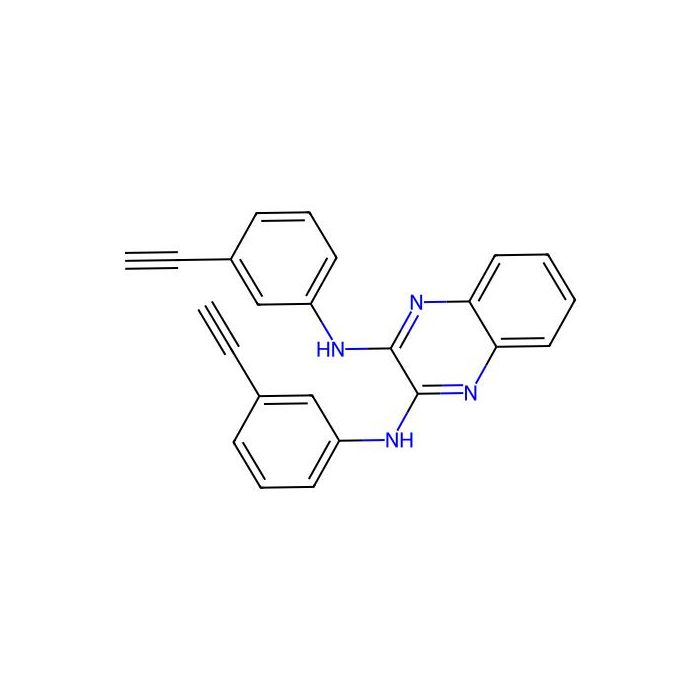
TD52, an Erlotinib derivative, is a potent cancerous inhibitor of protein phosphatase 2A (CIP2A) inhibitor. TD52 mediates the apoptotic effect in triple-negative breast cancer (TNBC) cells via regulating the CIP2A/PP2A/p-Akt signalling pathway. TD52 indirectly reduced CIP2A by disturbing Elk1 binding to the CIP2A promoter. TD52 has less p-EGFR inhibition and has potent anti-cancer activity[1]. TD52 is a click chemistry reagent, it contains an Alkyne group and can undergo copper-catalyzed azide-alkyne cycloaddition (CuAAc) with molecules containing Azide groups.
Certificados (CoA, COO, BSE/TSE y tabla de análisis)
C of A & Other Certificates(BSE/TSE, COO):
Analytical Chart:
Propiedades químicas y físicas
Solubilidad
DMSO : 100 mg/mL (277.46 mM; Need ultrasonic)
Peso molecular
360.4
XLogP3
5.500
Hydrogen Bond Donor Count
2
Hydrogen Bond Acceptor Count
4
Rotatable Bond Count
6
Exact Mass
360.137 Da
Monoisotopic Mass
360.137 Da
Topological Polar Surface Area
49.800 Ų
Heavy Atom Count
28
Formal Charge
0
Complexity
559.000
Isotope Atom Count
0
Defined Atom Stereocenter Count
0
Undefined Atom Stereocenter Count
0
Defined Bond Stereocenter Count
0
Undefined Bond Stereocenter Count
0
The total count of all stereochemical bonds
0
Covalently-Bonded Unit Count
1
Seguridad y peligros (GHS)
RIDADR
NONHforallmodesoftransport
Calculadoras de soluciones
Molarity Calculator
Determine the necessary mass, volume, or concentration for preparing a solution.
Dilution Calculator
Determine the dilution needed to prepare a stock solution.
Reconstitution Calculator
Reseñas
Reseñas de cliente
Application Protocols
Item-specific facts
No tested applications or recommended dilutions are provided for this item.
General small-molecule handling protocols (for screening workflows)
Stock solution: Dissolve at 10 mM in anhydrous DMSO. Sonicate briefly if needed. If particulate remains, warm gently (≤40 °C) and re-evaluate. Record exact concentration if gravimetric error is significant.
Aliquoting: Dispense single-use aliquots (10–50 µL) in inert, low-bind tubes or 384-well source plates; seal to minimize moisture/oxygen uptake.
Serial dilution: Prepare intermediate dilutions in DMSO, then into assay buffer to reach final concentrations, keeping total DMSO within assay tolerance (e.g., ≤0.5% v/v for cells).
QC on receipt: Run LC–MS and 1H NMR to confirm identity/purity. Archive chromatograms/spectra with the batch number.
Light and air: Until stability is known, protect from light and minimize air/moisture exposure. Work quickly at room temperature; return to cold storage promptly.
Plate management: For high-throughput screening, limit freeze–thaw cycles by using sealed plates with pierceable films and desiccant. Track plate maps and solvent controls meticulously.
These are general-purpose procedures and should be adapted to your assay and institutional SOPs.
Biological Roles
Item-specific facts
No target annotation, pathway mapping, or biological role is provided for TD52 in the Product Data.
General guidance
As a research-only library member, TD52 has no assigned endogenous role or validated pharmacology in this listing. Any biological effects must be established empirically in your system.
If biological activity is observed, follow up with mechanism-of-action studies: target engagement (e.g., CETSA/thermal shift), binding assays (SPR, ITC, DSF), chemoproteomics or affinity capture if structural handles allow, and genetic validation (orthogonal perturbation of the putative target).
Consider liability assessments common to small molecules: promiscuity profiling, off-target panels, and basic ADME screening (solubility, stability in buffer and microsomes, permeability) to contextualize observed phenotypes.
Caveats
Do not infer biological roles or therapeutic potential from library codes. Treat all observations as preliminary until reproduced with purified material and orthogonal assays.
Ensure solvent controls and counterscreens to rule out readout interference (fluorescence quenchers/emitters, redox cycling, colloidal aggregation).
Buffer Applications
Applicability
TD52 is not a buffer reagent. However, library compounds are typically diluted into biological buffers from organic stock solutions for screening.
Practical guidance (general)
Stock preparation: Make a 10 mM solution in DMSO. Confirm complete dissolution by visual inspection and, if needed, brief sonication.
Aqueous dilution: Add the DMSO stock slowly to vigorously mixed buffer to minimize local supersaturation and precipitation.
Typical buffer systems: PBS, HEPES, Tris, or assay-specific buffers. Maintain pH and ionic strength appropriate for the biological system.
Final solvent limits: Many enzyme assays tolerate up to 1% v/v DMSO; mammalian cells typically ≤0.1–0.5% v/v. Validate for your assay.
Solubilization aids: If precipitation occurs, test 0.01% non-ionic surfactant (e.g., Tween-20 or Pluronic F‑68), 0.5–5% hydroxypropyl‑β‑cyclodextrin, or adjust pH if compatible with compound stability (unknown for this item—proceed cautiously).
Filtration: If sterility is required, filter the final working solution through a 0.22 µm PVDF or PTFE membrane; avoid nylon if the compound may be cationic (unknown here).
Documentation
Record the final DMSO % and any excipients used. Note any visible precipitate or opalescence over assay time as it may affect apparent potency.
Green Alternatives
Context
The primary environmental consideration for library compounds is the choice of dissolution, workup, and cleaning solvents, as the compound itself is fixed.
Greener solvent strategies (general)
Prefer ethanol or isopropanol over acetonitrile or DMF when feasible for cleaning and intermediate dilutions.
In synthetic or scale-up contexts (if derivatization is attempted), consider replacing chlorinated solvents with 2‑MeTHF, CPME, EtOAc, or propylene carbonate where reaction-compatible.
For assay dilution, keep DMSO content as low as assay performance allows (≤0.1–0.5% v/v in cells) to reduce solvent load.
Illustrative comparison (general, not item-specific)
DMSO: High solvency, assay standard; environmental profile acceptable in small volumes; minimize exposure due to dermal transport.
Ethanol: Renewable routes available; readily biodegradable; often compatible biologically. Limitation: volatility and potential assay effects at higher %.
2‑MeTHF/CPME (synthetic contexts): Better EHS profiles than many ethers; water-tolerant; facilitate separations. Limitation: peroxide formation over time—manage with testing and inhibitors.
Operational tips
Use microscale assays and miniaturization (384/1536-well plates) to reduce solvent volumes.
Consolidate solvent use and implement solvent recycling where permitted.
Validate that any greener alternative does not compromise compound solubility or assay integrity; document any solvent-dependent activity shifts.
Pharmaceutical Uses
Item-specific facts
No pharmacopeial status, excipient role, or formulation use is provided. This product is designated For research use only.
General context
As a library screening compound, TD52 is not supplied or represented as an API or excipient. It is not intended for human or veterinary use, clinical diagnostics, or therapeutic applications.
If biological activity is discovered during research, any consideration of developability would require extensive preformulation and safety studies that are far beyond the scope of this listing.
Formulation-relevant considerations for research (non-clinical)
Solubility and stability mapping in common vehicles (DMSO, ethanol, PEG 300/400, Captisol/cyclodextrins) can support in vivo exploratory studies in non-clinical settings, subject to institutional approvals. Such use remains research-only and must comply with local regulations.
Avoid extrapolating research findings to clinical contexts. No dosage, safety margins, or regulatory statuses are provided or implied for this item.
Physical Properties
Item-specific facts (from Product Data)
Appearance: Not specified for this item; refer to CoA/Spec Sheet.
Physical constants (mp, bp, density, refractive index, pKa, logP, solubility): Not specified for this item; refer to CoA/Spec Sheet.
Literature/computational values
Not provided. Without a definitive structure (SMILES/InChI), no computed or literature values can be reported.
General guidance for library compounds (non-item-specific)
Solubility screening: Begin with DMSO at 10–50 mM; inspect for clarity and persistence of solution after 24 h at ambient temperature. If insoluble, try DMF, ethanol, or mixtures (e.g., DMSO:H2O, 1:3) and mild warming (≤40 °C).
Hygroscopicity/polymorphism: Many small molecules exhibit variable mp and hydrate/solvate formation. If you must determine mp, dry under high vacuum (room temp to 40 °C) and use sealed capillaries to avoid solvent loss during measurement.
Stability: Absent structural details, avoid extremes of pH, heat, and light until stability is established. Run a quick forced-degradation panel (pH 2, 7, 10; 40 °C; ambient light) and follow by LC–UV/MS to map liabilities.
Spectroscopy: If chromophores are suspected, record UV–Vis (200–400 nm) to inform HPLC detection; otherwise, use MS or ELSD. For NMR, dissolve in DMSO‑d6 or CD3OD as first-line solvents.
Always defer to the item’s CoA/SDS for definitive specifications.
Quality and Grades
Item-specific facts (from Product Data)
Grade/purity: Not specified for this item; refer to CoA/Spec Sheet.
What this means in practice
Library compounds are typically supplied as research grade, with characterization by LC–MS (purity by area %) and supporting NMR. However, exact purity thresholds, salt form, residual solvent limits, and water content are batch-specific.
Not specified for this item; refer to CoA/Spec Sheet for: assay purity, counterion/salt form, residual solvents, water content (KF), and analytical methods used.
Guidance for users
Verify identity and purity on receipt: LC–MS with a short generic gradient (e.g., 5–95% MeCN/H2O + 0.1% formic acid over 5–10 min) and 1H NMR in DMSO‑d6/CD3OD.
Note on stabilizers: No stabilizer information is provided for this item; refer to CoA/Spec Sheet. If sensitive, you may observe antioxidants or acid suppressants—reported on the CoA when present.
Salt form and counterions: If a salt form is supplied, report concentrations as free‑base/free‑acid equivalents in assays. Confirm salt identity by 13C NMR and HRMS or by ion chromatography.
If using for screening, consider re-purifying (prep HPLC) for critical studies to ensure >95–98% purity and remove trace impurities that can confound assay readouts.
Reaction and Applications
Item-specific facts
Manufacturer applications: Not provided beyond categorization as a small-molecule/compound library member.
Research use context (general guidance for library compounds)
Screening: TD52 is positioned as a research-only small molecule suitable for inclusion in biochemical, biophysical, or cell-based screens to discover tool compounds. No target, mechanism, or activity is claimed or implied.
Profiling: Use orthogonal assay formats (e.g., enzymatic readouts, thermal shift/DSF, SPR/BLI, NMR) to confirm any primary hits and mitigate assay interference.
Selectivity follow-up: If activity is observed, broaden testing across related targets to probe selectivity and off-target risks.
Interference controls: Evaluate compound aggregation (detergent sensitivity), redox cycling, autofluorescence, and metal chelation in appropriate counterscreens; apply PAINS and REOS filters computationally, understanding these are heuristics, not definitive.
Practical notes
Prepare a 10 mM DMSO stock; confirm clarity. Serially dilute to working concentrations immediately before assays.
If you observe instability, conduct rapid stability checks (LC–MS over time in stock solvent; challenge with aqueous buffers) and adjust handling (fresh aliquots, lower temperature, light protection) accordingly.
For any SAR exploration or analog procurement, request the full structure and stereochemistry from the CoA or supplier support to ensure relevance of comparators.
Reaction Conditions
Item-specific facts
No reaction condition data are provided, and the structure is undisclosed here; therefore, specific conditions cannot be recommended.
General guidance
If derivatization is planned after obtaining the structure, select conditions based on the functional groups present, using mild, chemoselective methods first to preserve unknown liabilities (e.g., avoid strong acids/bases if acid/base-labile groups are suspected).
Conduct small-scale feasibility experiments (≤10 mg) and monitor by LC–MS. Map stability across pH and temperature before committing to multistep sequences.
Examples (illustrative only; not claims for TD52)
Amide coupling: EDCI/HOBt or HATU in DMF/MeCN with base (DIPEA), 0–25 °C.
Cross-coupling: Pd(0)-catalyzed Suzuki–Miyaura in aqueous 2‑MeTHF/EtOH or dioxane/water with K2CO3, 50–90 °C.
Reductive amination: NaBH3CN or BH3·THF in MeOH/THF, pH‑controlled.
These examples are generic. Use only after confirming TD52 contains the requisite functional groups.
Safety and Handling
Item-specific facts (from Product Data)
GHS classification, signal word, pictograms, H-statements: Not specified for this item; refer to SDS.
Research Use Note: For research use only.
Storage: Store at −20 °C. Shipped in ice chest with ice pads.
General safety guidance (not item-specific; adopt conservative assumptions for an uncharacterized small molecule)
PPE: Lab coat, safety glasses, and appropriate chemically resistant gloves (e.g., nitrile). Avoid inhalation, ingestion, and skin contact. Handle in a fume hood.
First aid overview: If on skin, wash with soap and water; if in eyes, rinse cautiously with water for several minutes and seek medical attention; if inhaled, move to fresh air; if ingested, rinse mouth and seek medical attention. Consult the SDS for authoritative instructions.
Handling: Open only in dry conditions; avoid moisture ingress. If preparing DMSO stocks, note DMSO can enhance dermal absorption—prevent skin contact.
Incompatibilities/risks: Unknown without structure. As a precaution, avoid contact with strong oxidizers, strong acids/bases, and reducing agents. Do not heat to dryness without understanding thermal behavior.
Waste: Collect as organic chemical waste; segregate halogenated vs non-halogenated streams based on solvent used. Follow institutional and local regulations.
Always consult the official SDS for the specific batch before use.
Solvent Selection
Item-specific facts
No solubility or polarity data are provided for TD52; structure is not disclosed here.
General solvent strategy for small-molecule library members (literature-based)
Primary stock solvent: DMSO is the default due to broad solvating power and biological assay compatibility at low %.
Secondary options: DMF, ethanol, methanol, acetonitrile; water co-solvent after DMSO predissolution.
For water-sensitive compounds: Use anhydrous DMSO or dry aprotic solvents; store under inert gas.
Comparison of common stock solvents (general)
DMSO: Excellent solubility; miscible with water; widely accepted in bioassays up to 0.1–1% v/v. Con: enhances skin absorption.
Ethanol: Good for moderately polar organics; bioassay-compatible typically ≤1–2% v/v. Con: volatility; potential biological effects.
Acetonitrile: Low viscosity, UV‑transparent; often ≤1% v/v in assays. Con: cytotoxic at higher %.
DMF: Strong solvent; use sparingly in biology (≤0.1–0.5%). Con: toxicity and regulatory scrutiny.
Practical tips
Start with 10 mM in DMSO; if precipitation occurs on aqueous dilution, pre-dilute DMSO stock with ethanol or MeCN (1:1) before buffering, or add slowly with vigorous mixing.
Maintain final solvent below your assay’s tolerated level (e.g., ≤0.1–0.5% v/v DMSO for cells; ≤1% for many enzymes).
If long-term aqueous work is needed, consider solubilization aids such as 0.5–5% cyclodextrin, small amounts of non-ionic surfactant (e.g., 0.01% Tween-20), or pH adjustment when consistent with compound stability (unknown here—proceed cautiously).
Storage and Reconstitution
Item-specific facts (from Product Data)
Storage conditions: Store at −20 °C.
Shipping: Shipped in an ice chest with ice pads to maintain a cold chain.
Appearance and solvent of reconstitution: Not specified for this item; refer to CoA/Spec Sheet.
General guidance
Primary container: Keep tightly closed in the supplied container. If possible, store under inert atmosphere with desiccant to limit moisture/oxygen exposure until stability is known.
Aliquoting: Upon first opening, promptly prepare single-use aliquots to avoid repeated freeze–thaw cycles. Label with concentration, solvent, date, and batch.
Reconstitution: For screening use, dissolve in anhydrous DMSO to prepare a 10 mM stock unless otherwise directed by the CoA. Mix gently; avoid excessive heating. If solubility is limited, try DMF or ethanol as alternatives.
Stability: Without structural data, treat as potentially sensitive to hydrolysis, oxidation, and light. Store solutions at −20 °C to −80 °C, protected from light, and use within 3–6 months unless your internal stability testing supports longer storage.
Thawing/use: Warm to room temperature before opening to prevent condensation ingress. After dispensing, promptly reseal and return to −20 °C storage.
Always refer to the batch-specific CoA and SDS for definitive storage and handling instructions.
Structure and Identity
Item-specific facts (from Product Data)
Product name: TD52 (SKU: T650928)
CAS: 1798328-24-1
PubChem CID: 118656842
InChIKey: 332581 (provided as-is in source; appears non-standard/incomplete)
SMILES: Not specified for this item; refer to CoA/Spec Sheet.
Molecular formula: Not specified for this item; refer to CoA/Spec Sheet.
Molecular weight: Not specified for this item; refer to CoA/Spec Sheet.
Interpretive notes
Structural features: Not available. Without a valid SMILES/InChI or a structure diagram, functional groups, ring systems, or stereocenters cannot be described.
Naming: “TD52” is an internal/library code designation rather than an IUPAC name.
Practical guidance
For unequivocal identity confirmation in your lab, consider orthogonal checks on receipt: LC–MS (HRMS if available), 1H/13C NMR, and comparison to the CoA spectra. Obtain the complete InChIKey/SMILES from the CoA or contact support.
If you plan computational or property modeling, a correct canonical SMILES or SDF is required; request these files with the batch documentation.
Synthetic Utility
Applicability
Without structural information (no SMILES, functional groups, or stereochemistry provided), specific synthetic transformations cannot be recommended for TD52.
General possibilities (conditional, structure-dependent)
If you intend to derivatize TD52 for SAR or tagging, obtain the full structure and assess handle availability (e.g., aryl halides for cross-coupling, amines/acids/alcohols for amide/ester/urea formation, alkenes/alkynes for click/adduct chemistry).
Bioconjugation: If an amine or azide/alkyne is present, copper-catalyzed azide–alkyne cycloaddition or NHS-activated labeling may be feasible; this is entirely structure-dependent and not asserted for this item.
Operational guidance
Prioritize analytical characterization (LC–HRMS, NMR) to confirm functional groups before attempting any transformation.
Start with micro-scale scouting to evaluate chemoselectivity if multiple reactive sites are suspected. Monitor by LC–MS and quench carefully to avoid artifact formation.
Note: No item-specific reactivity claims are made here; consult the CoA for structural details before planning synthetic work.
Target Specificity
Item-specific facts
Target, family, species selectivity, and binding constants are not provided for this item.
Interpretation
TD52 is offered as a research-only small molecule with no assigned biological target in this listing. Any specificity profile must be determined experimentally by the end user using relevant biochemical or cellular assays.
Recommendations
If activity is observed, assemble a focused panel of related targets for selectivity determination and include orthogonal assay formats to mitigate readout artifacts.
Consider broad off-target profiling early (kinome panel, receptor binding, safety pharmacology) if the compound is advanced in your internal research pipeline.
¿Necesita ayuda para elegir la calidad?
Nuestra guía de selección de calidades cubre la pureza, el estado del estabilizador y la idoneidad de la aplicación para todas las variantes de nuestro catálogo.
Utilizamos cookies para garantizar el correcto funcionamiento del sitio web y, cuando esté permitido, para mejorar su experiencia. Puede gestionar sus preferencias en cualquier momento en Configuración. Más información en nuestra Política de Cookies.
¿Quieres que te enviemos un mensaje cuando tengamos descuentos disponibles?
Recordármelo más tarde
¡Gracias! Por favor, revisa tu bandeja de entrada de correo electrónico para confirmar.
Products are supplied to verified businesses, institutions, and qualified professionals for research and development use only. Not for use in humans, animals, diagnosis, or therapy.