Certificados (CoA, COO, BSE/TSE y tabla de análisis)
C of A & Other Certificates(BSE/TSE, COO):
Analytical Chart:
Propiedades químicas y físicas
Peso molecular
405.500 g/mol
XLogP3
4.200
Hydrogen Bond Donor Count
3
Hydrogen Bond Acceptor Count
5
Rotatable Bond Count
10
Exact Mass
405.216 Da
Monoisotopic Mass
405.216 Da
Topological Polar Surface Area
110.000 Ų
Heavy Atom Count
30
Formal Charge
0
Complexity
671.000
Isotope Atom Count
0
Defined Atom Stereocenter Count
0
Undefined Atom Stereocenter Count
0
Defined Bond Stereocenter Count
1
Undefined Bond Stereocenter Count
0
The total count of all stereochemical bonds
1
Covalently-Bonded Unit Count
1
Calculadoras de soluciones
Molarity Calculator
Determine the necessary mass, volume, or concentration for preparing a solution.
Dilution Calculator
Determine the dilution needed to prepare a stock solution.
Reconstitution Calculator
Reseñas
Reseñas de cliente
Application Protocols
No tested application protocols are provided for this catalog item. The following are general, non-binding guidelines for small-molecule tool compounds; adjust to your system and consult primary literature.
Stock preparation: Dissolve in DMSO (e.g., 10–50 mM), aliquot, store at −20 °C. Thaw on ice or at room temperature; avoid repeated freeze–thaw cycles.
In vitro receptor/enzymatic assays: Prepare serial dilutions in assay buffer maintaining constant DMSO percentage. Include vehicle controls and at least 8–12 points for concentration–response analysis.
Cell-based assays: Verify cytocompatible vehicle levels (often ≤0.1–0.5% DMSO). Pre-wet plasticware or add minimal protein to reduce adsorption if signal loss is suspected.
Analytical LC/LC–MS: Prepare standards in acetonitrile/water or methanol/water with 0.1% formic acid as appropriate to your method. Validate linearity, carryover, and stability.
Item-specific application data (WB, IHC, IF, FC, etc.): Not applicable/not specified for this small-molecule product.
Biological Roles
Contextual, literature-level overview (no medical claims):
Pathway focus: Terbogrel is described in the literature as a tool compound targeting the thromboxane A2 (TXA2) pathway within the prostanoid signaling family. TXA2 is a labile eicosanoid derived from arachidonic acid via cyclooxygenase and thromboxane synthase, acting primarily at the TP receptor.
Research utility: Such compounds are used to interrogate TXA2 biosynthesis and TP receptor-mediated signaling, enabling dissection of pathway contributions to platelet activation, smooth muscle tone, and intracellular second messengers in model systems.
Selectivity considerations: When used in complex systems, researchers typically confirm selectivity through counter-screens against related prostanoid receptors (DP, EP, FP, IP) and by monitoring off-target effects in orthogonal assays.
Experimental design notes:
Employ vehicle controls and concentration–response studies to determine potency window in your model.
Validate exposure by quantifying parent compound in the assay matrix over time to assess stability and binding to plastics/proteins.
Biomarker readouts: Depending on the system, readouts may include platelet aggregation metrics, calcium mobilization, IP3/DAG pathways, or cAMP changes—select those aligned to TP signaling in your experimental design.
Buffer Applications
Terbogrel is not a buffering agent and is not used to control pH. However, appropriate buffer selection is important for its use in bioassays.
Recommended approach (general): Use physiologically compatible buffers (e.g., HEPES, PBS) for cell-based or receptor assays, maintaining ionic strength and pH relevant to your model (commonly pH 7.2–7.4 for mammalian cell assays).
Solubilization: Add Terbogrel to the buffer from a concentrated DMSO stock immediately before use. Maintain consistent vehicle percentage across conditions.
Protein carriers: For compounds with low aqueous solubility or adsorption to plastics, addition of a minimal amount of serum or carrier protein (e.g., 0.1–0.5% BSA) may improve apparent solubility; verify that carriers do not interfere with readouts.
Filtration: If sterility is required, filter working solutions through 0.22 μm filters; pre-wet filters with buffer containing the same DMSO content to minimize loss.
Green Alternatives
Green chemistry considerations for Terbogrel pertain mainly to solvent use in preparation and analysis, since the compound itself is a fixed structure.
Reduce DMSO burden: Where compatible, use ethanol or aqueous buffers with minimal DMSO as carrier to lower environmental impact; monitor solubility and biological tolerance.
Analytical method development: Prefer water–acetonitrile gradients over water–methanol when feasible if it reduces energy use and waste on your platform; evaluate E-factor and solvent recovery options.
Micro-scale experimentation: Use miniaturized assay formats (96–384 well) to minimize compound and solvent consumption.
Pros (ethanol): Friendlier EHS profile; Cons: Lower solvency for hydrophobic compounds, potential biological confounds at similar v/v.
Operational tips:
Implement closed-waste collection for organic solvents.
Use amber vials to extend solution life and reduce decomposition, limiting repeat preparations.
Pharmaceutical Uses
No clinical or therapeutic claims are made for this product. The following pertains strictly to research and development contexts.
Role in R&D: Terbogrel may be used as a reference standard or comparator agent in pre-formulation screening, pharmacology assays, and ADME method development within the thromboxane/prostanoid research space.
Excipient/formulation notes (R&D scale): Not specified for this item; refer to CoA/Spec Sheet. For in vitro work, stock solutions are typically prepared in DMSO; for in vivo method development (preclinical labs), solubilization vehicles might include co-solvent systems, cyclodextrins, or lipid-based carriers as permissible under institutional approvals.
Pharmacopeia status: Not specified for this item; refer to CoA/Spec Sheet.
Analytical reference: Can serve as a system suitability compound to verify chromatographic separation of prostanoid-pathway modulators. Always qualify retention time, purity, and response factors on your instrument.
Stability-indicating methods: Develop LC or LC–MS methods capable of resolving potential degradants; confirm mass balance in stressed conditions if long-term studies are pursued.
Physical Properties
Item-specific physicochemical specifications were not provided. Do not treat the following as lot specifications; consult the CoA for your shipment.
Appearance: Not specified for this item; refer to CoA/Spec Sheet.
Melting point (literature/general): Not available here; check primary literature or PubChem/Reaxys.
Boiling point (literature/general): Not applicable/unknown for a nonvolatile solid-like research compound; consult databases if needed.
Density: Not specified for this item; refer to CoA/Spec Sheet.
Refractive index: Not applicable for solids; Not specified for this item; refer to CoA/Spec Sheet.
Solubility (practical, literature/general): Small, lipophilic bioactive molecules are commonly soluble in DMSO and may show limited aqueous solubility; empirical testing recommended. Consider co-solvents (DMSO → aqueous buffer) for biological assays.
LogP/logD, pKa (literature/computed): Not provided here; consult cheminformatics sources for guidance in permeability and formulation planning.
Practical notes (general):
For assay work, prepare concentrated DMSO stocks (e.g., 10–50 mM) and dilute into buffer immediately before use to minimize precipitation.
Filter sterilization (0.22 μm) of working solutions can help remove particulates if used in cell-free or cellular systems.
Quality and Grades
Item-specific grade and purity are not provided in the product data. The following guidance explains typical research-grade conventions.
Grade/Purity: Not specified for this item; refer to CoA/Spec Sheet. Research-grade small molecules are commonly supplied at high chemical purity suitable for biochemical assays and analytical use. Confirm impurity profile (organic impurities, residual solvents, water) on the lot-specific CoA.
Identification: Verify structure via provided CAS (149979-74-8) and cross-check with authenticated databases when building reference libraries.
Stabilizers: None specified. If a stabilizer or salt form is present, it will appear on the CoA/label; stabilizers can affect mass balance and solubility.
Analytical suitability: For use as a reference standard or tool compound, ensure documented purity (e.g., HPLC/UPLC area %) and identity (NMR/MS/HRMS). If using for quantitative assays, confirm assay traceability and, if needed, perform in-house qualification.
UV/fluorescence background: Not specified for this item; refer to CoA/Spec Sheet. If low-UV applications (HPLC detection) are planned, verify UV profile experimentally.
What to request when ordering: CoA with chromatographic purity, residual solvent/moisture data if relevant, salt/solvate form, and storage stability information.
Reaction and Applications
This product is primarily a bioactive tool compound and reference material rather than a synthetic reagent. Accordingly, the most relevant applications are in biochemical and analytical settings.
Biochemical research (general, literature-level): Employed as a probe in studies of the thromboxane/prostanoid signaling pathway, including receptor-level and enzyme-level investigations. Typical uses include receptor binding assays, functional readouts (second messenger studies), and pathway modulation in cell-free or cellular systems.
Analytical applications: Can serve as a system suitability or retention-time reference in LC/LC–MS method development when investigating related pathways. Validate purity and ionization behavior on your instrument.
Comparative pharmacology: Useful as a comparator compound in structure–activity relationship (SAR) studies targeting the prostanoid TP receptor pathway.
Not typically used for: General synthetic transformations, catalysis, or as a solvent.
Practical tips (general):
Prepare DMSO stocks under low-light, anhydrous conditions if stability is unknown; aliquot to avoid freeze–thaw.
Confirm activity in your system with a concentration–response curve; include vehicle controls to account for DMSO effects.
If performing long incubations, assess compound stability in buffer/media by LC to ensure exposure accuracy.
Reaction Conditions
Not typically applicable: Terbogrel is not used as a reagent in chemical transformations. Nevertheless, conditions relevant to its preparation and handling as an analytical/biological tool are outlined below.
Stock solution preparation (general): Dissolve in dry DMSO to 10–50 mM at room temperature with vortexing/sonication as needed. Filter (0.22 μm) if particulate remains. Store aliquots at −20 °C.
Aqueous dilution: Add DMSO stock to buffered solutions with rapid mixing to a final DMSO content compatible with the system (commonly ≤0.1–1% v/v). Inspect for precipitation; if observed, consider lower concentration or co-solvent strategies.
Light/moisture sensitivity: If unknown, handle under low light and keep desiccated. Use amber vials when possible.
Stability checks: Use LC or LC–MS to monitor parent peak area after incubation in your assay matrix over the relevant time frame. Include vehicle controls and, if possible, internal standards.
Expected “yields” in this context are assay-dependent signal windows rather than synthetic yields; determine empirically via concentration–response studies.
Safety and Handling
Authoritative safety information is provided in the SDS. The following are general laboratory precautions since GHS details were not supplied for this item.
GHS/Signal word/Pictograms/H-statements: Not specified for this item; refer to the SDS.
Likely hazards (general for small-molecule research compounds): May cause irritation to skin/eyes/respiratory tract; avoid inhalation of dust and contact with skin/eyes.
PPE: Use lab coat, safety glasses, and appropriate chemically resistant gloves. Handle powders in a fume hood or ventilated enclosure to minimize dust exposure.
Storage incompatibilities: Keep away from strong oxidizers and strong acids/bases unless stability is known. Protect from moisture and light as a precaution for aromatic/heteroatom-containing drug-like compounds.
Handling: Minimize repeated freeze–thaw of solutions; prepare aliquots. Allow vials to equilibrate to room temperature in a desiccator before opening to avoid condensation.
First aid (general): If on skin/eyes, rinse with water for several minutes; remove contaminated clothing. If inhaled, move to fresh air. If ingested or if symptoms persist, seek medical attention. Always consult the SDS for detailed instructions.
Waste: Dispose of in accordance with institutional and local regulations for organic laboratory chemicals.
Transport note: Shipped cold; avoid prolonged exposure to elevated temperatures during receipt and unpacking.
Solvent Selection
Because Terbogrel is a drug-like, non-volatile small molecule, dissolution strategy is often more critical than bulk solvent selection for reactions. For bioassays and stock solutions, consider the following general guidance (empirical verification required):
Primary stock solvent: DMSO is typically preferred for small, hydrophobic tool compounds due to broad solvency and biological compatibility at low final percentages (≤0.1–1% v/v in assays).
Co-solvent approaches: For aqueous work, prepare a DMSO concentrate and dilute into buffered saline or culture medium with vigorous mixing. If precipitation occurs, consider stepwise dilution, inclusion of non-ionic surfactants at very low levels, or alternative co-solvents (DMF, ethanol) as permitted by the assay.
Miscibility profile (general):
DMSO: fully miscible with water and many organics; strong solvency.
Ethanol/IPA: good solvency for moderately lipophilic compounds; miscible with water.
Acetonitrile/DMF: strong polar aprotics suitable for analytical sample prep.
Selection tips:
For enzymology/receptor binding: DMSO stocks diluted into buffered saline (avoid exceeding tolerated DMSO percentage for the biological system).
For analytical standards: Acetonitrile or methanol are common for LC methods; verify response and peak shape.
Water solubility: Unknown for this item; determine experimentally by serial dilution and visual/UV checks.
Storage and Reconstitution
Follow item-specific storage guidance and best practices for small-molecule tool compounds.
Storage conditions (Product Data): Store at −20 °C.
Shipping (Product Data): Ice chest + ice pads; protect from heat during transit and upon receipt.
Stability: Lot-specific stability is not provided. As a precaution, store in a dry, airtight, preferably amber vial. Minimize exposure to light and ambient humidity.
Reconstitution (general guidance):
Prepare concentrated stock solutions in anhydrous DMSO (e.g., 10–50 mM).
Aliquot into small volumes to avoid multiple freeze–thaw cycles.
For aqueous use, dilute the DMSO stock into buffer immediately before the experiment with vigorous mixing.
Freeze–thaw: Avoid repeated cycles. If necessary, keep thawed aliquots at 2–8 °C for short-term use and refreeze only once if performance is unaffected.
Documentation: Record preparation date, solvent, concentration, and storage conditions on the vial label and in your ELN.
Any additional item-specific parameters (form, exact solubility, salt content): Not specified for this item; refer to CoA/Spec Sheet.
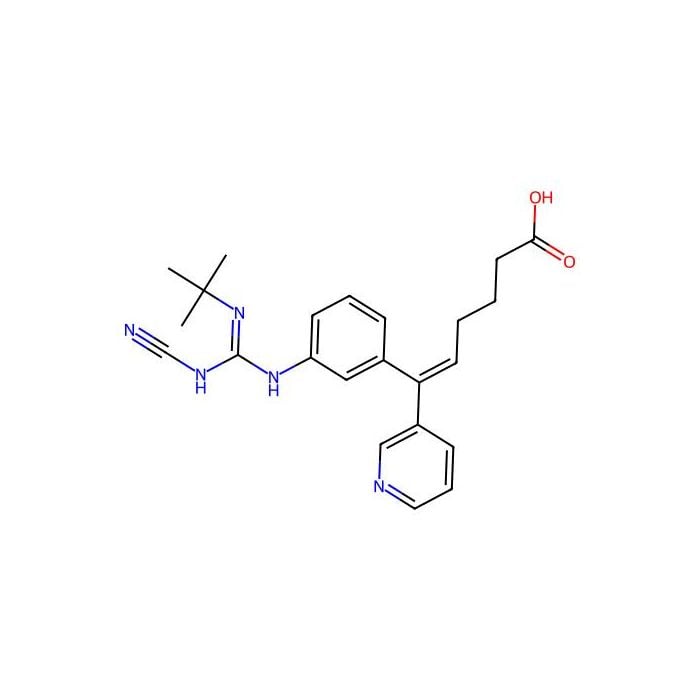
Structure and Identity
Brief overview: Terbogrel is a small-molecule research chemical commonly used as a tool compound in the thromboxane/prostanoid pathway. Item-specific identifiers are limited in the provided data; consult CoA/SDS for definitive identifiers.
Product name: Terbogrel (research grade)
CAS: 149979-74-8 (Product Data)
PubChem CID: 6449876 (Product Data)
InChIKey: 427839 (as provided; format appears non-standard—refer to CoA/SDS for confirmation)
SMILES: Not specified for this item; refer to CoA/Spec Sheet.
Molecular formula: Not specified for this item; refer to CoA/Spec Sheet.
Molecular weight: Not specified for this item; refer to CoA/Spec Sheet.
Structural features (general, literature-level, not item-specific):
Terbogrel is reported in the literature as a synthetic small molecule designed to interact with the thromboxane A2 (TXA2) signaling axis (prostanoid TP receptor and thromboxane synthase), implying an aromatic-rich, drug-like scaffold with heteroatoms that support receptor engagement and/or enzyme binding. Exact functional groups and stereochemistry should be confirmed against an authenticated structure record.
2D structure description (literature, high-level): typically a multi-ring, heteroatom-containing scaffold with polar functionalities suitable for salt formation and DMSO solubility for in vitro use. For precise atom connectivity, consult authenticated structure databases or the product CoA.
Synthetic Utility
Terbogrel is a finished small-molecule tool compound rather than a building block; it is not typically used as a reagent or synthon in multistep synthesis.
Not commonly applied for: Carbon–carbon bond formation, cross-couplings, or protective group chemistry.
Relevant uses instead:
Standard in analytical methods (HPLC/LC–MS) for method development around the thromboxane/prostanoid chemical space.
Positive/negative control compound in biochemical assays targeting the TXA2 pathway.
If chemical modification is intended (research only): Derivatization for tracer or affinity-probe development may be feasible but requires knowledge of the exact functional topology and SAR. Protect activity-critical motifs; verify that appended handles (e.g., biotin, fluorophores) do not abolish target engagement.
For synthetic chemists seeking related scaffolds or intermediates for library work, consult literature on prostanoid receptor ligands to identify modular cores more suitable as synthetic starting points.
Target Specificity
Item-specific target binding, potency, and selectivity data are not provided in the Product Data and should be sourced from the lot-specific documentation or primary literature.
Target, Ki/IC50/EC50, species reactivity: Not specified for this item; refer to CoA/Spec Sheet and peer-reviewed literature.
General literature context: Terbogrel has been described as a tool compound for the thromboxane A2 (TXA2) pathway. Users should confirm target engagement and selectivity in their biological system using appropriate counter-screens and orthogonal assays.
Recommendation: Establish internal reference curves and verify performance against known standards in your assay format.
We use cookies to ensure the website functions properly and, where permitted, to improve your experience. You can manage your preferences at any time in Settings. Learn more in our Cookie Policy.
Shall we send you a message when we have discounts available?
Remind me later
Thank you! Please check your email inbox to confirm.
Products are supplied to verified businesses, institutions, and qualified professionals for research and development use only. Not for use in humans, animals, diagnosis, or therapy.