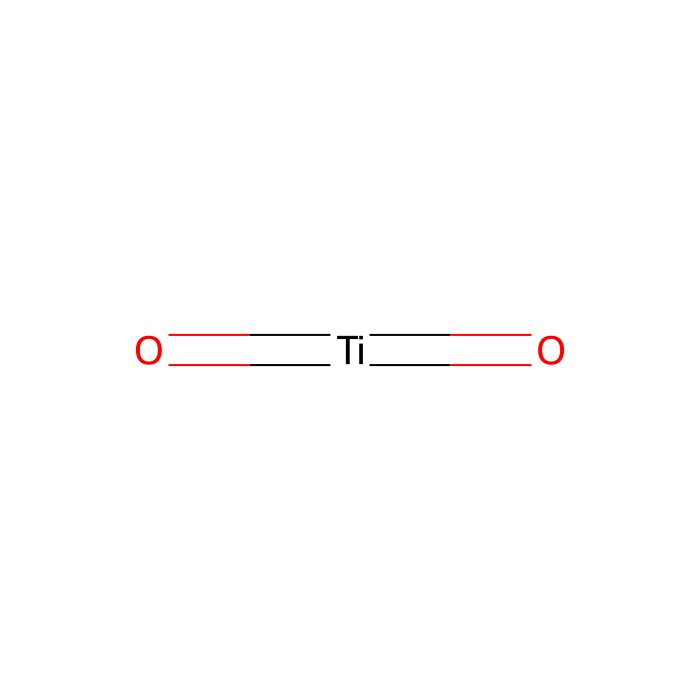
Titanium oxide, rutile - ≥99.8% metals basis, <100 nm particle size, hydrophilic , CAS No.13463-67-7

CAS: 13463-67-7 Cat. No.: T104951 Fórmula: TiO2 Peso molecular: 79.87 Número EC: 236-675-5
Disponible para pedir
GRADE & PURITY ≥99.8% metals basis <100 nm particle size, hydrophilic
Synonyms
Aerosil P 25 | A-Fil | Anatase (TiO2) | Bayertitan A | Bayertitan AN 3 | Calcotone White T | NCI-C0424O | Tronox | Tioxide RSM | Tioxide R-SM | Aerosil T 805 | Cosmetic White C47-5175 | Rutiox CR | Kronos RN 40P | Kronos titanium dioxide | Amperit 780.0 |
Storage
Room temperature
Shipped In
Normal
★
Size
Alemania (EU)
USA*
Price
Qty
100g
T104951-100g
—
5 Disponible

20,74€

28,55€
Guardar 7,81 € (27.36%)
500g
T104951-500g
—
3 Disponible

73,67€

99,70€
Guardar 26,03 € (26.11%)
Enter a quantity for the sizes you want to add.
🧪
Why this grade

≥99.8% metals basis, <100 nm particle size, hydrophilic for sensitive chromatographic and analytical workflows requiring minimal baseline interference.

🌡

Storage & shipping

Room temperature Ships Normal Check lot-specific COA for exact specifications.

📋

Quality documents

SDS, COA, datasheet, and spec sheet available for download. Lot-specific COA accessible via lot number lookup.

📚

Literature proof

Cited in 2596 peer-reviewed publications across chromatography, organic synthesis, and cross-coupling reactions.

Specifications

Sinónimos
Aerosil P 25 | A-Fil | Anatase (TiO2) | Bayertitan A | Bayertitan AN 3 | Calcotone White T | NCI-C0424O | Tronox | Tioxide RSM | Tioxide R-SM | Aerosil T 805 | Cosmetic White C47-5175 | Rutiox CR | Kronos RN 40P | Kronos titanium dioxide | Amperit 780.0 |
Especificaciones y pureza
≥99.8% metals basis, <100 nm particle size, hydrophilic
Condiciones de almacenamiento de almacenamiento
Room temperature
Enviado en
Normal
Pureza
≥99.8% metals basis
Nombres e identificadores
Pubchem Sid
Sonrisas canónicas
O=[Ti]=O
IUPAC Name
dioxotitanium
InChIKey
GWEVSGVZZGPLCZ-UHFFFAOYSA-N
INCHI
1S/2O.Ti
Isómeros SMILES
O=[Ti]=O
Peso molecular
79.87

Documentation

📋 Safety Data Sheet (SDS)

Comprehensive hazard, handling, storage, and regulatory compliance document.

Download SDS →

✅ Certificate of Analysis (COA)

Lot-specific quality data. Enter your lot number to retrieve the exact COA.

Look up COA →

📊 Datasheet

Quick-reference summary of product specifications and applications.

View datasheet →

🔬 Specification Sheet

Full quality attributes and acceptance criteria for this grade.

View spec sheet →

Advanced Data

Taxonomic Classification

Taxonomy Tree

KingdomInorganic compounds
SuperclassMixed metal/non-metal compounds
ClaseTransition metal organides
SubclassTransition metal oxides
Intermediate Tree Nodes Not available
Direct ParentTransition metal oxides
Alternative Parents Inorganic salts  Inorganic oxides  
Molecular FrameworkNot available
Substituents Transition metal oxide - Inorganic oxide - Inorganic salt
DescripciónThis compound belongs to the class of inorganic compounds known as transition metal oxides. These are inorganic compounds containing an oxygen atom of an oxidation state of -2, in which the heaviest atom bonded to the oxygen is a transition metal.
External Descriptors titanium molecular entity
Estructura 3D
Modelo de Estructura Química Interactiva


Certificados (CoA, COO, BSE/TSE y tabla de análisis)
C of A & Other Certificates(BSE/TSE, COO):
Analytical Chart:

Find and download the COA for your product by matching the lot number on the packaging.

10 results found

Lot NumberCertificate TypeFechaArticulo
A2306909Certificate of AnalysisSep 22, 2026 T104951
A2307060Certificate of AnalysisSep 22, 2026 T104951
A2307061Certificate of AnalysisJan 14, 2023 T104951
A2422187Certificate of AnalysisJan 14, 2023 T104951
C2519376Certificate of AnalysisJan 14, 2023 T104951
H2205406Certificate of AnalysisJul 08, 2022 T104951
H2205407Certificate of AnalysisJul 08, 2022 T104951
C2218321Certificate of AnalysisFeb 18, 2022 T104951
C2218331Certificate of AnalysisFeb 18, 2022 T104951
G2103197Certificate of AnalysisMar 08, 2021 T104951
Propiedades químicas y físicas
Punto de ebullición (°C)2900 °C/1013 hPa
Punto de fusión (°C)1855 °C
Peso molecular79.866 g/mol
XLogP3
Hydrogen Bond Donor Count0
Hydrogen Bond Acceptor Count2
Rotatable Bond Count0
Exact Mass79.9378 Da
Monoisotopic Mass79.9378 Da
Topological Polar Surface Area34.100 Ų
Heavy Atom Count3
Formal Charge0
Complexity18.300
Isotope Atom Count0
Defined Atom Stereocenter Count0
Undefined Atom Stereocenter Count0
Defined Bond Stereocenter Count0
Undefined Bond Stereocenter Count0
The total count of all stereochemical bonds0
Covalently-Bonded Unit Count1
Preguntas frecuentes y artículos
Silicon carbide provides technical solutions for the photovoltaic field
Semiconductor Materials: A Summary of Questions
Structure, Synthesis, and Applications of Barium Titanate – A Closer Look at the Core Dielectric Material in MLCCs
Applications of Nanoclay in Materials and Formulations: Dispersion Mechanisms, Performance Enhancement, and Product Selection
High-Refractive-Index vs Low-Refractive-Index Coating Materials: From AR/Waveguide Principles to a Formulation & Material-Selection Map (Including Product Category Tables A/B/C)
Panorama Guide to Lithium-Ion Battery Electrode Materials: Working Principles, Materials Map, and Selection Navigation (incl. Tables 1–4)
The Complete Guide to UV Absorbers: Definition & Scope, Key Engineering Metrics, Validation Methods, and Selection Navigation (Tables 1–3)
Optical & Optoelectronic Materials Selection Guide:Positioning materials, key metrics, and validation paths along “Generation → Guiding → Control → Readout” (with product navigation and Tables 1–4)
Ceramic Materials Guide: Basic Definitions, Classification Framework, and Research-Task-Oriented Selection (with Product Navigation and Tables 1–4)
Why Metal Nanocatalysts Can “Save Energy Yet Lose Performance Easily”: Durability Logic from Active Sites to Support/Interface Engineering (Including Selection Guide and Product Tables A–D)
Applications of Self-Assembled Monolayers (SAMs), Microcontact Printing, and Soft Lithography in Surface Functionalization and Micro/Nanopatterning
Polyetherimide (PEI): Structural Features, Main Properties, and Typical Application Directions
Citations of This Product
Calculadoras de soluciones
Reseñas

Reseñas de cliente

Shall we send you a message when we have discounts available?

Remind me later

Thank you! Please check your email inbox to confirm.

Oops! Notifications are disabled.