CALIDAD & PUREZAMoligand™?Moligand™ — Aladdin's line of ligands and bioactive small molecules. Use for receptor, pathway, and binding studies needing defined small-molecule tools.10 mM in DMSO
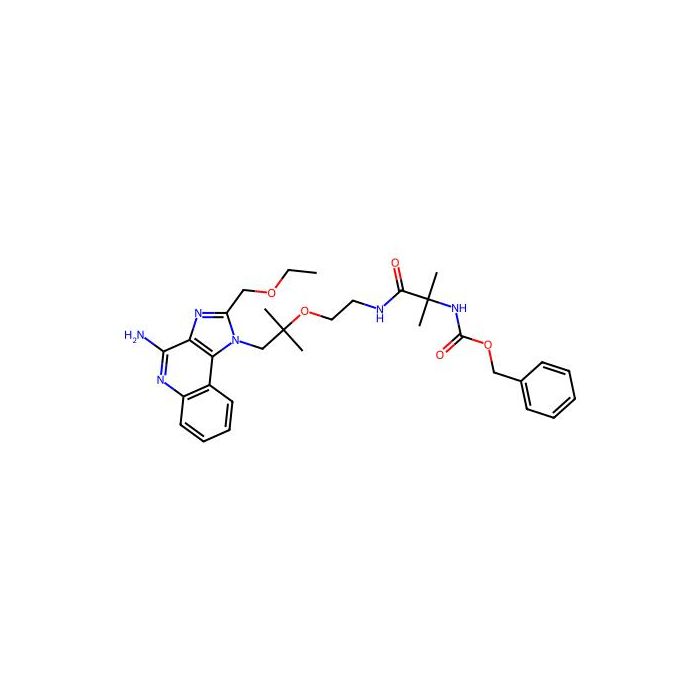
TLR8 agonist 5 is a potent TLR8 agonist with an EC 50 value of 20 nM for HEK-Blue hTLR8. TLR8 agonist 5 activates the immune response.
Especificaciones
Especificaciones y pureza
Moligand™, 10 mM in DMSO
Condiciones de almacenamiento de almacenamiento
Desiccated,Store at -80°C
Enviado en
Dry ice packs + Cold packs
Este producto requiere envío en cadena de frío. Los servicios terrestres y otros servicios económicos no están disponibles.
Grado
Moligand™
Nombres e identificadores
Peso molecular
576.69
Datos avanzados
Certificados (CoA, COO, BSE/TSE y tabla de análisis)
C of A & Other Certificates(BSE/TSE, COO):
Analytical Chart:
Calculadoras de soluciones
Molarity Calculator
Determine the necessary mass, volume, or concentration for preparing a solution.
Dilution Calculator
Determine the dilution needed to prepare a stock solution.
Reconstitution Calculator
Reseñas
Reseñas de cliente
Application Protocols
No item-specific, validated protocols are provided in this listing. The following are generalized literature-style workflows for small-molecule TLR8 agonists. Adjust per your assay and consult the CoA/Spec Sheet for any compound-specific constraints.
Cell-based NF-κB reporter assay (general):
Prepare a DMSO stock (e.g., 10 mM) if compatible; filter if needed. 2) Plate TLR8-expressing reporter cells at recommended density. 3) Treat with a dilution series (e.g., 10-point, 1:3) with constant DMSO across wells (≤0.5% v/v). 4) Incubate 6–24 h at 37°C, 5% CO2. 5) Measure reporter activity; analyze EC50 by nonlinear regression.
Cytokine induction in primary cells (general):
Isolate PBMCs/monocytes and rest overnight. 2) Dose cells with compound for 4–24 h. 3) Collect supernatants and quantify cytokines (e.g., TNF, IL-6) by ELISA; include vehicle and known TLR8 agonist controls. 4) Confirm TLR8 dependence via antagonist or pathway inhibitors as appropriate.
RNA expression profiling (general):
Treat cells as above for 2–6 h. 2) Extract RNA; perform qPCR or RNA-seq for TLR target genes. 3) Normalize to housekeeping genes and vehicle controls.
Always include cytotoxicity assessment (e.g., CellTiter-Glo) and vehicle-only controls.
Biological Roles
Context (literature, not product-specific claims):
TLR8 (Toll-like receptor 8) is an endosomal pattern-recognition receptor that detects uridine-rich single-stranded RNA and certain synthetic small molecules. Activation recruits MyD88, initiating IRAK–TRAF6 signaling, culminating in NF-κB and MAPK pathway engagement and transcription of pro-inflammatory genes.
Small-molecule TLR8 agonists are widely used to probe innate immune signaling in human monocytes, macrophages, and dendritic cells and to study species selectivity between TLR7 and TLR8.
Typical research uses of TLR8 agonists:
Validate TLR8 pathway competence in primary cells or engineered reporter lines.
Dissect kinetics of cytokine/chemokine induction (e.g., TNF, IL-6, IL-12 family) in vitro.
Explore endosomal acidification dependence and trafficking via inhibitors (e.g., bafilomycin A1) to confirm mechanism.
Benchmark structure–activity relationships for receptor bias, potency, and selectivity vs TLR7/9.
Caveats:
TLR8 responses can be species-dependent; rodent TLR8 differs from human in ligand responsiveness. Confirm cellular model relevance.
Excessive stimulation may induce cytotoxic stress; establish appropriate dose ranges and include vehicle controls.
This section provides general background for planning experiments. No medical or clinical use is implied; this product is for research use only.
Buffer Applications
This product is not a buffer or buffering agent. However, buffers are relevant to its use in biological assays.
General assay buffer considerations (literature context):
Cell-based assays: Use complete culture media (e.g., RPMI or DMEM with serum) or serum-free media as required by the model. Maintain consistent DMSO vehicle content across wells.
Biochemical/target engagement assays: Employ neutral pH buffers (e.g., HEPES or PBS, pH 7.2–7.4) unless endosomal mimic conditions are intentionally used. Avoid high detergent levels that may sequester hydrophobic ligands.
Compound addition: Dilute DMSO stock into pre-warmed media/buffer with mixing to minimize precipitation. Final DMSO typically ≤0.5% v/v (literature practice); optimize per assay.
Stability notes:
Some small molecules exhibit reduced stability at high temperature or extreme pH. Prepare fresh working dilutions immediately before use and minimize light exposure if the scaffold is chromophoric. Verify specifics from the CoA/Spec Sheet.
Green Alternatives
Because this item is a defined bioactive tool compound rather than a process solvent or reagent, “green alternatives” center on greener handling and delivery rather than replacing the active itself.
Solvent minimization: Prepare higher-concentration DMSO stocks (as solubility allows) to reduce solvent volumes introduced into assays, keeping final DMSO ≤0.1–0.5% where feasible.
Alternative vehicles: Consider aqueous solubilization aids compatible with biology (e.g., cyclodextrins, minimal ethanol co-solvent) to limit DMSO/DMF usage; validate carefully to avoid altering potency.
Microformatting: Use low-dead-volume plates and acoustic dispensing to curtail solvent waste and plastic usage in HTS.
Illustrative comparison (context, not product-specific):
DMSO vs ethanol: DMSO offers broader solubility; ethanol is more volatile and sometimes better tolerated at equivalent molar solvent content but may solubilize fewer scaffolds.
DMF/NMP: Strong solvents but less desirable in biological systems; avoid when possible.
End-of-life considerations:
Segregate organic solvent waste and aqueous biohazard waste. Employ solvent recycling where available.
Note: These are general green chemistry practices for handling bioactive small molecules and are not specifications for this product.
Pharmaceutical Uses
No pharmaceutical or clinical uses are claimed or supported for this catalog item. It is supplied strictly for research use only.
Research/development context (general):
Small-molecule TLR8 agonists may be employed as chemical probes during discovery-stage studies, including target validation, pathway mapping, and preliminary SAR exploration. Any extrapolation to formulation or clinical contexts requires extensive development and is beyond the scope of this product.
Excipient/formulation status:
No pharmacopeial monograph, excipient role, or GMP status is indicated for this item.
Early screening compounds are typically handled under non-GMP conditions with emphasis on identity and purity appropriate for in vitro experimentation. For any translational work, separate sourcing under appropriate quality systems would be required.
Physical Properties
Item-specific physicochemical data are not provided in this listing. For definitive values, consult the product’s CoA/Spec Sheet.
Appearance: Not specified for this item; refer to CoA/Spec Sheet.
Melting point: Not specified for this item; refer to CoA/Spec Sheet.
Boiling point: Not applicable/rarely reported for bioactive solids; not specified for this item; refer to CoA/Spec Sheet.
Density: Not specified for this item; refer to CoA/Spec Sheet.
Solubility: Not specified for this item; refer to CoA/Spec Sheet.
LogP/logD: Not specified for this item; refer to CoA/Spec Sheet.
pKa: Not specified for this item; refer to CoA/Spec Sheet.
UV-Vis: Not specified for this item; refer to CoA/Spec Sheet.
General literature guidance for small-molecule TLR agonists (context only, not product specifications):
Many members of this class are neutral to weakly basic heteroaromatics with moderate lipophilicity (typical cLogP 2–5, literature) to enable endosomal access; however, actual values vary widely by scaffold.
Stock solutions for screening are commonly prepared in anhydrous DMSO at 10–50 mM (literature practice). Always verify solubility and stability for this specific item from the CoA/Spec Sheet prior to use.
Quality and Grades
Grade/Purity: Moligand™
Item-specific note: The product is supplied as part of a small-molecule/compound library offering under the Moligand™ designation. No additional purity percentages or residual solvent/impurity specifications are provided in this listing. For certificate details, refer to the CoA/Spec Sheet.
What Moligand™ implies (general description of grade category):
Curated bioactive tool compound suitable for discovery research, screening, and pathway interrogation.
Typically prepared and packaged to support hit-finding and mechanism-of-action studies, with attention to identity and fit-for-purpose purity for in vitro research. Exact acceptance criteria, analytical methods, and spectral data are defined per lot and reported on the CoA.
Stabilizers and additives:
Not specified for this item; refer to CoA/Spec Sheet. If present, stabilizers are selected to preserve chemical integrity during storage without interfering with typical DMSO-based stocks.
Analytical documentation:
Identity and quality are confirmed per manufacturer’s internal methods (e.g., LC/MS, NMR, HPLC area%). Exact methods and thresholds are not specified here; consult the CoA for your lot.
Reaction and Applications
This product is intended as a bioactive small-molecule tool (TLR8 agonist) rather than a synthetic reagent. As such, it is not commonly used to promote or participate in named organic reactions.
Research applications (biology-focused, general literature context):
Pathway activation: Pharmacological activation of human TLR8 to probe MyD88-dependent NF-κB signaling, cytokine induction, and innate immune sensing of single-stranded RNA motifs in endosomes.
Assay development: Positive control for TLR8-responsive reporter assays (e.g., NF-κB-luciferase), cytokine ELISAs, and transcriptomics profiling.
Chemical biology: Time-course and dose–response studies to dissect endosomal TLR trafficking, receptor desensitization, and crosstalk with TLR7/9.
If synthetic derivatization is planned (SAR work, general note):
Without the disclosed structure, no scaffold-specific transformations can be recommended. Typical SAR studies for TLR agonists involve heteroaryl substitutions and fine-tuning basicity/lipophilicity, executed under standard cross-coupling and amide/urea formation conditions.
Reaction Conditions
Not typically applicable. This product is supplied for use as a biological tool compound, not as a reagent for promoting chemical reactions.
For researchers planning to synthesize analogs (general literature guidance only):
Common transformations for heteroaryl agonists include palladium-catalyzed cross-couplings (e.g., Suzuki–Miyaura in polar aprotic solvents at 60–100°C), nucleophilic substitutions on activated heterocycles, and amide/urea couplings with carbodiimides or uronium reagents in DMF/MeCN.
Workups favor aqueous quench followed by extraction or direct RP-HPLC purification; analytical method development typically uses gradient LC (water/acetonitrile + 0.1% formic acid).
These notes are general and not specific to this item’s unknown scaffold. Consult primary literature and your internal methods for precise conditions.
Safety and Handling
Hazard classification for this specific item has not been provided. Handle as a research chemical of unknown hazards and consult the SDS for authoritative guidance.
Item-specific data:
Signal word: Not specified for this item; refer to SDS.
H-statements: Not specified for this item; refer to SDS.
GHS classification: Not specified for this item; refer to SDS.
Pictograms: Not specified for this item; refer to SDS.
General laboratory precautions (good practice):
PPE: Use lab coat, nitrile gloves, and safety glasses. Avoid inhalation, ingestion, and skin contact. Work in a chemical fume hood to control dust/aerosols.
Avoid contact with strong oxidizers and strong acids/bases unless compatibility is confirmed.
Weigh promptly to minimize atmospheric moisture uptake; product is supplied for use under desiccated conditions.
First-aid overview (general):
Skin/eye contact: Rinse with water for at least 15 minutes; remove contaminated clothing. Seek medical attention if irritation persists.
Inhalation: Move to fresh air; seek medical attention if symptoms occur.
Ingestion: Rinse mouth; do not induce vomiting; seek medical attention.
Waste and decontamination:
Collect solutions and solids as organic hazardous waste. Deactivate biological assay plates according to institutional policy. Always defer to the SDS and local regulations.
Solvent Selection
Item-specific solubility and preferred solvents are not provided. Please consult the CoA/Spec Sheet for definitive guidance.
General guidance for small-molecule TLR agonists (literature context):
Stock solutions: DMSO is the standard solvent for screening stocks due to broad solubilizing power and biological compatibility at low final percentages (≤0.5% v/v in assay, literature). Verify the maximum tolerated DMSO content for your assay system.
Aqueous delivery: Dilute DMSO stocks into prewarmed buffer or media with vigorous mixing to avoid precipitation. Use serum-containing media when compatible to reduce compound adsorption.
Alternative solvents: If DMSO is unsuitable, co-solvent systems (e.g., minimal DMF or ethanol with aqueous buffer) may be explored; ensure assay compatibility and vehicle controls.
Quick comparison (general):
DMSO: Highest solvating power; widely used in HTS. Potential cytotoxicity at high %.
Ethanol: Lower solvency; good for rapid dilutions; volatility can change concentrations.
DMF: Strong solvency but less favored in bioassays; confirm cell/tissue tolerance.
Note: Always pilot a solubility/precipitation check and verify assay background effects of the chosen vehicle with appropriate controls.
Storage and Reconstitution
Item-specific conditions:
Storage conditions: Desiccated, Store at -80°C.
Shipped in: Dry ice packs + Cold packs.
Handling notes (specific to this listing):
Keep container tightly closed under desiccation. Minimize freeze–thaw and exposure to ambient humidity and temperature.
General reconstitution guidance for small-molecule screening compounds (literature context; verify with CoA/Spec Sheet for this item):
Solvent: Anhydrous DMSO is commonly used to prepare concentrated stocks (e.g., 10–50 mM) if the compound is DMSO-soluble. If solubility is limited, consider incremental sonication or warming (≤37°C) and reduce target concentration.
Aliquoting: Dispense single-use aliquots into inert vials or plates to avoid repeated freeze–thaw. Backfill with dry inert gas if prolonged storage is anticipated.
Storage of solutions: For maximum stability, store frozen at ≤-20°C to -80°C, protected from light and moisture. Track time at room temperature during dispensing.
Thawing: Warm briefly to room temperature before opening to prevent moisture condensation. Mix thoroughly and inspect for precipitation before use.
Note: If the CoA/Spec Sheet specifies different diluents, concentrations, or stability windows, follow those instructions as primary guidance.
Structure and Identity
Brief overview: This product is supplied as a small-molecule tool compound annotated as a TLR8 agonist. Detailed structural identifiers are not provided in the current listing.
Chemical name: Not specified for this item; refer to CoA/Spec Sheet.
CAS: 2413016-41-6
Molecular formula: Not specified for this item; refer to CoA/Spec Sheet.
Molecular weight: Not specified for this item; refer to CoA/Spec Sheet.
SMILES: Not specified for this item; refer to CoA/Spec Sheet.
InChIKey: Not specified for this item; refer to CoA/Spec Sheet.
Synonyms: Often listed as a small-molecule “TLR8 agonist 5” in screening libraries; specific synonym(s) not provided in this listing.
Structural features (general, literature context):
TLR8 agonists commonly feature heteroaromatic cores and H-bonding motifs capable of engaging endosomal TLR8. Precise ring system(s), stereochemistry, and substituent pattern for this item are not specified here.
2D description: Not specified for this item; refer to CoA/Spec Sheet for structural diagram if available.
Synthetic Utility
This item is provided as a finished bioactive small molecule (TLR8 agonist) and is not typically used as a synthetic reagent or building block.
General considerations if derivatization is intended (literature context, not specific to this scaffold):
Many TLR agonist chemotypes are amenable to late-stage diversification through cross-coupling (Suzuki, Buchwald–Hartwig) or amide/urea formation to modify substituent vectors for SAR.
Physicochemical tuning (e.g., basicity, lipophilicity, polar surface area) often modulates endosomal uptake and receptor selectivity; modifications should balance potency with solubility and permeability.
Purification is commonly achieved by reversed-phase preparative HPLC with volatile buffers; analytical confirmation by LC/MS and 1D/2D NMR.
Because the structure for “TLR8 agonist 5” is not disclosed here, no scaffold-specific synthetic disconnections or reaction conditions can be recommended. Refer to the literature for the particular chemotype in use and consult the CoA/Spec Sheet for structural details if provided.
For antibodies or proteins, “target specificity” describes epitope and species reactivity. This small molecule is not an antibody and does not have clone/isotype attributes.
No quantitative potency, selectivity, or species-specific activity data are provided for this item. Refer to the CoA/Spec Sheet and primary literature for any available EC50, Emax, or selectivity profiling versus TLR7/9 or other receptors.
General literature context:
Human TLR8 is the intended target for small-molecule TLR8 agonists; species selectivity should be confirmed empirically because rodent TLR8 response differs from human. Where possible, verify activity in human primary cells or humanized systems.
Preguntas frecuentes
What is Moligand??
Moligand? is one of Aladdin Scientific's premium product lines, formulated for high-purity applications across multiple workflows. Compared to standard grades in the same workflow, Moligand? products typically offer tighter specifications, more rigorous QC, and stronger lot-to-lot consistency.
How should this product be stored?
Store at ?80 °C, desiccated. Keep the container tightly closed with desiccant — the material is moisture-sensitive.
How is this product shipped?
This product ships frozen with dry ice and cold packs. Unpack on arrival and transfer it to the storage condition stated above; handle dry ice with insulated gloves in a ventilated area.
What are the CAS number, molecular formula and molecular weight?
The CAS Number is 2413016-41-6, the molecular formula is C31H40N6O5, and the molecular weight is 576.69 g/mol.
What documentation is provided?
Available product documentation, including Certificates of Analysis (COA), Safety Data Sheets (SDS), and specification sheets, is shown in the product document area. Document availability and access follow the current site policy.
¿Necesita ayuda para elegir la calidad?
Nuestra guía de selección de calidades cubre la pureza, el estado del estabilizador y la idoneidad de la aplicación para todas las variantes de nuestro catálogo.
Utilizamos cookies para garantizar el correcto funcionamiento del sitio web y, cuando esté permitido, para mejorar su experiencia. Puede gestionar sus preferencias en cualquier momento en Configuración. Más información en nuestra Política de Cookies.
¿Quieres que te enviemos un mensaje cuando tengamos descuentos disponibles?
Recordármelo más tarde
¡Gracias! Por favor, revisa tu bandeja de entrada de correo electrónico para confirmar.
Products are supplied to verified businesses, institutions, and qualified professionals for research and development use only. Not for use in humans, animals, diagnosis, or therapy.