CALIDAD & PUREZAMoligand™?Moligand™ — Aladdin's line of ligands and bioactive small molecules. Use for receptor, pathway, and binding studies needing defined small-molecule tools.≥99%
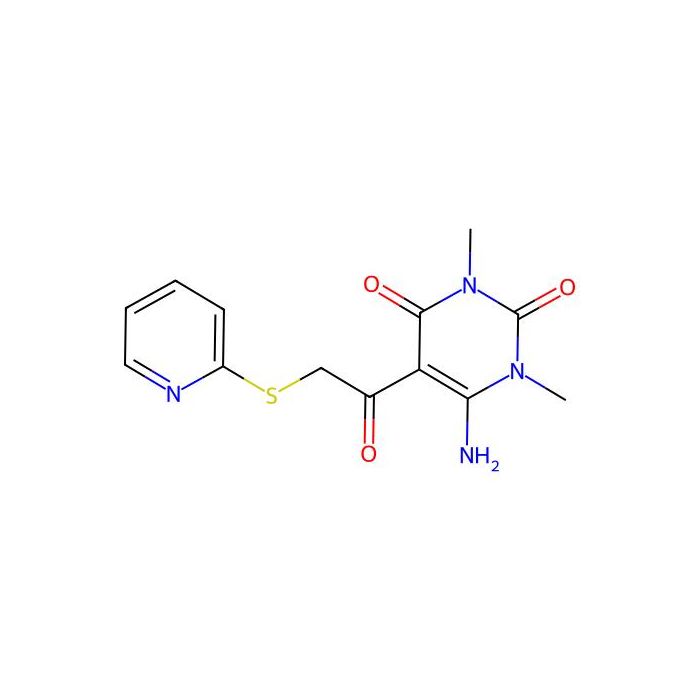
TM6089 is a unique Prolyl Hydroxylase (PHD) inhibitor which stimulates HIF activity without iron chelation and induces angiogenesis and exerts organ protection against ischemia. Local administration of TM6089 enhances angiogenesis, and oral administration stimulates HIF activity in transgenic rats expressing a hypoxia-responsive reporter vector.
Form:Solid
Especificaciones
Especificaciones y pureza
Moligand™,≥99%
Mecanismos bioquímicos y fisiológicos
TM6089 is a unique Prolyl Hydroxylase (PHD) inhibitor which stimulates HIF activity without iron chelation and induces angiogenesis and exerts organ protection against ischemia. Local administration of TM6089 enhances angiogenesis, and oral administration
Condiciones de almacenamiento de almacenamiento
Store at -20°C
Enviado en
Ice chest + Ice pads
Este producto requiere envío en cadena de frío. Los servicios terrestres y otros servicios económicos no están disponibles.
This compound belongs to the class of organic compounds known as aryl thioethers. These are organosulfur compounds containing a thioether group that is substituted by an aryl group.
External Descriptors
Not available
1. Djoumbou Feunang Y, Eisner R, Knox C, Chepelev L, Hastings J, Owen G, Fahy E, Steinbeck C, Subramanian S, Bolton E, Greiner R, and Wishart DS. ClassyFire: Automated Chemical Classification With A Comprehensive, Computable Taxonomy. Journal of Cheminformatics, 2016, 8:61.
DMSO : 41.67 mg/mL (136.03 mM; ultrasonic and warming and heat to 60°C)
Peso molecular
306.340 g/mol
XLogP3
0.900
Hydrogen Bond Donor Count
1
Hydrogen Bond Acceptor Count
6
Rotatable Bond Count
4
Exact Mass
306.079 Da
Monoisotopic Mass
306.079 Da
Topological Polar Surface Area
122.000 Ų
Heavy Atom Count
21
Formal Charge
0
Complexity
506.000
Isotope Atom Count
0
Defined Atom Stereocenter Count
0
Undefined Atom Stereocenter Count
0
Defined Bond Stereocenter Count
0
Undefined Bond Stereocenter Count
0
The total count of all stereochemical bonds
0
Covalently-Bonded Unit Count
1
Calculadoras de soluciones
Molarity Calculator
Determine the necessary mass, volume, or concentration for preparing a solution.
Dilution Calculator
Determine the dilution needed to prepare a stock solution.
Reconstitution Calculator
Reseñas
Reseñas de cliente
Application Protocols
No manufacturer-validated application protocols are provided for TM6089 in the Product Data. The following generalized workflow is offered for small-molecule screening compounds and should be adapted to your specific assay.
General HTS-compatible workflow (general knowledge):
Stock solution: Prepare a concentrated DMSO stock after confirming solubility. Typical screening stocks are 10–20 mM; adjust as needed.
Plate handling: Use low-binding polypropylene tubes and plates. Pre-equilibrate to room temperature before dispensing to minimize condensation.
Dispensing: Use acoustic or pin-tool transfer to achieve desired final concentrations with consistent DMSO % across wells.
Controls: Include positive/negative controls and DMSO vehicle controls. Assess potential fluorescence/absorbance interference from TM6089.
Data quality: Monitor Z′-factor, signal window, and potential edge effects. Confirm hits via dose–response and orthogonal assays.
Note: For biophysical assays (e.g., SPR/MST), filter and degas buffers, and centrifuge compound solutions before loading to remove particulates. Validate compound stability by LC-MS over assay time.
Biological Roles
No biological function or target information is provided in the Product Data for TM6089. As a Moligand-grade small molecule, it is expected to be used as a research tool in discovery assays rather than as a characterized metabolite or endogenous ligand.
General considerations for screening compounds (general knowledge):
Potential roles explored in research include acting as a ligand, modulator, or probe against enzyme, receptor, or protein–protein interaction targets during hit identification.
Any observed activity in user assays should be considered provisional until confirmed through orthogonal methods (e.g., counter-screens, biophysics, and structure–activity relationship data).
Off-target effects, aggregation-based inhibition (PAINS-like behaviors), or assay interference (fluorescence/absorbance) can confound interpretations. Employ control experiments to de-risk artifacts.
Recommendations:
If you determine a putative biological role for TM6089 in your system, document assay conditions (buffer composition, DMSO %, temperature, protein concentration) and replicate across methods to validate.
For mechanistic studies, acquire the structural information (CoA/SDS, literature via CAS/CID) to evaluate potential liabilities (reactive motifs, redox activity, chelation sites).
Note: No claims are made regarding biological activity, potency, selectivity, or mechanism of action for TM6089. For research use only.
Buffer Applications
TM6089 is a small-molecule screening compound, not a buffer reagent. As such, it does not define a buffering system nor a typical pH range. Buffer selection should be based on the biological assay or reaction in which TM6089 is tested.
Practical guidance (general):
Prepare TM6089 stock in DMSO, then dilute into your assay buffer (e.g., HEPES, PBS, Tris) while maintaining a constant final DMSO percentage across wells/samples.
Monitor for precipitation upon dilution; if observed, increase DMSO carryover slightly (within assay tolerance) or adjust ionic strength/pH consistent with your assay design.
Item-specific buffer-related properties (pKa, solubility vs pH) are not provided for this compound; consult the CoA/Spec Sheet or determine empirically.
Green Alternatives
Given that TM6089 is a discrete screening compound rather than a solvent or auxiliary reagent, “green alternatives” are not typically applicable in the usual sense (e.g., replacing a hazardous solvent). Nevertheless, greener handling strategies can be considered for library compounds:
Solvent choices (general): Prefer water-compatible assay formats and minimal DMSO percentages; where organic solvents are necessary, limit volumes and consider ethanol or MeCN over more hazardous options, subject to compound stability.
Waste minimization: Use miniaturized assay volumes (microplates, acoustic dispensing) to reduce solvent and compound consumption.
Energy-efficient storage: Consolidate aliquots to reduce freezer door openings and avoid repeated freeze-thaw cycles that might necessitate re-synthesis.
Safer operations: If the compound requires sonication or heating for dissolution, use the lowest effective energy/temperature to reduce risk and energy usage.
Comparison note: For solvent-intensive workflows, greener media like bio-based solvents (when compatible) can offset environmental impact; however, such choices must not compromise compound stability or assay readouts.
Item-specific greener substitute compounds cannot be proposed without knowing the structure or hazard profile. Consult your EHS team and the SDS for TM6089 to align handling with institutional green-chemistry policies.
Pharmaceutical Uses
TM6089 is provided strictly for research use only and is not intended for human or veterinary use, clinical diagnostics, or as an excipient. No pharmacopeial status or formulation role is provided in the Product Data.
General context (non-clinical, non-therapeutic):
Compounds of Moligand grade are commonly used in preclinical discovery workflows (e.g., target validation, SAR exploration) rather than in GMP manufacturing or clinical formulations.
If formulating for in vivo research, ensure all institutional approvals and perform comprehensive safety evaluations; however, such use falls outside the scope of this catalog listing.
Item-specific notes:
No claims are made regarding TM6089’s therapeutic activity, bioavailability, stability in dosage forms, or compatibility with excipients.
Any pharmacokinetic, toxicological, or ADME properties would be literature-derived and are not specified here. Refer to the CoA/SDS for handling-only information.
Physical Properties
Item-specific physicochemical data are not provided in the Product Data for TM6089. Where values are desired, please consult the CoA/Spec Sheet for your lot. Literature/computed values may be available via CAS 863421-32-3 or CID 2352701, but such values are not guaranteed for this item unless confirmed on the CoA.
Item-specific (from Product Data):
Appearance: Not specified for this item; refer to CoA/Spec Sheet.
Molecular Weight: Not specified for this item; refer to CoA/Spec Sheet.
Literature/computed properties (guidance only; not item specifications):
Melting point (MP), boiling point (BP), density, logP/logD, pKa, refractive index, and aqueous/organic solubility are not provided here. If using literature values found via CAS/CID, treat them as informational until verified against the CoA.
Practical notes for screening compounds (general knowledge):
Many small-molecule screening ligands are supplied as solids or concentrated solutions. Solubility is often best in DMSO and select polar aprotic solvents. Always confirm solubility empirically.
If hygroscopicity or polymorphism are concerns, the CoA will typically indicate handling notes; absent those, store and handle under dry conditions and minimize freeze-thaw.
When preparing stocks, note that turbidity or oiling-out indicates solubility limits; consider gentle warming, sonication, or co-solvent strategies while maintaining chemical stability.
Quality and Grades
Grade/Purity (from Product Data): Moligand™
What Moligand-grade generally implies (general knowledge; not a certificate):
Moligand-grade compounds are typically curated for ligand discovery, screening, and chemical biology workflows. Emphasis is placed on identity confirmation and suitability for high-throughput screening rather than analytical chromatography standards.
Documentation typically includes structure/identity confirmation and recommended storage conditions. UV cutoff, metal content, and trace impurity profiles are usually not part of this grade unless explicitly stated on the CoA.
Item-specific notes:
Purity %, stabilizers, residual solvent levels, and analytical limits are not specified for this item; refer to the CoA/Spec Sheet for lot-specific data.
If LC-MS, NMR, or HRMS data are needed, request the latest dataset tied to your lot.
Practical implications for end-users:
For screening/assay work, Moligand-grade is typically appropriate. For regulated analytical applications (e.g., quantitative impurity profiling), consider confirming whether the provided purity and identity data meet your internal acceptance criteria.
Batch-to-batch consistency and handling conditions should be verified on receipt. Retain CoA and store as instructed (-20°C) to preserve quality.
Shipping/Storage:
Shipped: Ice chest + ice pads (from Product Data)
Storage: Store at -20°C (from Product Data). Minimize thaw cycles and protect from moisture and light unless otherwise indicated on the CoA.
Reaction and Applications
This product is positioned as a Moligand-grade screening compound rather than a bulk synthetic reagent. Consequently, its primary application is in discovery biology and chemistry workflows rather than in named organic reactions. No manufacturer application text was provided beyond the research-use note.
Typical uses for Moligand-type compounds (general knowledge):
High-throughput screening (HTS), fragment/libraries, and target deconvolution workflows.
Chemical probe development: structure-activity relationship (SAR) exploration, hit validation, and preliminary potency/selectivity profiling.
If synthetic use is contemplated (general guidance):
Without a defined structure, reaction planning is not possible. If the structure is obtained from the CoA/literature, standard practices apply: confirm functional groups, protect liabilities, and test small-scale reactions to assess stability.
Practical tips for screening deployment:
Prepare concentrated DMSO stocks (e.g., 10–20 mM as assay permits) after verifying solubility; filter if necessary to remove particulates.
Track freeze-thaw cycles and avoid prolonged room-temperature exposure to minimize degradation.
Record any observed fluorescence/absorbance interference to inform assay design.
Note: No item-specific reaction chemistry or biological target applications are specified in the Product Data.
Reaction Conditions
This listing does not position TM6089 as a reagent for named organic reactions; no item-specific reaction conditions are provided in the Product Data.
General guidance for handling small-molecule screening compounds in experimental workflows:
Stock preparation: Dissolve in anhydrous DMSO at an empirically determined concentration compatible with your assay. Filter (0.2 µm PTFE) if particulate is present and the compound is filter-stable.
Stability checks: Conduct a short stability screen (e.g., LC-MS at t=0 and after 24–72 h at room temperature and 4°C in your selected solvent) to confirm suitability for automated dispensing and assay timelines.
Light/temperature: In absence of specific data, protect from light and avoid prolonged heating. Store at -20°C per Product Data.
Aqueous dilution: Add DMSO stocks to buffered media slowly with mixing to avoid localized supersaturation; confirm final clarity prior to readout.
If TM6089 is to be used in synthesis (not the primary intent), reaction temperatures, solvents, catalysts, and expected yields are wholly structure-dependent and must be developed after obtaining the verified structure and considering literature precedents.
Safety and Handling
Safety information in the Product Data is incomplete for TM6089. Always consult the official SDS for authoritative hazard, exposure, and first-aid information.
From Product Data:
GHS Classification: Not specified for this item; refer to SDS.
Signal Word: Not specified for this item; refer to SDS.
H-Statements: Not specified for this item; refer to SDS.
Pictograms: Not specified for this item; refer to SDS.
General laboratory precautions (best practice):
Use in a chemical fume hood. Wear lab coat, safety glasses, and appropriate chemically resistant gloves (e.g., nitrile). Avoid inhalation of dust/vapors and skin/eye contact.
Storage incompatibilities are unknown for this item; as a precaution, segregate from strong oxidizers and acids/bases until specific compatibility is confirmed by SDS.
First aid (general): If inhaled—move to fresh air; skin/eye contact—rinse with water for at least 15 minutes; ingestion—rinse mouth. Seek medical attention as needed. Defer to SDS for detailed measures.
Spill response: Contain and absorb with inert material; avoid generating dust/aerosols. Dispose according to institutional and local regulations.
Special risks (general for organic small molecules):
Photosensitivity, peroxide formation, or thermal instability are compound-specific; no such risks are specified here. Check SDS/CoA before heating, concentrating, or long-term light exposure.
Solvent Selection
Applicability: TM6089 is supplied as a Moligand-grade small molecule for screening; detailed solubility data are not provided. The guidance below reflects general practices for small-molecule library compounds and should be validated for TM6089 with small-scale tests.
General solvent strategy (general knowledge):
Primary stock solvent: DMSO is commonly used for small-molecule libraries due to broad solubilizing power and assay compatibility at low final % DMSO.
Alternative solvents: DMF, methanol, ethanol, acetonitrile can be used as co-solvents or for pre-dissolution, depending on stability.
Aqueous use: Prepare a DMSO stock, then dilute into buffer/media; keep final DMSO ≤0.1–1% v/v for sensitive assays (optimize empirically).
Polarity/miscibility (general):
DMSO is fully miscible with water and most organics, enabling serial dilutions and backfilling with buffer.
If precipitate forms upon aqueous dilution, increase DMSO carryover modestly, warm gently, or add a miscible co-solvent (e.g., MeCN) while monitoring assay tolerance.
DMF: similar solvency, higher toxicity/odor; use when DMSO is unsuitable.
MeOH/EtOH: volatile, convenient for rapid evaporation; may perturb biological assays.
Note: For TM6089, specific solubility limits, pH sensitivity, and stability are not provided; verify experimentally and consult CoA.
Storage and Reconstitution
From Product Data:
Storage Conditions: Store at -20°C.
Shipped In: Ice chest + ice pads.
Item-specific composition/appearance and stabilizers are not provided; refer to the CoA/Spec Sheet.
General reconstitution guidance for screening compounds (verify empirically for TM6089):
Allow vial to equilibrate to room temperature in a desiccator before opening to avoid moisture condensation.
Dissolve in anhydrous DMSO to prepare a concentrated stock appropriate for your assay. If solubility is uncertain, begin with a small trial (e.g., 1–5 mg/mL), then adjust.
If required, consider co-solvents (DMF, MeCN, MeOH) or gentle warming/sonication. Avoid prolonged heating or exposure to light unless stability is confirmed by CoA/SDS.
Aliquot stocks into single-use portions and store at -20°C or colder. Minimize freeze–thaw cycles.
Inspect for precipitation or discoloration before use; if observed, re-clarify by warming and vortexing or prepare a fresh solution.
Disposal: Follow institutional chemical waste procedures and local regulations. SDS should be consulted for any compound-specific storage incompatibilities or decomposition hazards.
Structure and Identity
Brief overview: TM6089 (SKU T649410) is listed as a Moligand-grade small molecule from our screening compound collection. Detailed structural identifiers are not fully specified in the Product Data for this item.
Product Name: TM6089
SKU: T649410
CAS: 863421-32-3 (from Product Data)
PubChem CID: 2352701 (from Product Data)
InChIKey: 371279 (from Product Data; note this is not in the typical 27-character InChIKey format; refer to CoA/Spec Sheet for confirmation)
SMILES: Not specified for this item; refer to CoA/Spec Sheet.
Molecular Formula: Not specified for this item; refer to CoA/Spec Sheet.
Molecular Weight: Not specified for this item; refer to CoA/Spec Sheet.
Structural features (general guidance):
Specific functional groups, ring systems, and stereochemistry are not provided in the current Product Data. Consult the CoA/Spec Sheet or the referenced CAS/CID records for authoritative structural details.
2D structure description: Not available from the current listing. If a structural diagram is needed for informatics or assay planning, please request the latest CoA or SDS bundle for TM6089.
Notes on identifiers (general):
Cross-referencing CAS 863421-32-3 and CID 2352701 in literature databases can provide a verified structure; however, those values would be literature identifiers and not item-specific specifications. Always defer to the CoA tied to your lot.
Synthetic Utility
Without a disclosed structure, the specific synthetic utility of TM6089 cannot be described. The product is positioned as a screening ligand/compound, not as a synthetic intermediate or reagent.
General notes (when structure is known; literature-level guidance):
If TM6089’s structure is obtained via CoA or literature (CAS 863421-32-3; CID 2352701), retrosynthetic analysis should identify key functional groups and disconnections, protecting-group needs, and potential liabilities (e.g., acid/base sensitivity, redox-active centers).
For library expansion, typical transformations include amide couplings, SNAr/SN2 substitutions, cross-couplings (Suzuki, Buchwald–Hartwig), and heterocycle elaborations, contingent on the specific scaffold.
Practical considerations:
Confirm identity/purity after any derivatization via orthogonal techniques (LC-MS, NMR, HRMS).
Track stability under reaction and workup conditions (pH, temperature, oxidants/reductants) before scale-up.
Item-specific reactivity, protecting-group strategy, and synthetic sequences are not available from the Product Data.
Target Specificity
No target, enzyme, receptor, or pathway specificity information is provided in the Product Data for TM6089. As a Moligand-grade screening compound, it is supplied without a defined biological target and is intended for research screening and discovery applications.
Antigen/epitope, species reactivity, clone, and isotype fields are not applicable to small molecules and are not provided for this item.
Users should determine target engagement empirically through their assay systems and confirm via orthogonal methods (biophysics, counterscreens, and structure–activity data).
Preguntas frecuentes
What is the purity of this product?
This product is supplied at ≥99% purity (chemical assay). Lot-specific values are stated on the Certificate of Analysis.
What is Moligand??
Moligand? is one of Aladdin Scientific's premium product lines, formulated for high-purity applications across multiple workflows. Compared to standard grades in the same workflow, Moligand? products typically offer tighter specifications, more rigorous QC, and stronger lot-to-lot consistency.
How should this product be stored?
Store at ?20 °C. Freezer storage is required to maintain the specified shelf life.
How is this product shipped?
This product ships in an insulated container with ice pads. Unpack on arrival and transfer it to the storage condition stated above.
What are the CAS number, molecular formula and molecular weight?
The CAS Number is 863421-32-3, the molecular formula is C13H14N4O3S, and the molecular weight is 306.34 g/mol. InChIKey UWXHGWIWBWQJNU-UHFFFAOYSA-N.
What documentation is provided?
Available product documentation, including Certificates of Analysis (COA), Safety Data Sheets (SDS), and specification sheets, is shown in the product document area. Document availability and access follow the current site policy.
¿Necesita ayuda para elegir la calidad?
Nuestra guía de selección de calidades cubre la pureza, el estado del estabilizador y la idoneidad de la aplicación para todas las variantes de nuestro catálogo.
Utilizamos cookies para garantizar el correcto funcionamiento del sitio web y, cuando esté permitido, para mejorar su experiencia. Puede gestionar sus preferencias en cualquier momento en Configuración. Más información en nuestra Política de Cookies.
¿Quieres que te enviemos un mensaje cuando tengamos descuentos disponibles?
Recordármelo más tarde
¡Gracias! Por favor, revisa tu bandeja de entrada de correo electrónico para confirmar.
Products are supplied to verified businesses, institutions, and qualified professionals for research and development use only. Not for use in humans, animals, diagnosis, or therapy.

 J2609652