Certificados (CoA, COO, BSE/TSE y tabla de análisis)
C of A & Other Certificates(BSE/TSE, COO):
Analytical Chart:
Calculadoras de soluciones
Molarity Calculator
Determine the necessary mass, volume, or concentration for preparing a solution.
Dilution Calculator
Determine the dilution needed to prepare a stock solution.
Reconstitution Calculator
Reseñas
Reseñas de cliente
Application Protocols
No bioassay or immunoassay protocols apply to this organometallic reagent. For synthetic applications, follow reaction‑specific procedures under anhydrous, inert conditions. Representative workflows include:
Preparation of aryl‑Sn(i‑Pr)3: Generate aryllithium at −78 °C in dry THF, add i‑Pr3SnCl dropwise, warm to 0–25 °C, quench, and purify under inert atmosphere.
Stille coupling: Combine aryl‑Sn(i‑Pr)3 and aryl halide with Pd catalyst in anhydrous toluene/dioxane, heat 50–110 °C until consumption; implement tin scavenging during workup.
Consult primary literature and the product SDS for detailed, substrate‑specific conditions and safety guidance.
Biological Roles
This product is an organotin reagent intended for synthetic chemistry. Biological functions are not a typical focus.
General considerations (literature/general knowledge)
Organotin compounds are not biogenic and have no known beneficial metabolic roles in mammals. Many trialkyl- and triaryltin species display significant biological toxicity and are persistent in the environment.
Exposure concerns relate to potential endocrine and neurotoxic effects observed with some organotins; these are hazard considerations rather than biological utility. Laboratory use should minimize environmental release and human exposure.
Research context
Any interaction with biomolecules (e.g., coordination to thiols or carboxylates) is generally studied in toxicology or environmental chemistry, not as intended application for this reagent.
For this catalog item, treat as a synthetic intermediate/auxiliary only; no biological role is claimed or implied. Refer to the SDS for exposure and toxicological information.
Buffer Applications
Tri‑i‑propyltin chloride is not used to prepare biochemical buffers. As a moisture‑sensitive organometallic chloride, it is incompatible with aqueous systems and will hydrolyze, releasing HCl and forming tin oxo species. For pH control or buffer preparation, select established buffer components (e.g., phosphate, HEPES, Tris) appropriate to your biological system.
Green Alternatives
While trialkylstannanes offer broad substrate tolerance, organotin toxicity and persistence drive consideration of greener strategies. Selection should be made case‑by‑case based on substrate and step economy.
Cross‑coupling replacements (general/literature)
Suzuki–Miyaura: Replace R–Sn(i‑Pr)3 with R–B(OH)2 or R–Bpin; typically Pd‑catalyzed in aqueous/green solvents; byproducts are less toxic and easier to purge.
Hiyama/Denmark: Use organosilanes (R–Si(OR)3) with fluoride or base activation; low toxicity, good stability.
Negishi: Use organozincs (R–ZnX) prepared in situ; highly reactive but moisture sensitive.
Radical hydrogen atom donors
Tris(trimethylsilyl)silane [(TMS)3SiH] and polymethylhydrosiloxanes (PMHS) can substitute for tin hydrides in many radical reductions, offering lower toxicity and easier waste handling.
Solvent and process considerations
Prefer 2‑MeTHF, CPME, or toluene over chlorinated solvents when compatible with the chemistry; ensure anhydrous quality.
Implement tin scavengers (e.g., copper salts, thiols, silica‑supported reagents) and rigorous aqueous purges if organotin routes are unavoidable.
Boron (Suzuki): Benign byproducts; often water‑compatible; requires boronate preparation.
Silicon (Hiyama): Low toxicity; sometimes slower; needs activation.
Zinc (Negishi): Fast; air‑sensitive; additional metal management.
Pharmaceutical Uses
Item scope
For research use only. No medical, diagnostic, or therapeutic use is intended.
Formulation/excipient status
Not a pharmacopeial excipient. Organotin reagents are generally excluded from pharmaceutical formulations due to toxicity and environmental persistence.
Process chemistry context (general)
Organotin intermediates are occasionally encountered in discovery‑stage synthesis or as transient protecting/auxiliary groups for challenging cross‑couplings. When used, strict control strategies are required to ensure removal of tin residues from intermediates and APIs.
Typical control measures include use of tin scavengers, phase‑transfer aqueous purges, and validated analytical methods (e.g., ICP‑MS for total Sn) with stringent purge acceptance criteria.
Regulatory considerations
Due to recognized toxicity, organotin residues are scrutinized; alternative coupling manifolds (boron/silicon/zinc) are strongly preferred in development to reduce risk and waste burden.
No clinical claims are made. This reagent is provided solely for laboratory synthesis and method development.
Physical Properties
Item-specific physicochemical specifications are not provided for this catalog entry.
Item-specific values
Boiling point: Not specified for this item; refer to CoA/Spec Sheet.
Melting point: Not specified for this item; refer to CoA/Spec Sheet.
Density: Not specified for this item; refer to CoA/Spec Sheet.
Refractive index: Not specified for this item; refer to CoA/Spec Sheet.
Water content/peroxide content/UV cutoff/trace metals: Not specified for this item; refer to CoA/Spec Sheet.
General/literature characteristics (for professional context; not item-specific)
Physical state: Typically a colorless to pale yellow liquid for many trialkylstannyl chlorides; hydrolytically sensitive.
Hydrolysis: Organotin chlorides can hydrolyze in the presence of moisture, generating HCl and tin oxo/hydroxo species; exclude water during handling.
Solubility profile: Generally immiscible with water; soluble in nonpolar and moderately polar aprotic solvents (hexanes, toluene, diethyl ether, THF, dichloromethane). Hydrolysis limits usefulness in protic media.
Volatility: Lower than lighter alkyl chlorides but sufficient to require good ventilation when handling at elevated temperature.
Partitioning: Trialkylstannanes are typically hydrophobic (high logP), implying strong affinity for organic phases.
Practical implications (general)
Use only rigorously dried glassware and anhydrous solvents. Maintain an inert atmosphere to suppress hydrolysis and possible HCl evolution.
If distillation is required (not recommended without item-specific guidance), employ reduced pressure, inert gas bleed, and water-free receivers to minimize decomposition.
Quality and Grades
Item-specific grade/purity: Not specified for this item; refer to CoA/Spec Sheet.
Interpreting common grades for organotin reagents (general guidance)
Reagent/technical grade: Suitable for many synthetic applications; may contain higher levels of organotin chlorides/oxo-species or residual alkyl redistribution products.
High-purity/synthesis grade: Tighter controls on assay, chloride content, and color; favored for sensitive cross-couplings to minimize background transmetalation issues.
Anhydrous specification: When present, indicates packaging under inert gas and moisture specification; critical for stoichiometric lithiation/transmetalation steps.
Stabilizers and implications
Organotin chlorides are typically supplied neat without stabilizers. Any stabilizer or inhibitor present would be stated on the CoA; absence here indicates none specified.
What to verify on receipt (practical tips)
Assay (GC or 119Sn NMR), water content (Karl Fischer if applicable), halide content, color, and 1H/13C/119Sn NMR profile for redistribution byproducts.
For air/moisture sensitivity: Confirm container integrity and inert headspace. If a low-moisture process is planned, consider pre-titration (e.g., with n‑BuLi quench) to assess residual protic impurities.
Reaction and Applications
Precursor to organostannanes (general/literature)
Synthesis of R–Sn(i‑Pr)3 by treating aryl/alkenyl/alkyl lithium or Grignard reagents with i‑Pr3SnCl in dry THF or toluene at low temperature. The bulky tin group often stabilizes sensitive stannanes toward redistribution and protodestannylation.
Stille coupling workflows
The resulting R–Sn(i‑Pr)3 participate in Pd‑catalyzed cross‑couplings with aryl/alkenyl halides or pseudohalides. Bulky i‑Pr ligands can modulate transmetalation kinetics; catalysts with more electron‑rich ligands (e.g., Pd(PPh3)4, Pd2(dba)3/P(t‑Bu)3) may compensate.
Radical chemistry via tin hydride (general)
Reduction of i‑Pr3SnCl with suitable hydride donors (e.g., LiAlH4 or NaBH4/I2 protocols) affords i‑Pr3SnH, a radical chain carrier for reductive dehalogenation, xanthate/thiocarbonyl reductions, and 5‑exo‑trig cyclizations. The bulk of i‑Pr groups can improve selectivity in some radical translocations vs Bu3SnH but with similar handling/toxicity considerations.
Tin alkoxides and Lewis acidity
i‑Pr3SnCl reacts with alcohols/phenols (base-assisted) to give i‑Pr3SnOR; such tin alkoxides function as Lewis acidic promoters or protecting group surrogates in selected transformations.
Practical tips (professional guidance)
Maintain rigorously anhydrous/inert conditions; hydrolysis generates HCl that quenches organometallics and poisons catalysts.
119Sn NMR (approx. −80 to −120 ppm region for trialkylstannanes; literature) is diagnostic for product assessment.
For cross‑couplings, employ aqueous workup with sulfide or fluoride scavengers only if validated; organotin residues require careful removal due to toxicity and regulatory constraints.
Reaction Conditions
General literature guidance is provided below; optimize for your substrate and catalyst system. Values are illustrative, not item‑specific specifications.
Formation of R–Sn(i‑Pr)3 from i‑Pr3SnCl
Reagents: Organolithium (–78 to 0 °C, THF) or Grignard (0 to 25 °C, THF/Et2O).
Conditions: Add i‑Pr3SnCl slowly to a precooled solution of R–Li (–78 °C) or add R–MgX to i‑Pr3SnCl at 0 °C; stir 0.5–2 h; quench carefully and isolate under inert conditions. Typical isolated yields reported for analogous systems: 60–90% (substrate‑dependent).
Stille cross‑coupling (after stannane formation)
Catalyst: Pd(PPh3)4 (2–5 mol%) or Pd2(dba)3 (1–2.5 mol%) with electron‑rich phosphines.
Solvent: Toluene, dioxane, THF, or DMF; rigorously anhydrous.
Temperature/time: 50–110 °C, 1–16 h. Additives: CuI (0–20 mol%) can accelerate transmetalation in challenging cases. Fluoride salts typically unnecessary for stannanes.
Generation of i‑Pr3SnH (literature)
Reduction: i‑Pr3SnCl + LiAlH4 in dry ether/THF at 0–25 °C; or NaBH4/I2 systems. Purge H2 evolution; isolate under inert gas.
Radical reductions: Use AIBN or photoredox initiation; solvents such as toluene or benzene analogs; temperatures 60–90 °C (thermal) or ambient (photochemical).
Workup/purification
Employ tin scavengers (e.g., silica‑bound thiols, Cu(II) salts) and sequential aqueous washes (e.g., KF/Na2S) where validated. Final tin levels should be verified by ICP‑MS when relevant.
Safety and Handling
Product Data hazards: Not specified for this item; consult the product SDS for authoritative classification and first-aid measures.
General GHS considerations for trialkylstannyl chlorides (literature/generic guidance)
Likely hazards: Acute toxicity (oral/dermal), skin/eye irritation or corrosion, specific target organ toxicity (repeated exposure), and very toxic to aquatic life with long-lasting effects. Hydrolysis may release HCl (corrosive).
Pictograms commonly seen: Corrosion, Skull & Crossbones or Exclamation Mark, Environment (note: confirm on SDS for this specific lot).
Handling practices (professional guidance)
Engineering controls: Work in a fume hood; avoid aerosols and heated open operations. Use closed transfers (syringe/cannula) under inert gas.
PPE: Chemical-resistant gloves (e.g., laminated or nitrile; evaluate breakthrough vs organotins), lab coat, splash goggles/face shield. Consider double-gloving for extended tasks.
Incompatibilities: Water, alcohols (protic media can cause hydrolysis), strong oxidizers, acids/bases that promote decomposition. Avoid contact with halogenating agents.
Spill response: Contain with inert absorbent; prevent release to the environment. Quench cautiously only if trained; otherwise collect under inert conditions for disposal.
First aid (overview; defer to SDS): If inhaled—fresh air and medical attention. Skin/eye—immediate decontamination with copious water for ≥15 min; remove contaminated clothing. Ingestion—do not induce vomiting; seek medical attention.
Waste disposition (general)
Treat as hazardous organotin waste. Do not discharge to drains. Use licensed waste contractors; segregate from halogenated oxidizers and aqueous waste streams.
Solvent Selection
Tri‑i‑propyltin chloride is a hydrophobic, moisture‑sensitive organometallic chloride. Solvent choice should balance solubility, moisture exclusion, and compatibility with the transformation.
Polarity and miscibility (general/literature)
Miscible/soluble: Nonpolar and moderately polar aprotics such as n‑hexane, heptane, cyclohexane, toluene/xylene, diethyl ether, MTBE, THF, DCM, and chloroform.
Avoid: Protic solvents (water, methanol, ethanol) that promote hydrolysis to HCl and tin oxo species. Strongly coordinating donor solvents (DMF, DMSO) are generally compatible but not preferred for moisture-sensitive handling unless rigorously dried.
Typical use scenarios
Formation of stannanes via transmetalation: Dry THF or toluene under N2/Ar at −78 to 25 °C to capture organolithium/Grignard reagents efficiently.
Stille-type couplings (after converting to R–Sn(i‑Pr)3): Aromatic solvents (toluene/xylene) or polar aprotics (DMF, dioxane) depending on catalyst and substrate; rigorously anhydrous conditions improve reproducibility.
Versus Bu3SnCl: i‑Pr3SnCl is bulkier—often slower transmetalation but improved chemoselectivity and reduced protodestannylation of sensitive stannanes.
Versus boron/silicon/zinc electrophiles: Greener alternatives exist for cross-coupling; choose tin only when substrate tolerance or radical pathways uniquely benefit from Sn chemistry.
Storage and Reconstitution
Storage (Product Data)
Storage conditions: Room temperature.
Professional handling/storage guidance (general)
Keep tightly closed under inert gas (nitrogen/argon) to minimize hydrolysis; use dry, amber glass with PTFE‑lined caps or a septum for syringe transfers.
Store in a desiccated cabinet away from moisture, acids, oxidizers, and heat sources. Secondary containment is recommended to prevent environmental release.
Stability notes (general)
Organotin chlorides can slowly hydrolyze upon air/moisture exposure, forming HCl and tin oxo species that degrade performance. Minimize headspace exchanges; backfill with inert gas after each use.
Reconstitution
Supplied typically as a neat liquid; no reconstitution is required. If dilution is desired for dosing, use anhydrous, oxygen‑free solvents (e.g., dry toluene, THF, or hexanes) and prepare solutions immediately before use.
Freeze–thaw
Not applicable. Avoid refrigeration that could lead to moisture condensation during warm‑up. Maintain at controlled room temperature per Product Data and protect from humidity.
Always defer to the product SDS and lot‑specific CoA for authoritative handling and stability information.
Structure and Identity
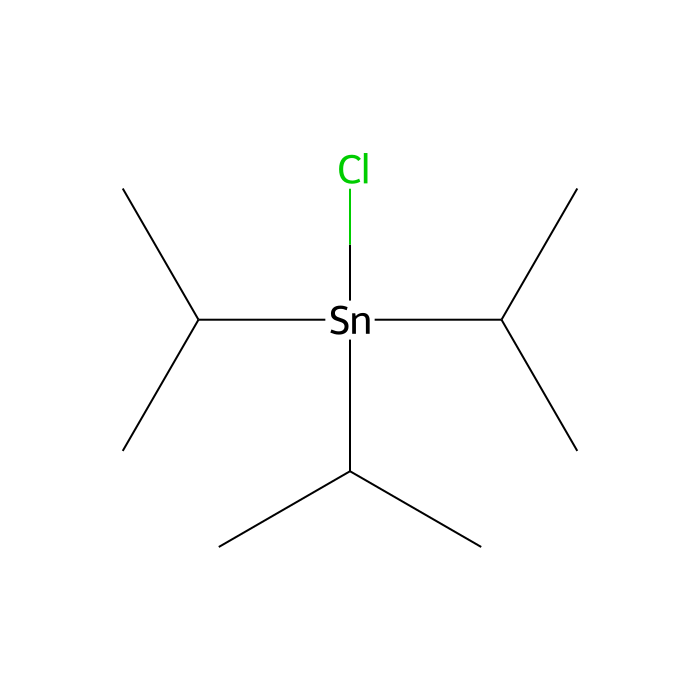
Tri‑i‑propyltin chloride is a sterically bulky trialkylorganotin chloride commonly used to prepare organostannanes and tin hydrides for radical chemistry.
Product Data identifiers (as provided)
CAS: 14101-95-2
CID: 197924
InChIKey: 60427 (as provided)
Literature/computed identifiers and descriptors (for reference; not item-specific specs)
Molecular formula (literature): C9H21ClSn
Molecular weight (computed from formula): ~283.25 g/mol
2D structural description: A tetracoordinate tin(IV) center bound to one chloride and three equivalent secondary alkyl groups (isopropyl, –CH(CH3)2). Geometry is approximately tetrahedral around Sn; the three branched alkyls impart substantial steric bulk relative to n‑propyl analogs.
Functional groups: Organotin(IV) chloride; three Sn–C(sp3) bonds and one Sn–Cl bond; no stereocenters on tin (formally achiral at Sn), each i‑Pr substituent bears a secondary carbon bound to Sn.
Structural features and implications (general chemistry)
The bulky i‑Pr groups reduce the tendency for unwanted redistribution and can slow transmetalation compared to n‑alkyl analogs (e.g., Bu3SnCl), often improving chemoselectivity but sometimes requiring stronger nucleophiles or longer times.
The Sn–Cl bond is polarized and susceptible to nucleophilic substitution by organolithium/Grignard reagents and alkoxides, forming R3SnR′ or R3SnOR intermediates.
Synthetic Utility
Transmetalation platform (general/literature)
i‑Pr3SnCl reacts cleanly with organolithium and Grignard reagents to install the bulky Sn(i‑Pr)3 group on sp2 and sp3 carbons. The resulting stannanes serve as cross‑coupling partners (Stille) or stable handles for subsequent functionalization (e.g., electrophilic halodestannylation to form C–X selectively).
Radical mediator precursor
Reduction to i‑Pr3SnH provides a competent hydrogen atom donor for radical chain processes (AIBN/thermal/photolytic initiation). The steric bulk can suppress over‑reduction or undesired tin capture in certain substrates relative to Bu3SnH, offering selectivity advantages in complex settings.
Lewis acidic derivatives
Conversion to alkoxides (i‑Pr3SnOR) or carboxylates affords Lewis acidic promoters that can activate carbonyls and aid in selective transformations.
Protecting/temporizing group strategies
The Sn(i‑Pr)3 unit can function as a temporary, chemoselective mask on vinyl/aryl systems, enabling iterative cross‑couplings or directed functionalizations followed by de-tin operations under mild electrophilic conditions.
Analytical and handling notes
119Sn NMR provides rapid assessment of tin environment; 1H/13C spectra show characteristic downfield shifts at the carbon bound to Sn due to heavy‑atom effects.
Because organotin residues complicate purification, plan sequences with built‑in tin removal steps (scavengers, precipitation as insoluble salts, or oxidative workups) to streamline downstream processing.
Target Specificity
Not applicable. This product is a small‑molecule organotin reagent and does not target biological epitopes or analytes. No antibody/biomolecule attributes (antigen, clone, isotype, species reactivity) apply.
Preguntas frecuentes
What is the purity of this product?
This product is supplied at ≥98% purity (chemical assay). Lot-specific values are stated on the Certificate of Analysis.
Utilizamos cookies para garantizar el correcto funcionamiento del sitio web y, cuando esté permitido, para mejorar su experiencia. Puede gestionar sus preferencias en cualquier momento en Configuración. Más información en nuestra Política de Cookies.
¿Quieres que te enviemos un mensaje cuando tengamos descuentos disponibles?
Recordármelo más tarde
¡Gracias! Por favor, revisa tu bandeja de entrada de correo electrónico para confirmar.
Products are supplied to verified businesses, institutions, and qualified professionals for research and development use only. Not for use in humans, animals, diagnosis, or therapy.