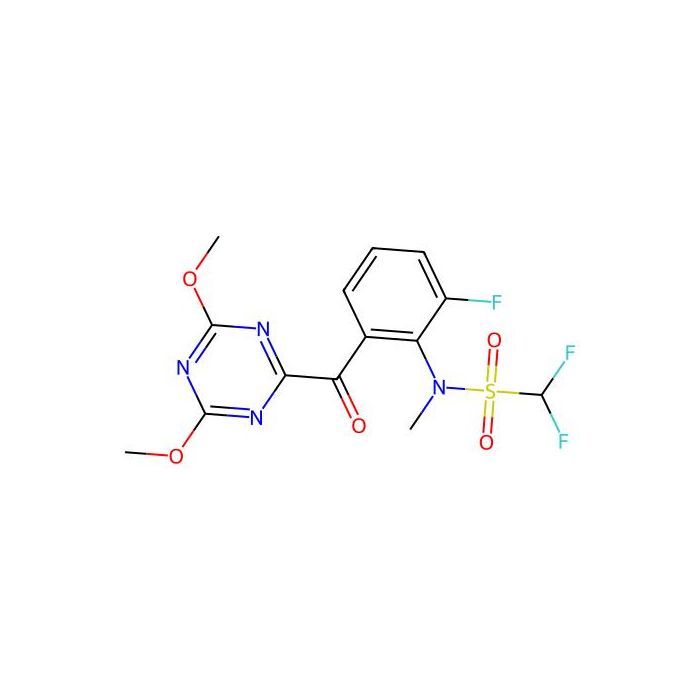
This compound belongs to the class of organic compounds known as aryl-phenylketones. These are aromatic compounds containing a ketone substituted by one aryl group, and a phenyl group.
External Descriptors
Not available
1. Djoumbou Feunang Y, Eisner R, Knox C, Chepelev L, Hastings J, Owen G, Fahy E, Steinbeck C, Subramanian S, Bolton E, Greiner R, and Wishart DS. ClassyFire: Automated Chemical Classification With A Comprehensive, Computable Taxonomy. Journal of Cheminformatics, 2016, 8:61.
Certificados (CoA, COO, BSE/TSE y tabla de análisis)
C of A & Other Certificates(BSE/TSE, COO):
Analytical Chart:
Propiedades químicas y físicas
Peso molecular
406.340 g/mol
XLogP3
2.500
Hydrogen Bond Donor Count
0
Hydrogen Bond Acceptor Count
12
Rotatable Bond Count
7
Exact Mass
406.056 Da
Monoisotopic Mass
406.056 Da
Topological Polar Surface Area
120.000 Ų
Heavy Atom Count
27
Formal Charge
0
Complexity
608.000
Isotope Atom Count
0
Defined Atom Stereocenter Count
0
Undefined Atom Stereocenter Count
0
Defined Bond Stereocenter Count
0
Undefined Bond Stereocenter Count
0
The total count of all stereochemical bonds
0
Covalently-Bonded Unit Count
1
Calculadoras de soluciones
Molarity Calculator
Determine the necessary mass, volume, or concentration for preparing a solution.
Dilution Calculator
Determine the dilution needed to prepare a stock solution.
Reconstitution Calculator
Reseñas
Reseñas de cliente
Application Protocols
No tested applications are provided for this item in the listing. The following are general, non-binding protocol outlines for common research uses.
Preparation of analytical stock solution:
Bring vial to ambient temperature in a desiccator. Weigh the desired amount quickly. Dissolve in dry ACN or DMSO to prepare a 1–10 mg/mL stock. Vortex and sonicate briefly if needed. Record exact concentration gravimetrically.
Aliquot into amber vials or polypropylene microtubes to minimize freeze–thaw.
LC–MS method development (outline):
Column: C18, 2.1 × 50 mm, 1.7–3 µm.
Mobile phase A: water + 0.1% formic acid (or 5 mM ammonium formate). Mobile phase B: ACN or MeOH.
Gradient: 5–95% B over 6–8 min; flow 0.3 mL/min; 30–40°C column oven.
Scan ESI(±) and APCI(±); choose the highest-response polarity and optimize source parameters.
Environmental matrix spike (outline):
Prepare matrix blanks (soil extract, plant extract). Spike with Triafamone at multiple levels (e.g., 10–1000 ng/mL). Process through cleanup (SPE or QuEChERS variants) and analyze by LC–MS/MS. Establish recovery and matrix effects.
These are generic templates; adapt to your laboratory SOPs and confirm compatibility with the physical properties of the actual lot.
Biological Roles
Item-specific biological data are not provided in the listing. The following context is general and literature-oriented.
Endogenous role: None. Triafamone is a synthetic small molecule; it is not known to be produced by biological systems.
Research context: Utilized in agrochemical research as an herbicidal active to study efficacy, environmental fate, and plant/metabolic processing. Mode-of-action details should be verified from primary literature for target-specific studies.
Biotransformation studies: Researchers may investigate uptake, conjugation, and degradation pathways in plants or soils, including formation of phase I/II metabolites. Design experiments with appropriate controls and stable reference solutions.
Toxicology screening (laboratory research only): In vitro assays (e.g., cytotoxicity, enzyme inhibition) can be conducted to map off-target interactions, but ensure compliance with institutional safety and ethical guidelines.
Important constraints:
This product is supplied strictly for research use only; it is not formulated or approved for field application, agricultural deployment, or any use in humans or animals.
Any claims about biological targets, potency, or spectrum of activity must be sourced from peer-reviewed literature and verified against the exact lot/identity of the material employed.
Buffer Applications
Not typically applicable. Triafamone is not a buffering reagent and has no defined acid/base pair for preparing biochemical buffer systems in the laboratory context.
Practical notes for handling in aqueous systems:
If aqueous dosing is required (e.g., bioassays), prepare a concentrated stock in a miscible organic solvent (DMSO or ACN), then dilute into an appropriate biological buffer (e.g., phosphate-buffered saline or MES/HEPES) while keeping the organic co-solvent ≤1–2% v/v to maintain buffer integrity.
Confirm that the presence of organic co-solvent does not alter the assay pH or enzyme kinetics relevant to your test system.
Green Alternatives
While Triafamone itself is the analyte/active and not replaceable in studies focused on this molecule, you can improve the sustainability profile of workflows involving it by optimizing solvents and processes.
Greener choices for common operations (general guidance):
Chromatography/mobile phases: Prefer water/ethanol or water/acetonitrile over water/THF or chlorinated solvents when chromatographic performance allows.
Extractions/workups: Consider ethyl acetate or methyl tert-butyl ether (MTBE) instead of DCM/chloroform; evaluate heptane/iPrOAc systems for normal-phase separations.
Reconstitution: If compatible with detection, use ethanol or ACN over DMSO to reduce environmental persistence and improve biodegradability.
Comparison snapshot (general; not specifications for this item):
DCM vs Ethyl acetate
Environmental impact: DCM (high) vs EtOAc (lower, biodegradable)
Performance: DCM stronger; EtOAc often adequate for partitioning moderately nonpolar analytes
THF vs 2-MeTHF
Peroxide risk: THF (forms peroxides) vs 2-MeTHF (lower tendency)
Source: 2-MeTHF can be bio-based; often similar solvency
Process considerations:
Minimize solvent volumes by using higher concentration stock solutions with validated stability.
Implement microscale photolysis or hydrolysis assays to cut waste while generating kinetic data.
Capture and segregate solvent waste streams to facilitate recycling where infrastructure exists.
Pharmaceutical Uses
Not applicable. Triafamone is an agrochemical research material and is not used as a pharmaceutical excipient or dosage-form component.
Context for method-development laboratories:
If your analytical platform and QA/QC procedures follow pharmacopeial-style validation (linearity, accuracy, precision, robustness), those same principles can be applied when establishing residue or stability-indicating methods for Triafamone.
No pharmacopeial monograph or compendial status is indicated for this item. For reference-standard traceability, maintain internal characterization records (NMR, HRMS, purity by qNMR or HPLC with mass balance).
Physical Properties
For this specific catalog item, detailed physicochemical specifications are not provided.
Item-specific (specification-grade) values:
Appearance: Not specified for this item; refer to CoA/Spec Sheet.
Molecular Weight: Not specified for this item; refer to CoA/Spec Sheet.
Melting point (MP): Not specified for this item; refer to CoA/Spec Sheet.
Boiling point (BP): Not specified for this item; refer to CoA/Spec Sheet.
Density: Not specified for this item; refer to CoA/Spec Sheet.
Refractive index: Not applicable/Not specified for this item; refer to CoA/Spec Sheet.
Solubility profile (water/organic): Not specified for this item; refer to CoA/Spec Sheet.
LogP / pKa: Not specified for this item; refer to CoA/Spec Sheet.
General literature guidance (context, not specifications):
Herbicidal actives of this class are commonly obtained as crystalline or microcrystalline solids with limited aqueous solubility and moderate-to-high solubility in polar aprotic organic solvents. Confirm actual behavior for Triafamone from experimental measurement prior to method development.
For analytical work (e.g., LC–MS), DMSO or acetonitrile stock solutions are frequently used to aid dissolution of hydrophobic actives; always verify solution stability and avoid prolonged exposure to light/heat unless stability data support it.
Notes for practitioners:
When developing chromatographic methods, begin with a scouting gradient on C18 using water + 0.1% formic acid and acetonitrile or methanol, then optimize based on retention and ionization efficiency (ESI/APCI) once the true polarity is known from authentic standards.
Quality and Grades
Grade and purity are not specified in this listing. For regulated or quantitation-critical applications, request and review the CoA to confirm assay, residual solvents, and chromatographic purity.
Grade/Purity: Not specified for this item; refer to CoA/Spec Sheet.
What this implies:
Without an explicit grade claim (e.g., ≥98% GC/HPLC, analytical reference standard), users should verify suitability for use via incoming QC (HPLC/UPLC, NMR, MS) as appropriate for their method validation stage.
If your work requires low-UV background or trace-metal limits (e.g., for LC–MS calibration standards), ask for supporting data or select lots accompanied by an analytical reference certificate.
Stabilizers/antioxidants: Not specified for this item; refer to CoA/Spec Sheet. If present, stabilizers can influence analytical response; document any additives during method development.
Guidance for selection:
For residue analysis or regulatory method development, prioritize lots with a fully characterized identity (NMR, HRMS) and quantitative purity determination with known uncertainty.
For synthetic or discovery research where ultra-high purity is not critical, typical HPLC-purity material can suffice; still confirm identity/purity in-house before critical experiments.
Reaction and Applications
This product is generally used as a research chemical or analytical reference standard rather than as a synthetic reagent. No manufacturer application notes are provided for this listing.
Typical research uses (literature-level, non-specification):
Analytical standards: Calibration and method validation for LC–MS/MS or GC–MS residue analysis in environmental or agricultural matrices.
Metabolism/degradation studies: Serving as the parent compound in studies of hydrolysis, photolysis, or biotransformation to characterize degradates.
Formulation research: Solubility/salt-screening or co-formulant compatibility evaluations in agrochemical formulation development.
Not commonly employed as:
A stoichiometric reagent, catalyst, or synthetic intermediate in general organic synthesis. Accordingly, named reaction contexts (e.g., cross-coupling, condensations) are typically not relevant to end users of this final active ingredient.
Practical tips:
Establish a verified reference spectrum set (HPLC/UPLC, MS, UV) for unambiguous identification during method development.
Assess photostability by exposing dilute solutions to controlled light and tracking changes by LC; protect from light during routine handling if instability is observed.
Validate storage stability of analytical stock solutions (e.g., at −20°C) and document any freeze–thaw effects on purity or response factors.
Reaction Conditions
This material is not typically employed as a reagent in named organic reactions; thus, there are no canonical “reaction conditions” for using Triafamone in synthesis.
Guidance for analytical and stability studies (general, literature-level):
Hydrolysis assays: Evaluate stability in buffered aqueous solutions across pH 4–9 at controlled temperatures (e.g., 25–40°C). Quench with ACN or acid/base as appropriate and analyze by LC.
Photolysis: Expose dilute solutions in quartz vials to controlled UV/visible light sources; compare to foil-wrapped controls. Monitor by LC–UV/MS for degradant profiling.
Thermal stress: Conduct isothermal holds (e.g., 50–60°C) in sealed vials to assess solid-state and solution stability.
Solvent screening: Determine solubility and solution stability in DMSO, ACN, MeOH, EtOAc. Record any rapid degradation or precipitation upon dilution into water or buffers.
Note: Temperatures, times, and yields are experiment-specific; no item-specific validated conditions are provided here. Always develop and document conditions under your institutional quality system.
Safety and Handling
Safety details specific to this item are not fully specified in the listing; consult the SDS for authoritative information before use.
Item-specific hazard data:
Signal word: Not specified for this item; refer to SDS.
H-statements: Not specified for this item; refer to SDS.
GHS classification & pictograms: Not specified for this item; refer to SDS.
General laboratory handling (good practice):
PPE: Lab coat, appropriate chemical-resistant gloves (e.g., nitrile), splash goggles; use in a certified chemical fume hood to avoid inhalation of dust or aerosols.
Avoid: Inhalation, ingestion, and skin/eye contact. Prevent environmental release—collect waste as hazardous organic waste according to institutional procedures.
First aid (overview): If on skin/eyes, rinse with water for 15 minutes and remove contaminated clothing; if inhaled, move to fresh air; if ingested, rinse mouth. Seek medical attention in all exposure cases. Follow SDS instructions.
Incompatibilities: Strong oxidizers and strong bases/acids may cause decomposition; verify actual incompatibilities from SDS.
Thermal/photolysis: Many agrochemical actives can degrade under strong UV or elevated temperatures; minimize exposure to light and heat during handling.
Storage and transport:
Store at -20°C (per Product Data), in a tightly closed container, desiccated and protected from light.
Shipped on ice chest + ice pads to maintain a cool chain.
Solvent Selection
No item-specific solubility data are provided. The following is practical, literature-level guidance for handling hydrophobic agrochemical actives.
Likely behavior: Many herbicidal actives exhibit low water solubility and dissolve in polar aprotic or moderately polar organic solvents.
Suggested primary solvents (method development):
Stock solutions: DMSO, acetonitrile (ACN), acetone, or methanol.
Workup/extraction: Ethyl acetate, dichloromethane (DCM), or MTBE, selected based on partitioning trials.
Aqueous handling: If aqueous dosing is required (e.g., bioassays), prepare concentrated DMSO or ACN stocks, then dilute into buffered media with vigorous mixing; keep co-solvent fraction low (≤1–2% v/v) to avoid matrix effects.
Polarity context: Without an experimentally confirmed logP/logD, bracket conditions—test both MeOH- and ACN-rich mobile phases and evaluate ESI(±) and APCI sources for MS response.
Quick comparison (general):
DMSO: maximal solvency; higher viscosity; can suppress ESI signal.
ACN: strong elution strength on C18; low viscosity; often preferred for LC–MS.
MeOH: stronger H-bonding; different selectivity; sometimes improves ionization.
Always confirm actual solubility and stability for Triafamone with a small-scale trial under your lab conditions.
Storage and Reconstitution
Item-specific storage and shipping conditions are provided; reconstitution guidance is generalized for small-molecule solids.
Storage (as supplied): Store at −20°C (per Product Data), in a tightly closed container, protected from light and moisture. Keep desiccated to prevent hydrolysis or solid-state changes.
Shipping: Supplied in an ice chest with ice pads to maintain a cool chain during transit.
Reconstitution:
Use dry, oxygen- and moisture-free solvents when possible. Typical starting solvents for small hydrophobic actives are ACN, DMSO, or MeOH. Actual solvent choice should be confirmed experimentally for Triafamone.
Prepare concentrated stocks (e.g., 1–10 mg/mL) to minimize freeze–thaw; filter through a 0.2 µm PTFE syringe filter if particulate is observed and filtration does not adsorb analyte.
Aliquoting and stability: Dispense into small amber vials to avoid repeated thawing. Record preparation date and storage conditions. If long-term storage is required, consider keeping primary stock at −20°C and working aliquots at 4°C for short-term use.
Shelf-life: Not specified for this item; refer to CoA/Spec Sheet. Establish in-lab by periodic purity checks (HPLC/UPLC) on retained samples stored under your intended conditions.
Always defer to the CoA/SDS for any additional, lot-specific handling and storage instructions.
Structure and Identity
Brief overview: Triafamone is a synthetic small-molecule herbicidal active used in agrochemical research. For this catalog item, limited structural identifiers are provided.
Product Name: Triafamone
CAS: 874195-61-6
InChIKey (catalog record): 97611 (note: this string is not a standard-length InChIKey; consult CoA/SDS for the definitive identifier)
SMILES: Not specified for this item; refer to CoA/Spec Sheet.
Molecular Formula: Not specified for this item; refer to CoA/Spec Sheet.
Molecular Weight: Not specified for this item; refer to CoA/Spec Sheet.
Structural features (general, literature-level):
Triafamone is reported in the agrochemical literature as a heteroaromatic herbicidal scaffold. Exact ring systems and functional groups should be verified from an authenticated spectral package (NMR/HRMS/IR) or an authoritative registry entry.
2D structure (descriptive):
Not provided in this listing. For structural elucidation and identity confirmation, rely on vendor-supplied spectral data and cross-reference with peer-reviewed databases (literature).
Synthetic Utility
As supplied, Triafamone is the final active ingredient rather than a building block; thus, its use as a generic synthetic intermediate is limited.
Potential roles in a synthesis or analysis workflow:
Reference compound in structure–activity relationship (SAR) series to benchmark new analogs against an established herbicidal scaffold.
Impurity/degradant mapping: Used to identify and trace synthetic byproducts or environmental degradates via LC–MS/HRMS.
Derivatization for analytics: Where direct detection is challenging, mild derivatization (e.g., carbamate/urea tagging, if applicable to functional groups present in the structure) may be explored solely for analytical sensitivity—ensure that derivatization chemistry is justified by the verified functional groups of Triafamone from primary structural data.
If pursuing total synthesis or analog preparation:
Consult primary patents and peer-reviewed syntheses for precise functional groups, protecting-group strategies, and coupling steps. Avoid assumptions—heteroaromatic substitution patterns and sulfonyl/urea/amide functionality (if present) dictate route design and must be confirmed from authoritative sources.
Target Specificity
No target, epitope, or biological specificity data are provided for this catalog item, and such details are generally applicable to biological reagents (e.g., antibodies), not small-molecule actives.
For small molecules like Triafamone, “specificity” would refer to biochemical mode of action or target enzyme(s) in plants. Those details are not included in this listing; consult primary agrochemical literature for definitive target assignments and kinetic parameters if needed for your research.
We use cookies to ensure the website functions properly and, where permitted, to improve your experience. You can manage your preferences at any time in Settings. Learn more in our Cookie Policy.
Shall we send you a message when we have discounts available?
Remind me later
Thank you! Please check your email inbox to confirm.
Products are supplied to verified businesses, institutions, and qualified professionals for research and development use only. Not for use in humans, animals, diagnosis, or therapy.