CALIDAD & PUREZAMoligand™?Moligand™ — Aladdin's line of ligands and bioactive small molecules. Use for receptor, pathway, and binding studies needing defined small-molecule tools.≥95%500μg/ml in ethanol
Synonyms
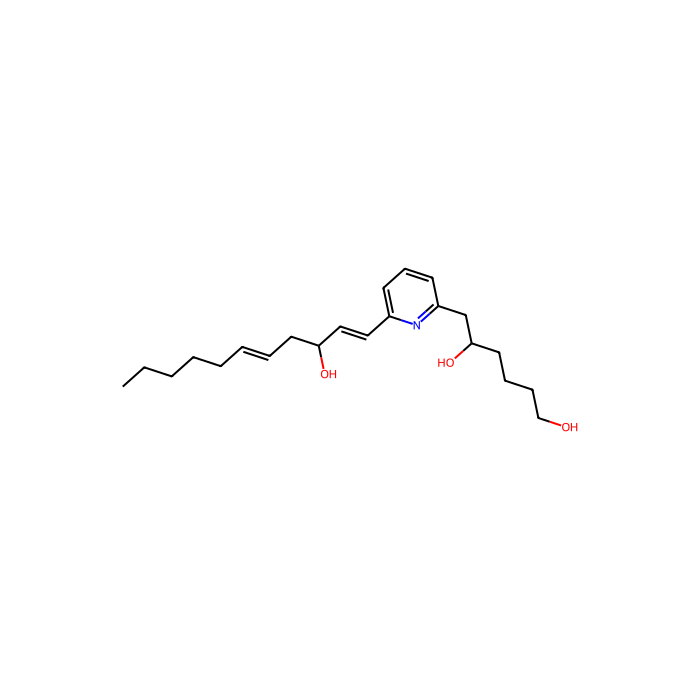
U 75302|1,5-Hexanediol, 6-(6-(3-hydroxy-1,5-undecadienyl)-2-pyridinyl)-, (R-(R*,S*-(E,Z)))-|6-(6-(3-Hydroxy-1,5-undecadien-1-yl)-2-pyridinyl)-1,5-hexanediol|(5S)-6-[6-[(1E,3R,5Z)-3-Hydroxy-1,5-undecadien-1-yl]-2-pyridinyl]-1,5-hexanediol|1,5-Hexanediol, 6-[6-[(1E,3R,5Z)-3-hydroxy-1,5-undecadien-1-yl]-2-pyridinyl]-, (5S)-|U75302|U-75302|(5S)-6-[6-[(1E,3R,5Z)-3-hydroxyundeca-1,5-dienyl]pyridin-2-yl]hexane-1,5-diol
Store at -20°C. Store under desiccating conditions. The product can be stored for up to 12 months.
Especificaciones
Sinónimos
U 75302 | 1,5-Hexanediol, 6-(6-(3-hydroxy-1,5-undecadienyl)-2-pyridinyl)-, (R-(R*,S*-(E,Z)))- | 6-(6-(3-Hydroxy-1,5-undecadien-1-yl)-2-pyridinyl)-1,5-hexanediol | (5S)-6-[6-[(1E,3R,5Z)-3-Hydroxy-1,5-undecadien-1-yl]-2-pyridinyl]-1,5-hexanediol | 1,5-Hexanediol, 6-[6-[(1E,3R,5Z)-3-hydroxy-1,5-undecadien-1-yl]-2-pyridinyl]-, (5S)- | U75302 Show more
Especificaciones y pureza
Moligand™, ≥95%, 500μg/ml in ethanol
Mecanismos bioquímicos y fisiológicos
Selective leukotriene B 4 BLT 1 receptor antagonist (IC 50 = 1.5 μM). Active in vitro and in vivo . Inhibits innate immune response and augments the leukocyte antiadesive effect of aspirin.
Condiciones de almacenamiento de almacenamiento
Store at -20°C,Desiccated
Enviado en
Ice chest + Ice pads
Este producto requiere envío en cadena de frío. Los servicios terrestres y otros servicios económicos no están disponibles.
Grado
Moligand™
Tipo de acción
ANTAGONIST
Mecanismo de acción
Antagonist of BLT 1 receptor
Nota
Wherever possible, you should prepare and use solutions on the same day. However, if you need to make up stock solutions in advance, we recommend that you store the solution as aliquots in tightly sealed vials at -20°C. Generally, these will be useable for up to one month. Before use, and prior to opening the vial we recommend that you allow your product to equilibrate to room temperature for at least 1 hour. Need more advice on solubility, usage and handling? Please visit our frequently asked questions (FAQ) page for more details.
This compound belongs to the class of organic compounds known as pyridines and derivatives. These are compounds containing a pyridine ring, which is a six-member aromatic heterocycle which consists of one nitrogen atom and five carbon atoms.
External Descriptors
Not available
1. Djoumbou Feunang Y, Eisner R, Knox C, Chepelev L, Hastings J, Owen G, Fahy E, Steinbeck C, Subramanian S, Bolton E, Greiner R, and Wishart DS. ClassyFire: Automated Chemical Classification With A Comprehensive, Computable Taxonomy. Journal of Cheminformatics, 2016, 8:61.
Determine the necessary mass, volume, or concentration for preparing a solution.
Dilution Calculator
Determine the dilution needed to prepare a stock solution.
Reconstitution Calculator
Reseñas
Reseñas de cliente
Application Protocols
No tested applications or vendor-validated protocols are provided for this item.
General protocol guidance for small-molecule research ligands:
Stock preparation: Dissolve in anhydrous DMSO to prepare a 10–50 mM stock (adjust based on observed solubility). Vortex and, if necessary, sonicate briefly. Filter or centrifuge to clarify.
Storage of stocks: Aliquot into low-bind tubes (single-use volumes). Store at −20 °C, desiccated, and protect from light. Avoid repeated freeze–thaw cycles.
Working solutions: Dilute the DMSO stock into assay buffer or media with vigorous mixing. Keep final DMSO within assay tolerance (commonly ≤0.1–0.5% v/v). Include vehicle controls.
Plate-based assays: Equilibrate temperature, pre-mix compounds with media to minimize edge effects, and randomize well positions to reduce bias.
Analytical confirmation: Where potency readouts are critical, verify on-plate concentration by LC–MS of representative wells or by UV calibration if chromophore permits.
For specific bioassays relevant to U-75302, consult peer-reviewed literature by CAS/CID and adapt conditions (time course, temperature, serum content) to your model system.
Biological Roles
Product Data does not specify the biological target(s) or mode of action for U-75302. The following guidance is provided as general context for small-molecule research ligands.
Research ligands are used to modulate or probe biological pathways in vitro and in cells to elucidate mechanism and validate targets. Activities can include receptor antagonism/agonism, enzyme inhibition, ion-channel modulation, or pathway perturbation.
The CAS (119477-85-9) and PubChem CID (6449854) can be used to retrieve peer-reviewed reports of biological activity. Verify species, assay format, and potency endpoints (e.g., Ki, IC50, EC50) directly from the source before designing experiments.
For cellular work, assess permeability, efflux liability, nonspecific binding, and potential aggregation (e.g., through detergent control and dynamic light scattering). Include vehicle controls and, where possible, orthogonal readouts.
If using in complex matrices (serum-containing media), consider protein binding and free fraction, which can shift apparent potency.
Avoid extrapolating in vitro findings to clinical claims. This product is strictly for research use only.
Important: Because target specificity is not provided in this listing, do not assume a particular biological role or pathway. Align your protocol with literature for the exact identifier and confirm activity with a positive control standard in your assay system.
Buffer Applications
U-75302 is not a buffering reagent and is not typically used to control solution pH. Therefore, classic buffer formulation guidance (e.g., phosphate, HEPES, Tris) is not applicable.
Practical notes for assay buffers (general):
When dosing U-75302 from an organic stock (commonly DMSO), maintain consistent vehicle across all wells or samples (e.g., 0.1% DMSO v/v) to control for solvent effects.
Pre-wet and mix thoroughly to avoid precipitation; consider adding 0.01–0.1% nonionic surfactant if compatible with the assay.
Filter or centrifuge working solutions to remove particulates before sensitive optical measurements.
If your protocol requires a specific buffer system, choose based on biological target and assay pH; U-75302 does not constrain buffer selection beyond its solubility and stability considerations.
Green Alternatives
While U-75302 itself is a fixed structure, greener choices can be made around its handling, dissolution, and experimental design.
Greener solvent considerations (general):
Prefer DMSO over DMF for initial stock preparation due to better worker acceptability and lower regulatory concern, provided solubility is adequate.
For workups and cleaning, replace chlorinated solvents with ethyl acetate, isopropanol, or acetone where feasible.
Use aqueous assay systems with minimal organic cosolvent (≤0.1–0.5% DMSO) and microvolume additions to reduce solvent waste.
Comparison (general guidance):
DMSO vs DMF: DMSO generally scores better in several solvent selection guides; both are polar aprotic, but DMSO often has a preferable EHS profile.
Ethanol vs acetonitrile: Ethanol is biogenic and greener; acetonitrile may be needed for some analytics but can be minimized.
Operational measures:
Prepare concentrated stocks to minimize total solvent volume; distribute as single-use aliquots to prevent repeated thawing and disposal.
Adopt microscale assays (low-volume plates) and automation to reduce waste.
Ensure dry storage conditions to preserve material quality and prevent rework/repurchase.
Note: If your program allows, consider testing functionally similar chemotypes that are reported with improved stability or solubility in greener vehicles. Selection must be guided by biological performance and IP constraints.
Pharmaceutical Uses
No pharmacopeial status or excipient/formulation role is provided for this item. U-75302 is supplied strictly for research use only.
General notes (non-therapeutic):
In preclinical research settings, bioactive small molecules may be used as reference standards or tool compounds in analytical methods (e.g., LC–MS retention markers, stability studies) or to benchmark assay performance.
If formulating for in vivo research (where institutionally permitted), select vehicles based on solubility and tolerability (e.g., PEG400/saline, Captisol, or lipid-based carriers). Such usage requires institution-specific approvals and is outside the scope of this product listing.
No clinical, diagnostic, or therapeutic applications are supported or implied for this product.
For any regulated use, obtain appropriate GMP-grade materials and regulatory documentation; Moligand-grade materials are not intended for human or veterinary administration.
Physical Properties
Item-specific data from Product Data:
Appearance: Not specified for this item; refer to CoA/Spec Sheet.
Molecular weight: Not specified for this item; refer to CoA/Spec Sheet.
Physical constants and behavior (literature/general guidance; not product specifications):
Melting point (MP), boiling point (BP), density, refractive index, logP, pKa: Not specified here. For method development or formulation, consult literature reports by CAS 119477-85-9 and confirm with in-house measurements when critical.
Solubility/useful vehicles: Many research ligands are readily soluble in anhydrous DMSO (e.g., 10–50 mM stock) and variably soluble in DMF or ethanol; aqueous solubility often requires co-solvent and surfactant. Verify empirically for this item.
Hygroscopicity: Storage guidance includes “desiccated,” suggesting sensitivity to moisture; handle under dry conditions to maintain integrity.
Practical notes for handling (general best practices):
Prepare a small test stock (e.g., 10 mM in dry DMSO) and inspect for clarity. If undissolved, warm gently (<=40 °C) and vortex/sonicate. Avoid prolonged heating.
For aqueous media, pre-dilute the DMSO stock into buffer with vigorous mixing to avoid precipitation; keep final DMSO within assay tolerance (commonly <=0.1–0.5%).
If crystalline solid is observed to cake or clump after exposure to air, re-desiccate before weighing to improve accuracy.
Always defer to the batch CoA/Spec Sheet and SDS for authoritative properties and limits.
Quality and Grades
Supplied grade: Moligand™ (from Product Data)
What Moligand™ typically signifies (general description; not numeric specifications):
Intended for discovery biology, screening, and target validation workflows where consistent identity and purity are required for SAR and pharmacology. Batches are commonly supported by identity confirmation (e.g., LC–MS/NMR) and high assay purity suitable for biochemical/cellular assays.
Low residual solvent/moisture and minimal inorganic content are generally expected, but exact limits are batch-dependent.
Item-specific notes:
No numeric purity, impurity profile, water content, or stabilizer information is provided in this listing. Not specified for this item; refer to CoA/Spec Sheet.
UV cutoff, metals, and other trace analyses: Not specified for this item; refer to CoA/Spec Sheet.
Practical guidance for quality-sensitive applications:
For quantitative pharmacology or ADME, obtain the batch CoA and consider in-house verification (orthogonal purity by qNMR, HPLC-UV/ELSD, and HRMS).
If using in cell assays, filter or centrifuge DMSO stocks to remove particulates. Track freeze–thaw cycles and storage time.
For analytical reference standard use, qualify the lot against an authentic reference if available (matching retention time, exact mass, and impurity fingerprint).
Documentation:
Retain CoA/Spec Sheet and SDS with your batch records. If needed, request additional analytical details (chromatograms, spectra) from Aladdin Scientific Support.
Reaction and Applications
This product is provided for use as a research ligand/screening compound rather than as a synthetic reagent. No manufacturer reaction applications are provided for this item.
Typical research applications (general guidance):
Target engagement studies: Employed as a defined small molecule in biochemical binding assays, thermal shift assays, or cellular target engagement readouts.
Phenotypic screening: Used to probe cellular pathways and phenotypes; helps prioritize targets for follow-up studies.
SAR campaigns: Serves as a reference chemotype for structure–activity relationship exploration and medicinal chemistry optimization.
Analytical method development: Can function as a system suitability or retention time marker in LC/MS methods relevant to the chemotype.
Practical considerations:
Prepare concentrated DMSO stocks under dry conditions; confirm identity/purity by LC/MS where critical.
Track assay vehicle effects (DMSO, ethanol) and include vehicle-only controls.
If comparing potencies across batches, normalize to assay day and include an internal reference curve.
Note: If you intend to use U-75302 as a synthetic building block (e.g., for derivatization), confirm functional handles and reactivity using literature procedures for the exact structure (consult CAS 119477-85-9) and perform small-scale feasibility before scale-up.
Reaction Conditions
No manufacturer-supplied reaction conditions or synthetic protocols are provided for U-75302, and the product is not positioned as a general synthetic reagent.
General guidance if undertaking derivatization (consult literature for the exact structure tied to CAS 119477-85-9):
Solvents: Anhydrous polar aprotics (DMSO, DMF, NMP) or chlorinated solvents are commonly used for late-stage functionalization; greener alternatives (MeCN, 2-MeTHF) may be possible depending on reactivity.
Temperatures: Many functionalizations proceed at 0–80 °C; avoid temperatures that risk decomposition of sensitive moieties.
Atmosphere: Use inert gas (N2/Ar) for air-/moisture-sensitive steps. Verify stability toward base/acid before selecting conditions.
Workup: Minimize aqueous exposure if hydrolytically sensitive; employ rapid chromatographic purification with light protection if needed.
Expected performance: Yields, selectivity, and conditions are highly structure-dependent and should be sourced from peer-reviewed procedures specific to U-75302. Pilot reactions on milligram scale are recommended before scale-up.
If you require a reagent-grade material for chemical transformations, consider dedicated building blocks with known reactivity rather than this research ligand.
Safety and Handling
Regulatory/GHS information from Product Data:
Signal word: Not specified for this item; refer to SDS.
H-statements: Not specified for this item; refer to SDS.
GHS classification and pictograms: Not specified for this item; refer to SDS.
General laboratory safety for small-molecule research ligands (guidance, not a substitute for SDS):
PPE: Wear lab coat, safety glasses, and appropriate chemically resistant gloves (e.g., nitrile). Work in a certified fume hood to minimize exposure to powders and vapors.
Avoid inhalation of dust and contact with skin/eyes. Use anti-static precautions when weighing fine powders.
Storage incompatibilities: Keep dry and segregate from strong oxidizers, strong acids/bases, and reactive reducing/oxidizing agents unless compatibility is known. Protect from light if photolysis is suspected for this chemotype.
First aid (summary): Inhalation—move to fresh air; Skin/Eye—rinse with water for at least 15 minutes; Ingestion—rinse mouth. Seek medical attention in all cases of exposure. Bring SDS to healthcare provider.
Spill/accidental release: Avoid dust generation; sweep up using dampened disposable towels or HEPA vacuum. Dispose of waste according to institutional chemical waste procedures.
Thermal/chemical stability: Store as directed (see Storage tab). Avoid repeated freeze–thaw of solutions to minimize degradation.
Always consult the official SDS for this product for definitive hazard classification, exposure limits, and emergency procedures.
Solvent Selection
U-75302 is supplied as a small-molecule research ligand. Specific solubility values are not provided for this item; refer to CoA/Spec Sheet. The following is general guidance for bioactive small molecules.
Primary vehicles for stock solutions:
DMSO (anhydrous): Common first choice; supports 10–50 mM stocks for many hydrophobic ligands. Low volatility and excellent miscibility with water facilitate assay dilution.
DMF: Useful alternative when DMSO solubility is insufficient; consider cytotoxicity and assay compatibility.
Ethanol: Sometimes suitable for more lipophilic chemotypes; verify assay tolerance and potential precipitation upon aqueous dilution.
Assay dilution strategies:
Pre-dilute the concentrated organic stock into assay buffer with vigorous mixing to avoid local supersaturation; final DMSO content typically limited to 0.1–0.5% v/v in many cell assays (confirm with your protocol).
Use surfactants (e.g., 0.01–0.1% Tween-20) or serum-containing media to improve solubilization if permitted by the assay design.
Comparison (general):
DMSO: Highest solvency, widely tolerated; hygroscopic, can extract plastics at high %.
General reconstitution guidance for small-molecule ligands:
Solvent choice: Start with anhydrous DMSO for primary stocks unless the CoA/Spec Sheet advises otherwise. Alternative vehicles (DMF, ethanol) may be used if solubility dictates; verify assay compatibility.
Concentration: Prepare concentrated stocks (e.g., 10–50 mM) to minimize freeze–thaw and solvent volume in assays. Label aliquots with lot, concentration, and date.
Aliquoting: Dispense into single-use, low-bind vials or microtubes under dry conditions. Purge headspace with inert gas if sensitivity to oxidation/moisture is suspected.
Stability: Keep tightly capped, protected from light, and avoid repeated warming. Track cumulative time at room temperature and the number of freeze–thaw cycles.
Thaw/use cycle:
Thaw aliquots rapidly at room temperature, mix to homogeneity, and return unused material to −20 °C promptly. Do not refreeze partially used aliquots when working at low micromolar doses; discard to maintain reproducibility.
Specifications not provided:
Appearance, water content, stabilizers, and solution shelf-life: Not specified for this item; refer to CoA/Spec Sheet.
Always consult the SDS and batch CoA for authoritative guidance on stability and handling.
Structure and Identity
Overview: U-75302 (SKU U275240) is supplied as a Moligand-grade small-molecule research ligand from Aladdin Scientific’s small-molecule and compound library.
Item-specific identifiers (from Product Data):
CAS: 119477-85-9
PubChem CID: 6449854
SKU: U275240
InChIKey: 164834 (as provided)
SMILES: Not specified for this item; refer to CoA/Spec Sheet.
Molecular formula: Not specified for this item; refer to CoA/Spec Sheet.
Molecular weight: Not specified for this item; refer to CoA/Spec Sheet.
Structural description:
Functional groups, ring systems, and stereochemistry: Not specified for this item in the listing. Consult the CoA/Spec Sheet or public databases by CAS or CID for a definitive structural depiction.
Notes for users:
For cheminformatics or registration, cross-reference the CAS (119477-85-9) and CID (6449854) in your ELN or compound registry.
If structural confirmation is required for your workflow, request the current batch CoA (which typically includes NMR/HRMS/LC data) or verify against a certified reference standard.
Literature/general information (non-specification):
U-75302 is described in the literature as a bioactive small molecule used as a research ligand. For exact 2D/3D structure, stereochemistry, and standardized identifiers (InChI, canonical SMILES), consult authoritative databases (e.g., PubChem entry for CID 6449854) or peer-reviewed sources. Do not treat literature values as specifications for this supplied lot; verify against CoA.
Synthetic Utility
This product is provided as a finished bioactive small molecule rather than a general-purpose synthetic building block.
Potential uses in a chemistry workflow (general guidance):
Reference compound for SAR: Serves as a comparator in structure–activity campaigns; analogs may be synthesized by medicinal chemists to explore substituent effects, physicochemical tuning, or IP space. Use the literature structure (by CAS/CID) to design vectors for modification.
Analytical standard: Useful for calibrating LC–MS methods (retention time, ionization behavior) relevant to the chemotype.
Probe derivatization: If the literature structure contains amenable functional groups, derivatives such as photoaffinity probes, clickable handles, or biotin conjugates may be designed for target-ID workflows. Confirm feasibility from primary literature before attempting.
Caveats:
Functional group reactivity, protecting-group strategies, and stereochemical stability are structure-dependent. Because detailed structure is not specified in this listing, consult peer-reviewed synthetic routes associated with CAS 119477-85-9.
If scaling derivatizations, perform thorough impurity tracking; small changes can alter biological profiles.
Conclusion: U-75302 is primarily a research ligand/tool. Treat it as a reference chemotype rather than a routine synthon unless literature supports targeted derivatization.
Target Specificity
Target, epitope, species reactivity, clone/isotype (if antibody), or any bio-target details are not provided in the Product Data for U-75302.
Item-specific target information: Not specified for this item; refer to CoA/Spec Sheet and primary literature associated with CAS 119477-85-9 / CID 6449854.
Guidance: When designing assays, consult authoritative references for reported targets and confirm activity under your exact assay conditions. Include positive controls and orthogonal assays to validate specificity.
No claims of target specificity are made in this listing.
Preguntas frecuentes
What is the purity of this product?
This product is supplied at ≥95% purity (chemical assay). Lot-specific values are stated on the Certificate of Analysis.
What is Moligand??
Moligand? is one of Aladdin Scientific's premium product lines, formulated for high-purity applications across multiple workflows. Compared to standard grades in the same workflow, Moligand? products typically offer tighter specifications, more rigorous QC, and stronger lot-to-lot consistency.
How should this product be stored?
Store at ?20 °C, desiccated. Keep the container tightly closed with desiccant — the material is moisture-sensitive.
How is this product shipped?
This product ships in an insulated container with ice pads. Unpack on arrival and transfer it to the storage condition stated above.
What are the CAS number, molecular formula and molecular weight?
The CAS Number is 119477-85-9, the molecular formula is C22H35NO3, and the molecular weight is 361.5 g/mol. InChIKey JNBOAUIJLDEICX-LJCAKPRGSA-N.
What documentation is provided?
Available product documentation, including Certificates of Analysis (COA), Safety Data Sheets (SDS), and specification sheets, is shown in the product document area. Document availability and access follow the current site policy.
¿Necesita ayuda para elegir la calidad?
Nuestra guía de selección de calidades cubre la pureza, el estado del estabilizador y la idoneidad de la aplicación para todas las variantes de nuestro catálogo.
Utilizamos cookies para garantizar el correcto funcionamiento del sitio web y, cuando esté permitido, para mejorar su experiencia. Puede gestionar sus preferencias en cualquier momento en Configuración. Más información en nuestra Política de Cookies.
¿Quieres que te enviemos un mensaje cuando tengamos descuentos disponibles?
Recordármelo más tarde
¡Gracias! Por favor, revisa tu bandeja de entrada de correo electrónico para confirmar.
Products are supplied to verified businesses, institutions, and qualified professionals for research and development use only. Not for use in humans, animals, diagnosis, or therapy.
 L2518517
