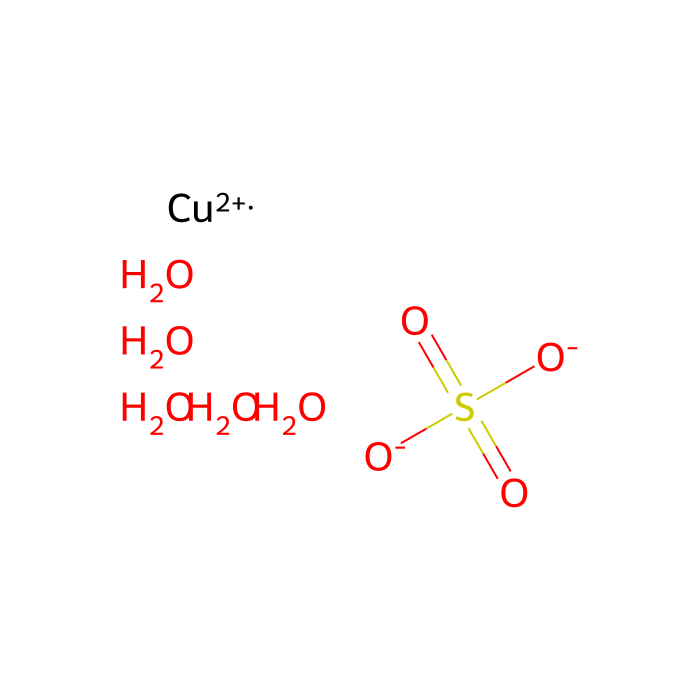
Determine the necessary mass, volume, or concentration for preparing a solution.
Taxonomy Tree
| Kingdom | Inorganic compounds |
|---|---|
| Superclass | Mixed metal/non-metal compounds |
| Class | Transition metal oxoanionic compounds |
| Subclass | Transition metal sulfates |
| Intermediate Tree Nodes | Not available |
| Direct Parent | Transition metal sulfates |
| Alternative Parents | Inorganic oxides Inorganic copper salts |
| Molecular Framework | Not available |
| Substituents | Transition metal sulfate - Inorganic copper salt - Inorganic oxide - Inorganic salt |
| Description | This compound belongs to the class of inorganic compounds known as transition metal sulfates. These are inorganic compounds in which the largest oxoanion is sulfate, and in which the heaviest atom not in an oxoanion is a transition metal. |
| External Descriptors | hydrate - metal sulfate |
Find and download the COA for your product by matching the lot number on the packaging.
| Lot Number | Certificate Type | Date | Item |
|---|---|---|---|
| Certificate of Analysis | May 19, 2026 | C397523 | |
| Certificate of Analysis | Sep 03, 2025 | C397523 | |
| Certificate of Analysis | Sep 03, 2025 | C397523 | |
| Certificate of Analysis | May 21, 2025 | C397523 | |
| Certificate of Analysis | Oct 23, 2024 | C397523 | |
| Certificate of Analysis | Sep 11, 2023 | C397523 |
| x_melt_point_char | 147 °C |
|---|---|
| Molecular Weight | 249.69 |
| XLogP3 | |
| Hydrogen Bond Donor Count | 5 |
| Hydrogen Bond Acceptor Count | 9 |
| Rotatable Bond Count | 0 |
| Exact Mass | 248.934 Da |
| Monoisotopic Mass | 248.934 Da |
| Topological Polar Surface Area | 93.600 Ų |
| Heavy Atom Count | 11 |
| Formal Charge | 0 |
| Complexity | 62.200 |
| Isotope Atom Count | 0 |
| Defined Atom Stereocenter Count | 0 |
| Undefined Atom Stereocenter Count | 0 |
| Defined Bond Stereocenter Count | 0 |
| Undefined Bond Stereocenter Count | 0 |
| The total count of all stereochemical bonds | 0 |
| Covalently-Bonded Unit Count | 7 |
H302:Harmful if swallowed
H318:Causes serious eye damage
H400:Very toxic to aquatic life
H410:Very toxic to aquatic life with long lasting effects
P264:Wash hands [and …] thoroughly after handling.
P270:Do not eat, drink or smoke when using this product.
P273:Avoid release to the environment.
P280:Wear protective gloves/protective clothing/eye protection/face protection.
P330:Rinse mouth.
P391:Collect spillage.
P501:Dispose of contents/container to an approved waste disposal plant.
P264+P265:Wash hands [and …] thoroughly after handling. Do not touch eyes.
P301+P317:IF SWALLOWED: Get medical help.
P305+P354+P338:IF IN EYES: Immediately rinse with water for several minutes. Remove contact lenses if present and easy to do. Continue rinsing.
P317:Get emergency medical help.
No item-specific, validated application protocols are provided for this catalog entry.
General protocol sketches (literature; for reference only)
Note: These are general literature-style outlines, not validated methods for this specific item. Consult primary literature/SOPs and adapt conditions to your system.
General biochemical context (literature)
Coordination chemistry
Cautions
Note
Not typically used as a buffering agent.
Practical guidance
Context
Comparisons (literature; general guidance)
Small comparison snapshot
Trade-offs
Greener practice tips
Formulation/excipient context
Bioprocessing and media (research/manufacturing context)
Regulatory notes
Cautions
Practical tips
Item-specific properties
Literature/typical properties for guidance (not product specifications)
Practical notes
Item-specific quality details
Guidance on grades and what they imply (general)
Stabilizers and hydration state
What to check on the CoA/Spec Sheet
General roles (literature)
Representative applications and tips
Practical considerations
General guidance from literature (not product specifications)
CuAAC (azide–alkyne cycloaddition)
Oxidation of primary alcohols (Cu/TEMPO/O2)
Thiol to disulfide coupling
Workup tips
Always validate and optimize on your substrate set.
Item-specific hazard fields
Typical GHS information for copper(II) sulfate salts (literature; consult SDS for this product)
Handling and PPE
Storage and incompatibilities
First aid (overview; consult SDS)
Special risks
Applicability
Solubility and polarity (literature)
Typical solvent systems
Selection tips
Item-specific storage and shipping
General guidance
Reconstitution and solution preparation
Freeze–thaw guidance
Always consult the product’s CoA and SDS for authoritative storage and handling information.
Brief: Inorganic copper(II) sulfate salt; CAS indicates the pentahydrate form is typical for "Cupric Sulfate" in commerce.
Item-specific facts (from Product Data)
Literature identity (for reference only; not product specifications)
Structural features (general)
Value as an inorganic reagent (literature)
Transformations facilitated by CuSO4
Practical considerations
Not applicable. This product is an inorganic salt reagent, not a biological targeting agent or antibody. No clone/isotype/species specificity applies. For biochemical applications involving copper–ligand interactions, refer to Biological Roles and Reaction & Applications sections.