Determine the necessary mass, volume, or concentration for preparing a solution.
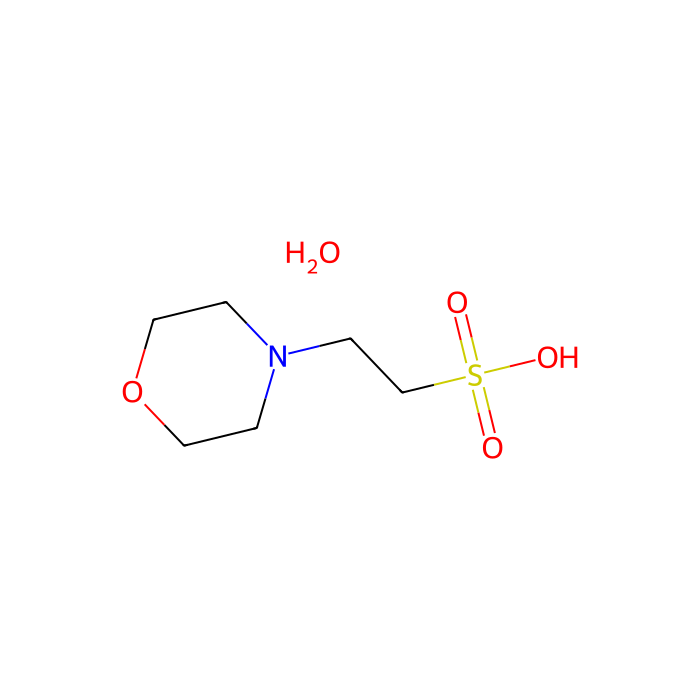
A zwitterionic N-substituted aminosulfonic acid Good’s buffer. Used as a running buffer for resolving very small proteins (ex: 13 kDa) on bis-tris gels; also used as a biological buffer in plant cell cultures.
Often used as a running buffer for resolving very small proteins.
MES monohydrate is a biological buffer often referred to as GoodÂ’s buffer. It is useful for cell culture media and protein based buffer formulations to maintain a stable environment in solution. It is also used in the purification bioprocesses of antibodies, peptides, proteins, blood components and growth factors. It is a useful resolving agent for very small proteins on bis-tris gels. Buffer solutions are used as a means of keeping pH at a nearly constant value in a wide variety of chemical applications.
Taxonomy Tree
| Kingdom | Organic compounds |
|---|---|
| Superclass | Organoheterocyclic compounds |
| Class | Oxazinanes |
| Subclass | Morpholines |
| Intermediate Tree Nodes | Not available |
| Direct Parent | Morpholines |
| Alternative Parents | Sulfonyls Organosulfonic acids Alkanesulfonic acids Trialkylamines Oxacyclic compounds Dialkyl ethers Azacyclic compounds Organopnictogen compounds Organic oxides Hydrocarbon derivatives |
| Molecular Framework | Aliphatic heteromonocyclic compounds |
| Substituents | Morpholine - Organic sulfonic acid or derivatives - Organosulfonic acid or derivatives - Organosulfonic acid - Sulfonyl - Alkanesulfonic acid - Tertiary amine - Tertiary aliphatic amine - Dialkyl ether - Ether - Oxacycle - Azacycle - Organopnictogen compound - Organic oxygen compound - Organosulfur compound - Organooxygen compound - Organonitrogen compound - Organic nitrogen compound - Organic oxide - Hydrocarbon derivative - Amine - Aliphatic heteromonocyclic compound |
| Description | This compound belongs to the class of organic compounds known as morpholines. These are organic compounds containing a morpholine moiety, which consists of a six-member aliphatic saturated ring with the formula C4H9NO, where the oxygen and nitrogen atoms lie at positions 1 and 4, respectively. |
| External Descriptors | Not available |
Find and download the COA for your product by matching the lot number on the packaging.
| Lot Number | Certificate Type | Date | Item |
|---|---|---|---|
| Certificate of Analysis | Jul 20, 2026 | M105074 | |
| Certificate of Analysis | Jul 20, 2026 | M105074 | |
| Certificate of Analysis | Jul 20, 2026 | M105074 | |
| Certificate of Analysis | Apr 30, 2026 | M105074 | |
| Certificate of Analysis | Apr 30, 2026 | M105074 | |
| Certificate of Analysis | Apr 30, 2026 | M105074 | |
| Certificate of Analysis | Apr 30, 2026 | M105074 | |
| Certificate of Analysis | Apr 30, 2026 | M105074 | |
| Certificate of Analysis | Jun 17, 2025 | M105074 | |
| Certificate of Analysis | Jun 17, 2025 | M105074 | |
| Certificate of Analysis | Jun 17, 2025 | M105074 | |
| Certificate of Analysis | Mar 31, 2025 | M105074 | |
| Certificate of Analysis | Mar 31, 2025 | M105074 | |
| Certificate of Analysis | Mar 31, 2025 | M105074 | |
| Certificate of Analysis | Mar 31, 2025 | M105074 | |
| Certificate of Analysis | May 04, 2023 | M105074 | |
| Certificate of Analysis | May 04, 2023 | M105074 | |
| Certificate of Analysis | May 04, 2023 | M105074 | |
| Certificate of Analysis | May 04, 2023 | M105074 | |
| Certificate of Analysis | Jun 27, 2022 | M105074 | |
| Certificate of Analysis | Jun 27, 2022 | M105074 | |
| Certificate of Analysis | Jun 27, 2022 | M105074 | |
| Certificate of Analysis | Jun 27, 2022 | M105074 | |
| Certificate of Analysis | Mar 19, 2022 | M105074 | |
| Certificate of Analysis | Mar 19, 2022 | M105074 | |
| Certificate of Analysis | Mar 19, 2022 | M105074 | |
| Certificate of Analysis | Mar 19, 2022 | M105074 | |
| Certificate of Analysis | Jan 04, 2022 | M105074 | |
| Certificate of Analysis | Jan 04, 2022 | M105074 | |
| Certificate of Analysis | Jan 04, 2022 | M105074 | |
| Certificate of Analysis | Jan 04, 2022 | M105074 |
| Solubility | Soluble in water (0.5 M at 20 °C). |
|---|---|
| x_melt_point_char | ca 308° dec. |
| Molecular Weight | 213.25 |
| XLogP3 | |
| Hydrogen Bond Donor Count | 2 |
| Hydrogen Bond Acceptor Count | 6 |
| Rotatable Bond Count | 3 |
| Exact Mass | 213.067 Da |
| Monoisotopic Mass | 213.067 Da |
| Topological Polar Surface Area | 76.200 Ų |
| Heavy Atom Count | 13 |
| Formal Charge | 0 |
| Complexity | 214.000 |
| Isotope Atom Count | 0 |
| Defined Atom Stereocenter Count | 0 |
| Undefined Atom Stereocenter Count | 0 |
| Defined Bond Stereocenter Count | 0 |
| Undefined Bond Stereocenter Count | 0 |
| The total count of all stereochemical bonds | 0 |
| Covalently-Bonded Unit Count | 2 |
H315:Causes skin irritation
H319:Causes serious eye irritation
H335:May cause respiratory irritation
P261:Avoid breathing dust/fume/gas/mist/vapors/spray.
P264:Wash hands [and …] thoroughly after handling.
P271:Use only outdoors or in a well-ventilated area.
P280:Wear protective gloves/protective clothing/eye protection/face protection.
P302+P352:IF ON SKIN: wash with plenty of water.
P304+P340:IF INHALED: Remove person to fresh air and keep comfortable for breathing.
P305+P351+P338:IF IN EYES: Rinse cautiously with water for several minutes. Remove contact lenses if present and easy to do - continue rinsing.
P362+P364:Take off contaminated clothing and wash it before reuse.
P405:Store locked up.
P403+P233:Store in a well-ventilated place. Keep container tightly closed.
P501:Dispose of contents/container to an approved waste disposal plant.