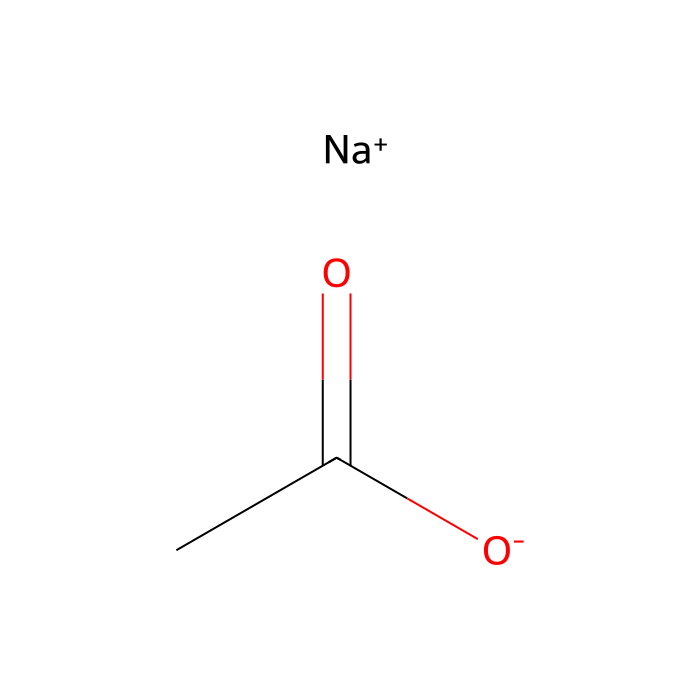
Sodium acetate - Anhydrous Grade, Ph.Eur., Premium-Grade Reagents, Suitable for Analysis, ACS , CAS No.127-09-3

CAS: 127-09-3 Cat. No.: S431679 Formula: CH3COONa Molecular Weight: 82.03 EC Number: 204-823-8 PubChem CID: 517045
AVAILABLE TO ORDER
GRADE & PURITY Anhydrous Grade ? Anhydrous grade — water removed and packaged dry for moisture-sensitive chemistry. Use in reactions where even trace water would interfere or quench. Ph.Eur. ? European Pharmacopoeia grade — conforms to Ph.Eur. monographs across EU member states. Use for pharmaceutical work needing European compendial compliance. Premium-Grade Reagents ? Premium-grade reagents with enhanced purity and tighter QC than standard grades. Use for demanding applications needing extra consistency. Suitable for Analysis ? Suitable-for-analysis grade — purity adequate for general analytical procedures. Use as a dependable analytical reagent across routine methods. ACS ? ACS grade — meets American Chemical Society specifications, the analytical benchmark in the US. Use for analytical and QC work needing ACS-defined purity.
Synonyms
Anhydrous sodium acetate | NCGC00260289-01 | AKOS003052995 | Sodium acetate, AR, anhydrous, >=99% | Sodium acetate, BioUltra, for luminescence, anhydrous, >=99.0% (NT) | Sodium acetate-1-13c-2-d3 | NSC 77459 | SODIUM ACETATE [MI] | UNII-NVG71ZZ7P0 | CH3CO
Storage
Room temperature,Argon charged
Shipped In
Normal
★
Size
Germany (EU)
USA*
Price
Qty
250g
S431679-250g
1 In stock
1 In stock
€97.97
Enter a quantity for the sizes you want to add.
🧪
Why this grade

Anhydrous Grade, Ph.Eur., Premium-Grade Reagents, Suitable for Analysis, ACS ACS,Anhydrous Grade,Ph.Eur.,Premium-Grade Reagents,Suitable for Analysis for sensitive chromatographic and analytical workflows requiring minimal baseline interference.

🌡

Storage & shipping

Room temperature,Argon charged Ships Normal Check lot-specific COA for exact specifications.

📋

Quality documents

SDS, COA, datasheet, and spec sheet available for download. Lot-specific COA accessible via lot number lookup.

📚

Literature proof

Cited in 1671 peer-reviewed publications across chromatography, organic synthesis, and cross-coupling reactions.

Specifications

Synonyms
Anhydrous sodium acetate | NCGC00260289-01 | AKOS003052995 | Sodium acetate, AR, anhydrous, >=99% | Sodium acetate, BioUltra, for luminescence, anhydrous, >=99.0% (NT) | Sodium acetate-1-13c-2-d3 | NSC 77459 | SODIUM ACETATE [MI] | UNII-NVG71ZZ7P0 | CH3CO
Specifications & Purity
Anhydrous Grade, Ph.Eur., Premium-Grade Reagents, Suitable for Analysis, ACS
Storage
Room temperature,Argon charged
Shipped In
Normal
Grade
ACS, Anhydrous Grade, Ph.Eur., Premium-Grade Reagents, Suitable for Analysis
Names and Identifiers
Pubchem Sid
Canonical Smiles
CC(=O)[O-].[Na+]
IUPAC Name
sodium;acetate
InChIKey
VMHLLURERBWHNL-UHFFFAOYSA-M
INCHI
1S/C2H4O2.Na/c1-2(3)4;/h1H3,(H,3,4);/q;+1/p-1
Isomeric SMILES
CC(=O)[O-].[Na+]
PubChem CID
517045
Molecular Weight
82.03

Documentation

📋 Safety Data Sheet (SDS)

Comprehensive hazard, handling, storage, and regulatory compliance document.

Download SDS →

✅ Certificate of Analysis (COA)

Lot-specific quality data. Enter your lot number to retrieve the exact COA.

Look up COA →

📊 Datasheet

Quick-reference summary of product specifications and applications.

View datasheet →

🔬 Specification Sheet

Full quality attributes and acceptance criteria for this grade.

View spec sheet →

Advanced Data

Taxonomic Classification

Taxonomy Tree

KingdomOrganic compounds
SuperclassOrganic acids and derivatives
ClassCarboxylic acids and derivatives
SubclassCarboxylic acid derivatives
Intermediate Tree Nodes Carboxylic acid salts
Direct ParentAcetate salts
Alternative Parents Monocarboxylic acids and derivatives  Carboxylic acids  Organic sodium salts  Organic oxides  Hydrocarbon derivatives  Carbonyl compounds  
Molecular FrameworkAliphatic acyclic compounds
Substituents Acetate salt - Organic alkali metal salt - Monocarboxylic acid or derivatives - Carboxylic acid - Organic oxygen compound - Organic oxide - Hydrocarbon derivative - Organic sodium salt - Organic salt - Organooxygen compound - Carbonyl group - Aliphatic acyclic compound
DescriptionThis compound belongs to the class of organic compounds known as acetate salts. These are organic compounds containing acetic acid as its acid component.
External Descriptors organic sodium salt
3D Structure
Interactive Chemical Structure Model


Associated Targets(Human)
CA2 Tclin Carbonic anhydrase II (17698 Activities)
Activity TypeRelationActivity valueUnitsAction TypeJournalPubMed IddoiAssay Aladdin ID
CA1 Tclin Carbonic anhydrase I (13240 Activities)
Activity TypeRelationActivity valueUnitsAction TypeJournalPubMed IddoiAssay Aladdin ID
CA5A Tclin Carbonic anhydrase VA (1168 Activities)
Activity TypeRelationActivity valueUnitsAction TypeJournalPubMed IddoiAssay Aladdin ID
CA9 Tclin Carbonic anhydrase IX (8255 Activities)
Activity TypeRelationActivity valueUnitsAction TypeJournalPubMed IddoiAssay Aladdin ID
FFAR3 Tchem Free fatty acid receptor 3 (304 Activities)
Activity TypeRelationActivity valueUnitsAction TypeJournalPubMed IddoiAssay Aladdin ID
Associated Targets(non-human)
CA4 Carbonic anhydrase IV (1713 Activities)
Activity TypeRelationActivity valueUnitsAction TypeJournalPubMed IddoiAssay Aladdin ID
Carbonic anhydrase (69 Activities)
Activity TypeRelationActivity valueUnitsAction TypeJournalPubMed IddoiAssay Aladdin ID
Mechanisms of Action
Certificates(CoA,COO,BSE/TSE and Analysis Chart)
C of A & Other Certificates(BSE/TSE, COO):
Analytical Chart:

Find and download the COA for your product by matching the lot number on the packaging.

12 results found

Lot NumberCertificate TypeDateItem
J2517732Certificate of AnalysisSep 22, 2025 S431679
J2517733Certificate of AnalysisSep 22, 2025 S431679
B2520438Certificate of AnalysisJan 15, 2025 S431679
B2520439Certificate of AnalysisJan 15, 2025 S431679
B2520440Certificate of AnalysisJan 15, 2025 S431679
A2506290Certificate of AnalysisNov 15, 2024 S431679
K2412314Certificate of AnalysisNov 15, 2024 S431679
D23061245Certificate of AnalysisApr 14, 2023 S431679
D23061244Certificate of AnalysisApr 13, 2023 S431679
D23061246Certificate of AnalysisApr 08, 2023 S431679
D2417050Certificate of AnalysisApr 08, 2023 S431679
G2417059Certificate of AnalysisApr 08, 2023 S431679
Chemical and Physical Properties
Solubility365g/L
SensitivityMoisture sensitive
x_flash_point_drop_centigrade>250°C
x_melt_point_char324°C
Molecular Weight82.030 g/mol
XLogP3
Hydrogen Bond Donor Count0
Hydrogen Bond Acceptor Count2
Rotatable Bond Count0
Exact Mass82.0031 Da
Monoisotopic Mass82.0031 Da
Topological Polar Surface Area40.100 Ų
Heavy Atom Count5
Formal Charge0
Complexity34.600
Isotope Atom Count0
Defined Atom Stereocenter Count0
Undefined Atom Stereocenter Count0
Defined Bond Stereocenter Count0
Undefined Bond Stereocenter Count0
The total count of all stereochemical bonds0
Covalently-Bonded Unit Count2
FAQs and Articles
Aladdin@Guidelines for the formulation of commonly used buffers for biological experiments
Oxidizing Agent-Benzaldehyde
Pyridinium Chlorochromate (PCC) Corey-Suggs Reagent
Premium-Grade Reagents
The Guide to Anhydrous Grade for Reagents
What Is “Suitable for Analysis” Grade? A Practical Guide
Protein Tris-Acetate Electrophoresis System Standard Operating Procedure
TRAP Staining: Principle and Procedure
GST-Tagged Protein Purification
PAS Staining (Periodic Acid–Schiff, PAS) Standard Operating Procedure (SOP)
A Review of Ten Commonly Used Techniques for Detection, Quantification, and Interaction Analysis in Nucleic Acid Research
Selection of Common Research Salts: A Task Map for Alkali Metal Salts & Alkaline Earth Metal Salts (with Product Tables 1–6)
2-Methylpyridine–Borane (2-Picoline·BH₃) Reductive Amination Guide: Process Drivers for Replacing NaBH₃CN, the Practical Operating Window, and Scale-Up/Quench Close-Out Essentials (Including Product Tables 1–3)
Recent Advances in Methods for Measuring Starch-Related Indices in Plants and Their Application-Oriented Selection
Plant Omics Panorama: Workflow Frameworks and Multi-Omics Integration from Genomics to Transcriptomics, Proteomics, and Metabolomics
Acid Phosphatase: Dephosphorylation Reactions in Acidic Microenvironments and Their Research, Assay, and Detection Applications
Deoxyribonuclease (DNase): DNA Hydrolytic Cleavage Properties, Methodological Value, and Multi-Context Applications
Agarose Precast Gels: Composition, Advantages, and Application Workflows for Standardized Nucleic Acid Electrophoresis Matrices
Chymosin: A Review of Molecular Features, Coagulation Kinetics, and Activity Evaluation
Phytase: Enzymological Properties, Mechanism of Action, and Applications in Feed and Food
Chitinases: Substrate-Specific Degradation Mechanisms, Enzymatic Properties, and Application Directions
Functional Framework of Starch Metabolism-Related Enzymes in Food Science Research and Mechanistic Analysis of Quality Regulation
Acetyl-Group Metabolic Enzyme Network and In Vitro Enzymology Analysis
Metabolic Basis and Research Framework of Glycerol Utilization and Metabolic Reprogramming
Technical Comparison and Method Selection for Hydroxyproline Determination
Structural Characteristics, Operational Methods, and Separation Applications of Dextran Gels
Noncanonical Functions of Epigenetic Enzymes and Regulation of Mitochondrial Metabolism
Experimental Research on Candidate Probiotics: From Strain Identification and Mechanistic Evaluation to Product Selection
The Chemical Basis of Natural Lacquer Durability: Urushiol Structure, Oxidative Polymerization Film Formation, and Coating Film Properties
Experimental Evaluation of the Synergistic Actions of Endoglucanase, CBH I, and β-Glucosidase in Lignocellulosic Saccharification
Comparison of Iron Content Detection Methods: TPTZ, 1,10-Phenanthroline, Ferrozine, 2,2'-Bipyridine, and Instrumental Analysis
Phase-Partitioning Principles, System Differences, and Application Selection in Phenol-Based DNA and RNA Extraction
How to Evaluate Reaction Generality through Substrate Scope: From the Number of Examples to Standardized Substrate Selection
Air Decomposition of Solid Sodium Methoxide and Sodium Ethoxide—Effects on Cross-Coupling Reaction Optimization and Reproducibility
Citations of This Product
Solution Calculators
Reviews

Customer Reviews

Need help choosing the grade?

Our grade selection guide covers purity, stabilizer status, and application suitability for all variants in our catalog.

View Anhydrous Grade grade guide → View Ph.Eur. grade guide → View Premium-Grade Reagents grade guide → View Suitable for Analysis grade guide → View ACS grade guide →

Related Products

Sodium Acetate Solution - 3M , pH5.2, Sterilized, DEPC-treated , CAS No.127-09-3
Sodium acetate anhydrous - Suitable for molecular biology, ≥99%(NT) , CAS No.127-09-3
Sodium acetate anhydrous - for cell culture, for insect cell culture, ≥99% , CAS No.127-09-3
Sodium acetate anhydrous - ACS, ≥99% , CAS No.127-09-3
Acetate anion standard solution - 1mg/ml (1,000ppm) , CAS No.127-09-3
Acetate anion standard solution - 0.1mg/ml (100ppm) , CAS No.127-09-3
Sodium Acetate, 1M - 1M , CAS No.127-09-3
Sodium acetate anhydrous - GR, ≥99% , CAS No.127-09-3
Sodium acetate anhydrous - PrimorTrace™, ≥99.99% metals basis , CAS No.127-09-3
Sodium acetate anhydrous - HPLC grade, ≥99%(NT), used for sodium acetate in a novel automated method for xylanase activity measurement, enhancing analytical efficiency and precision . Preparation and properties of type-specific M antigen isolated from a g
Sodium acetate anhydrous - AR , CAS No.127-09-3
Sodium acetate anhydrous - for electrophoresis, ≥99% , CAS No.127-09-3
Sodium Acetate Solution - 3M , pH5.2, Sterilized , CAS No.127-09-3
Sodium acetate anhydrous - 10mM in Water , CAS No.127-09-3
Sodium acetate anhydrous - PharmPure™, pharmaceutical grade , CAS No.127-09-3
Sodium acetate - anhydrous, PrimorTrace™, Ultra pure, ≥99.99% metals basis , CAS No.127-09-3
Sodium acetate - UltraPureChrom™, for HPLC, ≥99%(NT) , CAS No.127-09-3
Sodium acetate - UltraBio™, Ultra pure, ≥99% , CAS No.127-09-3
Sodium acetate solution - Ultrapure BioReagent, for molecular biology, ~3 M in H2O , CAS No.127-09-3
Sodium acetate - anhydrous, high-purity, Reagent grade, ≥99% , CAS No.127-09-3
Acetate standard solution - 10mg/mL , CAS No.127-09-3
Sodium acetate solution - Suitable for molecular biology, 3M, pH5.2, Prepared with DEPC for RNA applications, Also suitable for DNA applications. , CAS No.127-09-3

Shall we send you a message when we have discounts available?

Remind me later

Thank you! Please check your email inbox to confirm.

Oops! Notifications are disabled.