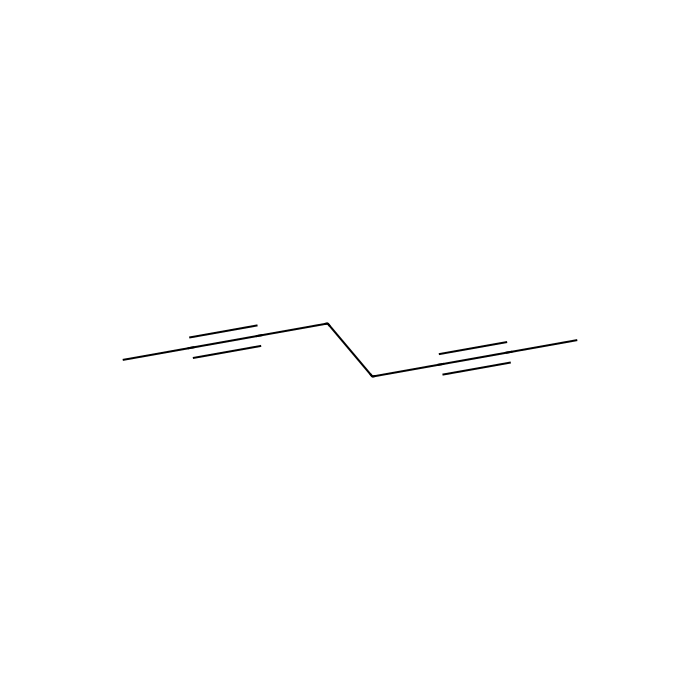
This compound belongs to the class of organic compounds known as unsaturated aliphatic hydrocarbons. These are aliphatic Hydrocarbons that contains one or more unsaturated carbon atoms. These compounds contain one or more double or triple bonds.
External Descriptors
Not available
1. Djoumbou Feunang Y, Eisner R, Knox C, Chepelev L, Hastings J, Owen G, Fahy E, Steinbeck C, Subramanian S, Bolton E, Greiner R, and Wishart DS. ClassyFire: Automated Chemical Classification With A Comprehensive, Computable Taxonomy. Journal of Cheminformatics, 2016, 8:61.
Certificati (CoA, COO, BSE/TSE e tabella di analisi)
C of A & Other Certificates(BSE/TSE, COO):
Analytical Chart:
Proprietà chimiche e fisiche
Punto di fusione (°C)
27 °C
Peso molecolare
106.160 g/mol
XLogP3
2.400
Hydrogen Bond Donor Count
0
Hydrogen Bond Acceptor Count
0
Rotatable Bond Count
1
Exact Mass
106.078 Da
Monoisotopic Mass
106.078 Da
Topological Polar Surface Area
0.000 Ų
Heavy Atom Count
8
Formal Charge
0
Complexity
139.000
Isotope Atom Count
0
Defined Atom Stereocenter Count
0
Undefined Atom Stereocenter Count
0
Defined Bond Stereocenter Count
0
Undefined Bond Stereocenter Count
0
The total count of all stereochemical bonds
0
Covalently-Bonded Unit Count
1
Calcolatori di soluzioni
Molarity Calculator
Determine the necessary mass, volume, or concentration for preparing a solution.
Dilution Calculator
Determine the dilution needed to prepare a stock solution.
Reconstitution Calculator
Recensioni
Recensioni dei clienti
Application Protocols
No antibody/assay application protocols apply to this small-molecule hydrocarbon.
Item-specific tested applications: Not specified for this item.
General laboratory use
Provide anhydrous, oxygen-free conditions for metal-catalyzed reactions (Schlenk or glovebox techniques).
For hydrogenations, pre-wet Pd/C with solvent, add substrate under inert gas, then introduce H2 via balloon or manifold while stirring and monitoring by GC.
For halogenation, cool reaction solvent (e.g., DCM) to 0 °C, add halogen solution dropwise, monitor by TLC/GC, and quench excess halogen safely (e.g., sodium thiosulfate).
These are illustrative general workflows; adapt to your specific transformation and scale.
Biological Roles
Item-specific biological data: Not specified for this item; refer to literature if needed.
General context
2,6-Octadiyne is a simple hydrocarbon diyne with no known intrinsic biological role in primary metabolism. Hydrocarbons of this type are typically biologically inert substrates and are used in chemical synthesis rather than biochemistry.
Internal alkynes can interact with certain enzymes or membranes nonspecifically due to hydrophobicity; however, without additional functional groups, specific biochemical activity is uncommon.
In chemical biology, diynes can serve as handles for post-synthetic functionalization (e.g., via metal-catalyzed additions) but copper-catalyzed azide–alkyne cycloaddition (CuAAC) requires a terminal alkyne and thus is not directly applicable to 2,6-octadiyne without prior transformation.
Research-use disclaimer
For research use only (per Product Data). Not for human or veterinary use, diagnostic, or therapeutic applications.
Buffer Applications
This compound is a nonpolar hydrocarbon and is not used to prepare aqueous buffer systems.
Not typically applicable: It is practically insoluble in water and lacks acid/base functionality to confer buffering capacity.
Practical note: If used in biochemistry workflows, it will be as an organic-phase substrate or reagent, not as a buffer component. Select an orthogonal aqueous buffer (e.g., phosphate, Tris) appropriate to your biological system independently of this compound.
Green Alternatives
While 2,6-octadiyne is a substrate (not a solvent), greener choices can be made in the reaction medium and conditions used with it.
Greener solvent options (literature/general)
Replace chlorinated solvents with toluene, ethyl acetate, 2-MeTHF, CPME, or dimethyl carbonate where compatible.
Prefer ethanol or isopropanol for catalytic hydrogenations when solubility allows.
Catalysis and conditions
Use catalytic over stoichiometric electrophiles/nucleophiles when possible (e.g., catalytic hydrosilylation vs. stoichiometric organometallic additions).
Lower temperature cycloadditions using efficient Co/Ni catalysts reduce energy use relative to thermal processes.
Process-intensification strategies
Flow hydrogenation with supported catalysts in green solvents can improve safety and E-factor.
Comparative note (general)
For reactions that only require a single alkyne, a mono-alkyne (e.g., octyne isomers) may reduce overfunctionalization risk; however, 2,6-octadiyne uniquely enables bis-additions and [2+2+2] processes, potentially shortening synthetic routes and improving step economy.
Toluene/EtOAc/2-MeTHF: good solvency for hydrocarbons; improved EHS; may require temperature adjustments for rates.
Alcohols (EtOH/iPrOH): green for hydrogenation; watch catalyst compatibility and solubility.
Pharmaceutical Uses
Item-specific information: Not specified for this item; refer to CoA/Spec Sheet.
General context (no therapeutic claims)
2,6-Octadiyne has no recognized role as a pharmacopeial excipient. Its utility, if any, would be as a synthetic intermediate in medicinal chemistry programs (e.g., to build diketones, dihaloalkanes, or aromatic cores via cyclotrimerization) rather than as a formulation ingredient.
For GMP settings, any use would require full qualification of identity, purity, residual solvents, and elemental impurities per ICH/USP guidelines; none of these specifications are provided here for this SKU and must be established project-specifically.
Physical Properties
Item-specific specifications
Appearance: Not specified for this item; refer to CoA/Spec Sheet.
Grade/Purity: Not specified for this item; refer to CoA/Spec Sheet.
Literature/general physicochemical data (for reference; not item-specific)
Physical state at ambient conditions: expected to be a colorless, volatile liquid (typical for C8 internal diynes; confirm on CoA/SDS for this item).
Boiling point: not located in the provided data; consult primary literature or SDS. For related C8 hydrocarbons, typical BP is in the ~110–140 °C range (literature, qualitative context only).
Melting point: not located in the provided data; refer to CoA.
Density (20–25 °C): not specified here; refer to CoA/SDS. Hydrocarbons of this size typically show ρ ~0.75–0.85 g/mL (general context).
Solubility: practically insoluble in water; miscible with nonpolar and moderately polar organic solvents (hexanes, toluene, ether, THF, chlorinated solvents) — literature/general behavior for nonpolar diynes.
LogP: expected positive (hydrocarbon; general); specific value not located in provided data.
Refractive index: not specified for this item; refer to CoA.
Notes for practitioners
As an internal diyne, volatility is moderate; handle in a fume hood. Physical constants for your specific lot should be verified on the CoA/SDS.
Quality and Grades
Item-specific details
Grade/Purity: Not specified for this item; refer to CoA/Spec Sheet.
Stabilizers/inhibitors: Not specified for this item; refer to CoA/Spec Sheet.
Guidance for users
If chromatography or photophysical studies are intended, confirm UV-Vis background and impurity profile on the CoA. For catalytic reactions, trace metal content can influence outcomes; check elemental analyses if provided.
Diyne integrity: Internal alkynes are generally stable, but prolonged storage in light/air can lead to slow oxidative addition products. If maximal reactivity/selectivity is needed (e.g., in [2+2+2] cyclotrimerizations), consider brief distillation under reduced pressure or passing through a short basic alumina plug to remove adventitious acids or peroxides if any formed.
Batch-to-batch consistency: Verify identity by GC/MS or 1H/13C NMR (characteristic sp carbons ~70–90 ppm; methylene/methyl resonances in aliphatic region). IR shows strong C≡C stretch typically ~2100–2260 cm−1 (general reference).
What grade means (general)
“Analytical reagent” or “puriss.” grades indicate tight impurity controls; “technical” grades may contain higher levels of olefinic or saturated byproducts. Select the grade commensurate with reaction sensitivity (e.g., low–ppm halogens/metals for organometallic catalysis). Always defer to the CoA for this specific SKU (O159920).
Reaction and Applications
Representative transformations using 2,6-octadiyne (literature/general; not item-specific)
Partial or full hydrogenation: stepwise reduction of one or both C≡C units to obtain 2,6-octadiene or octane; Lindlar-type catalysts can target Z-alkenes when reducing internal alkynes.
Electrophilic additions: halogenation (Br2/Cl2) to give vicinal dihaloalkenes/alkanes; hydrohalogenation under strong-acid conditions yields dihaloalkanes via addition across each triple bond.
Hydroboration–oxidation: 9-BBN or catecholborane adds across internal alkynes; subsequent oxidation (H2O2/NaOH) gives diketone motifs (after enol–ketone tautomerization) when applied to both triple bonds.
Hydrosilylation and hydrostannylation: Pt or Karstedt catalysts form vinylsilanes/stannanes for further cross-couplings.
[2+2+2] Cycloaddition: cobalt, nickel, or ruthenium catalysts cyclotrimerize diynes with an additional alkyne (intra- or intermolecular) to aromatics; with 2,6-octadiyne as a component, C6 ring construction is accessible.
Pauson–Khand reaction: internal alkynes participate (with an alkene and CO) to form cyclopentenones under Co/Rh catalysis.
Use contexts
Building block for materials science (rigid spacers, conjugated backbones after partial functionalization), and for synthesizing diketones or dihalo intermediates.
Practical tips
Dry, oxygen-free conditions improve selectivity in metal-catalyzed additions/cyclizations.
Because there is no terminal alkyne proton, Glaser-type oxidative coupling does not apply directly; plan strategies that activate internal alkynes (e.g., radical additions or metal-catalyzed hydrofunctionalizations).
Control stoichiometry to target mono- vs. bis-transformation across the two alkynes.
Reaction Conditions
General literature guidance for internal alkyne transformations; optimize for your system and consult primary sources.
Partial hydrogenation to 2,6-octadiene
Catalyst: Lindlar Pd/CaCO3/Pb(OAc)2 or Pd/BaSO4; solvent: EtOH, EtOAc, or heptane; H2 (1 atm) at 20–25 °C; monitor by GC; typical conversions in 0.5–4 h, Z-alkenes favored. Over-reduction to alkane occurs with more active catalysts or higher pressure.
Full hydrogenation to octane
Catalyst: Pd/C or Raney Ni; solvent: EtOH/iPrOH or heptane; H2 (1–5 atm), 20–50 °C; rapid, often complete in <2 h on small scale.
Hydroboration–oxidation (to diketone)
Reagents: 9-BBN (2.2–2.5 equiv) or catecholborane with catalytic Rh; solvent: THF or 2-MeTHF; 0–25 °C for hydroboration, then oxidative workup (H2O2/NaOH, 0–25 °C). Regioselectivity is catalyst-dependent for internal alkynes; expect ketone formation after tautomerization.
Halogenation
Br2 (2.0–2.2 equiv) in DCM at 0 °C to rt; rapid addition across each triple bond; quench with Na2S2O3; control equivalents to limit over-addition.
[2+2+2] Cyclotrimerization
Catalyst: CpCo(CO)2 in situ activated (e.g., with photolysis or thermal), or Ni(cod)2/dppp; solvent: toluene or chlorobenzene; 80–140 °C; 4–24 h; affords benzene derivatives when combined with a third alkyne; yields are substrate/catalyst dependent (moderate to high reported in literature for similar diynes).
Hydrosilylation
Catalyst: Karstedt Pt catalyst (ppm levels); solvent: toluene; 25–80 °C; 1–6 h; vinylsilane products amenable to further cross-coupling.
Note: Conditions are representative for internal alkynes and should be validated experimentally for 2,6-octadiyne.
Safety and Handling
Item-specific hazard information (from Product Data)
Signal word: Not specified for this item; refer to SDS.
H-statements: Not specified for this item; refer to SDS.
GHS classification/pictograms: Not specified for this item; refer to SDS.
General safety profile for low–molecular weight internal alkynes (literature/general; not item-specific)
Flammability: Typically highly flammable liquids/vapors; keep away from heat, sparks, open flames, and hot surfaces. Use intrinsically safe equipment where appropriate.
Acute exposure: Hydrocarbon vapors may cause CNS depression at high concentrations; avoid inhalation and skin contact. Use in a certified fume hood.
Chemical reactivity: Incompatible with strong oxidizers (risk of exotherm), strong electrophiles/halogenating agents (rapid addition), and certain radical initiators (polyaddition). Copper salts promote oxidative coupling of alkynes; while this substance lacks terminal C–H, minimize unintended metal-catalyzed transformations by using clean, metal-free apparatus when required.
Peroxide formation: Not typically a concern for hydrocarbons of this type (unlike ethers); nevertheless, store tightly closed and check aged materials per institutional policy.
PPE and handling practices
Wear safety glasses or splash goggles, lab coat, and appropriate chemically resistant gloves (e.g., nitrile). Use explosion-proof ventilation for larger-scale operations.
First aid (overview; defer to SDS): move to fresh air if inhaled; rinse skin with soap/water on contact; flush eyes with water for ≥15 min; seek medical attention if symptoms persist.
Storage
Store at room temperature (per Product Data), in a tightly sealed container, under inert atmosphere if long-term purity is critical. Segregate from oxidizers.
Solvent Selection
This product is a hydrocarbon substrate, not a solvent. Selection below refers to solvents suitable for dissolving and reacting 2,6-octadiyne.
Polarity/miscibility (general behavior)
Nonpolar to weakly polar; dissolves well in hexanes/heptane, toluene, diethyl ether, MTBE, CPME, THF, DCM, and chloroform; negligibly soluble in water.
Choosing a medium by transformation
Hydrogenation: lower alcohols (EtOH, iPrOH) or ethyl acetate often used with Pd/C; nonpolar solvents (heptane, toluene) minimize catalyst wetting issues on scale.
Hydroboration/oxidation or hydrosilylation: THF, 2-MeTHF, or toluene; dry, oxygen-free conditions recommended.
Halogenation/addition reactions: DCM, chloroform, or acetonitrile at controlled temperature; exclude light for halogenations.
[2+2+2] Cycloadditions: toluene, xylenes, chlorobenzene, or anisole at 80–140 °C with CpCo/CpRu/Ni catalysts.
Avoid strongly protic/acidic media if the aim is to preserve the alkyne functionality; acids catalyze addition/isomerization.
If GC analytics are important, choose solvents with clear resolution and minimal co-elution near C8 hydrocarbons (e.g., avoid octane in sample diluent).
Storage and Reconstitution
Item-specific guidance (from Product Data)
Storage Conditions: Room temperature
Shipped In: Normal
Additional best practices (general; not item-specific)
Keep tightly sealed under inert gas (nitrogen or argon) to preserve alkyne integrity over long storage.
Store away from light and sources of ignition; segregate from oxidizers and strong acids.
If solid impurities or discoloration are observed, consider distillation under reduced pressure prior to critical applications.
Reconstitution
Not applicable; supplied neat. If needed, prepare stock solutions in dry, oxygen-free solvents (e.g., toluene, THF, hexanes) and store at 2–8 °C in sealed vials for short periods, minimizing headspace.
Shelf-life note
Specific shelf-life is not specified for this item; refer to CoA/Spec Sheet and retest (GC/NMR) as per your lab’s quality procedures prior to sensitive reactions.
Structure and Identity
Brief description: 2,6-Octadiyne is a linear C8 aliphatic hydrocarbon featuring two internal carbon–carbon triple bonds at positions 2 and 6.
Item-specific (from Product Data)
Product Name: 2,6-Octadiyne
CAS: 764-73-8
CID: 136585
InChIKey: 277564 (as provided)
Storage: Room temperature; shipped under normal conditions
Literature/Computed identifiers and features (general reference; not item-specific)
2D structural features: unbranched eight-carbon chain; two internal sp-hybridized C≡C units (no terminal acetylenic hydrogens); terminal carbons are methyl groups; central segment contains two methylenes (–CH2–CH2–) separating the diynes.
Stereochemistry
Not applicable; no stereogenic centers or E/Z geometry in alkynes.
Functional group summary
Two internal alkynes (diyne), hydrocarbon otherwise (nonpolar, non-functionalized).
Synthetic Utility
Functional group leverage
Two internal C≡C bonds enable stepwise or tandem difunctionalizations (e.g., dihydrogenation, dihalogenation, double hydroboration) to access symmetrical or unsymmetrical C8 derivatives.
Each alkyne serves as a masked carbonyl precursor via hydroboration–oxidation (ketone formation) or oxymercuration-demercuration (historical), enabling diketone synthesis.
Strategic roles in synthesis (literature/general)
Aromatic ring construction via [2+2+2] cyclotrimerization with a third alkyne (Co/Ni catalysts) provides substituted benzenes in concise steps.
Access to conjugated dienes through selective semi-hydrogenation or partial halogenation–elimination sequences.
Introduction of silicon, boron, or tin handles by hydrometallation, enabling subsequent cross-couplings (Hiyama/Baldwin-type vinylsilane couplings, etc.).
As a linear, rigid spacer in materials/oligomer synthesis where defined distance and limited conformational freedom are desired.
Practical considerations
Regioselectivity in additions to internal alkynes depends on catalyst/ligand choice; symmetrical substitution (as here: Me–C≡C– and –C≡C–Me ends) simplifies outcomes relative to unsymmetrical internal alkynes.
Absent a terminal proton, Glaser–Hay coupling is not directly applicable; plan alternative routes for C–C extension (e.g., radical additions, alkyne metathesis, or carbometallation followed by cross-coupling).
Target Specificity
Not applicable. This product is a small-molecule hydrocarbon, not a biomolecule or affinity reagent.
Item-specific data: None provided for antigens, epitopes, species, clone, or isotype.
Guidance: For biological targeting applications, consider separate affinity reagents (antibodies, ligands) appropriate to your system.
We use cookies to ensure the website functions properly and, where permitted, to improve your experience. You can manage your preferences at any time in Settings. Learn more in our Cookie Policy.
Shall we send you a message when we have discounts available?
Remind me later
Thank you! Please check your email inbox to confirm.
Products are supplied to verified businesses, institutions, and qualified professionals for research and development use only. Not for use in humans, animals, diagnosis, or therapy.