Determine the necessary mass, volume, or concentration for preparing a solution.
| Activity Type | Activity Value -log(M) | Mechanism of Action | Activity Reference | Publications (PubMed IDs) |
|---|

Taxonomy Tree
| Kingdom | Organic compounds |
|---|---|
| Superclass | Organoheterocyclic compounds |
| Classe | Benzothiazines |
| Subclass | Phenothiazines |
| Intermediate Tree Nodes | Not available |
| Direct Parent | Phenothiazines |
| Alternative Parents | Diarylthioethers Acetophenones Aryl alkyl ketones 1,4-thiazines Secondary amines Azacyclic compounds Organopnictogen compounds Organic oxides Hydrocarbon derivatives |
| Molecular Framework | Aromatic heteropolycyclic compounds |
| Substituents | Phenothiazine - Diarylthioether - Acetophenone - Aryl thioether - Aryl alkyl ketone - Aryl ketone - Para-thiazine - Benzenoid - Ketone - Secondary amine - Azacycle - Thioether - Organic nitrogen compound - Hydrocarbon derivative - Organic oxide - Organooxygen compound - Organonitrogen compound - Organopnictogen compound - Amine - Organic oxygen compound - Aromatic heteropolycyclic compound |
| Descrizione | This compound belongs to the class of organic compounds known as phenothiazines. These are polycyclic aromatic compounds containing a phenothiazine moiety, which is a linear tricyclic system that consists of a two benzene rings joined by a para-thiazine ring. |
| External Descriptors | Not available |
| Activity Type | Activity Value -log(M) | Mechanism of Action | Activity Reference | Publications (PubMed IDs) |
|---|
| Activity Type | Activity Value -log(M) | Mechanism of Action | Activity Reference | Publications (PubMed IDs) |
|---|
| Activity Type | Relation | Activity value | Units | Action Type | Journal | PubMed Id | doi | Assay Aladdin ID |
|---|
| Activity Type | Relation | Activity value | Units | Action Type | Journal | PubMed Id | doi | Assay Aladdin ID |
|---|
| Activity Type | Relation | Activity value | Units | Action Type | Journal | PubMed Id | doi | Assay Aladdin ID |
|---|
| Activity Type | Relation | Activity value | Units | Action Type | Journal | PubMed Id | doi | Assay Aladdin ID |
|---|
| Activity Type | Relation | Activity value | Units | Action Type | Journal | PubMed Id | doi | Assay Aladdin ID |
|---|
| Activity Type | Relation | Activity value | Units | Action Type | Journal | PubMed Id | doi | Assay Aladdin ID |
|---|
| Activity Type | Relation | Activity value | Units | Action Type | Journal | PubMed Id | doi | Assay Aladdin ID |
|---|
| Activity Type | Relation | Activity value | Units | Action Type | Journal | PubMed Id | doi | Assay Aladdin ID |
|---|
| Activity Type | Relation | Activity value | Units | Action Type | Journal | PubMed Id | doi | Assay Aladdin ID |
|---|
| Activity Type | Relation | Activity value | Units | Action Type | Journal | PubMed Id | doi | Assay Aladdin ID |
|---|
| Activity Type | Relation | Activity value | Units | Action Type | Journal | PubMed Id | doi | Assay Aladdin ID |
|---|
| Activity Type | Relation | Activity value | Units | Action Type | Journal | PubMed Id | doi | Assay Aladdin ID |
|---|
| Activity Type | Relation | Activity value | Units | Action Type | Journal | PubMed Id | doi | Assay Aladdin ID |
|---|
| Activity Type | Relation | Activity value | Units | Action Type | Journal | PubMed Id | doi | Assay Aladdin ID |
|---|
| Activity Type | Relation | Activity value | Units | Action Type | Journal | PubMed Id | doi | Assay Aladdin ID |
|---|
| Activity Type | Relation | Activity value | Units | Action Type | Journal | PubMed Id | doi | Assay Aladdin ID |
|---|
| Activity Type | Relation | Activity value | Units | Action Type | Journal | PubMed Id | doi | Assay Aladdin ID |
|---|
| Activity Type | Relation | Activity value | Units | Action Type | Journal | PubMed Id | doi | Assay Aladdin ID |
|---|
| Activity Type | Relation | Activity value | Units | Action Type | Journal | PubMed Id | doi | Assay Aladdin ID |
|---|
| Activity Type | Relation | Activity value | Units | Action Type | Journal | PubMed Id | doi | Assay Aladdin ID |
|---|
| Activity Type | Relation | Activity value | Units | Action Type | Journal | PubMed Id | doi | Assay Aladdin ID |
|---|
| Activity Type | Relation | Activity value | Units | Action Type | Journal | PubMed Id | doi | Assay Aladdin ID |
|---|
| Activity Type | Relation | Activity value | Units | Action Type | Journal | PubMed Id | doi | Assay Aladdin ID |
|---|
| Activity Type | Relation | Activity value | Units | Action Type | Journal | PubMed Id | doi | Assay Aladdin ID |
|---|
| Activity Type | Relation | Activity value | Units | Action Type | Journal | PubMed Id | doi | Assay Aladdin ID |
|---|
| Activity Type | Relation | Activity value | Units | Action Type | Journal | PubMed Id | doi | Assay Aladdin ID |
|---|
| Activity Type | Relation | Activity value | Units | Action Type | Journal | PubMed Id | doi | Assay Aladdin ID |
|---|
| Activity Type | Relation | Activity value | Units | Action Type | Journal | PubMed Id | doi | Assay Aladdin ID |
|---|
| Activity Type | Relation | Activity value | Units | Action Type | Journal | PubMed Id | doi | Assay Aladdin ID |
|---|
| Activity Type | Relation | Activity value | Units | Action Type | Journal | PubMed Id | doi | Assay Aladdin ID |
|---|
| Activity Type | Relation | Activity value | Units | Action Type | Journal | PubMed Id | doi | Assay Aladdin ID |
|---|
| Activity Type | Relation | Activity value | Units | Action Type | Journal | PubMed Id | doi | Assay Aladdin ID |
|---|
Find and download the COA for your product by matching the lot number on the packaging.
| Lot Number | Certificate Type | Data | Oggetto |
|---|---|---|---|
 L2409130 | Certificate of Analysis | Sep 08, 2026 | W135667 |
| L2523131 | Certificate of Analysis | Dec 31, 2025 | W135667 |
| D2221030 | Certificate of Analysis | Nov 24, 2025 | W135667 |
| I2110381 | Certificate of Analysis | Mar 03, 2025 | W135667 |
| I2110382 | Certificate of Analysis | Mar 03, 2025 | W135667 |
| I2110486 | Certificate of Analysis | Mar 03, 2025 | W135667 |
| Solubilità | Solvent:DMSO, Max Conc. mg/mL: 24.13, Max Conc. mM: 100 |
|---|---|
| Sensibilità | heat sensitive |
| Punto di fusione (°C) | 180-185°C |
| Peso molecolare | 241.310 g/mol |
| XLogP3 | 3.800 |
| Hydrogen Bond Donor Count | 1 |
| Hydrogen Bond Acceptor Count | 3 |
| Rotatable Bond Count | 1 |
| Exact Mass | 241.056 Da |
| Monoisotopic Mass | 241.056 Da |
| Topological Polar Surface Area | 54.400 Ų |
| Heavy Atom Count | 17 |
| Formal Charge | 0 |
| Complexity | 307.000 |
| Isotope Atom Count | 0 |
| Defined Atom Stereocenter Count | 0 |
| Undefined Atom Stereocenter Count | 0 |
| Defined Bond Stereocenter Count | 0 |
| Undefined Bond Stereocenter Count | 0 |
| The total count of all stereochemical bonds | 0 |
| Covalently-Bonded Unit Count | 1 |
No tested bioanalytical application protocols (e.g., WB, IHC, IF, FC) are provided for this small-molecule reagent. For synthetic uses, see the Reaction Conditions and Synthetic Utility sections for practical guidance on typical transformations.
This product is supplied for research use only. No biological function is assigned to 2-acetylphenothiazine as a natural metabolite.
No clinical or therapeutic claims are made. If employing in biological assays, validate purity, endotoxin levels (if relevant), and solvent vehicle effects (e.g., DMSO percentage) independently for your system.
Not typically applicable. 2-Acetylphenothiazine is a neutral, poorly water-soluble organic compound and is not used as a buffering agent. For work in aqueous systems, dissolve in a suitable co-solvent (e.g., DMSO, MeCN, ethanol) and add to buffers at low percentages while monitoring solubility and precipitation.
When working with 2-acetylphenothiazine, solvent and reagent choices largely determine the environmental footprint.
Small comparison (general):
DCM: Excellent solubility and workup; persistence and toxicity concerns.
2-MeTHF: Bio-based, wider liquid range, good for organometallics; may require drying and can have peroxide risk over time.
Ethyl acetate: Readily biodegradable, easy removal; may need warming for dissolution.
MeCN: Good polarity, recyclable; toxicity and petrochemical origin.
Reagent considerations:
Always confirm that greener alternatives meet performance requirements; run small solubility and reactivity screens before scale-up.
No excipient or pharmacopeial status is specified for this item.
Item-specific specifications are not provided for this catalog entry. Do not treat the following as specifications; consult the CoA/SDS for authoritative values.
For exact numerical property data (mp, bp, solubilities, UV cutoff), see the Certificate of Analysis/Specification Sheet for this lot.
2-Acetylphenothiazine is a versatile aromatic ketone on a redox-active phenothiazine core. The acetyl group enables classic carbonyl transformations, while the ring nitrogen and heteroaromatic framework support further derivatization.
Note: No manufacturer application notes were provided; above reflects general literature uses of aryl methyl ketones on phenothiazine frameworks.
Guidance below reflects general literature practices for aryl methyl ketones and phenothiazines; they are not item-specific specifications.
Yields vary by substituent; pilot reactions (0.1–0.5 mmol) are recommended to optimize solvent, temperature, and equivalents for this substrate.
For lot-specific stability or assay data, consult the CoA and SDS accompanying the shipment.
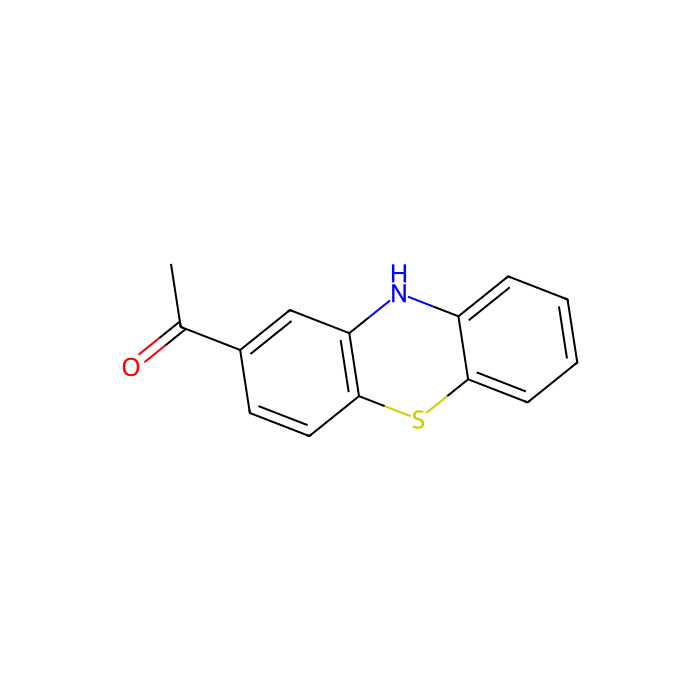
2-Acetylphenothiazine is an aromatic heterotricyclic ketone derived from the phenothiazine scaffold with an acetyl substituent at the 2-position of the fused ring system.
2D structure (verbal): Two fused benzene rings sandwich a central six-membered ring bearing S and NH at para positions; an acetyl group resides ortho to the ring junction on one outer benzene, giving an anisotropic, polarized aromatic ketone on a redox-active scaffold.
The combination of an aryl methyl ketone and a phenothiazine core provides multiple orthogonal handles for synthesis.
These strategies enable rapid access to targeted libraries for materials and discovery programs; adjust conditions to the phenothiazine’s redox sensitivity and limited aqueous solubility.
Not applicable. This product is a small-molecule chemical and is not an antibody, enzyme, or biologic. No antigen/epitope or species reactivity pertains.