Determine the necessary mass, volume, or concentration for preparing a solution.
| Activity Type | Relation | Activity value | Units | Action Type | Journal | PubMed Id | doi | Assay Aladdin ID |
|---|

≥98% for sensitive chromatographic and analytical workflows requiring minimal baseline interference.
Conservare a 2-8°C Ships Ghiaccio umido Check lot-specific COA for exact specifications.
SDS, COA, datasheet, and spec sheet available for download. Lot-specific COA accessible via lot number lookup.
Cited in 33 peer-reviewed publications across chromatography, organic synthesis, and cross-coupling reactions.
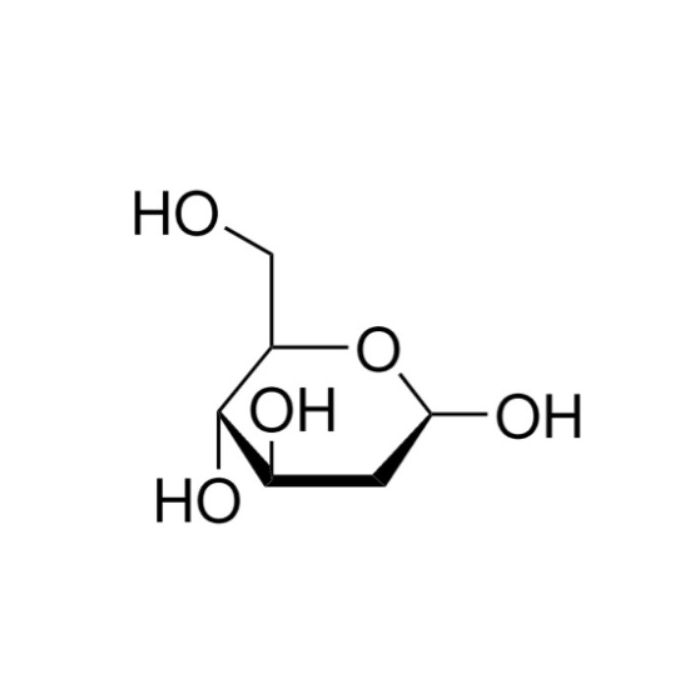
il 2-Deossi-D-glucosio è utilizzato nello sviluppo di strategie antitumorali che prevedono la radio- e la chemio-sensibilizzazione e lo stress ossidativo.
Comprehensive hazard, handling, storage, and regulatory compliance document.
Download SDS →Lot-specific quality data. Enter your lot number to retrieve the exact COA.
Look up COA →Full quality attributes and acceptance criteria for this grade.
View spec sheet →Taxonomy Tree
| Kingdom | Organic compounds |
|---|---|
| Superclass | Lipids and lipid-like molecules |
| Classe | Fatty Acyls |
| Subclass | Fatty alcohols |
| Intermediate Tree Nodes | Not available |
| Direct Parent | Fatty alcohols |
| Alternative Parents | Medium-chain aldehydes Beta-hydroxy aldehydes Alpha-hydrogen aldehydes Secondary alcohols Polyols Primary alcohols Organic oxides Hydrocarbon derivatives |
| Molecular Framework | Aliphatic acyclic compounds |
| Substituents | Fatty alcohol - Medium-chain aldehyde - Beta-hydroxy aldehyde - Alpha-hydrogen aldehyde - Secondary alcohol - Polyol - Organic oxygen compound - Organic oxide - Hydrocarbon derivative - Primary alcohol - Organooxygen compound - Carbonyl group - Aldehyde - Alcohol - Aliphatic acyclic compound |
| Descrizione | This compound belongs to the class of organic compounds known as fatty alcohols. These are aliphatic alcohols consisting of a chain of a least six carbon atoms. |
| External Descriptors | Not available |
| Activity Type | Relation | Activity value | Units | Action Type | Journal | PubMed Id | doi | Assay Aladdin ID |
|---|
Find and download the COA for your product by matching the lot number on the packaging.
| Lot Number | Certificate Type | Data | Oggetto |
|---|---|---|---|
 G2622241 | Certificate of Analysis | Jul 09, 2026 | D109194 |
| G2622240 | Certificate of Analysis | Jul 09, 2026 | D109194 |
| G2622238 | Certificate of Analysis | Jul 09, 2026 | D109194 |
| J2514015 | Certificate of Analysis | Aug 09, 2025 | D109194 |
| H2520594 | Certificate of Analysis | Aug 09, 2025 | D109194 |
| H2520593 | Certificate of Analysis | Aug 09, 2025 | D109194 |
| H2520587 | Certificate of Analysis | Aug 09, 2025 | D109194 |
| H2520586 | Certificate of Analysis | Aug 09, 2025 | D109194 |
| G2603070 | Certificate of Analysis | Aug 09, 2025 | D109194 |
| A2516115 | Certificate of Analysis | Dec 30, 2024 | D109194 |
| A2516113 | Certificate of Analysis | Dec 30, 2024 | D109194 |
| A2516118 | Certificate of Analysis | Dec 30, 2024 | D109194 |
| A2516117 | Certificate of Analysis | Dec 30, 2024 | D109194 |
| H2430351 | Certificate of Analysis | Aug 19, 2024 | D109194 |
| H2430350 | Certificate of Analysis | Aug 19, 2024 | D109194 |
| H2430349 | Certificate of Analysis | Aug 19, 2024 | D109194 |
| H2430348 | Certificate of Analysis | Aug 19, 2024 | D109194 |
| G2312784 | Certificate of Analysis | Jun 07, 2023 | D109194 |
| G2312790 | Certificate of Analysis | Jun 07, 2023 | D109194 |
| G2312792 | Certificate of Analysis | Jun 07, 2023 | D109194 |
| G2312783 | Certificate of Analysis | Jun 07, 2023 | D109194 |
| G2312782 | Certificate of Analysis | Jun 07, 2023 | D109194 |
| D2408085 | Certificate of Analysis | Jun 07, 2023 | D109194 |
| G2312775 | Certificate of Analysis | Jun 07, 2023 | D109194 |
| G2312774 | Certificate of Analysis | Jun 07, 2023 | D109194 |
| I2418083 | Certificate of Analysis | Jun 07, 2023 | D109194 |
| F2312717 | Certificate of Analysis | May 15, 2023 | D109194 |
| G2205098 | Certificate of Analysis | Jun 01, 2022 | D109194 |
| G2205096 | Certificate of Analysis | Jun 01, 2022 | D109194 |
| G2205112 | Certificate of Analysis | Jun 01, 2022 | D109194 |
| G2205097 | Certificate of Analysis | Jun 01, 2022 | D109194 |
| E2124150 | Certificate of Analysis | Mar 17, 2021 | D109194 |
| E2124230 | Certificate of Analysis | Mar 17, 2021 | D109194 |
| E2124231 | Certificate of Analysis | Mar 17, 2021 | D109194 |
| Solubilità | Soluble in water. |
|---|---|
| Rotazione specifica [α] | 46.5 ° (C=1, H2O) |
| Punto di fusione (°C) | 146-147°C |
| Peso molecolare | 164.160 g/mol |
| XLogP3 | -2.900 |
| Hydrogen Bond Donor Count | 4 |
| Hydrogen Bond Acceptor Count | 5 |
| Rotatable Bond Count | 5 |
| Exact Mass | 164.068 Da |
| Monoisotopic Mass | 164.068 Da |
| Topological Polar Surface Area | 98.000 Ų |
| Heavy Atom Count | 11 |
| Formal Charge | 0 |
| Complexity | 116.000 |
| Isotope Atom Count | 0 |
| Defined Atom Stereocenter Count | 3 |
| Undefined Atom Stereocenter Count | 0 |
| Defined Bond Stereocenter Count | 0 |
| Undefined Bond Stereocenter Count | 0 |
| The total count of all stereochemical bonds | 0 |
| Covalently-Bonded Unit Count | 1 |