Determine the necessary mass, volume, or concentration for preparing a solution.
| Activity Type | Relation | Activity value | Units | Action Type | Journal | PubMed Id | doi | Assay Aladdin ID |
|---|

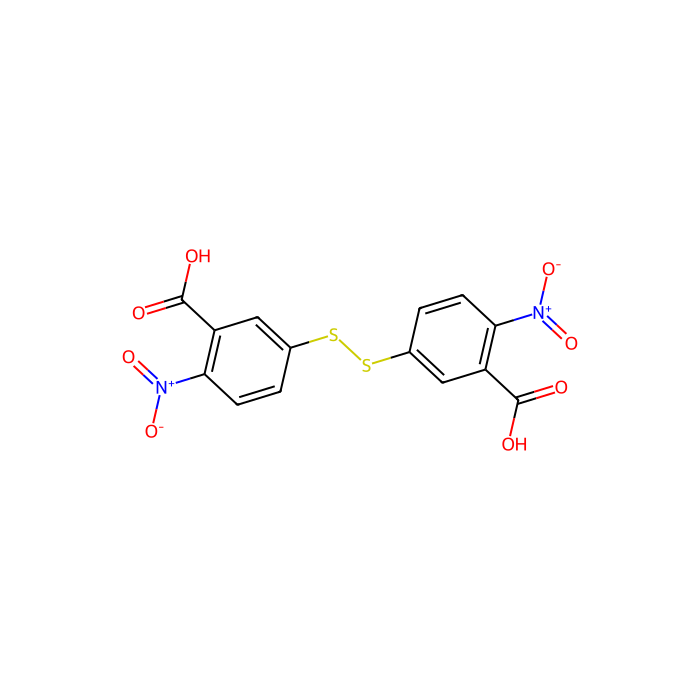
Ellman's Reagent (DTNB) reacts with sulfhydryl groups to yield a colored product, providing a reliable method to measure reduced cysteines and other free sulfhydryls in solution. Ellman's Reagent (5,5'-dithio-bis-[2-nitrobenzoic acid]) is used to estimate sulfhydryl groups in a sample by comparing to a standard curve of a sulfhydryl-containing compound such as cysteine. Alternatively, sulfhydryl groups can be assayed using the extinction coefficient of TNB (14,150M-1cm-1 at 412nm). Ellman's Reagent has been used for applications other than sulfhydryl estimation, such as for determining alkylthiols by HPLC using a pre-column derivatization procedure and to study thiols in the active site of several enzymes. Highlights: ?Sulfhydryl assay – reacts quantitatively with free (reduced) sulfhydryl groups (–SH) to yield detectable TNB product ?Colorimetric detection – colored product enables spectrophotometric measurement in cuvettes or microplates (λmax = 412nm; ε = 14,150/M?cm) ?Proven method – well-characterized chemistry provides quantitation of peptide or protein sulfhydryl groups using extinction coefficient calculation or by comparison to a cysteine standard
A sensitive reagent for measuring the free sulfhydryl content in proteins, peptides, and tissues.
Taxonomy Tree
| Kingdom | Organic compounds |
|---|---|
| Superclass | Benzenoids |
| Classe | Benzene and substituted derivatives |
| Subclass | Benzoic acids and derivatives |
| Intermediate Tree Nodes | Not available |
| Direct Parent | Nitrobenzoic acids and derivatives |
| Alternative Parents | M-sulfanylbenzoic acids Benzoic acids Nitrobenzenes Benzoyl derivatives Nitroaromatic compounds Dicarboxylic acids and derivatives Organic disulfides Sulfenyl compounds Propargyl-type 1,3-dipolar organic compounds Carboxylic acids Organic oxoazanium compounds Hydrocarbon derivatives Organic oxides Organonitrogen compounds Organooxygen compounds Organopnictogen compounds |
| Molecular Framework | Aromatic homomonocyclic compounds |
| Substituents | Nitrobenzoate - M-sulfanylbenzoic acid - M-sulfanylbenzoic acid or derivatives - Benzoic acid - Nitrobenzene - Nitroaromatic compound - Benzoyl - Dicarboxylic acid or derivatives - Organic nitro compound - C-nitro compound - Organic disulfide - Carboxylic acid derivative - Carboxylic acid - Organic 1,3-dipolar compound - Propargyl-type 1,3-dipolar organic compound - Allyl-type 1,3-dipolar organic compound - Sulfenyl compound - Organic oxoazanium - Organic oxygen compound - Hydrocarbon derivative - Organic nitrogen compound - Organopnictogen compound - Organic oxide - Organonitrogen compound - Organooxygen compound - Organosulfur compound - Aromatic homomonocyclic compound |
| Descrizione | This compound belongs to the class of organic compounds known as nitrobenzoic acids and derivatives. These are compounds containing a nitrobenzoic acid moiety, which consists of a benzene ring bearing both a carboxylic acid group and a nitro group on two different ring carbon atoms. |
| External Descriptors | organic disulfide - nitrobenzoic acid |
| Activity Type | Relation | Activity value | Units | Action Type | Journal | PubMed Id | doi | Assay Aladdin ID |
|---|
| Activity Type | Relation | Activity value | Units | Action Type | Journal | PubMed Id | doi | Assay Aladdin ID |
|---|
| Activity Type | Relation | Activity value | Units | Action Type | Journal | PubMed Id | doi | Assay Aladdin ID |
|---|
| Sensibilità | Heat Sensitive |
|---|---|
| Punto di fusione (°C) | 240-245°C |
| Peso molecolare | 396.4 |
| XLogP3 | 2.700 |
| Hydrogen Bond Donor Count | 2 |
| Hydrogen Bond Acceptor Count | 10 |
| Rotatable Bond Count | 5 |
| Exact Mass | 395.972 Da |
| Monoisotopic Mass | 395.972 Da |
| Topological Polar Surface Area | 217.000 Ų |
| Heavy Atom Count | 26 |
| Formal Charge | 0 |
| Complexity | 528.000 |
| Isotope Atom Count | 0 |
| Defined Atom Stereocenter Count | 0 |
| Undefined Atom Stereocenter Count | 0 |
| Defined Bond Stereocenter Count | 0 |
| Undefined Bond Stereocenter Count | 0 |
| The total count of all stereochemical bonds | 0 |
| Covalently-Bonded Unit Count | 1 |